
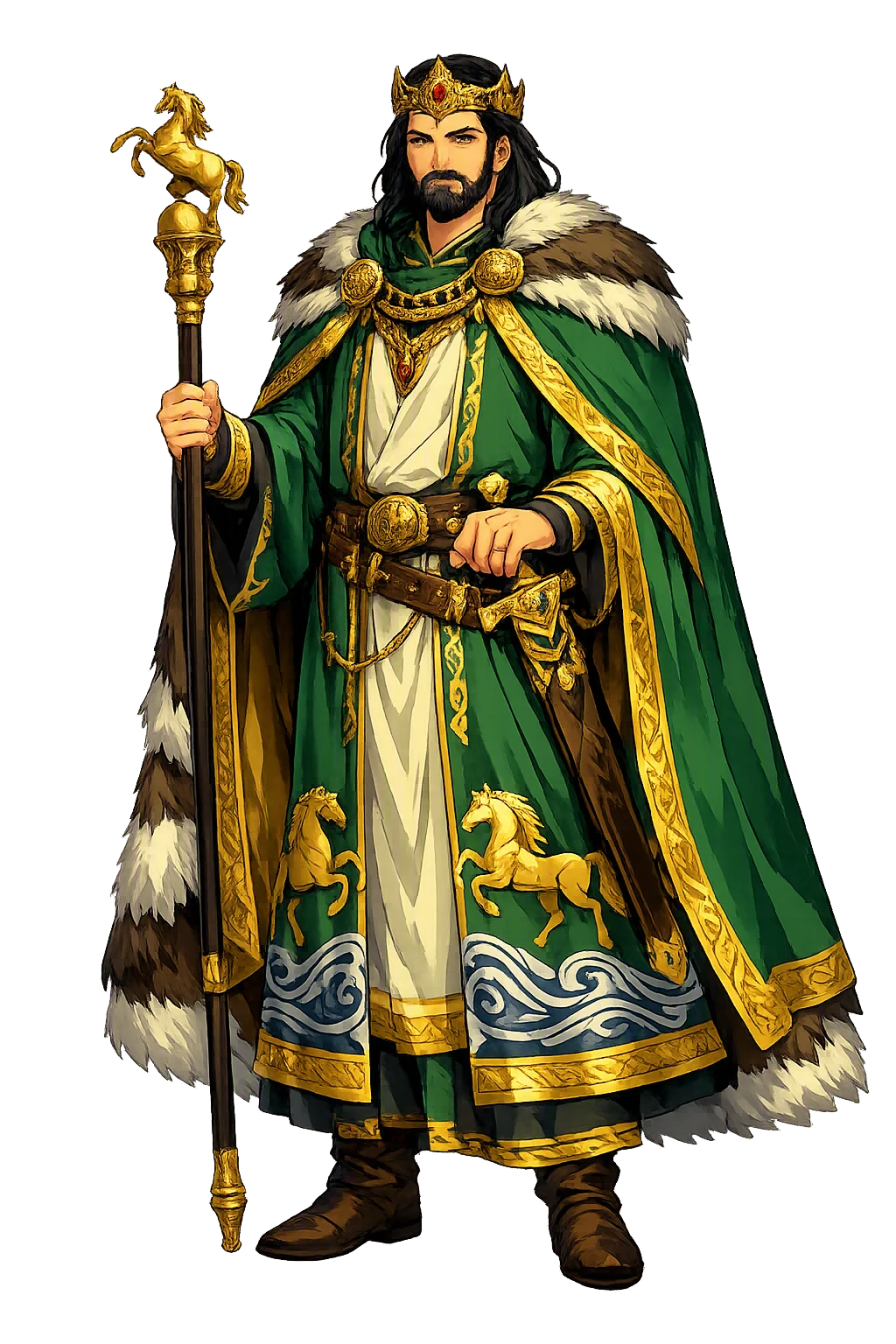
From Celtic transcription to Unicode: the journey of Matholwch
Long before it was a domain, this name traveled through scripts. Matholwch begins in Celtic transcription, passes through scholarly transliteration, and ends — for now — inside the punycode machinery of the global DNS. Each stage of that journey preserves some information and loses some, and the craft of restoration is knowing exactly which marks matter. This post follows the name stage by stage: the original script, the reconstructed pronunciation, the mythological record, the material evidence, and finally the Unicode form that carries all of it into the address bar. Think of it as a biography of a name, told through its spelling.
At a Glance
- Restored name: Matholwch
- ASCII form: matholwch
- Meaning: "Good bear"
- Domain of influence: King of Ireland
- Pantheon: Celtic
- Classification: Tier 2
Overview
Matholwch (matholwch) — King of Ireland · Good bear — is the king of Ireland in the Second Branch of the Mabinogi, Branwen ferch Llŷr: the bridegroom who came with thirteen ships to Harlech to ask the sister of Bendigeidfran in marriage, the wronged man compensated with a golden platter and the Cauldron of Rebirth, and the husband who could not protect his queen when the insult of the maimed horses came home to his court. He exists nowhere else: no Irish tale names him, and his kingship is a fact of Welsh literature, not of Irish tradition — the branch stages him as the hinge on which the peace between the two islands turns and breaks.
His tale is the Mabinogion's national tragedy. A marriage made in good faith between the Island of the Mighty and Ireland is undone by an insult — Efnisien's maiming of the Irish horses — that no honor-price could make forgotten, and it ends with the hosts of both islands destroyed, the cauldron burst, Branwen dead of grief on the bank of the Alaw, and Matholwch himself unrecorded even in death.
PuniCodex restores the name as Matholwch — identical to the ASCII input, because normalized Middle Welsh writes no diacritic in this name. The mechanical rule therefore places it in Tier 2: nothing distinctive is lost in transit, a statement about orthography and never about the king. No domain is claimed: the plain-ASCII matholwch.com is registered to a third party outside the collection and is watched for release.
The Name
The name is attested in Middle Welsh as Matholwch, in the White Book of Rhydderch and the Red Book of Hergest, the two great codices that preserve the Four Branches complete. The traditional gloss, printed in the standard dictionaries of Celtic mythology, is 'Good bear', and it is honestly presented as a gloss rather than a demonstration: the etymology of the name is not settled.
The philological record runs as follows. The first element, math-, invites comparison with Old Irish math, 'bear' — the word behind the Irish personal name Mathgamain, 'bear-cub' — and with Gaulish personal names in Matu- (Matugenos and kin) attested epigraphically on the continent. It also recalls the other great math- name of the Four Branches, Math fab Mathonwy, though the resemblance has never been turned into a demonstrated kinship. An alternative line of analysis takes the first element as Celtic mata-, 'good, fortunate', and the second as a word of rank or wealth; what the compound meant to the tale's first tellers is no longer recoverable with confidence.
The ASCII form matholwch loses nothing, because the normalized Middle Welsh spelling is already plain Latin letters: Welsh writes its distinctive sounds with digraphs (th, ch, ll) and the vowel-letter w, none of which the ASCII alphabet lacks. The restoration is therefore a matter of canonical reference, not rescued diacritics, and the name is classified Tier 2 by the project's mechanical rule.
The letter-by-letter transformation runs:
- m → M — Same, capitalized
- a → a — Same
- t → t — Same
- h → h — Same
- o → o — Same
- l → l — Same
- w → w — Same
- c → c — Same
- h → h — Same
The project holds no domain for this name: matholwch.com is registered to a third party outside the PuniCodex collection and is watched for release. The temple lives at its canonical lexicon address.
The Original Script
The name is preserved in medieval Welsh manuscripts in the Latin alphabet as Matholwch — Middle Welsh in the bookhand of the White Book of Rhydderch and the Red Book of Hergest, attested c. 1350–1425 in the codices that preserve the Four Branches complete. The earlier monumental scripts of the two islands — the ogham stones of Ireland and western Wales — predate the manuscript tradition, but no attestation of this name has ever been read on any of them; the manuscript form is the primary witness.
The scholarly rendering proceeds step by step:
- Middle Welsh was written in the Latin alphabet; its distinctive sounds are carried by digraphs — th for [θ], ch for [x], ll for [ɬ] — and by the vowel-letter w, none of which requires any mark outside the ASCII set.
- The spelling Matholwch is stable across the two great codices; Williams's edition prints it without variant.
- The name's traditional gloss 'Good bear' rests on comparison with Old Irish math, 'bear', and Gaulish Matu- names; the etymology is not settled, and this edition registers the gloss as traditional rather than demonstrated.
- The Unicode restoration Matholwch is therefore identical to the ASCII form apart from the capital; the temple form is a canonical reference, not a rescued spelling.
One caution attaches to the record: the kingship itself is a literary fact only. No Irish source knows a King Matholwch; the title 'King of Ireland' belongs to the Second Branch and to nothing else.
Pronunciation
The reconstructed pronunciation of the name is /maˈθɔl.ʊx/ — Medieval Welsh Reconstruction.
Phoneme by phoneme:
- Ma- — Unstressed open [ma], the light first syllable
- -th- — Voiceless dental fricative [θ], the 'th' of English 'thin'; Welsh writes it as the digraph th, sharply distinct from dd, the voiced 'th' of 'this'
- -ol- — Short stressed [ɔ], carrying the penultimate stress that Welsh assigns to nearly every word
- -wch — Welsh w is a full vowel, here short [ʊ] like the 'u' of 'put'; ch is the voiceless velar fricative [x], the rough ch of Scottish 'loch'
For the modern speaker, the closest approximation is: 'ma-THOL-ukh' — stress the middle syllable; the ending rhymes, roughly, with the Scottish pronunciation of 'loch' after a short 'oo'.
Kindred and historical forms of the name:
- Middle Welsh — Matholwch, the manuscript form of the White Book of Rhydderch and the Red Book of Hergest
- Old Irish — math, 'bear', the word the first element is compared with; cf. Mathgamain, 'bear-cub'
- Gaulish — Matu- personal names (Matugenos and kin), epigraphic cousins of the same element, comparative only
- Welsh — Math fab Mathonwy, the other great math- name of the Four Branches; the resemblance is real, the kinship unproven
Matholwch is Tier 2 because the restoration preserves nothing ASCII loses: the letters of the manuscript form are the letters of the keyboard. The capital alone marks the temple form.
Mythology
Matholwch has essentially one story — but it is the Second Branch of the Mabinogi, and medieval Welsh literature remembers it as its national tragedy.
The Thirteen Ships at Harlech
Bendigeidfran — Brân the Blessed, crowned king of Britain — was seated on the rock of Harlech above the sea, with his brother Manawydan and his half-brothers Nisien and Efnisien, when thirteen ships came from the south of Ireland, fair and swift, their shields above their gunwales. It was Matholwch, king of Ireland, come to ask for Branwen, Brân's sister, so that Ireland and the Island of the Mighty might be joined by marriage and grow stronger together. Brân consented; the wedding was held at Aberffraw, and because no house had ever been built that could contain Brân, they slept in tents.
The Maiming of the Horses and the Recompense
Efnisien, the half-brother whose gift was quarreling, had not been consulted, and took the omission as an insult to his honor. Falling on Matholwch's horses, he cut their lips to the teeth, their ears to their heads, their tails to the skin, and their eyelids to the bone. Matholwch's party armed for home in silence, which Brân read rightly as the beginning of a war. An embassy led by Manawydan carried the offer of recompense: the horses replaced in full, a silver staff as tall as himself, a golden platter as broad as his face — and, beyond price, the Cauldron of Rebirth. The honor-price was paid, the peace was sworn, and neither was ever real again.
The Cauldron of Rebirth
Matholwch asked where such a cauldron had come from, and Brân told him: it had come to him out of Ireland itself. Llassar Llaes Gyfnewid and his wife Cymidei Cymeinfoll — a woman who gave birth to a fully armed warrior every six weeks — had fled the Irish king's plot to burn them alive in a white-hot iron house, and had brought the cauldron with them to Wales. Its property: cast a slain warrior into it at evening, and by morning he rises as fighting-fit as before, except that he never again has the power of speech.
The Starling and the Crossing of the Sea
Matholwch sailed home with his bride; Ireland welcomed her, and she bore a son, Gwern. But the insult would not lie down: his nobles nursed the grudge until they drove their king to atone for it, and Branwen was put out of the chamber into the kitchen, where the butcher came every day and struck her on the ear. All passage to Wales was stopped. Branwen reared a starling at the edge of the kneading-trough, taught it speech, tied her letter beneath its wing, and sent it across the sea; the bird found Brân at Caer Seint in Arfon. The crowned king of Britain crossed at the head of his host — wading, for no ship could hold him — and when the Irish destroyed the bridges and his men asked his counsel, he answered with the sentence Welsh has never let go: 'A fo ben, bid bont' — he who would be a leader, let him be a bridge — and lay down across the river so the host could pass over him.
The Hundred Pillars and the End of the Cauldron
The Irish sued for peace: the kingship of Ireland would go to Gwern, and a house would be built for Brân — the first ever made that could hold him. The house rose with a hundred pillars, a bag on every pillar, an armed man in every bag; Efnisien came in first to inspect the peace and crushed each head between his fingers. At the feast the boy Gwern was passed lovingly from lap to lap until he came to Efnisien's, and Efnisien cast him into the fire. In the battle that followed, the Irish threw their slain into the cauldron and sent them back each morning, mute and fighting — until Efnisien lay down among the Irish dead as if slain, was cast in with the corpses, and stretched himself until the cauldron burst in pieces and his own heart burst with it. Of the Irish there escaped only five pregnant women, from whom the five provinces of Ireland were repeopled; of the Welsh, seven men — Pryderi, Manawydan, Glifieu, Taliesin, Ynawg, Grudyeu, and Heilyn — and Brân, dying of a poisoned spear in the foot, who bade them cut off his head. Branwen died of a broken heart on the bank of the Alaw, crying that two good islands had been laid waste because of her. Of Matholwch himself the tale says nothing more: he is not given a death, only swallowed in the general ruin of his kingdom.
The Concealment and the Disclosure (Triads)
The triadic tradition keeps the tale's ending: Brân's head, buried in the White Hill in London facing France, was one of the Three Fortunate Concealments of the Island of Britain — no oppression would come across the sea while it lay hidden — and Arthur's digging of it up, because he would not hold the island by any strength but his own, was one of the Three Unfortunate Disclosures.
Symbols & Iconography
Matholwch's attributes are not regalia but the furniture of his tragedy — the objects the Second Branch fixes around his kingship:
- The thirteen ships — Sea-borne kingship: the power that comes across the water to ask, and can always sail away
- The maimed horses — Efnisien's insult: lips cut to the teeth, ears to the heads, tails to the skin, eyelids to the bone — an injury to property felt as an injury to honor
- The Cauldron of Rebirth — The compensation that outlasted the peace: resurrection without speech, the body restored and the voice withheld
- The starling — Branwen's tamed messenger, taught to speak, carrying her letter to Brân when no ship could sail from Ireland
- The house of a hundred pillars — Peace built as a trap: a bag on every pillar, an armed man in every bag, and Efnisien going down the row asking what was in them — 'Flour,' they said
- Gwern — His son by Branwen, offered the kingship of Ireland as the price of peace, and cast into the fire by Efnisien at the feast meant to seal it
Archaeology & Evidence
Matholwch is a textual figure: no inscription, ogham stone, or place-name in Ireland names him, and his kingship exists entirely within the Welsh tale. His manuscript witnesses are exact: the Second Branch survives complete in the White Book of Rhydderch (Aberystwyth, National Library of Wales, Peniarth MS 4, c. 1350) and the Red Book of Hergest (Oxford, Jesus College MS 111, c. 1375–1425), the two great codices on which Williams's edition rests.
The tale's one fixed point in the landscape is Welsh: Bedd Branwen, the cairn beside the river Alaw on Anglesey where the branch says Branwen was buried, is a genuine Bronze Age burial monument — cremation urns were recovered when the cairn was opened in the early nineteenth century, and later investigation confirmed its prehistoric date. The name attached to it is medieval folklore rather than prehistory, but it proves the story was already rooted in Welsh ground centuries ago. The nearest epigraphic kin of his name-element are the Gaulish personal names in Matu- (Matugenos and kin): comparative evidence only, never identification.
Realm & Domain
Matholwch is catalogued under the domain 'King of Ireland' — a title that is a fact of Welsh literature and of nothing else, since no Irish text knows him. The title unpacks into four realities in the tale.
The Sea-Kingdom
He comes with thirteen ships — the branch's exact number — and the fleet is his kingship made visible: Ireland arriving as a suitor at Harlech, and Ireland sailing home with its bride. Every movement of his power in the tale is a movement across the sea.
The Bridegroom
The marriage is an act of state: Branwen is given so that Ireland and the Island of the Mighty 'might be joined and grow stronger together'. Matholwch is the bridegroom of an alliance, and the tale measures everything that follows against the good faith of its beginning.
The War
His is the kingdom the insult poisons. The compensation — horses replaced, silver staff, golden platter, and the Cauldron of Rebirth — is paid in full and fails in full, because his nobles will not let the maiming be forgotten. The war that follows destroys the hosts of both islands; the tale does not even grant him a death-scene, only the general ruin.
The Cauldron's Keeper
By the compensation, Matholwch becomes keeper of the Pair Dadeni, the Cauldron of Rebirth: the vessel in which the slain are cast at evening to rise fighting-fit by morning, speechless. In the last battle it is Ireland's engine of war — until Efnisien is thrown into it among the dead and bursts it from within.
Across Cultures
Matholwch is a Welsh invention wearing an Irish crown, and the tradition knows it: no Irish-language tale names him, and his kingship of Ireland exists only inside Branwen ferch Llŷr. The honest comparisons are structural, and Proinsias Mac Cana's monograph on the branch mapped them: Brân's sea-crossing against the Voyage of Bran mac Febail (Immram Brain), the children of Llŷr against the Irish family of Lir, and above all the Cauldron of Rebirth against the cauldron-lore of Ireland. The standard parallel is the cauldron of the Dagda, brought from the city of Murias, from which no company ever went away unsatisfied: the Welsh and Irish vessels divide the motif between them — Ireland's feeds the living without limit, Wales's revives the dead and takes their speech as payment.
Arthurian scholarship, from Loomis onward, has long set the cauldron and Brân's carried head beside the Grail procession of Peredur; the comparison is illuminating and unprovable, and this temple registers it as such. The Christian redactors of the White Book and the Red Book made no attempt to euhemerize Matholwch: he was already only a king, the one fully human principal in a tale of giants and wonders.
Cultural Legacy
Matholwch entered the world's reading with Lady Charlotte Guest's translation of the Mabinogion (1838–49), which carried the Second Branch into English and made the maimed horses and the Cauldron of Rebirth part of the general inheritance of fantasy literature. Ifor Williams's Pedeir Keinc y Mabinogi (1930) fixed the text for scholarship, and Sioned Davies's translation (2007) is the modern English standard.
The branch's sentences have never left Welsh letters — 'a fo ben, bid bont' is quoted wherever leadership is discussed — and Evangeline Walton's The Children of Llyr (1971) retells the whole catastrophe as a novel. The cauldron motif, transmitting through the Welsh tradition, stands behind every modern cauldron that raises armies of the dead, and Lloyd Alexander's Prydain chronicles drew freely on the Mabinogion's world. On Anglesey, the Bronze Age cairn beside the river Alaw still answers to the name Bedd Branwen, Branwen's grave — the tale's one fixed point in the landscape of the two islands it ruined.
A Meditation
Matholwch is the king who accepted the compensation and could not accept it. Nothing in the Second Branch is more carefully drawn than the failure of the settlement: the horses replaced, the silver staff, the golden platter, the cauldron itself — a full honor-price, formally paid, formally received. And still the insult kept working, not in him alone but in his nobles, until it expelled the queen to the kitchen and the butcher's daily blow. The tale is the Mabinogion's treatise on the difference between settling a wrong and healing one.
His cauldron is the perfect emblem of the settlement's logic: it undoes the death and keeps the silence. The men who climb out of it fight as well as ever and cannot speak — cannot say what the war cost, cannot forgive, cannot testify. Matholwch ends as he began, a king whose kingdom is decided by what others do around him: Efnisien maims his horses, his nobles disgrace his wife, his guests massacre his peace, his bridegroom's gift arms his own destruction. The tale does not even grant him a death. It grants him something more instructive — a marriage made in good faith between two islands, and the proof that good faith is not enough when honor has been taught to count higher.
The Unicode Restoration
Matholwch is classified as Tier 2: the restoration needs no distinctive letters or diacritics its ASCII form would lose. The ASCII fallback matholwch still resolves everywhere, but it is the restored form that carries the name's full information. That is the whole thesis of this temple: the marks are the message.
Why This Restoration Matters
Every stage of the journey from Celtic transcription to Unicode was an act of care: the scribe who first wrote the name, the lexicographer who glossed it, the engineer who taught the DNS to carry it. The PuniCodex restoration is the latest stage, not the last word — the Scholarly Edition is revised as the evidence improves. What does not change is the principle: a name deserves to be written the way its own tradition wrote it. Matholwch in the address bar is that principle, made routable.
Explore Further
This post is one doorway into the temple. The home page carries the full character breakdown and the ambient canvas; the lore page tells the myths in long form; the Scholarly Edition preserves the sources, pronunciation data, and revision history; and the patron wall supports the restoration directly. For the wider map, browse the Lexicon, explore the Pantheon, or return to the PuniCodex blog.
Related Names
Sources
The full scholarly apparatus — every citation, revision, and review — lives in the Scholarly Edition. Key references for this post:
- Davies, Sioned, trans., The Mabinogion, Oxford World's Classics (Oxford: Oxford University Press, 2007), 'Branwen Daughter of Llŷr'.
- Mac Cana, Proinsias, Branwen Daughter of Llŷr: A Study of the Irish Affinities and of the Composition of the Second Branch of the Mabinogi (Cardiff: University of Wales Press, 1958).
- Koch, John T., ed., Celtic Culture: A Historical Encyclopedia, 5 vols. (Santa Barbara: ABC-CLIO, 2006), s.v. Matholwch.
- Williams, Ifor, ed., Pedeir Keinc y Mabinogi (Cardiff: University of Wales Press, 1930).
- Lexicon authorities for this entry: Mabinogion, MacKillop.