PuniCodex

Extended Lore

龍王 Lóngwáng

Etymology · Phonology · Orthography · Cultural Legacy · Primary Sources

Tier 1 Lóngwáng.com
Lóngwáng — Dragons, Rain, Rivers
01

Quick Facts

Essential information about Lóngwáng, Dragons, Rain, Rivers

Original Script龍王
Unicode RestorationLóngwáng
Reconstructed Pronunciation/lʊŋ˧˥ waŋ˧˥/
PantheonChinese
DomainDragons, Rain, Rivers
Meaningwater deity in Chinese mythology
ClassificationTier 1
Primary DomainLóngwáng.com
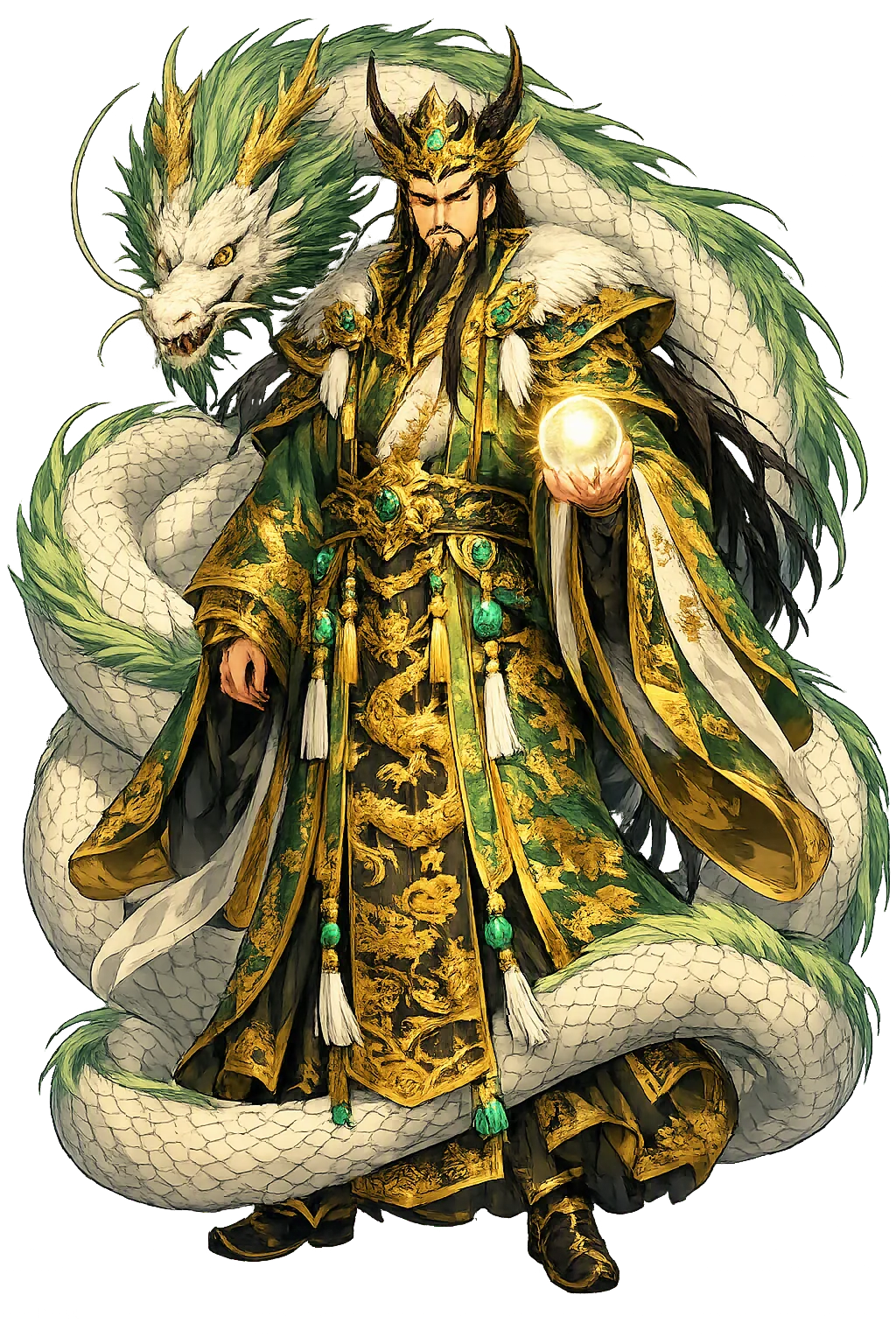
Sacred SymbolsCrystal palace, Rúyì Jīngū Bàng, Dragon robe and royal crown, Rain clouds and tidal bore, Shrimp soldiers and crab generals
02

Etymology & Word Family

From original script to Unicode restoration

Original Script 龍王 Lóngwáng — "water deity in Chinese mythology"
Unicode Restoration Lóngwáng Restored stress, length, and script
Modern ASCII longwang Plain-ASCII fallback

龍王 denotes the Dragon King, the crowned ruler of the waters in Chinese religion and literature. The Modern Standard Mandarin reading is Lóngwáng — both syllables in Tone 2 (rising, ˧˥) — as recorded in the Unihan Database (Unicode Consortium, kMandarin) for 龍 and 王, and in standard Mandarin dictionaries. Baxter & Sagart (2014) reconstruct the Old Chinese forms as *[m]-roŋ (龍, GSR 1193a) and *[ɢ]ʷaŋ (王). The tone-marked Pinyin restoration Lóngwáng preserves the citation rising tones of both syllables; in connected speech the contours may be compressed, but the lexical tones remain Tone 2 throughout.

03

Unicode Character Breakdown

Character-by-character philological analysis

CharacterUnicodeNameBlockPhonetic Role
LU+004CLatin Capital Letter LBasic LatinSame, capitalized
óU+00F3Latin Small Letter O with AcuteLatin-1 SupplementStress on o
nU+006ELatin Small Letter NBasic LatinSame
gU+0067Latin Small Letter GBasic LatinSame
wU+0077Latin Small Letter WBasic LatinSame
áU+00E1Latin Small Letter A with AcuteLatin-1 SupplementStress on a
nU+006ELatin Small Letter NBasic LatinSame
gU+0067Latin Small Letter GBasic LatinSame

The Tier 1 classification reflects how much of the original phonology this restoration preserves — stress and vowel length for Greek names, distinctive letters and diacritics for every other tradition.

04

Cultural Significance

From ancient cult to modern Unicode

Ancient Domain

Lóngwáng, the Dragon King, is not one god but a crowned office — four brothers who hold the Four Seas that ring the Chinese world, each enthroned in an underwater crystal palace with its own court, treasury, and army of shrimp soldiers and crab generals. Āo Guǎng 敖廣 of the East Sea is the most prominent; beside him rule Āo Qīn 敖欽 of the South, Āo Rùn 敖閏 of the West, and Āo Shùn 敖順 of the North. Beneath them, lesser dragon kings govern every river, lake, and well worth the naming.

In their world, rainfall is a bureaucratic act. The Jade Emperor issues the mandate — how much rain, where, and at what hour — and the Dragon King delivers it, down to the last tenth of an inch. It is the Chinese imagination at its most characteristic: the wild water of heaven brought under a seal, a ledger, and a chain of command. The novels and the village temples agree on the stakes — a king who edits the figures loses his head, and a village that loses the king's favour loses its harvest.

Lóngwáng in Later Traditions

The Dragon Kings are among the clearest cases of Buddhism and native Chinese religion merging into a single figure. Native Chinese water-dragon and river-god cults are ancient, but the named kings with submarine palaces, retinues, and treasuries owe much to the Indian nāgarājas — serpent kings of the waters — carried into China with the translated sūtras; Chinese translators rendered nāga as lóng (dragon), and the eight nāga kings of Buddhist scripture became native sea-kings. The relative weight of the Indian import against the older Chinese cult remains a matter of scholarly debate. Taoism then absorbed the kings wholesale into its celestial administration as rain officials answerable to the Jade Emperor. From China the figure travelled with the culture: in Japan the dragon kings appear as ryūō, kin to the sea-god Ryūjin of the undersea palace; in Korea as Yongwang, propitiated by fishing and farming villages alike; in Vietnam as Long Vương, guardian of waters and of the nation's own dragon genealogy.

Modern Legacy

The Dragon King never fully retired. His temples still stand along China's coasts and rivers, and rain-processions to the local king persisted in the countryside into the twentieth century. In literature and performance he is a permanent stock character: every adaptation of the Journey to the West — opera, film, television, animation — must eventually send someone down to the crystal palace, whether to borrow a weapon or to wreck the court. The feud with Nézhā alone has carried him through a century of Chinese animation, from the 1979 feature Nézhā Nào Hǎi (Nezha Conquers the Dragon King) to the 2019 blockbuster Ne Zha, where the dragon clan's grievance drives the plot. In the modern idiom the Dragon King's palace remains a byword for fabulous drowned wealth, and the figure himself endures wherever Chinese fantasy needs a throne beneath the sea.

Unicode Restoration as Cultural Act

Restoring Lóngwáng in a domain name is more than orthographic accuracy. It is a statement that the internet should recognize the full range of human writing — not only the ASCII keyboard.

05

Frequently Asked Questions

Common questions about Lóngwáng, Dragons, Rain, Rivers, and Unicode restoration

01How do you pronounce Lóngwáng?

In reconstructed pronunciation, Lóngwáng is /lʊŋ˧˥ waŋ˧˥/ — approximately LUHNG-WAHNG — two even syllables, each rising from mid to high pitch; the 'o' of the first is like the 'oo' in 'book', the 'a' of the second like the 'a' in 'father'..

02What does Lóngwáng mean?

Lóngwáng means water deity in Chinese mythology in the chinese tradition.

03What are the symbols of Lóngwáng?

Lóngwáng is associated with Crystal palace (The underwater court (龍宮, Dragon Palace) — sovereignty, hidden wealth, and the ordered world beneath the chaos of the sea), Rúyì Jīngū Bàng (The compliant gold-banded staff, an iron pillar that once pinned the seas — the tameable measure of the waters, taken from the East Sea treasury by Sūn Wùkōng), Dragon robe and royal crown (Enfeoffed kingship within the celestial bureaucracy — the Dragon King rules as a peer of heaven's administration, not as a free lord), Rain clouds and tidal bore (The waters he commands — rain, rivers, lakes, and tides delivered by decree, withheld in drought, unleashed in flood), Shrimp soldiers and crab generals (The aquatic retinue of the Dragon Palace — the sea's own creatures enrolled as a court, a mirror of the imperial administration below the waves).

04Why restore Lóngwáng in Unicode?

Plain ASCII longwang strips the stress, length, and script that make the name specific. Unicode restoration returns the name to its original written dignity.

05What is the most important myth about Lóngwáng?

The Journey to the West preserves the great cautionary tale of the celestial bureaucracy. The Dragon King of the Jìng River wagers with a mortal fortune-teller over the next day's rain; when the Jade Emperor's decree arrives matching the diviner's figures exactly, the king — unwilling to lose — secretly alters the amount and delays the timing. The difference is trifling, and it does not matter. For editing heaven's paperwork he is sentenced to death and executed, a reminder that in a cosmos run as an administration, the smallest forged figure is treason.

06

Scholarly Sources

The philological foundations of this restoration

Every claim on this page is grounded in established scholarship. The orthographic restorations follow disciplinary convention. The etymological chain follows the best available reference works. This is not invention — it is resurrection through scholarship.

Lexicography & Philology

  • Shan Hai Jing
  • Chinese folklore

Primary Texts

  • Primary sources in the chinese tradition for Lóngwáng.

Archaeology & Art History

  • Material evidence — iconography, inscriptions, and temple archaeology — for Lóngwáng and related cults.
  • The material cult behind the Dragon Kings is far older than the kings themselves. Shang oracle bones (c. 1250–1045 BCE) record rain sacrifices addressed to river and water powers, and Han texts describe rain-making rites performed with clay dragons — Dong Zhongshu's Chunqiu Fanlu gives the liturgy, and Wang Chong's Lunheng argues against it. Han mirrors and tomb reliefs show the older cosmic dragon of clouds and ascent, not yet a crowned bureaucrat. The named Dragon Kings of the Four Seas crystallize in medieval China under Buddhist influence: nāga kings with submarine palaces appear in translated sūtras from the early centuries CE, the Tang court formally enfeoffed the dragon kings of the Four Seas with royal titles, and by the Song their temples stood in the official register of sacrifices. The literary cycle reaches canonical form in the Ming novels Fengshen Yanyi and Xiyouji.

Religious Studies

  • Journey to the West (Xiyouji)
  • Investiture of the Gods (Fengshen Yanyi)
  • Dragon King (encyclopedia overview)
  • Ao Guang, Dragon King of the East Sea
  • Shanhaijing (Classic of Mountains and Seas)
  • Huainanzi
  • Encyclopaedia Britannica: Longwang
  • Unihan Database (Unicode Consortium)
Return

The Surface Awaits

You have traced the name from its earliest attestation to its Unicode restoration. Now return to the myth. The story is where the name lives.

Back to Lore
Lóngwáng mascot