
Lóng in 2026: why scholars still care
In 2026, names are treated as data points. Lóng is a reminder that they are also cultural artifacts — and that the difference matters for search engines, AI training corpora, and anyone who types the name of a Chinese figure into a browser. Scholars never stopped caring about the difference between long and Lóng; the web simply made that care actionable. What follows is the full scholarly picture — name, script, sound, myth, cult, and legacy — followed by the engineering compromise that lets a restored spelling live at a real address. The question is not whether the name is old. It is whether the digital world is old enough to hold it.
At a Glance
- Restored name: Lóng
- ASCII form: long
- Meaning: "Chinese dragon"
- Domain of influence: Dragon
- Pantheon: Chinese
- Classification: Tier 2
- Original script: 龍 (Chinese characters)
- Live domain: lóng.com
Overview
Lóng (long) — Dragon · Chinese dragon — belongs to the Chinese tradition, where it is catalogued under the domain "Dragon". The name means "Chinese dragon".
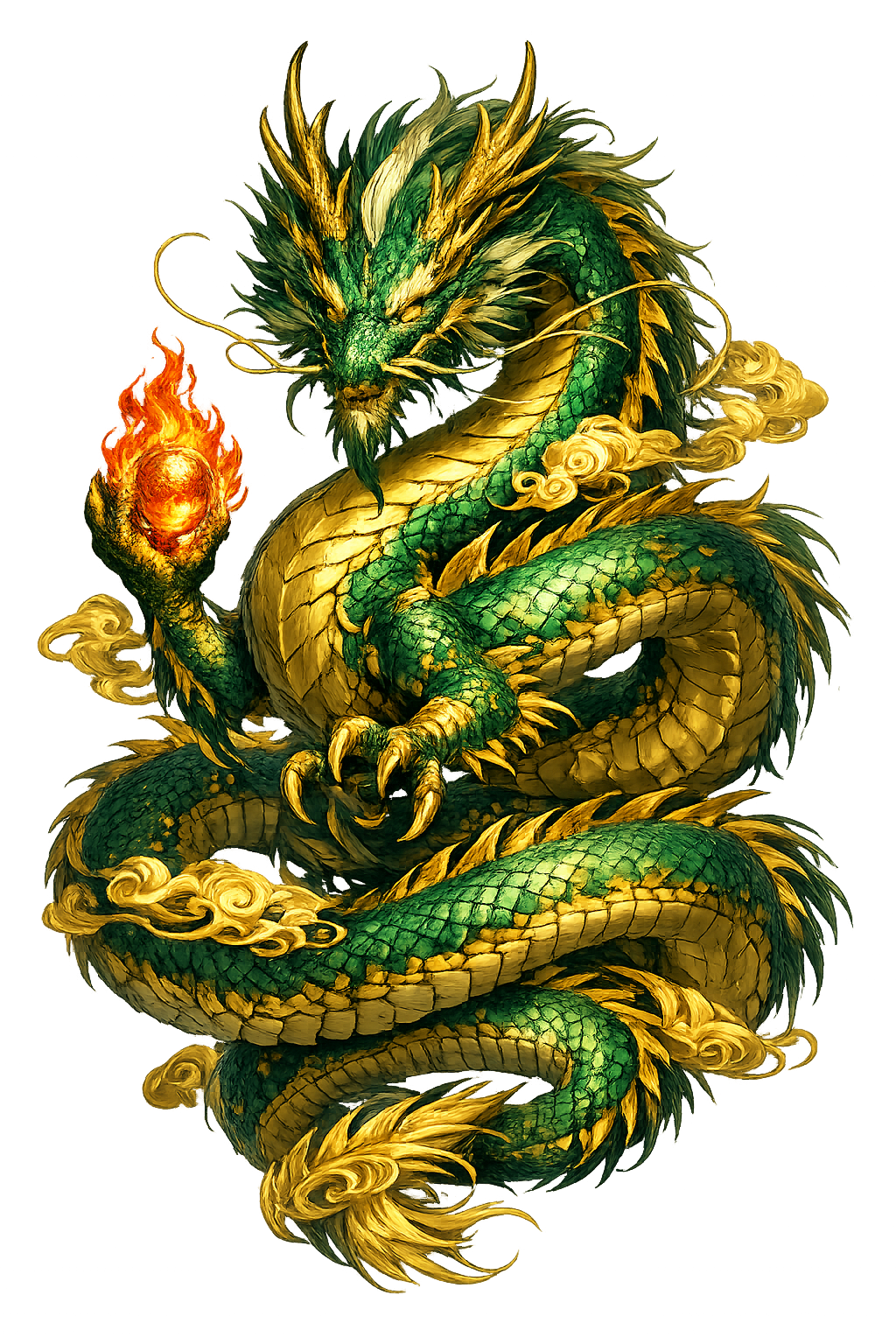
Lóng is not the fire-breathing tyrant of Western fairy tales. The Chinese dragon is a composite being — antlers of a stag, head of a camel, eyes of a demon, neck of a snake, belly of a clam, scales of a carp, claws of an eagle, pads of a tiger — the 'nine resemblances' catalogued by the Han scholar Wang Fu — and yet it moves as a single fluid force. It is the spirit of water in all its forms: the river, the rain, the mist, and the storm. It is also the imperial emblem of absolute legitimacy, the yang counterweight to the phoenix's yin, and the power that makes the fields fertile.
Wherever Chinese civilization spread, the dragon went with it: carved on jade, coiled around columns, embroidered on silk, and raised above temples as a promise that heaven still listened.
PuniCodex restores the name as Lóng and serves its temple at lóng.com. The original preserves one prosodic feature — stress or vowel length — rather than both, which places the name in Tier 2. The plain ASCII form long survives as a modern convenience imposed by the early domain-name system; the restoration, not the fallback, is the form the project defends as philologically complete.
The Name
The name is attested in Chinese characters as 龍. Etymologically it means "Chinese dragon".
The ASCII form long survives only because the early domain-name system could not carry diacritics; it is a technological compromise, not an ancient spelling. The Unicode restoration Lóng recovers the stress accent of the original directly in the address bar. The original preserves one prosodic feature — stress or vowel length — rather than both, which places the name in Tier 2.
The letter-by-letter transformation runs:
- l → L — Same, capitalized
- o → ó — Second tone
- n → n — Same
- g → g — Same
The project holds the domain lóng.com (xn--lng-gna.com) as the canonical home of this name.
The Original Script
The name is preserved in Chinese characters as 龍 — Hanzi (Sino-Tibetan), attested Oracle-bone – present, c. 1200 BCE –, in China. The script is written left-to-right; traditional top-to-bottom.
The scholarly transliteration is Lóng (Hanyu Pinyin with tone mark), giving the normalized reading /lʊŋ/ or /loŋ/.
The rendering proceeds step by step:
- The Chinese character 龍 (simplified 龙) represents the dragon, a central cosmological creature in Chinese religion and imperial symbolism.
- Modern Mandarin reading is lóng (second tone), written in Pinyin with an acute accent.
- Old Chinese reconstructions include C-rjoŋ or mə-roŋ (Baxter-Sagart); the initial consonant cluster is debated.
- The Unicode restoration Lóng preserves the Mandarin tone mark; the ASCII form loses tone and therefore meaning-distinctive information.
The original script is 龍 in traditional Chinese and 龙 in simplified. Pinyin Lóng (Tone 2) is the Modern Standard Mandarin reading, recorded in the Unihan Database and standard dictionaries. The registrable Unicode restoration uses tone-marked Pinyin rather than the hanzi because PUNICODEX renders the original character in the temple's 'Original Script' card while keeping the domain label pronounceable and internationally registrable. Baxter & Sagart (2014) reconstruct the Old Chinese form as *[m]-roŋ.
Pronunciation
The reconstructed pronunciation of the name is /lʊŋ˧˥/ — Modern Standard Mandarin (Pinyin).
Phoneme by phoneme:
- lóng — Single syllable with voiced alveolar lateral approximant [l], final [ʊŋ] (close-mid back rounded vowel + velar nasal), and Tone 2 (rising, ˧˥). Pinyin 'o' before 'ng' corresponds to IPA [ʊ].
For the modern speaker, the closest approximation is: LUHNG — the 'o' is like the 'oo' in 'book', and the tone rises from mid to high, as in a questioning intonation.
Kindred and historical forms of the name:
- Traditional — 龍
- Simplified — 龙
- Wade-Giles — lung²
- Cantonese — lung⁴
- Related terms — 龍王 Lóngwáng (Dragon King); 龍鳳 lóngfèng (dragon and phoenix)
龍 denotes the Chinese dragon, an emblem of imperial authority, fertility, and cosmic yang force. The Modern Standard Mandarin reading is lóng (Tone 2), as recorded in the Unihan Database (Unicode Consortium, kMandarin) and standard Mandarin dictionaries. Baxter & Sagart (2014) reconstruct the Old Chinese form as *[m]-roŋ (GSR 1193a). The tone-marked Pinyin restoration Lóng preserves the citation rising tone of the second tone; in connected speech the contour may be compressed, but the lexical tone remains Tone 2.
Mythology
Chinese dragon lore is less a single narrative than a vast ecology of stories about transformation, weather, and sovereignty. The dragon is not born from an egg alone; it is earned, summoned, or revealed.
Yinglong, the Winged Dragon (Shanhaijing)
In the Classic of Mountains and Seas, the winged dragon Yinglong answers the Yellow Emperor's call at the Battle of Zhuolu. Chiyou, the rebel, has raised fog so thick that armies lose their way; Yinglong slays Chiyou and ends the war. Afterward the dragon is said to be bound to the earth, unable to return to heaven — a mythic echo of the cost of using cosmic power for mortal victory.
The Carp at Dragon Gate (Folklore)
Each year carp swim upstream against the Yellow River's rapids at Longmen. Those that leap the falls are transformed into dragons. The tale turned the phrase lǐ yú tiào lóng mén into a metaphor for success in the imperial examinations — the small, persistent creature who becomes a sovereign force.
The Dragon Kings of the Four Seas (Daoist and Popular Religion)
Four Dragon Kings rule the eastern, southern, western, and northern seas. They control tides, storms, and the water table; villages propitiated them with offerings during drought. The best known is the Dragon King of the Eastern Sea, Ao Guang, whose treasury and temper feature in tales from the Journey to the West.
The Azure Dragon of the East (Astronomy and Iconography)
Qīnglóng, the Azure Dragon, is one of the Four Symbols guarding the cardinal directions. It corresponds to spring, the east, and the wood phase. Ancient star maps trace its sinuous body across the eastern sky, a celestial dragon that marks the season of planting and renewal.
Symbols & Iconography
The iconography of Lóng concentrates in a small set of recurring attributes, each a compressed statement about the name. The canonical anatomy is the 'nine resemblances' (九似) recorded by the Eastern Han scholar Wang Fu — stag's horns, camel's head, demon's eyes, snake's neck, clam's belly, carp's scales, eagle's claws, tiger's paws, cow's ears — a composite codified by Song writers and painters:
- Dragon pearl — Wisdom and spiritual energy, the luminous essence the dragon guards or pursues; in painting it often blazes with flame-scrolls.
- Antlers and horns — Vitality, longevity, and the stag-like generative power of nature.
- Carp scales — Transformation: the carp that leaps the Dragon Gate rapids becomes a dragon.
- Clouds and waves — The dragon's medium; it does not fly through air but swims through mist and rain.
- Five claws — Imperial supremacy. Ming and Qing sumptuary law reserved the five-clawed dragon for the emperor; princes and high officials bore the four-clawed mang 蟒.
The pearl-chasing dragon enters the great painting tradition with Chen Rong's Nine Dragons handscroll (dated 1244, Museum of Fine Arts, Boston), whose creatures tumble through cloud and surf with the pearl just beyond reach.
Archaeology & Evidence
The earliest dragon image in China may be the mosaic of clam shells laid out beside the dead in tomb M45 at Xishuipo, Puyang (Yangshao culture, fourth millennium BCE), where a dragon and a tiger flank the buried man. The coiled jade 'pig-dragons' of the Hongshan culture (c. 4700–2900 BCE) from Inner Mongolia and Liaoning show the creature already rendered in the prestige material of the age. The Erlitou culture (c. 1900–1500 BCE) produced a turquoise-inlaid dragon plaque, and Shang and Zhou bronzes wove dragon forms into the taotie masks of ritual vessels. Han dynasty tomb murals and stone reliefs show dragons pulling chariots, guarding ascents to immortality, and separating heaven from earth. Textual witnesses begin with the Shang oracle-bone inscriptions, in which the graph 龍 already appears; by the Western Zhou the dragon is firmly established as a royal and meteorological symbol.
Realm & Domain
Lóng is not the fire-breathing tyrant of Western fairy tales. The Chinese dragon is a composite being — antlers of a stag, head of a camel, eyes of a demon, neck of a snake, belly of a clam, scales of a carp, claws of an eagle, pads of a tiger — the 'nine resemblances' catalogued by the Han scholar Wang Fu — and yet it moves as a single fluid force. It is the spirit of water in all its forms: the river, the rain, the mist, and the storm. It is also the imperial emblem of absolute legitimacy, the yang counterweight to the phoenix's yin, and the power that makes the fields fertile.
Wherever Chinese civilization spread, the dragon went with it: carved on jade, coiled around columns, embroidered on silk, and raised above temples as a promise that heaven still listened.
Water and Weather
Dragons command rivers, lakes, clouds, and rain; drought is read as the dragon's withdrawal, flood as its untimely arrival.
Imperial Authority
The five-clawed dragon was reserved for the Son of Heaven; to usurp it was treason, to bear it legitimately was to claim the mandate of heaven.
The Pearl of Wisdom
The dragon chasing a flaming pearl symbolizes the pursuit of enlightenment, potency, and the luminous source of all things.
Cosmic Yang
As the active, ascending, bright principle, the dragon pairs with the phoenix to model the complementary dynamism of the cosmos.
Across Cultures
The Chinese dragon absorbed and influenced dragon imagery across East Asia. The Japanese ryū and tatsu, the Korean yong, and the Vietnamese rồng all descend from the same visual and cosmological root, though each culture adjusted claw count, temperament, and symbolic color. Indian nāgas — serpent deities of water and the underworld — entered Chinese Buddhism and were often depicted as dragon-like guardians, especially at temple gates and in rain-making rituals. The Western dragon, by contrast, is a distinct tradition: a hoarding, fire-breathing antagonist shaped by Near Eastern and medieval European warfare, only superficially related to the Chinese rain-bringing sovereign. Modern global culture often conflates the two, but they answer to different cosmologies.
Within the Chinese tradition, closely related names in the corpus include [[bagua|Bāguà]], [[taichi|Tàijí]], [[taishang|Tàishàng]], [[tian|Tiān]], [[tiandi|Tiāndì]], and [[wuxing|Wǔxíng]].
Cultural Legacy
The dragon never left Chinese public life. The Qing imperial flag was a five-clawed dragon on a yellow field; the Republic of China and early People's Republic used dragon motifs on currency, stamps, and regalia. Today the dragon dance winds through Lunar New Year streets worldwide, and the Year of the Dragon is the most auspicious sign in the zodiac. In feng shui, dragon imagery channels qi; in martial arts, Long Xing Mo Qiao and other styles imitate its coiling power. The dragon has also become a contested nationalist symbol — claimed by state propaganda, diaspora communities, and pop culture alike as a badge of Chinese identity, ambition, and ancestral continuity.
The Scholarly Record
The account of Lóng given in this edition rests on the witnesses and reference works listed below. Lexica and etymological dictionaries secure the form and meaning of the name; the literary and religious texts supply the narrative evidence.
- Shanhaijing (Classic of Mountains and Seas). Full text
- Sima Qian, Shiji (Records of the Grand Historian).
- Shuowen Jiezi.
- Yijing (Book of Changes).
- Baxter & Sagart, Old Chinese Reconstruction. Full text
- Eberhard, A Dictionary of Chinese Symbols.
- Liu, The Chinese Dragon.
- Unihan Database (Unicode Consortium). Full text
A Meditation
The Chinese dragon teaches that power need not be hard. It is water made conscious: yielding enough to flow around any obstacle, forceful enough to wear down mountains. Unlike the Western dragon guarding a static hoard, the Chinese dragon is process — rain becoming river, river becoming mist, mist returning to cloud. It is a reminder that sovereignty in the Chinese imagination is less about domination than about maintaining the dynamic balance that lets life flourish.
To name a domain Lóng is therefore to claim something older than empire: the claim that the cosmos itself pulses with living, transformative energy. The dragon does not ask to be worshipped from a distance; it asks to be recognized in the rain on the field, the mist on the mountain, and the long coiling body of a river moving toward the sea.
The Unicode Restoration
Lóng is classified as Tier 2: the original preserves at least one philological feature that ASCII cannot encode. The ASCII fallback long still resolves everywhere, but it is the restored form that carries the name's full information. Across the 4 characters of the name, the restoration adjusts 1: 1 mark of stress (ó). That is the whole thesis of this temple: the marks are the message.
Character by Character
The journey from long to Lóng, one character at a time:
- l → L — Same, capitalized
- o → ó — Second tone
- n → n — Same
- g → g — Same
The Domain Name
The restored name is live as a working domain: lóng.com, which the DNS carries in punycode form as xn--lng-gna.com — an ASCII-compatible encoding that lets a non-ASCII name travel the global network without breaking older infrastructure. The visitor sees Lóng; the machines see the encoding. That duality is the engineering compromise on which the entire restoration rests, and it is why a name written the way its own tradition wrote it in Chinese characters can now be typed into any browser on earth.
The Chinese Pantheon
Lóng is one of 43 entries the PuniCodex lexicon catalogues under the Chinese pantheon. The Pantheon page gathers the tradition's major figures in one place, and the Lexicon lets you filter all 895 restorations by tradition, tier, or script — the fastest way to see where this name sits among its kin.
Frequently Asked Questions
What does Lóng mean? The traditional gloss is "Chinese dragon."
Which tradition does Lóng belong to? Lóng is catalogued in the Chinese pantheon of the PuniCodex lexicon.
Why is Lóng classified as Tier 2? Because the original preserves at least one philological feature that ASCII cannot encode — and the marks in the restored spelling preserve exactly that evidence.
Is Lóng a working domain? Yes — lóng.com resolves today and routes to this temple.
What is the punycode for lóng.com? The DNS encoding is xn--lng-gna.com; browsers perform the translation automatically, so visitors only ever see the restored name.
Why This Restoration Matters
In 2026 the stakes are practical. Search indexes, language models, and localization pipelines all inherit whatever spelling the web normalizes — which means every Unicode domain is also a training signal. Lóng teaches the machinery that the restored form exists, that it is used, and that it points to a real place. That is why a project built on philology ends up caring about DNS: the infrastructure decides which names the future sees. This restoration makes sure the future sees the whole name.
Explore Further
This post is one doorway into the temple. The home page carries the full character breakdown and the ambient canvas; the lore page tells the myths in long form; the Scholarly Edition preserves the sources, pronunciation data, and revision history; and the patron wall supports the restoration directly. For the wider map, browse the Lexicon, explore the Pantheon, or return to the PuniCodex blog.
Related Names
Sources
The full scholarly apparatus — every citation, revision, and review — lives in the Scholarly Edition. Key references for this post:
- Shanhaijing (Classic of Mountains and Seas).
- Unihan Database (Unicode Consortium), kMandarin reading for U+9F8D 龍.
- Baxter & Sagart, Old Chinese: A New Reconstruction (2014).
- Yijing (Book of Changes), Qian hexagram line statements.
- Shijing (Book of Poetry), sacrificial odes.
- Zuozhuan (Chunqiu Zuozhuan), Duke Zhao 29.
- Sima Qian, Shiji (Records of the Grand Historian).
- Shuowen Jiezi.
- Wang Fu's 'nine resemblances' (九似), quoted in M. W. de Visser, The Dragon in China and Japan (1913).
- Eberhard, A Dictionary of Chinese Symbols.
- Lexicon authorities for this entry: Chinese folklore, Chinese classics.