
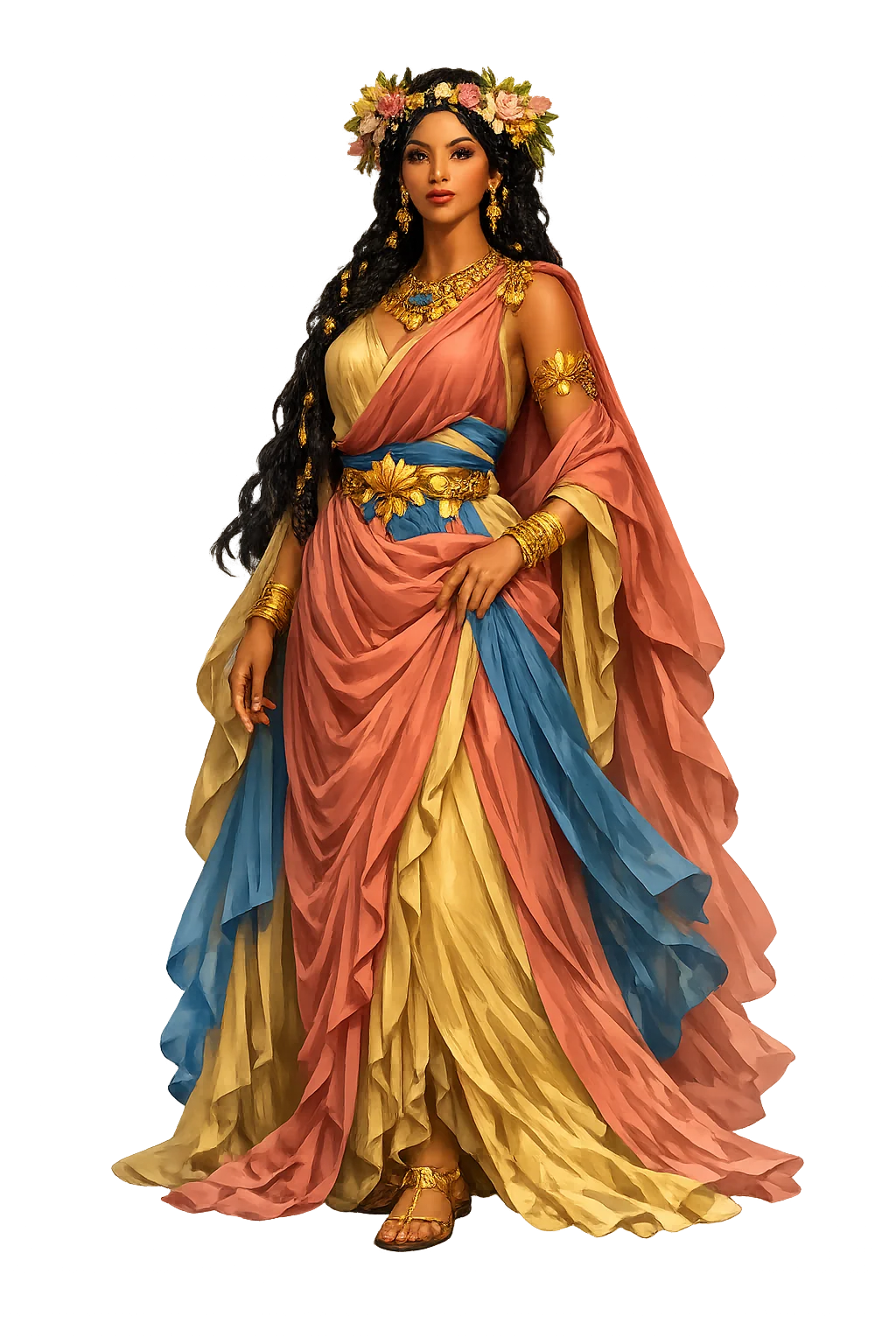
The appointments Libyē made — and who is keeping them
The mistake is reading myths as entertainment. Libyē's cycle reads more like a charter — each story assigning a duty the modern world still pays for.
At a Glance
- Temple: Libyē
- Pantheon: Greek-location
- Domain of influence: Personified Continent of Africa
- Pattern seats: 5
- Sectors touched: Culture & Entertainment · Technology & Innovation · Commerce & Governance · Health & Wellbeing
- Strongest seat: Travel, Tourism & Place Branding
- Series: The Resonance Files, No. 140 of 271
The Cycle, Read Forward
Travel, Tourism & Place Branding — through Daughter of Io and Epaphus
Libya's father was Epaphus, the son born to Io after her wanderings from Argos to Egypt. Io, transformed into a heifer by Zeus and driven across Europe and Asia, finally found rest in Egypt and there gave birth to Epaphus.
The atlas states the seat in one line: The ancient name of Africa’s shore. The story above is the long version of the same sentence. The trade thinks it is optimizing a process. It is re-enacting a charter.
AI, Data & Predictive Intelligence — through Mother of Belus and Agenor
By Poseidon, Libya bore twin sons Belus and Agenor, who became the eponymous founders of the dynasties of Egypt and Phoenicia. Belus remained in Egypt and fathered Danaus and Aegyptus, whose quarrel produced the story of the Danaïds; Agenor traveled to Phoenicia and fathered Cadmus, Europa, and Phoenix, whose descendants founded Thebes and shaped the mythic history of Crete.
The atlas states the seat in one line: The Oracle of Ammon at Siwa, the Libyan Delphi; prophecy drew kings across the desert. The story above is the long version of the same sentence. The trade thinks it is optimizing a process. It is re-enacting a charter.
Mapping & Geospatial — through Libya and the Peoples of Africa
Herodotus devotes a long digression in Book 4 to the peoples, animals, and customs of Libya, from the seafaring lotus-eaters to the girdle-wearing Garamantes and the gold-trading Carthaginians. He reports strange creatures — the dog-headed men, the headless Blemmyes, the wild cattle whose horns curve forward, forcing them to graze walking backward (4.
The atlas states the seat in one line: The Greek name for Africa west of Egypt; the Roman province kept it on the map. The story above is the long version of the same sentence. Industries do not invent their archetypes; they inherit them and call them best practice.
Ancestry & Heritage Services — through The Western Garden of the Hesperides
Greek writers placed the Garden of the Hesperides at Libya's western extremity, where the sun sinks into the Ocean and the known world yields to marvel. There golden apples of immortality grew under the care of nymphs, daughters of Atlas or of Night, and were guarded by the ever-watchful serpent Ladon.
The atlas states the seat in one line: Mother of Belus and Agenor; the ancestress bridging Greek, Egyptian, and Libyan lines. The story above is the long version of the same sentence. That is the cycle working: story becomes duty, duty becomes trade.
The Theme That Runs the Cycle
Libyē is the Greek name for Africa west of Egypt, personified as a daughter of Epaphus and Memphis. Her myth places her at the intersection of Egypt and the Greek colonial world, the ancestress of the Libyan peoples and the mother of Belus and Agenor, founders of the great Near Eastern dynasties. Through her, the African continent enters Greek genealogy as a sister of Asia and Europe, equally ancient and equally consequential. Libye's mythic daughters spread across North Africa and the Aegean, their genealogies encoding Greek attempts to explain Phoenician, Egyptian, and native Libyan interactions. The name later designated the Roman province of Africa and, in modern usage, the nation-state on the Mediterranean coast. Through every transformation, it retained its association with the vast Sahara and the cultures that edge it.
The Method, Stated Plainly
Skeptical? Good — the system is built for you. Every seat in this file carries its why-line and its weight, the full derivation is public at the methodology page, and the challenge process is part of the design. Falsifiable is not a posture here; it is the mechanism.
For the Ones Who Work There
If you work in travel, tourism & place branding, ai, data & predictive intelligence, or any trade this temple holds a seat in, this is the honest version of what a placement means: your industry beside the story it has been re-telling all along — on the temple floor itself, before an audience that came specifically to read it. The patron tier and the advertising terms describe the mechanics; the resonance above describes the fit.
The File Continues
One of 271 Resonance Files — the series where the pantheon goes to work. Read the founding dispatch for the name, the Restoration File for the spelling, or the whole archive end to end.
Continue the series — previous: Liwyāṯān (read it) · next: Lóng (read it).
The Resonance Files are argued from the same canonical record as the pattern atlas itself: the lexicon, the lore catalog, and the cited sources. Every seat can be challenged at the methodology page — and the challenge is the point.