
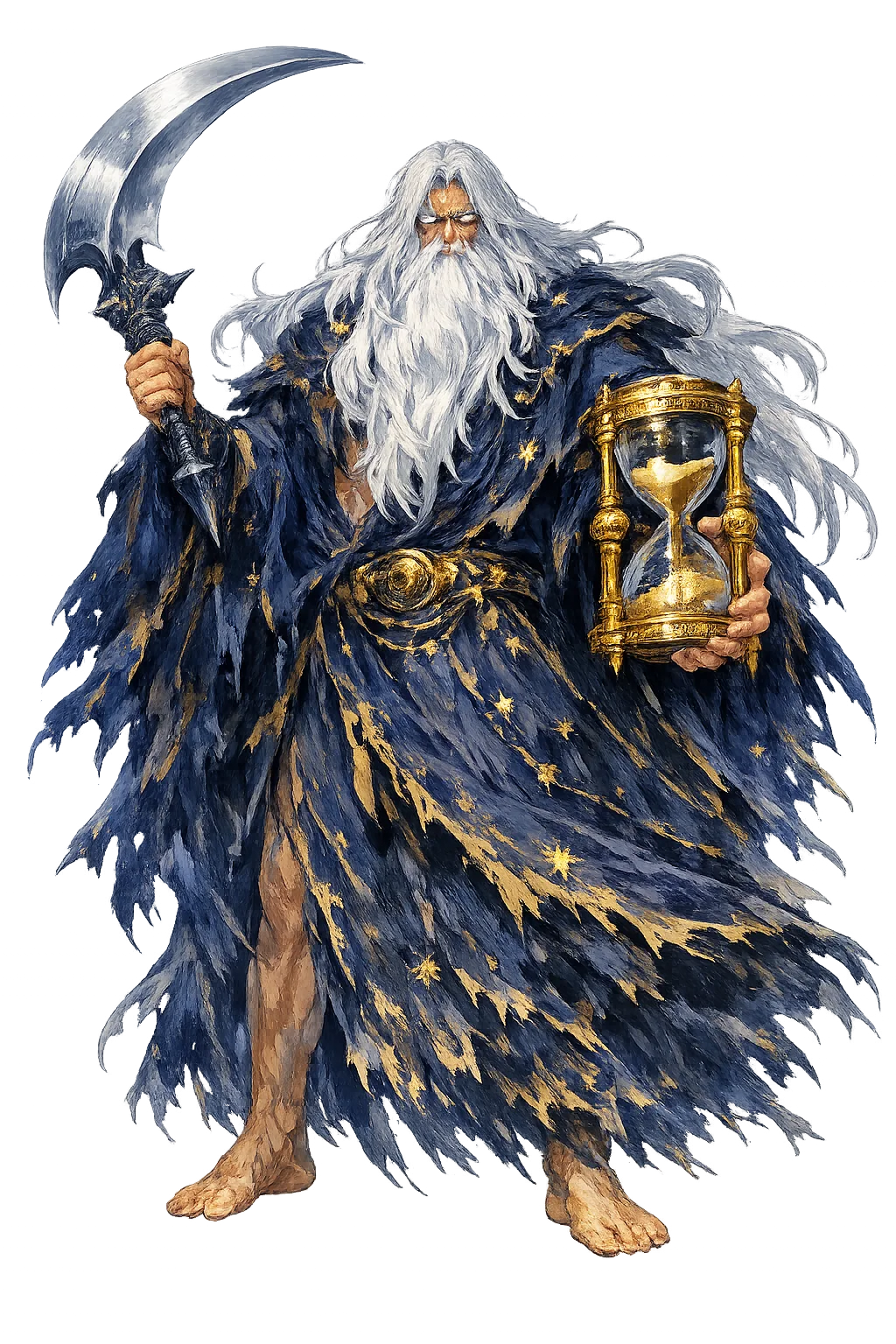
Krónos in 2026: why scholars still care
In 2026, names are treated as data points. Krónos is a reminder that they are also cultural artifacts — and that the difference matters for search engines, AI training corpora, and anyone who types the name of a Greek figure into a browser. Scholars never stopped caring about the difference between kronos and Krónos; the web simply made that care actionable. What follows is the full scholarly picture — name, script, sound, myth, cult, and legacy — followed by the engineering compromise that lets a restored spelling live at a real address. The question is not whether the name is old. It is whether the digital world is old enough to hold it.
At a Glance
- Restored name: Krónos
- ASCII form: kronos
- Meaning: "Youngest Titan, personification of time, who castrated and deposed his father Uranus before being overthrown by his son Zeus"
- Domain of influence: Time, Harvest, Titans
- Pantheon: Greek
- Classification: Tier 2
- Original script: Κρόνος (Greek)
- Live domain: krónos.com
Overview
Krónos (Greek Κρόνος) is the youngest of the Titans born to Gaîa and Ouranós, and the pivotal figure of the Greek succession myth: he castrates his father with a sickle of grey adamant, rules the cosmos through a remembered Golden Age, swallows his children to forestall a prophecy, and is finally overthrown by his son Zeús and confined with the defeated Titans. In cult his footprint is small but real — the Athenian harvest feast of the Kronia and the Kronion hill at Olympia both bear his name — and in Rome he was wholly identified with the agricultural god Saturn.
PuniCodex restores the name as Krónos, carrying the acute accent of the Greek Κρόνος on its first omicron. Because the original preserves stress but no long vowel, the name is classed as Tier 2 (accent-preserving); the temple is served at krónos.com, the plain ASCII kronos surviving only as the domain-era fallback.
The Name
The name is attested in Greek as Κρόνος, uniform across the literary record from Hesiod onward and registered in the standard onomastica. Its etymology is genuinely disputed. One ancient line connects it with a root meaning 'to cut' (compare κείρω), folk-etymologically apt for the sickle castration; on this basis a proto-form kers- ('to cut') has been proposed, with uncertain cognates in Latin hornum and Sanskrit śṛṇāti. The rival identification with Χρόνος ('Time') is a later conflation of Hellenistic and Orphic speculation, not the original formation, and Beekes, treating every such connection as unproven, regards a Pre-Greek substrate origin as likely.
The restoration Krónos reproduces the acute accent of the first omicron — the pitch peak of the Greek word — in the address bar itself; the plain ASCII kronos survives only because the early domain-name system could not carry diacritics.
The letter-by-letter transformation runs:
- k → K — Same, capitalized
- r → r — Same
- o → ó — Acute stress on the first omicron
- n → n — Same
- o → o — Short omicron
- s → s — Same
Attested and derived spellings of the name:
- krónos — owned form: lowercase owned domain form
- Cronus — scholarly variant: the Latinized spelling standard in English scholarship and literature, transmitted through Latin authors
The project holds the domain krónos.com (xn--krnos-1ta.com) as the canonical home of this name.
Etymology & Roots
The recorded derivation reads: Traditionally linked to χρόνος (time), but the etymology is disputed; some connect the Titan’s name to a root meaning "to cut" (referring to the castration of Uranus)
The reconstructed proto-form is *kers- (proto-indo-european), glossed as "to cut".
The reconstruction is classed as disputed.
Kindred forms recorded in the lexicon:
- hornum (Latin) — uncertain
- śṛṇāti (Sanskrit) — uncertain
The Original Script
The name is preserved in Greek as Κρόνος — Greek alphabet (Classical / Attic), attested Ancient Greek, c. 8th century BCE – present, in Greece and the Greek-speaking Mediterranean. The script is written left-to-right.
The scholarly transliteration is Krónos (Greek alphabet with polytonic accents), giving the normalized reading /ˈkro.nos/.
The rendering proceeds step by step:
- The Greek form Κρόνος is written in the Classical Greek alphabet.
- Letters with acute, grave, or circumflex accents preserve the pitch accent of Ancient Greek.
- Macrons and omegas (η, ω) mark long vowels, a feature lost in the plain ASCII form.
- The Unicode restoration Krónos encodes the scholarly spelling as a registrable domain name.
Pronunciation
The reconstructed Attic pronunciation of the name is /kró.nos/: two short omicrons, with the acute accent — a raised pitch in classical Attic — falling on the first syllable.
Phoneme by phoneme:
- Kr- — voiceless velar stop [k] followed by a trilled rho.
- -ó- — short omicron bearing the acute accent, the pitch peak of the word.
- -nos — nu, short omicron, sigma; the final -ος is the regular masculine nominative ending.
For the modern speaker, the closest approximation is 'KROH-nohs' — first syllable like 'crow' without the w, second like 'nose'.
Kindred and historical forms of the name:
- κείρω (keírō), 'to cut' — a proposed but disputed etymological kin, traced to PIE *(s)ker-.
- Χρόνος (Khrónos), 'Time' — a later conflation, not the original etymology.
- ἀγκυλομήτης (ankylomḗtēs), 'crooked-counselled' — the god's fixed epic epithet, attached to him from his first naming in Hesiod.
Krónos is Tier 2 because Κρόνος preserves the acute stress but no long vowel: both omicrons are short. The restoration records exactly that one prosodic feature and no more.
Mythology
Krónos embodies the Greek succession myth: the son who overthrows his father and is overthrown by his own son in turn. Hesiod's Theogony is the primary account.
The castration of Ouranós
Gaîa, in pain from the children Ouranós kept hidden within her, made a sickle of grey adamant and asked her sons for aid; only Krónos, 'crooked-counselled,' dared. From the ambush he severed his father's genitals and cast them into the sea; from the drops of blood arose the Erinyes, the Giants, and the Melian nymphs, and from the severed flesh, drifting in foam, grew Aphrodítē. (Theogony 154–210.)
The swallowed children
Warned that he was fated to fall to his own son, Krónos swallowed each child Rhéā bore — Hestía, Dēmētēr, Hēra, Hádēs, and Poseidôn. Rhea bore Zeús secretly in Crete and gave Krónos a stone in swaddling clothes, which he swallowed. (Theogony 453–506; Apollodorus, Library 1.1.5–7.)
The Titanomachy
Grown to strength, Zeus forced Krónos to disgorge the stone — afterwards set up at Delphi — and then his brothers and sisters. The gods fought the Titans for ten years; the war turned only when Zeus freed the hundred-handed Briareos, Kottos, and Gyes, and the defeated Titans were cast into Tártaros. (Theogony 617–735; Apollodorus 1.2.1.)
The Golden Age and after
Hesiod's golden race of mortals lived 'in the time of Kronos' like gods, without toil, grief, or old age (Works and Days 109–126) — a memory enacted at the Athenian Kronia, where slaves and masters feasted as equals. Later poetry softens the ending: Pindar releases the old king to rule the Isles of the Blessed, while Homer knows him only as a prisoner beside Iapetos beneath the earth.
Symbols & Iconography
The attested attributes of Krónos are few, and each belongs to a specific tradition:
- Sickle (harpe) — the blade of grey adamant, made by Gaia, used in the castration and doubled by the reaping-hook of the harvest (Hesiod, Theogony 161–182).
- Swaddled stone — the stone wrapped in cloth that Rhea gave him in place of the infant Zeus (Theogony 485–491); Pausanias saw at Delphi the stone shown as this very substitute, anointed daily with olive oil and dressed with unworked wool at festivals.
- Golden grain — the plenty of the lost Golden Age 'in the time of Kronos' and of the harvest feast Kronia (Hesiod, Works and Days 109–126).
- Veiled head and falx — the attributes of the Roman Saturn: a veiled old man carrying the pruning knife, the standard type on gems, lamps, and provincial reliefs.
Secure Greek images of Krónos are remarkably few, and none is early; the Greeks were slow to picture a devouring, deposed father. Where identified, he is a mature, heavily bearded king; his signs are the curved sickle or harpe of castration and harvest, ears of grain, and — in the rare narrative scenes of the myth — the swaddled stone or the act of swallowing itself.
The fuller iconography is Roman. As Saturn he becomes a veiled old man carrying the falx (pruning knife), a type fixed on gems, lamps, and provincial reliefs, sometimes with the serpent of time beside him. Renaissance art, having conflated Krónos with Khrónos (Time), then produced the enduring figure of the sickle-bearing, devouring old man — 'Old Father Time' — for which no exact classical Greek ancestor exists.
Epithets & Cult Titles
Krónos's epithet record is thin — one great epic tag and a handful of cultic and poetic survivals.
- ἀγκυλομήτης (ankylomḗtēs) — 'crooked-counselled,' his fixed epic epithet, present at his first naming in Hesiod (Theogony 137) and standard in Homer.
- Κρόνιος (Krónios) — 'of Krónos,' the cultic adjective: the Olympian hill was the Kronion, and the Athenian harvest feast of the Kronia bore his name.
- Κρόνου πύργος (Krónou pýrgos) — 'the tower of Krónos,' Pindar's name for the Isles of the Blessed, where the released and gentle old king rules heroes freed from care (Olympian 2).
- Saturnus — the Roman interpretatio: as Saturn the sickle-bearing king received temples, the December Saturnalia, and ultimately a day of the week.
The Homeric Hymns
No Homeric Hymn to Krónos survives; the deposed king had no place in the archaic hymnic corpus. His only ancient hymn is the late Orphic Hymn to Krónos (13), which addresses him as sire of blessed gods and men. His earliest hexameter presence is Hesiodic and extensive: the Theogony names him the 'crooked-counselled' youngest Titan (137), then narrates the sickle-attack on Ouranós (154–210), the swallowing of his children (453–506), and his fall in the Titanomachy (617–735). Homer knows him chiefly as a name inside genealogies and as a prisoner: Iliad 8.478–481 places him with Iapetos in the depths of Tartaros, beyond the rays of the sun and the breath of the winds.
Oracle Sites & Sanctuaries
Krónos had no oracle of his own — a striking absence for so old a god, explained by the Greek sense that his reign was finished. His cult geography is real but modest. At Olympia the wooded hill north of the Altis, the Kronion, bore his name, and on its summit the Elean officials called the Basilae still sacrificed to him at the spring equinox in Pausanias's day; the same author records an altar of Earth within the Altis where an oracle of Earth had once spoken, in the days before Zeús claimed Olympia — the nearest the old order came to a prophetic voice. At Athens the Kronia, a harvest feast of the month Hekatombaion, suspended hierarchy: masters and slaves dined together in memory of the Golden Age. In Italy his counterpart Saturn was worshipped below the Capitoline, where the temple housed the Roman state treasury — wealth stored, fittingly, with the god of the buried harvest.
Archaeology & Evidence
The material record for Krónos is modest. At Olympia the Kronion — the wooded hill bounding the Altis on the north — was named for him, and Pausanias records that the Elean officials called the Basilae still sacrificed to Krónos on its summit at the spring equinox, in the Elean month Elaphius; the same author notes an altar and former oracle of Earth within the Altis, a survival of the older order the cult of Zeus displaced. In Attica the Kronia is literarily attested as a public harvest feast of the month Hekatombaion, but no major temple of Krónos is known there. In Rome his successor Saturn held one of the city's oldest temples, at the foot of the Capitoline overlooking the Forum; its dedication was placed by Roman tradition in the first years of the Republic, it housed the state treasury (aerarium), and its eight surviving columns still stand.
Realm & Domain
Krónos's mythic portfolio concentrates in four attested spheres.
- The sickle — the curved blade of grey adamant, made by Gaîa, with which he castrated Ouranós and seized kingship (Hesiod, Theogony 161–182).
- The harvest — the Athenian Kronia, a summer feast at which masters and slaves dined together, tied his name to grain, abundance, and the year's turning.
- The throne — kingship over gods and men during the remembered Golden Age, when mortals lived free of toil and old age 'in the time of Kronos' (Hesiod, Works and Days 109–126).
- The devourer — the swallowing of his five children to forestall the prophecy of his own overthrow (Theogony 453–491).
Across Cultures
The Roman identification of Krónos with Saturnus, an old Italic agricultural god, is total by the historical period: as Saturn he received the December Saturnalia — a festival of feasting, gift-giving, and the suspension of slave-and-master roles that reproduces Golden Age equality — and his temple below the Capitoline housed the Roman state treasury. The learned conflation of Krónos with Khrónos ('Time') arose in Hellenistic speculation and became canonical in the Renaissance, when Saturn acquired the scythe and hourglass of Father Time.
The succession myth itself is not uniquely Greek. The Hittite 'Song of Kumarbi' (the Kingship in Heaven cycle), preserved on tablets from the Hittite capital at Boghazköy, narrates a strikingly parallel sequence — Anu deposed by Kumarbi, who bites off his rival's genitals, and Kumarbi in turn challenged by the storm-god — and most scholars treat the Greek Ouranós–Krónos–Zeús succession as adapted from this older Near Eastern pattern.
Within the corpus, the names most directly bound to Krónos are his parents Gaîa and Ouranós, his sister and consort Rhéā, his victorious son Zeús, and Tártaros, the abyss of his imprisonment.
Cultural Legacy
The afterlife of Krónos runs on two tracks that the Renaissance merged. As Saturn he survives in the calendar — Saturday preserves the Latin dies Saturni, 'Saturn's day' — and in the heavens, where the sixth planet carries his Roman name. As Father Time he emerged from the Krónos–Khrónos conflation: Erwin Panofsky traced how Renaissance iconography gave the devouring god the scythe and hourglass that define 'Old Father Time', a figure with no exact classical Greek ancestor. The myth's darkest image, the devouring father, culminates in Goya's Saturn Devouring His Son (c. 1819–1823), painted on the walls of the Quinta del Sordo and now in the Museo del Prado, Madrid. In modern usage 'Kronos' and the Latinized 'Cronus' name corporations, time-recording software, and a stream of fictional tyrants and time-devices — nearly always drawing on the Time conflation rather than on the Greek god of the sickle. The older Krónos, lord of the lost age of plenty, survives chiefly in the study of myth itself.
The Scholarly Record
The account of Krónos given in this edition rests on the witnesses and reference works listed below. The lexica secure the form of the name and the state of the etymological question; the literary and antiquarian texts supply the narrative and cultic evidence.
- Liddell-Scott-Jones, Greek-English Lexicon, 9th ed. with 1996 supplement, s.v. Κρόνος. Full text
- Beekes, Etymological Dictionary of Greek, 2 vols., Brill, 2010, s.v. Κρόνος. Full text
- Pape-Benseler, Wörterbuch der griechischen Eigennamen, 3rd ed., 1863. Full text
- Hesiod, Theogony 137, 154–210, 453–506, 617–735. Full text
- Hesiod, Works and Days 109–126 (the golden race 'in the time of Kronos'). Full text
- Apollodorus, Library 1.1.5–7; 1.2.1. Full text
- Pausanias, Description of Greece 5.14.10; 6.20.1; 10.24.6.
- Pindar, Olympian 2 (the tower of Kronos); Homer, Iliad 8.478–481.
- Macrobius, Saturnalia 1 (Saturn and the Saturnalia).
- H. A. Hoffner, Hittite Myths, 2nd ed., 1998 (the Song of Kumarbi).
A Meditation
Krónos is the god of the inevitable replacement. He does not ask permission to succeed his father, and he does not forgive his son for succeeding him. In this he is the most honest of the gods: he admits that power is temporary, that every ruler becomes the obstacle the next generation must remove.
But Krónos is also the god of the harvest, and the harvest is time made visible. The sickle cuts the grain because the grain has reached its hour. His tragedy is that he tried to stop the cycle he embodied. To name him Krónos is to remember that time cuts down even the one who holds the blade.
The Unicode Restoration
Krónos is classified as Tier 2: the original preserves at least one philological feature that ASCII cannot encode. The ASCII fallback kronos still resolves everywhere, but it is the restored form that carries the name's full information. Across the 6 characters of the name, the restoration adjusts 1: 1 mark of stress (ó). That is the whole thesis of this temple: the marks are the message.
The Domain Name
The restored name is live as a working domain: krónos.com, which the DNS carries in punycode form as xn--krnos-1ta.com — an ASCII-compatible encoding that lets a non-ASCII name travel the global network without breaking older infrastructure. The visitor sees Krónos; the machines see the encoding. That duality is the engineering compromise on which the entire restoration rests, and it is why a name written the way its own tradition wrote it in Greek can now be typed into any browser on earth.
Why This Restoration Matters
In 2026 the stakes are practical. Search indexes, language models, and localization pipelines all inherit whatever spelling the web normalizes — which means every Unicode domain is also a training signal. Krónos teaches the machinery that the restored form exists, that it is used, and that it points to a real place. That is why a project built on philology ends up caring about DNS: the infrastructure decides which names the future sees. This restoration makes sure the future sees the whole name.
Explore Further
This post is one doorway into the temple. The home page carries the full character breakdown and the ambient canvas; the lore page tells the myths in long form; the Scholarly Edition preserves the sources, pronunciation data, and revision history; and the patron wall supports the restoration directly. For the wider map, browse the Lexicon, explore the Pantheon, or return to the PuniCodex blog.
Related Names
Sources
The full scholarly apparatus — every citation, revision, and review — lives in the Scholarly Edition. Key references for this post:
- Hesiod, Theogony 137, 154–210, 453–506, 617–735.
- Liddell-Scott-Jones Greek-English Lexicon, 9th ed. with 1996 supplement, s.v. Κρόνος.
- Pape-Benseler, Wörterbuch der griechischen Eigennamen, 3rd ed., 1863.
- Beekes, Etymological Dictionary of Greek, 2 vols., Brill, 2010, s.v. Κρόνος.
- Hesiod, Works and Days 109–126.
- Pausanias, Description of Greece 10.24.6 (the stone at Delphi).
- Pausanias, Description of Greece 6.20.1 (the Kronion); Demosthenes, Against Timocrates (the Kronia).
- Demosthenes, Against Timocrates (the Kronia festival).
- Lexicon Iconographicum Mythologiae Classicae (LIMC), s.v. Saturnus.
- Pindar, Olympian 2 (the tower of Kronos); Homer, Iliad 8.478–481.
- Lexicon authorities for this entry: LSJ, Pape-Benseler, Beekes, Hesiod, Theogony.