The Authentic Orthography
Time, Harvest, Titans · Youngest Titan, personification of time, who castrated and deposed his father Uranus before being overthrown by his son Zeus
Unicode restoration and ASCII comparison
Κρόνος
The name in its original Greek form. Krónos (Κρόνος) is attested in the source tradition — “Youngest Titan, personification of time, who castrated and deposed his father Uranus before being overthrown by his son Zeus”. Its acute accents carry the full phonetic and orthographic weight of the source tradition.
kronos
Reduced to plain kronos, the name loses everything that made it specific: acute accents. What remains is an ASCII string that machines can parse but that no longer speaks with its original voice.
Krónos
The Unicode restoration recovers what ASCII flattened. Krónos restores acute accents, returning the name to its original written dignity. The domain encodes to Punycode, but the browser displays the truth.
Krónos.com → xn--krnos-1ta.com
The non-ASCII characters in Krónos are encoded while the ASCII remains visible. To the DNS, it is Punycode. To humanity, it is Krónos.
How Krónos travels from ancient script to the modern URL
Greek Κρόνος; perhaps related to χρόνος “time" by later folk-etymology, but probably pre-Greek.
Time, Harvest, Titans
The Unicode restoration Krónos preserves Greek stress and length; the ASCII form kronos loses these features.
How Krónos was spoken
Harvest, Time, Sovereignty
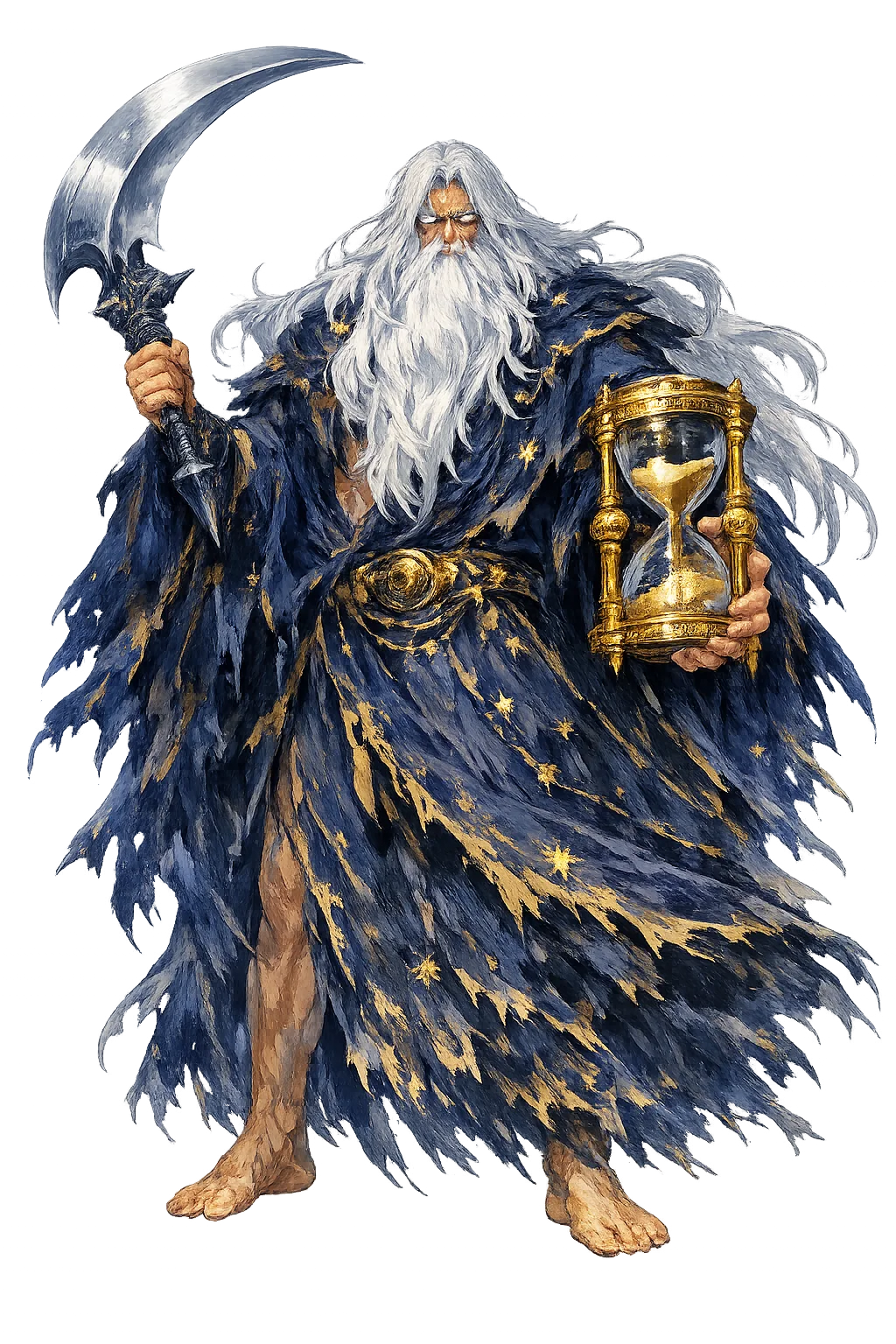
Krónos is the youngest of the first-generation Titans, but he is the one who acts. He takes the sickle his mother gives him and cuts the sky. He swallows his children to stop time from replacing him. He rules a Golden Age that ends the moment his last son is born.
The curved blade with which he castrated Ouranos and took power.
The Kronia festival linked him to grain, abundance, and the cycles of the year.
Kingship over gods and men during the mythic Golden Age.
He swallowed his children to prevent the prophecy of his overthrow.
Stories of Krónos
Krónos is the hinge between the primordial gods and the Olympian order. His myth is the myth of generational succession — the son who overthrows the father and is in turn overthrown.
Ouranos hated the children Gaia bore him and hid them inside her. Gaia fashioned a great stone sickle and persuaded her sons to avenge her. Only Krónos was willing. He ambushed his father and castrated him; from the blood sprang the Erinyes, the Giants, and the Meliae, while the severed genitals, cast into the sea, produced Aphrodítē. (Hesiod, Theogony 154–210.)
Warned that one of his children would overthrow him, Krónos devoured each infant Rhea bore him: Hestía, Deméter, Hera, Hádes, and Poseidôn. Rhea, grieving, hid Zeus in a Cretan cave and gave Krónos a stone wrapped in swaddling clothes. He swallowed it without looking. (Hesiod, Theogony 453–491; Apollodorus 1.1.5–7.)
When Zeus grew to manhood, he forced Krónos to disgorge his siblings. Together they waged war against the Titans for ten years. Zeus freed the Cyclopes and Hecatoncheires from Tartarus, and with their aid the Titans were cast down. Krónos was imprisoned in Tartarus, or, in some traditions, exiled to the Isles of the Blessed. (Hesiod, Theogony 617–735; Apollodorus 1.2.1.)
Before his fall, Krónos ruled the Golden Age, when mortals lived like gods, free from toil, grief, and old age. This memory survived in the Athenian Kronia festival, a harvest celebration where slaves and masters feasted together, temporarily dissolving social order.
Krónos is the god of the inevitable replacement. He does not ask permission to succeed his father, and he does not forgive his son for succeeding him. In this he is the most honest of the gods: he admits that power is temporary, that every ruler becomes the obstacle the next generation must remove.
Enter Extended Lore