
Why Jǫrmungandr belongs in your address bar
Every address bar is a choice. When you type Jǫrmungandr, you are not typing a novelty; you are restoring a name that the early DNS, built for English typewriters, could not carry. The plain ASCII form jormungandr is a leftover of that constraint, not the name itself. This post is the long version of the restoration: where the name comes from, how the Younger Futhark tradition wrote it, how it is pronounced, what the myths and the material record preserve, and why its Unicode form now lives as a working domain. The claim throughout is simple — the original spelling is not decoration. It is the name.
At a Glance
- Restored name: Jǫrmungandr
- ASCII form: jormungandr
- Meaning: "Huge monster (from jǫrmun + gandr)"
- Domain of influence: World Serpent
- Pantheon: Norse
- Classification: Tier 2
- Original script: ᛁᚢᚱᛘᚢᚾᚴᛅᚾᛏᚱ (Younger Futhark)
- Live domain: jǫrmungandr.com
Overview
Jǫrmungandr (jormungandr) — World Serpent · Huge monster (from jǫrmun + gandr) — belongs to the Norse tradition, where it is catalogued under the domain "World Serpent". The name is a compound of jǫrmun-, 'mighty, vast', and gandr, 'monster', hence "huge monster".
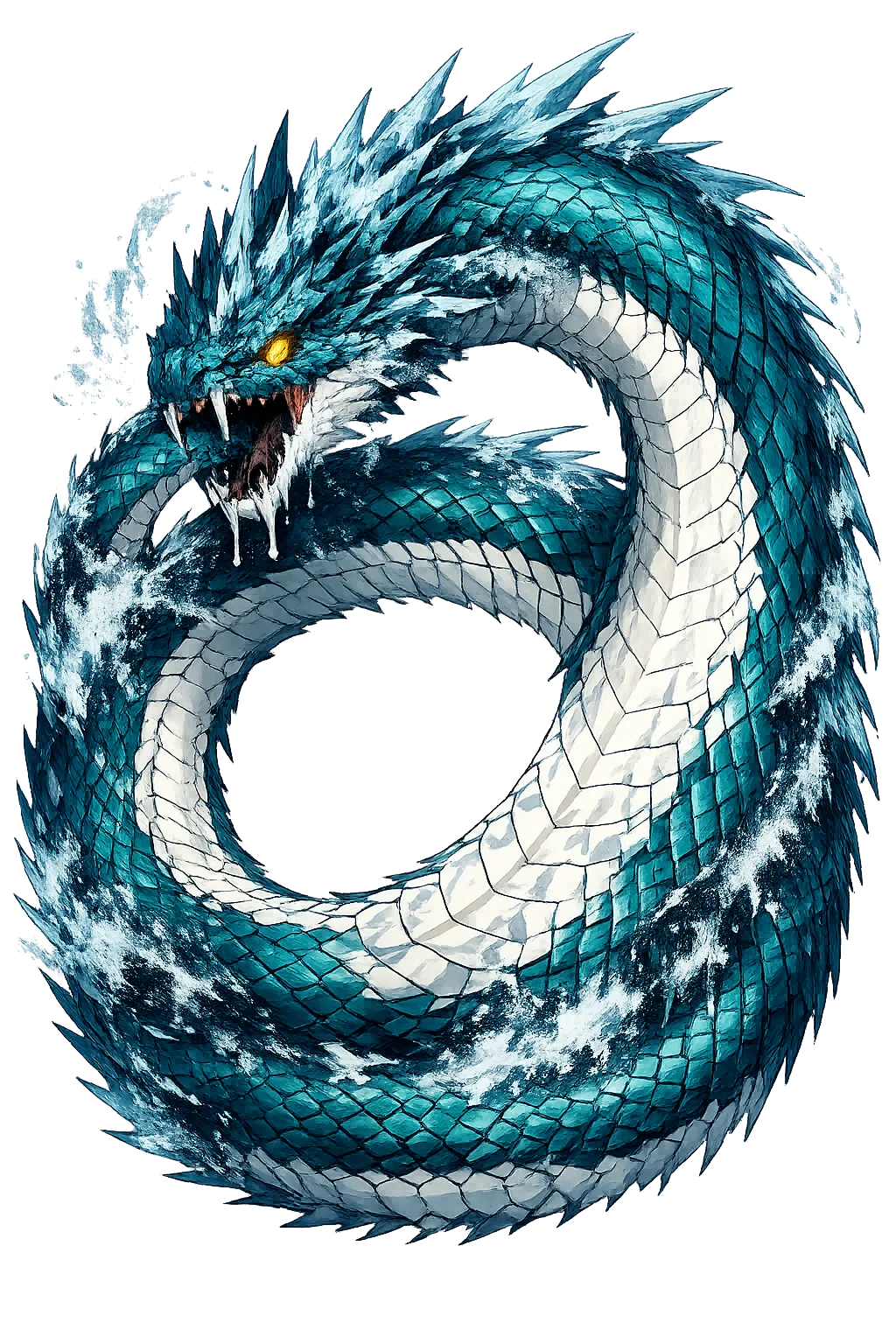
Jǫrmungandr is the great serpent that encircles Miðgarðr, biting its own tail. One of the three monstrous children of [[loki|Loki]] and [[angrboda|Angrboða]], it was cast into the ocean by Óðinn and grew until it surrounded the entire world. It is the nemesis of [[thor|Þórr]], and at [[ragnarok|Ragnarök]] the two will finally kill one another.
PuniCodex restores the name as Jǫrmungandr and serves its temple at jǫrmungandr.com. The restoration preserves a single distinctive feature of the Old Norse form — the rounded vowel ǫ — rather than a marked stress or length, which places the name in Tier 2. The plain ASCII form jormungandr survives as a modern convenience imposed by the early domain-name system; the restoration, not the fallback, is the form the project defends as philologically complete.
The Name
The name is attested in Younger Futhark as ᛁᚢᚱᛘᚢᚾᚴᛅᚾᛏᚱ. Etymologically it is a compound: jǫrmun-, a poetic intensive element meaning 'mighty, vast' (also in the royal name Jǫrmunrekr and the poetic term Jǫrmungrund, 'mighty ground'), plus gandr, 'monster, wolf; magic staff' — hence "huge monster".
The ASCII form jormungandr survives only because the early domain-name system could not carry diacritics; it is a technological compromise, not an ancient spelling. The Unicode restoration Jǫrmungandr recovers the full diacritic detail of the scholarly transliteration directly in the address bar. The restoration preserves a single distinctive feature — the rounded vowel ǫ — rather than a marked stress or length, which places the name in Tier 2.
The letter-by-letter transformation runs:
- j → J — Same
- o → ǫ — O-hook: short /ɔ/ vowel
- r → r — Same
- m → m — Same
- u → u — Same
- n → n — Same
- g → g — Same
- a → a — Same
- n → n — Same
- d → d — Same
- r → r — Same
The project holds the domain jǫrmungandr.com (xn--jrmungandr-ejd.com) as the canonical home of this name. The poetic corpus also knows the figure by its older by-name Miðgarðsormr, 'the serpent of Miðgarðr'.
The Original Script
The name is preserved in Younger Futhark as ᛁᚢᚱᛘᚢᚾᚴᛅᚾᛏᚱ.
The scholarly transliteration is iurmunkantr.
The rendering proceeds step by step:
- ᛁ (ís) writes both /i/ and /e/; in initial position it also serves for the glide /j/, since Younger Futhark has no dedicated j-rune — hence the transliteration begins with i-, not j-
- ᚢ (úr) writes the rounded back vowels /u, o, ø, ǫ, y/ and /w/
- ᚱ (reið) writes /r/; doubled ᚱ at the end transliterates the nominative ending -r
- ᛘ (maðr) writes /m/, ᚴ (kaun) writes /k, g/, ᛅ (ár) writes /a/, ᚾ (naudr) writes /n/, ᛏ (Týr) writes /t, d/
- The spelling iurmunkantr is a normalized phonetic reconstruction; Younger Futhark does not distinguish voiced/voiceless stops or separate short and long vowels
No runic inscription actually names the serpent: the futhark form is a scholarly normalization of the Old Norse name transmitted by the Eddas, not an epigraphic attestation.
Pronunciation
The reconstructed pronunciation of the name is /ˈjɔrˌmun.ɡan.dr/ — Old Norse Reconstruction.
Phoneme by phoneme:
- J- — Palatal approximant [j], the y-glide as in English 'yes'.
- -ǫr- — Short open-mid back rounded [ɔ] plus trilled [r], the first syllable carrying stress.
- -mun- — Bilabial nasal [m], close back rounded [u], and alveolar nasal [n].
- -gandr — Voiced velar [ɡ], open front [a], alveolar nasal [n], and trilled [r].
For the modern speaker, the closest approximation is: 'YOR-mun-gand-r' — stress the first syllable, pronounce the 'or' like the 'o' in 'hot' with an r-color, and keep the final r light and trilled.
Kindred and historical forms of the name:
- Old Norse components — jǫrmun-, 'mighty, vast' (also in Jǫrmunrekr, Jǫrmungrund) + gandr, 'monster, magic staff, wolf'
- Alternate name — Miðgarðsormr, 'the Midgard serpent, the worm that encircles the world'
- Family — Son of [[loki|Loki]] and [[angrboda|Angrboða]]; brother of [[fenrir|Fenrir]] and [[hel|Hel]]
Jǫrmungandr is Tier 2: the ǫ preserves the distinctive Old Norse rounded back vowel, but the name carries no stress accent or length mark. The first element is related to words for 'great' or 'universal'; gandr can mean monster, wand, or wolf, making the compound a 'mighty monster' or 'vast beast'.
Mythology
Jǫrmungandr is one of the three great threats to the gods, alongside [[fenrir|Fenrir]] and [[hel|Hel]]. It does not speak in the myths, yet its body defines the shape of the world and its final battle with Þórr is one of the climactic moments of Ragnarök.
The Casting into the Sea (Gylfaginning)
When the gods learned that [[loki|Loki]] and [[angrboda|Angrboða]] had produced three monstrous children — Fenrir, Jǫrmungandr, and Hel — they seized them. Fenrir they bound, Hel they cast into Niflhel, and Jǫrmungandr they threw into the sea that surrounds all lands. There it grew so large that it encircled Miðgarðr and bit its own tail. The gods' attempt to neutralize the threat merely made it cosmic.
Fishing for the World Serpent (Hymiskviða)
Þórr goes fishing with the giant [[hymir|Hymir]], using the head of Hymir's best ox as bait. He hooks Jǫrmungandr and pulls it up until its venom drips and the sea boils around the boat. Hymir, terrified, cuts the line, and the serpent sinks back into the deep. The episode foreshadows their final meeting: the fisher who hooks the world is fated to be killed by it.
The Death of Thor (Völuspá / Gylfaginning)
At Ragnarök, Jǫrmungandr will rise from the sea and poison land and sky. Þórr will slay it with [[mjolnir|Mjölnir]], but after walking nine paces he will fall dead from the serpent's venom. It is a mutual killing: the guardian of order and the beast of chaos destroy each other, leaving the world to be inherited by quieter gods.
Symbols & Iconography
The iconography associated with Jǫrmungandr concentrates in a small set of recurring attributes, each a compressed statement about the name:
- Coiled serpent biting its tail — The ouroboros, an image of the world bounded by a single endless body; on the Altuna stone the beast is shown coiled beneath Þórr's boat, already a monumental form in the Viking Age
- Ocean — The watery realm into which Jǫrmungandr was cast and in which it grew until it surrounded all lands
- Ox-head bait — The head of Hymir's best ox, which Þórr used as bait when he fished for the serpent in Hymiskviða; Snorri names the ox Himinhrjótr
- Venom — The poison that will kill Þórr even after he slays the worm at Ragnarök, dropping him after nine paces
Archaeology & Evidence
The serpent's myth is one of the best-attested scenes in Viking-Age art. The Altuna runestone in Uppland, Sweden (U 1161) shows Þórr in a boat, hammer raised, his foot thrust through the planking as he strains on the line to the serpent below — the fishing rendered in stone on an eleventh-century Christian memorial. The same episode appears on the Hørdum stone in Denmark and on a fragmentary cross-slab from Gosforth church in Cumbria, England (the 'fishing stone'), while the Ardre VIII picture stone from Gotland has been read in the same tradition, though not without dispute. The widespread Mjǫllnir pendants of the tenth and eleventh centuries belong to the same visual culture in which Þórr's cosmic battles were central, though none depicts the serpent directly. The ouroboros motif, by contrast, appears independently in Greek, Egyptian, and medieval European iconography and cannot be assumed to derive from the Norse figure.
Realm & Domain
Jǫrmungandr is the great serpent that encircles Miðgarðr, biting its own tail. One of the three monstrous children of [[loki|Loki]] and [[angrboda|Angrboða]], it was cast into the ocean by Óðinn and grew until it surrounded the entire world. It is the nemesis of [[thor|Þórr]], and at [[ragnarok|Ragnarök]] the two will finally kill one another.
Encircler of Worlds
So vast that it grips its own tail beneath the ocean that surrounds the human world.
Nemesis of Thor
Their enmity shapes two myths: the fishing trip and the final battle at Ragnarök.
Child of Loki
Born of Loki and the giantess Angrboða in Jötunheimr, then hurled into the sea.
Ouroboros
The tail-biting serpent becomes an image of cyclical time and cosmic boundary.
Across Cultures
The tail-biting serpent is not unique to Norse myth. Comparable figures include the Greek Ouroboros, the Egyptian Mehen, and various Indo-European and Near Eastern dragon-serpents that encircle the cosmos or guard the boundary between worlds. Some scholars see Jǫrmungandr as a specifically Germanic development of an Indo-European 'chaos monster' defeated by a thunder-god, comparable to the Vedic Vṛtra slain by Indra or the Babylonian [[tiamat|Tiāmat]] defeated by Marduk — the dragon-slaying formula Calvert Watkins traced as a shared Indo-European poetic inheritance. The figure of the world-serpent also influenced medieval Christian art and early modern alchemy, where the ouroboros became a symbol of cyclical renewal.
Kindred figures in the PuniCodex cross-tradition index include [[apep|Ꜥpp]], [[chaos|Cháos]], [[leviathan|Liwyāṯān]], [[tiamat|Tiāmat]], [[typhon|Typhōn]], and [[yam|Yām]], each linked through chaos / primordial / world serpent.
Cultural Legacy
Jǫrmungandr's afterlife runs on two tracks. The first is the ouroboros detached from its Norse context: the tail-biting serpent of Greek and alchemical tradition, which C. G. Jung treated as an emblem of the self-devouring and self-renewing psyche, became one of the most reproduced symbols of cyclical wholeness in esoteric and psychological writing, and the Norse world-serpent is routinely — if loosely — assimilated to it. The second is direct reception of the Norse figure: the world-serpent appears as the Midgard Serpent, a recurring cosmic adversary in Marvel's Thor comics, and reached its largest modern audience as a major character in Santa Monica Studio's God of War (2018) and God of War Ragnarök (2022), where it speaks a giant's tongue and fights alongside the protagonists against Þórr's line. In modern Heathenry the serpent is treated ambivalently — a hostile power in the mythology, yet also the boundary that holds the world together, honored in some circles as a force of necessary limitation.
The Scholarly Record
The account of Jǫrmungandr given in this edition rests on the witnesses and reference works listed below. Lexica and etymological dictionaries secure the form and meaning of the name; the literary and religious texts supply the narrative evidence.
- Poetic Edda: Hymiskviða (Þórr fishes for Jǫrmungandr).
- Poetic Edda: Völuspá (the serpent rises at Ragnarök).
- Snorri Sturluson, Prose Edda: Gylfaginning (birth, casting into the sea, and final battle).
- Cleasby & Vigfusson, An Icelandic-English Dictionary (1874), s.v. jǫrmun-, gandr.
- Zoëga, A Concise Dictionary of Old Icelandic (1910).
- de Vries, Jan, Altgermanische Religionsgeschichte.
- Simek, Rudolf, Dictionary of Northern Mythology.
- Lindow, John, Norse Mythology: A Guide to the Gods, Heroes, Rituals, and Beliefs.
A Meditation
Jǫrmungandr is the boundary made flesh. It holds the world in place by encircling it, yet its very presence is a threat. The serpent is not evil in a moral sense; it is simply too large, too ancient, too other to coexist peacefully with the gods.
The myth teaches that every order contains its own undoing. The ocean that protects Miðgarðr also nourishes the beast that will drown it. Þórr's final walk of nine paces after killing the serpent is one of the most moving images in the corpus: victory and death arrive together, and even the strongest god cannot save himself from the venom of the world he defended.
The Unicode Restoration
Jǫrmungandr is classified as Tier 2: the original preserves at least one philological feature that ASCII cannot encode. The ASCII fallback jormungandr still resolves everywhere, but it is the restored form that carries the name's full information. Across the 11 characters of the name, the restoration adjusts 1: 1 further adjustment (ǫ). That is the whole thesis of this temple: the marks are the message.
Character by Character
The journey from jormungandr to Jǫrmungandr, one character at a time:
- j → J — Same
- o → ǫ — O-hook: short /ɔ/ vowel
- r → r — Same
- m → m — Same
- u → u — Same
- n → n — Same
- g → g — Same
- a → a — Same
- n → n — Same
- d → d — Same
- r → r — Same
The Domain Name
The restored name is live as a working domain: jǫrmungandr.com, which the DNS carries in punycode form as xn--jrmungandr-ejd.com — an ASCII-compatible encoding that lets a non-ASCII name travel the global network without breaking older infrastructure. The visitor sees Jǫrmungandr; the machines see the encoding. That duality is the engineering compromise on which the entire restoration rests, and it is why a name written the way its own tradition wrote it in Younger Futhark can now be typed into any browser on earth.
The Norse Pantheon
Jǫrmungandr is one of 86 entries the PuniCodex lexicon catalogues under the Norse pantheon. The Pantheon page gathers the tradition's major figures in one place, and the Lexicon lets you filter all 895 restorations by tradition, tier, or script — the fastest way to see where this name sits among its kin.
Frequently Asked Questions
What does Jǫrmungandr mean? The traditional gloss is "Huge monster (from jǫrmun + gandr)."
Which tradition does Jǫrmungandr belong to? Jǫrmungandr is catalogued in the Norse pantheon of the PuniCodex lexicon.
Why is Jǫrmungandr classified as Tier 2? Because the original preserves at least one philological feature that ASCII cannot encode — and the marks in the restored spelling preserve exactly that evidence.
Is Jǫrmungandr a working domain? Yes — jǫrmungandr.com resolves today and routes to this temple.
What is the punycode for jǫrmungandr.com? The DNS encoding is xn--jrmungandr-ejd.com; browsers perform the translation automatically, so visitors only ever see the restored name.
Typing Jǫrmungandr
You do not need a special keyboard to use this restoration. The PuniCodex Type Tool converts the ASCII form jormungandr into Jǫrmungandr as you type, and the browser extension offers the same conversion inside any text field. Copy the restored form, paste it into the address bar, and the DNS does the rest.
Why This Restoration Matters
Restoring Jǫrmungandr is part of a larger effort to make the web multilingual by default. The PuniCodex project does not ask users to learn a new alphabet; it asks the infrastructure to respect the alphabets that already exist. Every section of this post — the script, the sound, the myths, the evidence — converges on the same point: the marks in Jǫrmungandr are information, and information deserves an address of its own. A single Unicode domain is a small proof, but it is a proof that scales: every name restored makes the next one easier, and every visit to jǫrmungandr.com is a vote for the restored form.
Explore Further
This post is one doorway into the temple. The home page carries the full character breakdown and the ambient canvas; the lore page tells the myths in long form; the Scholarly Edition preserves the sources, pronunciation data, and revision history; and the patron wall supports the restoration directly. For the wider map, browse the Lexicon, explore the Pantheon, or return to the PuniCodex blog.
Related Names
Sources
The full scholarly apparatus — every citation, revision, and review — lives in the Scholarly Edition. Key references for this post:
- Cleasby & Vigfusson, An Icelandic-English Dictionary, 2nd ed. with supplement, 1874.
- Poetic Edda (Eddukvæði), ed. Neckel-Kuhn; trans. Carolyn Larrington, Oxford World's Classics (2014); Codex Regius c. 1270.
- Snorri Sturluson, Prose Edda, trans. Anthony Faulkes, Everyman / Viking Society for Northern Research; composed c. 1220.
- Cleasby & Vigfusson, An Icelandic-English Dictionary (1874), s.v. jǫrmun-, gandr.
- Snorri Sturluson, Prose Edda: Gylfaginning 34, 51 (birth, casting into the sea, and final battle).
- Poetic Edda: Völuspá (the serpent rises at Ragnarök).
- Poetic Edda: Hymiskviða and Völuspá (the serpent named in the fishing narrative and the Ragnarök sequence).
- Lexicon authorities for this entry: Cleasby-Vigfusson, Zoëga.