
Why Iūnō belongs in your address bar
Every address bar is a choice. When you type Iūnō, you are not typing a novelty; you are restoring a name that the early DNS, built for English typewriters, could not carry. The plain ASCII form iuno is a leftover of that constraint, not the name itself. This post is the long version of the restoration: where the name comes from, how the Original Script tradition wrote it, how it is pronounced, what the myths and the material record preserve, and why its Unicode form now lives as a working domain. The claim throughout is simple — the original spelling is not decoration. It is the name.
At a Glance
- Restored name: Iūnō
- ASCII form: iuno
- Meaning: "From the same root as Iuppiter, the bright sky"
- Domain of influence: Queenship, Marriage, Sky
- Pantheon: Roman
- Classification: Tier 2
- Live domain: iūnō.com
Overview
Iūnō (iuno) — The Queen of Heaven — belongs to the Roman tradition, where it is catalogued under the domain "Queenship, Marriage, Sky". The name means "From the same root as Iuppiter, the bright sky".
Iūnō is not "Hēra with a Latin accent" but a sovereign in her own right: protector of women in every life-stage, keeper of the state's financial memory on the Capitoline, and the one goddess Rome's enemies learned to fear as the will behind the legions.
PuniCodex restores the name as Iūnō and serves its temple at iūnō.com. The original preserves one prosodic feature — stress or vowel length — rather than both, which places the name in Tier 2. The plain ASCII form iuno survives as a modern convenience imposed by the early domain-name system; the restoration, not the fallback, is the form the project defends as philologically complete.
The Name
No indigenous written attestation survives for this name; Iūnō is a scholarly transliteration of the reconstructed spoken form. Etymologically the name means "From the same root as Iuppiter, the bright sky".
The ASCII form iuno survives only because the early domain-name system could not carry diacritics; it is a technological compromise, not an ancient spelling. The Unicode restoration Iūnō recovers the vowel length of the original directly in the address bar. The original preserves one prosodic feature — stress or vowel length — rather than both, which places the name in Tier 2.
The letter-by-letter transformation runs:
- i → I — Same letter
- u → ū — Macron marks the long vowel
- n → n — Same letter
- o → ō — Macron marks the long vowel
The project holds the domain iūnō.com (xn--in-wra2j.com) as the canonical home of this name.
The Original Script
The original script for this roman name has not yet been added to PUNICODEX. The form shown is a scholarly transliteration.
The form Iūnō is therefore a scholarly transliteration rather than an attested ancient spelling; it encodes the reconstructed sound of the name for modern use, and no mark in it is decorative.
Pronunciation
The reconstructed pronunciation of the name is /ˈjuː.noː/ — Classical Latin.
For the modern speaker, the closest approximation is: YOO-noh, long ū and long ō.
Kindred and historical forms of the name:
- Latin — Iūnō
- Greek twin — Ἥρα
- Etruscan — Uni
- Owned form — Iūnō
Latin Iūnō carries two long vowels, and both are preserved in the restoration; the macrons follow Lewis & Short. Her name shares the deep root of iuvenis, "young" — the goddess of the vital force in its prime — which is why her festival, the Kalends, belonged to women at the height of their powers. Old Latin inscriptions write the name IVNO — the consonantal V of Iūnō that the alphabet later split from U.
Mythology
Roman Iūnō inherits Hēra's jealousy plots but outgrows them: in Rome she is less the wronged wife than the state's queen — a power that must be ritually persuaded, city by city, to change sides.
Tantaene Irae (The War)
The Aeneid's engine is her anger: Virgil asks whether heavenly minds can hold such wrath, and answers with seven books of her persecution of Aeneas — the storm off Carthage, the madness of the Italian women, the marriage of Lavinia delayed to blood. When she finally yields, she extracts a condition: the Trojan name shall perish, and only Roman remain. She loses the war and wins the peace.
The Goddess Who Changed Sides (The Evocatio)
Before Rome stormed Veii in 396 BCE, the general Camillus performed the evocatio — formally calling the enemy city's Iūnō Regina to abandon Veii for a finer temple in Rome. The Veientine statue, Livy says, nodded assent. Rome conquered Italy partly by inviting its goddesses to defect: Iūnō's transferability made her the instrument of empire's softest power.
The Geese of the Capitol (The Warning)
When the Gauls scaled the Capitoline cliff by night in 390 BCE, the watchdogs slept — but Iūnō's sacred geese heard them and raised such a clamour that Marcus Manlius woke and threw the first Gaul back down. Rome remembered: dogs were thereafter crucified annually, geese honoured — and Iūnō received the title Moneta, the Warner, beside whose temple the mint later stood.
Matronalia (The Festival)
On March 1, the old New Year, Roman matrons kept Iūnō Lucina's feast: husbands prayed for wives, slaves were feasted by mistresses, and the temple on the Esquiline — vowed after a plague of stillbirths — received the processions of flowering branches. It was Rome's Mother's Day and its recognition of women's collective religious power.
Symbols & Iconography
The iconography associated with Iūnō concentrates in a small set of recurring attributes, each a compressed statement about the name:
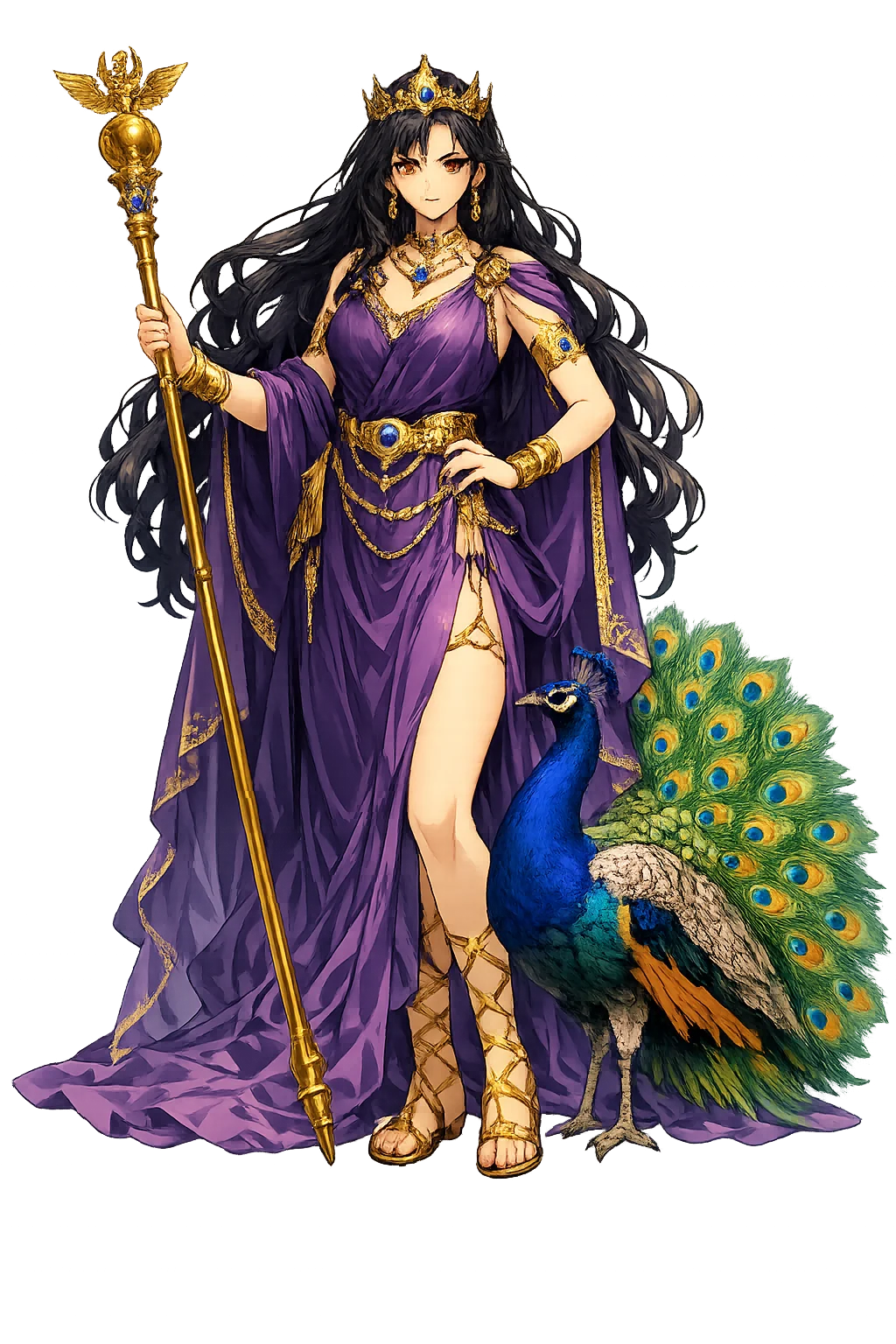
- The peacock — Her Argive bird — the hundred eyes of Árgos set in its tail
- The diadem — Sovereignty; she rules by right, not by marriage alone
- The goose — Vigilance — the alarm the dogs slept through
- The lily — In later art, the flower of her maternity
Epithets & Cult Titles
Her titles form a complete biography of Roman womanhood and statecraft.
- Regina — 'the Queen'; her Capitoline title as consort of the Optimus Maximus.
- Lucina — 'she who brings to light'; the goddess of childbirth, invoked by name in labour.
- Moneta — 'the Warner'; from the geese of 390 BCE — and hence, from her mint, the world's word for money.
- Caprotina — 'of the wild fig'; her July festival title, when slave-women feasted under the tree.
- Sospita — 'the Saviour'; her Lanuvium title, with the serpent and the goat-skin.
- Curitis — 'of the spear'; her warrior title among the Sabines.
Oracle Sites & Sanctuaries
The temple of Iūnō Moneta crowned the Arx of the Capitol from 344 BCE — vowed after the Gaulish alarm her geese had given — and the Roman mint worked beside it for centuries, which is why money is named for her. Lanuvium kept her oldest Latin cult: Iūnō Sospita, whose annual serpent-rite (a virgin offering barley-cakes to the sacred snake, innocence proven by its acceptance) Cicero discusses as a matter of public record. Carthage's Caelestis, the Punic queen Rome imported after the city's fall, filled the temple on the Aventine and lasted, Augustine complains, into his own lifetime.
Archaeology & Evidence
The temple of Iūnō Moneta stood on the Arx of the Capitol (349 BCE), where the church of Santa Maria in Aracoeli now rises; the mint's location beside it is the accepted explanation of her name's fortune. Veii's Portonaccio temple — the probable home of the defected Regina — preserves its Etruscan terracottas in the Villa Giulia. Inscribed curses and votives from her Italic sanctuaries (especially at Lanuvium, with its famous serpent cult) document her continuous worship from Latium's earliest towns.
Realm & Domain
Iūnō is not "Hēra with a Latin accent" but a sovereign in her own right: protector of women in every life-stage, keeper of the state's financial memory on the Capitoline, and the one goddess Rome's enemies learned to fear as the will behind the legions.
Lucina
Iūnō Lucina, "she who brings to light" — the goddess women call in childbirth.
Moneta
"The Warner" — her Capitoline title; Rome's mint stood in her temple, giving the world the word "money."
The Geese
Her sacred geese that woke the Capitol in 390 BCE when the Gauls climbed by night.
Regina
The Queen — third of the Capitoline triad with Iūpiter and Minerva, enthroned on the city's heart-hill.
Across Cultures
Her Etruscan form Uni was Rome's first loan: the Capitoline triad itself (Iūpiter, Iūnō, Minerva) is the Etruscan Tinia-Uni-Ménrva. Through evocatio she accumulated the identities of every conquered city's queen — Iūnō Caelestis of Carthage was worshipped in Rome after Carthage burned — and her African form survived into Augustine's polemics. In the Greek East she was simply Hēra again: the empire made her portable in both directions.
Within the Roman tradition, closely related names in the corpus include [[diana|Diāna]], [[ianus|Iānus]], [[iuppiter|Iūppiter]], [[neptunus|Neptūnus]], and [[vulcanus|Vulcānus]].
Cultural Legacy
Her titles became common nouns: "money" and "monetary" descend from the mint in Moneta's temple; June (Iūnius) bears her name on every calendar; "junoesque" still describes stately beauty. The evocatio — winning by inviting the other side's gods to defect — remains the strangest instrument in the history of religious warfare, and scholars cite it in every discussion of Roman imperialism's flexibility.
The Scholarly Record
The account of Iūnō given in this edition rests on the witnesses and reference works listed below. Lexica and etymological dictionaries secure the form and meaning of the name; the literary and religious texts supply the narrative evidence.
- Lewis & Short, A Latin Dictionary, Oxford, Clarendon Press; Perseus digitization, 1879. Full text
- Ovid (Publius Ovidius Naso), Metamorphoses / Fasti / Heroides, Loeb Classical Library, 17. Full text
- Varro, De Lingua Latina / Antiquitates Rerum Divinarum, Loeb Classical Library, 45 BCE.
- Cicero, Marcus Tullius — collected works, Loeb Classical Library, 43 BCE. Full text
- Macrobius, Saturnalia, Loeb Classical Library (Kaster), 430.
- Cambridge Ancient History, Multiple volumes, 1970. Full text
A Meditation
Iūnō is the power that must be persuaded, never merely defeated. Rome's deepest political insight is carved into her story: that legitimacy — of marriage, of money, of the state — is not seized but transferred, and only by consent. Her geese still wake at night in every institution that survives by vigilance rather than force.
The Unicode Restoration
Iūnō is classified as Tier 2: the original preserves at least one philological feature that ASCII cannot encode. The ASCII fallback iuno still resolves everywhere, but it is the restored form that carries the name's full information. Across the 4 characters of the name, the restoration adjusts 2: 2 marks of length (ū, ō). That is the whole thesis of this temple: the marks are the message.
Character by Character
The journey from iuno to Iūnō, one character at a time:
- i → I — Same letter
- u → ū — Macron marks the long vowel
- n → n — Same letter
- o → ō — Macron marks the long vowel
The Domain Name
The restored name is live as a working domain: iūnō.com, which the DNS carries in punycode form as xn--in-wra2j.com — an ASCII-compatible encoding that lets a non-ASCII name travel the global network without breaking older infrastructure. The visitor sees Iūnō; the machines see the encoding. That duality is the engineering compromise on which the entire restoration rests, and it is why a name written the way its own tradition wrote it in Original Script can now be typed into any browser on earth.
The Roman Pantheon
Iūnō is one of 6 entries the PuniCodex lexicon catalogues under the Roman pantheon. The Pantheon page gathers the tradition's major figures in one place, and the Lexicon lets you filter all 915 restorations by tradition, tier, or script — the fastest way to see where this name sits among its kin.
Frequently Asked Questions
What does Iūnō mean? The traditional gloss is "From the same root as Iuppiter, the bright sky."
Which tradition does Iūnō belong to? Iūnō is catalogued in the Roman pantheon of the PuniCodex lexicon.
Why is Iūnō classified as Tier 2? Because the original preserves at least one philological feature that ASCII cannot encode — and the marks in the restored spelling preserve exactly that evidence.
Is Iūnō a working domain? Yes — iūnō.com resolves today and routes to this temple.
What is the punycode for iūnō.com? The DNS encoding is xn--in-wra2j.com; browsers perform the translation automatically, so visitors only ever see the restored name.
Typing Iūnō
You do not need a special keyboard to use this restoration. The PuniCodex Type Tool converts the ASCII form iuno into Iūnō as you type, and the browser extension offers the same conversion inside any text field. Copy the restored form, paste it into the address bar, and the DNS does the rest.
Sister Temples
Other temples in the Roman pantheon include Neptūnus, and Diāna — each with its own restoration story, its own scholarly record, and its own place in the lexicon.
Why This Restoration Matters
Restoring Iūnō is part of a larger effort to make the web multilingual by default. The PuniCodex project does not ask users to learn a new alphabet; it asks the infrastructure to respect the alphabets that already exist. Every section of this post — the script, the sound, the myths, the evidence — converges on the same point: the marks in Iūnō are information, and information deserves an address of its own. A single Unicode domain is a small proof, but it is a proof that scales: every name restored makes the next one easier, and every visit to iūnō.com is a vote for the restored form.
Explore Further
This post is one doorway into the temple. The home page carries the full character breakdown and the ambient canvas; the lore page tells the myths in long form; the Scholarly Edition preserves the sources, pronunciation data, and revision history; and the patron wall supports the restoration directly. For the wider map, browse the Lexicon, explore the Pantheon, or return to the PuniCodex blog.
Related Names
Sources
The full scholarly apparatus — every citation, revision, and review — lives in the Scholarly Edition. Key references for this post:
- Virgil (Publius Vergilius Maro), Aeneid / Eclogues / Georgics, Loeb Classical Library / Oxford Classical Texts, 19 BCE.
- Ovid (Publius Ovidius Naso), Metamorphoses / Fasti / Heroides, Loeb Classical Library, 17.
- Lewis & Short, A Latin Dictionary, Oxford, Clarendon Press; Perseus digitization, 1879.
- Cicero, Marcus Tullius — collected works, Loeb Classical Library, 43 BCE.
- Cambridge Ancient History, Multiple volumes, 1970.
- Varro, De Lingua Latina / Antiquitates Rerum Divinarum, Loeb Classical Library, 45 BCE.
- Macrobius, Saturnalia, Loeb Classical Library (Kaster), 430.
- Ovid, Fasti 3 and 6; Cicero, De Divinatione 1.101.
- Cicero, De Divinatione 1.79 (Lanuvium); Livy 7.28 (Moneta).
- Lexicon authorities for this entry: Lewis & Short, Virgil, Ovid.