
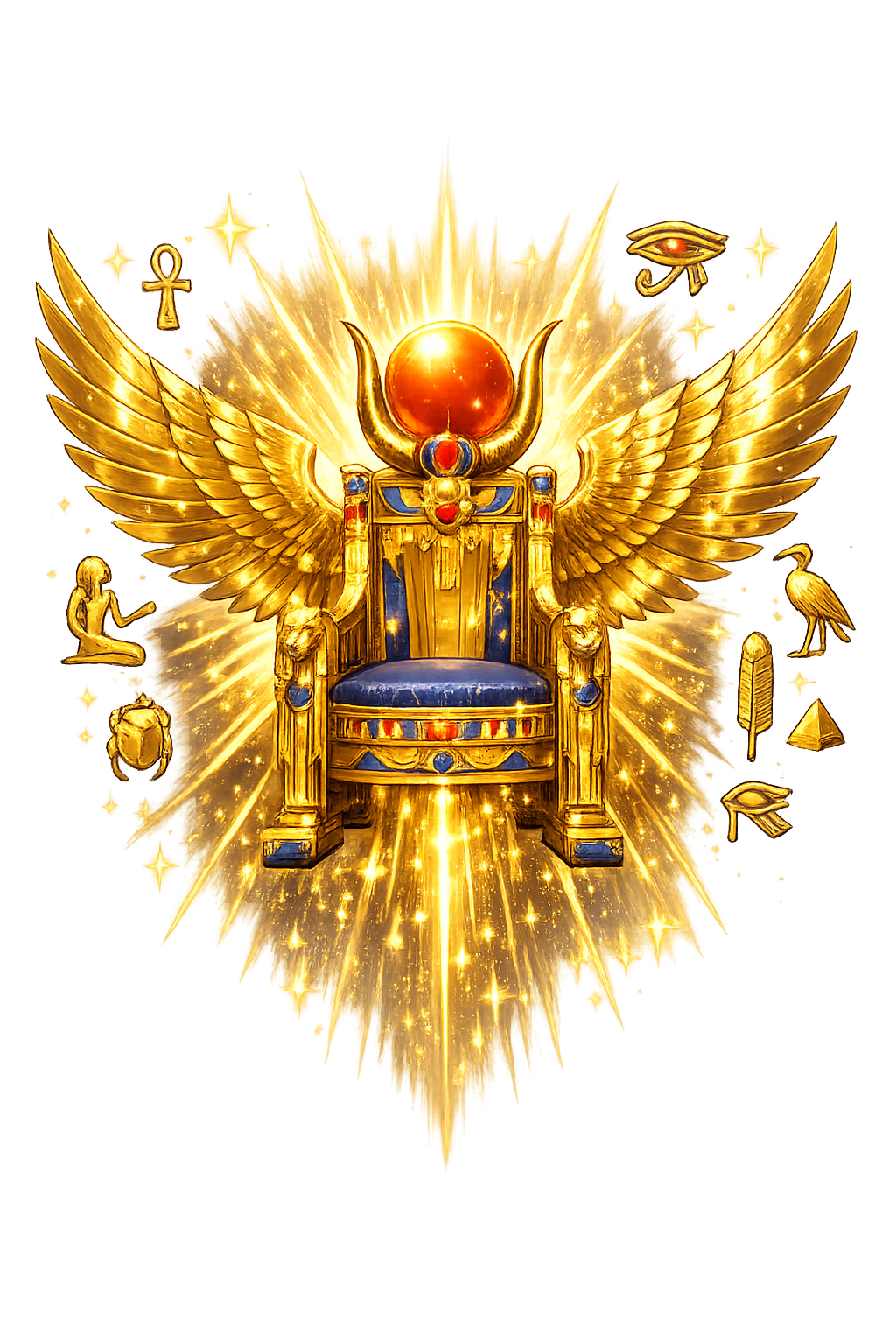
The name Ꜣst and the world it opens
A name is a door. Ꜣst opens onto an entire world: the domain of magic, motherhood, throne, a Egyptian tradition, and centuries of storytelling, worship, and scholarship. This post walks through that world room by room — the name and its roots, the original script, the sound of it, the myths, the symbols, the sites, the afterlife across cultures — and ends at the newest room of all: a Unicode domain that makes the whole structure addressable. isis gets you to the same building, but only the restored form tells you why it was built.
At a Glance
- Restored name: Ꜣst
- ASCII form: isis
- Meaning: "Throne (Egyptian ꜣst)"
- Domain of influence: Magic, Motherhood, Throne
- Pantheon: Egyptian
- Classification: Tier 2
- Original script: 𓊨𓏏𓆇 (Hieroglyphs)
- Live domain: ꜣst.com
Overview
Ꜣst (isis) — Magic, Motherhood, Throne · Throne (Egyptian ꜣst) — belongs to the Egyptian tradition, where it is catalogued under the domain "Magic, Motherhood, Throne". The name means "Throne (Egyptian ꜣst)".
Ꜣst is the throne that walks. Her very name is written with the hieroglyph of a seat (O29), and the king sits on her lap as on the throne of Egypt itself. She is the sister-wife of Osiris, the mother of Horus, and the most formidable magician in the Egyptian cosmos — a goddess who knows the secret names of things and is not afraid to use them.
Where other gods rule by force or decree, Ꜣst rules by devotion, cunning, and love. She reassembles the murdered Osiris, hides her infant son from Set, and outwits the sun-god Re himself to extract his hidden name. Her story is the Egyptian closest approach to a gospel: a god who dies, a mother who saves, a child who inherits.
PuniCodex restores the name as Ꜣst and serves its temple at ꜣst.com. The original preserves one prosodic feature — stress or vowel length — rather than both, which places the name in Tier 2. The plain ASCII form isis survives as a modern convenience imposed by the early domain-name system; the restoration, not the fallback, is the form the project defends as philologically complete.
The Name
The name is attested in Hieroglyphs as 𓊨𓏏𓆇. Etymologically it means "Throne (Egyptian ꜣst)".
The ASCII form isis survives only because the early domain-name system could not carry diacritics; it is a technological compromise, not an ancient spelling. The Unicode restoration Ꜣst recovers the full diacritic detail of the scholarly transliteration directly in the address bar. The original preserves one prosodic feature — stress or vowel length — rather than both, which places the name in Tier 2.
The letter-by-letter transformation runs:
- i → Ꜣ — Alef: glottal stop, voiced
- s → s — Same
- i → t — T: unwritten vowel position
- s → — — Dropped: not represented in Egyptological
Attested and derived spellings of the name:
- Ísis — alternate stress, scholarly variant: Acute on iota: alternate stress position
The project holds the domain ꜣst.com (xn--st-rq8h.com) as the canonical home of this name.
The Original Script
The name is preserved in Hieroglyphs as 𓊨𓏏𓆇 — Egyptian hieroglyphic, attested Old Kingdom – Late Antiquity, c. 2600 BCE – 400 CE, in Egypt. The script is written right-to-left / top-to-bottom.
The scholarly transliteration is Ꜣst (Egyptological conventional), giving the normalized reading Original vocalisation unknown; Egyptological /ˈiː.sɪs/..
The rendering proceeds step by step:
- The Egyptian name is written 𓊨𓏏𓆇 in hieroglyphs.
- Hieroglyphs combine logograms, phonograms, and determinatives; the exact function of each sign depends on context.
- Egyptian writing does not record vowels; the vocalised form is a modern convention reconstructed from Coptic and Greek evidence.
- The Unicode restoration Ꜣst uses Egyptological alef/ayin and other registrable characters; the hieroglyphic form is not registrable in .com.
The name is written with the throne hieroglyph (O29), functioning as a phonogram ꜣ, followed by s and t: ꜣ-s-t. The throne sign is also the name's semantic core: Isis is the throne. The initial ꜣ is an Egyptological alef, a glottal stop represented in PuniCodex by U+A723. Coptic writes the name ⲎⲤⲈ (Ēse), while Greek Ἶσις gave rise to the modern 'Isis.' Because hieroglyphs omit vowels, the precise pronunciation of the pharaonic form is reconstructed; the registrable Ꜣst preserves the consonantal skeleton and the throne icon embedded in the goddess's identity.
Pronunciation
The reconstructed pronunciation of the name is /ˈʔaːsət/ — Egyptological Reconstruction.
Phoneme by phoneme:
- Ꜣ- — Glottal stop [ʔ], the Egyptological alef (U+A723); at the beginning of the name it functions as a consonantal onset before the vowel.
- -aː- — Long open vowel in the first syllable; hieroglyphic ꜣst records no vowels, so the quality depends on Coptic and Greek evidence.
- -s — Voiceless alveolar fricative [s], as in English 'see'.
- -t — Voiceless alveolar stop [t]; the final -t is the feminine suffix, often unpronounced in later Egyptian and absent in Coptic.
For the modern speaker, the closest approximation is: 'AH-set' — begin with a slight catch in the throat (the alef), then 'set' with a crisp or silent final t. The variant 'EE-set' is also widely defended.
Kindred and historical forms of the name:
- Coptic — ⲎⲤⲈ (Ēse), the Late Egyptian/Early Coptic form
- Greek — Ἶσις (Isis), the Hellenized form from which the modern name derives
- Meroitic — Wos(a) / Wusa, the Nubian reflex
- Late Egyptian — ʾĒsə, the stage immediately before Coptic
This entry is the Egyptian goddess ꜣst (Aset/Iset), not the later Greek name Isis. Hieroglyphs record only ꜣ-s-t; the vowel evolution is reconstructed as Rūsat > Rūsaʾ > ʾŪsaʾ > ʾĒsə, whence Coptic ⲎⲤⲈ and Greek Ἶσις. The ꜣ is a glottal stop, and the final -t is a feminine marker often silent in speech. PUNICODEX uses the registrable alef ꜣ (U+A723) to signal the historic consonant; this is a Tier 2 restoration. Sources: Allen, Middle Egyptian (2014); Faulkner, A Concise Dictionary of Middle Egyptian, s.v. ꜣst; Wörterbuch der ägyptischen Sprache I, s.v. ꜣst; Hoch, Semitic Words in Egyptian Texts (1994), on the representation of Egyptian alef in Semitic transcriptions.
Mythology
Isis's mythology is the central drama of the Osirian cycle: love, murder, fragmentation, and restoration. It is also a handbook of magical power, because Isis does not accept loss as final.
The Lament and the Search (Myth of Osiris)
When Set dismembers Osiris and scatters his body across Egypt, Ꜣst wanders the land in mourning, gathering the pieces with her sister Nephthys. She reassembles them, anoints the body, and, by her magic, conceives Horus. The Pyramid Texts and later Plutarch's On Isis and Osiris preserve different versions of the story, but the core is constant: Isis makes wholeness out of what was torn apart.
Chemmis (Birth of Horus)
Pregnant and hunted, Isis hides in the marshes of Chemmis (Khemmis) to give birth to Horus. She protects him from scorpions, snakes, and the agents of Set, nursing him until he is old enough to claim his father's throne. The 'Isis lactans' image — Isis suckling Horus — became one of the most potent icons of divine motherhood in the ancient world.
The Secret Name (Magic of Re)
In a New Kingdom narrative, Isis plots to learn the hidden name of Re, source of his power. She fashions a serpent from his spittle and earth, and its bite brings the sun-god to agony. Only when he reveals his true name does she provide the cure. The tale is a theological statement: even the supreme god is vulnerable to the one who knows the true word.
A Mother's Rage (The Seven Scorpions)
While fleeing Set, Isis travels with seven scorpions. When a rich woman shuts her door, the scorpions sting the woman's child; Isis, moved by pity, heals the boy with her voice and magic, then turns the venom back on the scorpion goddess Serqet. The story binds maternal vengeance to maternal mercy.
Symbols & Iconography
The iconography associated with Ꜣst concentrates in a small set of recurring attributes, each a compressed statement about the name:
- Throne hieroglyph — Her name and body; the seat on which the king is established
- Outspread wings — Protection of the living and the dead; the winged goddess sheltering Osiris or the king
- Ankh — The life she grants to Horus, the king, and the justified dead
- Sistrum — Musical power used to frighten enemies and celebrate the goddess
- Tyet knot — The 'blood of Isis,' a protective amulet associated with her menstrual and life-giving power
Archaeology & Evidence
The temple of Isis at Philae, relocated to Agilkia by the UNESCO Nubian campaign, preserves the last known hieroglyphic inscription — a graffito dated to 394 CE — and the last dated demotic text (452 CE); no other sanctuary documents so precisely the end of the hieroglyphic tradition. Earlier shrines flourished at Abydos, at Behbeit el-Hagar, the Delta Iseum, and at Giza, where a temple of 'Isis, Mistress of the Pyramids' served a Late Period cult. Her most important literary monument is carved on stone: the Great Hymn to Osiris inscribed on the stela of the official Amenmose (Louvre C 286, Eighteenth Dynasty), the most complete Egyptian account of her search for Osiris, her conception of Horus, and her protection of the child in the marshes. The Metternich Stela and the other Horus cippi of the Late Period celebrate the same magical protection, while bronze statuettes of Isis suckling Horus — the 'Isis lactans' type that fed the iconography of the Virgin and Child — survive by the thousand.
Realm & Domain
Ꜣst is the throne that walks. Her very name is written with the hieroglyph of a seat (O29), and the king sits on her lap as on the throne of Egypt itself. She is the sister-wife of Osiris, the mother of Horus, and the most formidable magician in the Egyptian cosmos — a goddess who knows the secret names of things and is not afraid to use them.
Where other gods rule by force or decree, Ꜣst rules by devotion, cunning, and love. She reassembles the murdered Osiris, hides her infant son from Set, and outwits the sun-god Re himself to extract his hidden name. Her story is the Egyptian closest approach to a gospel: a god who dies, a mother who saves, a child who inherits.
The Throne
Her name and form are bound to the royal seat; every pharaoh is enthroned on Isis.
Words of Power
She commands heka, the force that animates ritual speech, and knows names that even Re keeps secret.
Mother of Horus
She conceives Horus after Osiris's death and nurses him in the papyrus thickets of Chemmis.
The Protectress
With outspread wings she shelters the living, the dead, and especially children and kings.
Across Cultures
Ꜣst absorbed or was identified with many goddesses: Hathor in her solar-mother aspect, Mut as consort of Amun, and Serqet in protective magic. Greeks identified her with Demeter, both searching goddesses of grain and mourning, and with Aphrodite in her erotic power. Roman Egypt made Isis a universal saviour whose cult spread across the Mediterranean, reaching Pompeii, London, and the Danube. Early Christianity drew on her iconography for the Virgin Mary: the nursing mother, the queen of heaven, the star-crowned woman of Revelation. The Copts rendered her name as ⲎⲤⲈ, a sound that still haunts the modern name 'Isis.'
Within the Egyptian tradition, closely related names in the corpus include [[ab|Ꜣb]], [[akh|Ꜣḫ]], [[amun|Ꜣmun]], [[ankh|ꜥnḫ]], [[apep|Ꜥpp]], and [[ba|Bꜣ]].
Cultural Legacy
Isis gave the ancient Mediterranean one of its first truly international mystery religions. Her temples offered initiation, personal salvation, and a goddess who heard individual prayers. After Egypt became Christian, her images were redeployed for the Virgin and Child. In modern times the name 'Isis' has been borrowed by terrorist groups, a sad irony that has nothing to do with the goddess. Contemporary Pagans, Kemetics, and feminist theologians reclaim her as a goddess of magic, motherhood, and political resistance. Her throne hieroglyph still sits at the center of every royal image in which a king is 'established' on the goddess herself.
The Scholarly Record
The account of Ꜣst given in this edition rests on the witnesses and reference works listed below. Lexica and etymological dictionaries secure the form and meaning of the name; the literary and religious texts supply the narrative evidence.
- Allen, Middle Egyptian (2014).
- Faulkner, A Concise Dictionary of Middle Egyptian, s.v. ꜣst.
- Wörterbuch der ägyptischen Sprache I, s.v. ꜣst.
- Lichtheim, Ancient Egyptian Literature, vol. 2.
- Assmann, The Search for God in Ancient Egypt.
- Plutarch, On Isis and Osiris.
- Pyramid Texts, Utterances 219–222.
- Metternich Stela.
- Book of the Dead, Spell 156.
A Meditation
Isis is the goddess who refuses to let death have the last word. She does not bargain with the underworld; she walks into it, collects the fragments, and reassembles the beloved. Her power is not the thunderbolt but the patient knot, the hidden name, the breast that keeps a threatened child alive.
In a world that often splits love from power, Isis holds them together. She is the throne and the lap, the magician and the mother, the one who outwits the sun and weeps for a murdered husband. She teaches that sovereignty is not domination but the capacity to make broken things whole again. To call on Isis is to call on the part of the soul that will not stop searching until what was lost is found.
The Unicode Restoration
Ꜣst is classified as Tier 2: the original preserves at least one philological feature that ASCII cannot encode. The ASCII fallback isis still resolves everywhere, but it is the restored form that carries the name's full information. Across the 4 characters of the name, the restoration adjusts 3: 3 further adjustments (Ꜣ, t, s). That is the whole thesis of this temple: the marks are the message.
Name Variations
The lexicon records 1 additional form of the name:
- Ísis (alt-stress) — Acute on iota: alternate stress position
The temple uses Ꜣst as the primary form: it is the spelling that best balances philological accuracy with the practical limits of DNS.
Character by Character
The journey from isis to Ꜣst, one character at a time:
- i → Ꜣ — Alef: glottal stop, voiced
- s → s — Same
- i → t — T: unwritten vowel position
- s → s — Dropped: not represented in Egyptological
The Domain Name
The restored name is live as a working domain: ꜣst.com, which the DNS carries in punycode form as xn--st-rq8h.com — an ASCII-compatible encoding that lets a non-ASCII name travel the global network without breaking older infrastructure. The visitor sees Ꜣst; the machines see the encoding. That duality is the engineering compromise on which the entire restoration rests, and it is why a name written the way its own tradition wrote it in Hieroglyphs can now be typed into any browser on earth.
The Egyptian Pantheon
Ꜣst is one of 66 entries the PuniCodex lexicon catalogues under the Egyptian pantheon. The Pantheon page gathers the tradition's major figures in one place, and the Lexicon lets you filter all 895 restorations by tradition, tier, or script — the fastest way to see where this name sits among its kin.
Frequently Asked Questions
What does Ꜣst mean? The traditional gloss is "Throne (Egyptian ꜣst)."
Which tradition does Ꜣst belong to? Ꜣst is catalogued in the Egyptian pantheon of the PuniCodex lexicon.
Why is Ꜣst classified as Tier 2? Because the original preserves at least one philological feature that ASCII cannot encode — and the marks in the restored spelling preserve exactly that evidence.
Is Ꜣst a working domain? Yes — ꜣst.com resolves today and routes to this temple.
What is the punycode for ꜣst.com? The DNS encoding is xn--st-rq8h.com; browsers perform the translation automatically, so visitors only ever see the restored name.
Why This Restoration Matters
A door only matters if people walk through it. ꜣst.com is open, and everything behind it — the myths, the scholarship, the canvas, the patrons — hangs on the restored spelling. The PuniCodex project bets that the web will make room for names as they were actually written, and Ꜣst is one of its standing proofs. Visit, share, cite, type it yourself: each use is a small rehearsal for a web where no name has to hide its marks to be found.
Explore Further
This post is one doorway into the temple. The home page carries the full character breakdown and the ambient canvas; the lore page tells the myths in long form; the Scholarly Edition preserves the sources, pronunciation data, and revision history; and the patron wall supports the restoration directly. For the wider map, browse the Lexicon, explore the Pantheon, or return to the PuniCodex blog.
Related Names
Sources
The full scholarly apparatus — every citation, revision, and review — lives in the Scholarly Edition. Key references for this post:
- James P. Allen, Middle Egyptian: An Introduction to the Language and Culture of Hieroglyphs, Cambridge University Press, 2000.
- Allen, Middle Egyptian (2014).
- Faulkner, A Concise Dictionary of Middle Egyptian, s.v. ꜣst.
- Wörterbuch der ägyptischen Sprache I, s.v. ꜣst.
- Frankfurter, Religion in Roman Egypt: Assimilation and Resistance (1998).
- Lexicon authorities for this entry: Faulkner, Wb.