
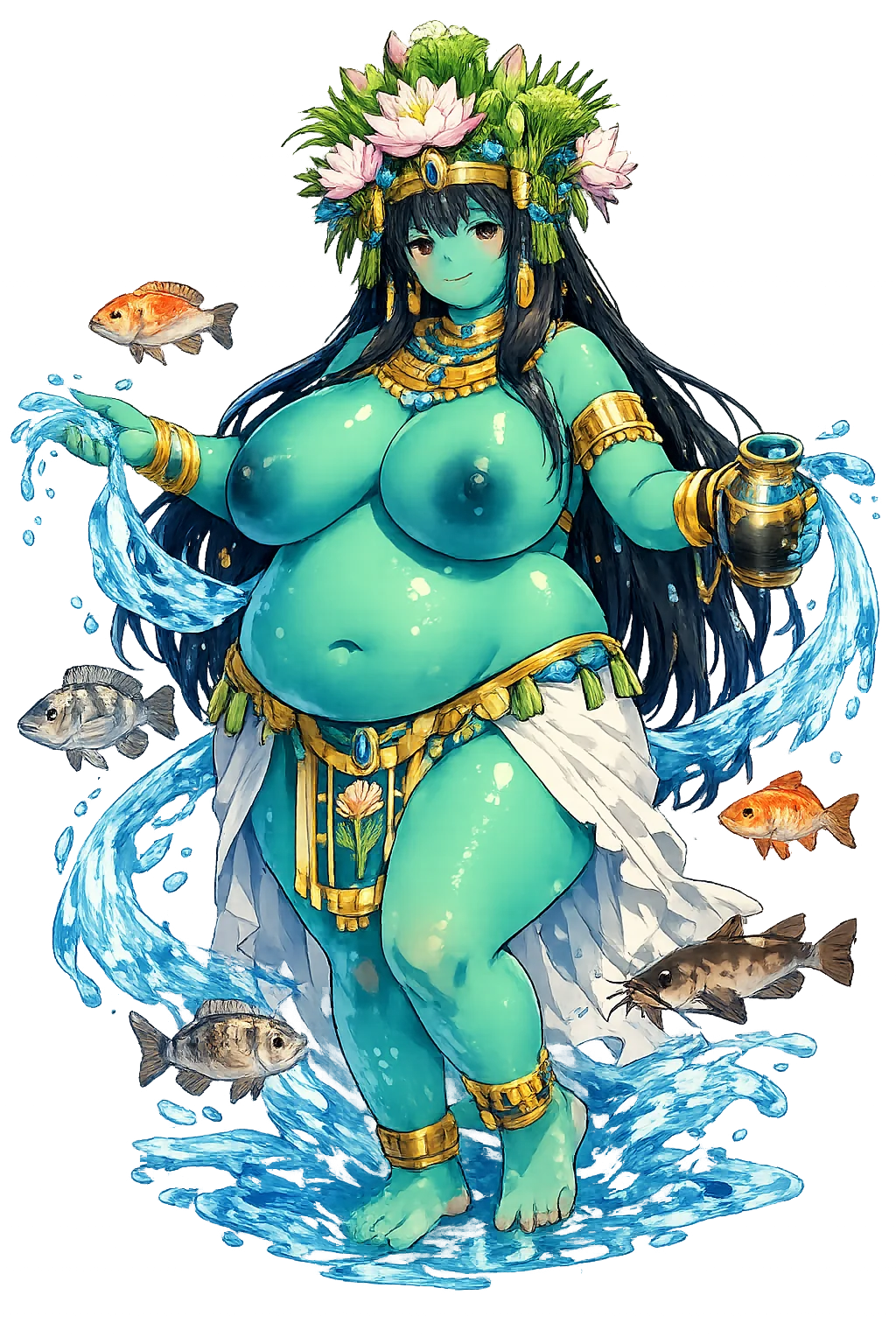
The name Ḥp and the world it opens
A name is a door. Ḥp opens onto an entire world: the domain of nile, inundation, abundance, a Egyptian tradition, and centuries of storytelling, worship, and scholarship. This post walks through that world room by room — the name and its roots, the original script, the sound of it, the myths, the symbols, the sites, the afterlife across cultures — and ends at the newest room of all: a Unicode domain that makes the whole structure addressable. hp gets you to the same building, but only the restored form tells you why it was built.
At a Glance
- Restored name: Ḥp
- ASCII form: hp
- Meaning: "The Nile flood god Hapi; from ḥꜥpj"
- Domain of influence: Nile, Inundation, Abundance
- Pantheon: Egyptian
- Classification: Tier 2
- Original script: 𓎛𓊪 (Hieroglyphs)
- Live domain: ḥp.com
Overview
Ḥp (hp) — The Bringer of the Flood — belongs to the Egyptian tradition, where it is catalogued under the domain "Nile, Inundation, Abundance". The name means "The Nile flood god Hapi; from ḥꜥpj".
ḥp is the Nile flood personified: the annual miracle on which all of Egypt hung, arriving as a blue-green, androgynous, heavy-bellied bringer of plenty. No temple was built to him — he needed none; the river was his temple, and its rising his epiphany.
PuniCodex restores the name as Ḥp and serves its temple at ḥp.com. The original preserves one prosodic feature — stress or vowel length — rather than both, which places the name in Tier 2. The plain ASCII form hp survives as a modern convenience imposed by the early domain-name system; the restoration, not the fallback, is the form the project defends as philologically complete.
The Name
The name is attested in Hieroglyphs as 𓎛𓊪. Etymologically it means "The Nile flood god Hapi; from ḥꜥpj".
The ASCII form hp survives only because the early domain-name system could not carry diacritics; it is a technological compromise, not an ancient spelling. The Unicode restoration Ḥp recovers the full diacritic detail of the scholarly transliteration directly in the address bar. The original preserves one prosodic feature — stress or vowel length — rather than both, which places the name in Tier 2.
The letter-by-letter transformation runs:
- h → Ḥ — Script-specific diacritic
- p → p — Same letter
The project holds the domain ḥp.com (xn--p-xnm.com) as the canonical home of this name.
The Original Script
The name is preserved in Hieroglyphs as 𓎛𓊪.
The scholarly transliteration is ḥp.
The rendering proceeds step by step:
- 𓎛 twisted wick of plant fibre = ḥ
- Q3 basket (𓊪) = p
- ḥp is the consonantal skeleton of ḥꜥpj, the Nile inundation god
Written ḥ-p with the water sign and the determinative of the fat-bellied offering-bringer; in the fullest orthographies the name rides in the Hymn to Hapi's papyrus copies. The god himself — blue-skinned, heavy-breasted, crowned with papyrus or lotus — is his own determinative: abundance in human form.
Pronunciation
The reconstructed pronunciation of the name is /ˈħaː.pi/ — Egyptological (from ḥp/ḥꜥpj).
For the modern speaker, the closest approximation is: HAH-pee; the ḥ is a strong breath, not a plain h.
Kindred and historical forms of the name:
- Egyptian — ḥp
- Conventional — Hapi
- Greek twin — Νεῖλος
- Owned form — ḥp
ḥp is conventionally vocalized "Hapi"; the ḥ (Gardiner Aa1) is the pharyngeal fricative heard at the start of the name. He must not be confused with Ḥpy the baboon-headed son of Horus — same sound, different god: the restoration keeps the underdot that marks the river-lord's true name.
Mythology
ḥp has no adventures because he is not a character but an event: the flood. His mythology is hydrology made sacred — the river's rhythm given a face, a hymn, and a table of offerings.
The Hymn to Hapi (The Hymn)
The great Hymn to Hapi — a school text for a millennium, surviving in New Kingdom copies — calls him "lord of fish and fowl, maker of barley, creator of wheat," and says what every Egyptian knew: when he is high, the land rejoices; when he fails, "the whole land is in panic." No god in the hymn's Egypt is more feared for absence or praised for arrival.
The Tying of the Two Lands (The Union)
On temple thrones across Egypt, two ḥp-figures — one crowned with Upper Egypt's lotus, one with the Delta's papyrus — knot the plants around the sema hieroglyph of the windpipe: sema-tawy, "uniting the Two Lands." The flood itself performs the political theology: one river, one country, one harvest.
The Caverns of the Nile (The Source)
Egyptians imagined the flood welling from subterranean caverns at the First Cataract — the realm of Khnum at Elephantine — and ḥp dwelling in the abyss with it. The theology matters less than the observation: the river rises at the solstice as Sirius returns, and the whole calendar, tax system, and liturgy bent to his timing.
Symbols & Iconography
The iconography associated with Ḥp concentrates in a small set of recurring attributes, each a compressed statement about the name:
- The blue-green skin — The water itself, and the vegetation it summons
- The heavy breasts and belly — Androgynous abundance — the flood as both father and mother
- The papyrus and lotus — Lower and Upper Egypt, both his crowns
Archaeology & Evidence
Nilometers survive at Elephantine (a stairwell of cubit scales rebuilt under the Romans), at Roda island in Cairo (the famous octagonal shaft, Abbasid-era over Fatimid work), and at Philae. His iconography is among the most common in Egyptian art: the procession of fat-bellied offering-bringers lines the base of temple walls from Karnak to Dendera, and the double-ḥp sema-tawy decorates royal thrones from the Old Kingdom onward. The Hymn to Hapi's best copies come from school texts — pupils learned the river's praise by heart.
He had no temple of his own — the river was his sanctuary — but his stations survive as engineering: the nilometers of Elephantine, where a stairwell of cubit-scales measured his rising beside Khnum's temple; Philae, where the flood's arrival was met with festivals at Isis' island; and the Roda nilometer in Cairo, whose Abbasid shaft still descends to the river. His iconography lines the base of every temple wall — the long processions of offering-bringers, each a province's flood personified — so that to walk around an Egyptian temple is to watch ḥp feed the country, province by province, forever.
Realm & Domain
ḥp is the Nile flood personified: the annual miracle on which all of Egypt hung, arriving as a blue-green, androgynous, heavy-bellied bringer of plenty. No temple was built to him — he needed none; the river was his temple, and its rising his epiphany.
The Inundation
The akhet season: the river rising to feed the black land — Egypt's single most sacred event.
The Offerings
He bears trays of fish, fowl, and produce — the land's abundance carried in his own arms.
The Sema-Tawy
The double Hapi tying papyrus and lotus around the windpipe-sign: the Two Lands knotted into one.
The Nilometer
His measure at Elephantine: cubits of rise that set the year's tax and the year's hope.
Across Cultures
The Greeks called him Neilos and gave the river-god a Greek biography — making him, in some accounts, father of Memphis and ancestor of the Danaid line that returned to Argos. The word "Nile" itself descends through this identification. In Nubia he merged with local flood-lords; in the Fayum, his abundance fed the crocodile cult of Sobek, whose lake was the flood's great reservoir. Every downstream culture read the same rising water and named its own god.
Within the Egyptian tradition, closely related names in the corpus include [[ab|Ꜣb]], [[akh|Ꜣḫ]], [[amun|Ꜣmun]], [[ankh|ꜥnḫ]], [[anubis|Jnpw]], and [[apep|Ꜥpp]].
Cultural Legacy
He is the reason Egyptology has a tax-system to study: nilometer readings governed assessments, and the "perfect flood" — about 16 cubits at Memphis — was the single most important number in the ancient economy. The Aswan High Dam ended his annual epiphany in 1970: the fields no longer drown, and Egypt marks the loss in every history of the river. "Hapi" survives in countless modern Egyptian names and in the eco-memory of a regulated Nile.
The Scholarly Record
The account of Ḥp given in this edition rests on the witnesses and reference works listed below. Lexica and etymological dictionaries secure the form and meaning of the name; the literary and religious texts supply the narrative evidence.
- A Concise Dictionary of Middle Egyptian, Griffith Institute, 1962. Full text
- D. Bonneau, La Crue du Nil, Librairie C. Klincksieck, Paris, 1964.
- Alan H. Gardiner, Egyptian Grammar: Being an Introduction to the Study of Hieroglyphs, Griffith Institute / Oxford University Press (3rd ed. 1957), 1927. Full text
- James P. Allen, Middle Egyptian: An Introduction to the Language and Culture of Hieroglyphs, Cambridge University Press, 2000. Full text
- H. te Velde, Seth, God of Confusion, Brill, Probleme der Ägyptologie 6, 1967.
- Egyptology (modern Egyptological scholarship), UCLA Encyclopedia of Egyptology / field standard, ongoing. Full text
A Meditation
ḥp is the god of the right amount. Too little and Egypt starved; too much and it drowned: his theology is the arithmetic of enough. Every flood-forecast, every reservoir, every rationing scheme since is his liturgy translated — the oldest question of abundance is not how to get more, but how to receive what comes.
The dam ended his flood in a single generation, and Egypt's ambivalence about the Aswan High Dam is his modern myth: the silt no longer comes, the fields are fed by chemistry, the delta retreats — and no one would vote to bring the drowning back. ḥp's question outlives his river: abundance engineered is abundance owed to what? The flood that fed for five thousand years was never free; it was merely invoiced in a currency — rhythm, silt, patience — that modernity is only now learning to price again.
The hymn says it plainly: when he rises, the land rejoices; when he fails, the temples themselves seem to close. Egypt knew what every river civilization relearns — the water is not a resource but a relationship, renewed annually or not at all. The nilometer's cubits were the oldest economic forecast in the world, and the tax register waited on the river like a priest on an oracle.
The Unicode Restoration
Ḥp is classified as Tier 2: the original preserves at least one philological feature that ASCII cannot encode. The ASCII fallback hp still resolves everywhere, but it is the restored form that carries the name's full information. Across the 2 characters of the name, the restoration adjusts 1: 1 further adjustment (Ḥ). That is the whole thesis of this temple: the marks are the message.
Character by Character
The journey from hp to Ḥp, one character at a time:
- h → Ḥ — Script-specific diacritic
- p → p — Same letter
The Domain Name
The restored name is live as a working domain: ḥp.com, which the DNS carries in punycode form as xn--p-xnm.com — an ASCII-compatible encoding that lets a non-ASCII name travel the global network without breaking older infrastructure. The visitor sees Ḥp; the machines see the encoding. That duality is the engineering compromise on which the entire restoration rests, and it is why a name written the way its own tradition wrote it in Hieroglyphs can now be typed into any browser on earth.
The Egyptian Pantheon
Ḥp is one of 67 entries the PuniCodex lexicon catalogues under the Egyptian pantheon. The Pantheon page gathers the tradition's major figures in one place, and the Lexicon lets you filter all 915 restorations by tradition, tier, or script — the fastest way to see where this name sits among its kin.
Frequently Asked Questions
What does Ḥp mean? The traditional gloss is "The Nile flood god Hapi; from ḥꜥpj."
Which tradition does Ḥp belong to? Ḥp is catalogued in the Egyptian pantheon of the PuniCodex lexicon.
Why is Ḥp classified as Tier 2? Because the original preserves at least one philological feature that ASCII cannot encode — and the marks in the restored spelling preserve exactly that evidence.
Is Ḥp a working domain? Yes — ḥp.com resolves today and routes to this temple.
What is the punycode for ḥp.com? The DNS encoding is xn--p-xnm.com; browsers perform the translation automatically, so visitors only ever see the restored name.
Typing Ḥp
You do not need a special keyboard to use this restoration. The PuniCodex Type Tool converts the ASCII form hp into Ḥp as you type, and the browser extension offers the same conversion inside any text field. Copy the restored form, paste it into the address bar, and the DNS does the rest.
Sister Temples
Other temples in the Egyptian pantheon include Mntw, Nnw, and Ptḥ — each with its own restoration story, its own scholarly record, and its own place in the lexicon.
Why This Restoration Matters
A door only matters if people walk through it. ḥp.com is open, and everything behind it — the myths, the scholarship, the canvas, the patrons — hangs on the restored spelling. The PuniCodex project bets that the web will make room for names as they were actually written, and Ḥp is one of its standing proofs. Visit, share, cite, type it yourself: each use is a small rehearsal for a web where no name has to hide its marks to be found.
Explore Further
This post is one doorway into the temple. The home page carries the full character breakdown and the ambient canvas; the lore page tells the myths in long form; the Scholarly Edition preserves the sources, pronunciation data, and revision history; and the patron wall supports the restoration directly. For the wider map, browse the Lexicon, explore the Pantheon, or return to the PuniCodex blog.
Related Names
Sources
The full scholarly apparatus — every citation, revision, and review — lives in the Scholarly Edition. Key references for this post:
- A Concise Dictionary of Middle Egyptian, Griffith Institute, 1962.
- Alan H. Gardiner, Egyptian Grammar: Being an Introduction to the Study of Hieroglyphs, Griffith Institute / Oxford University Press (3rd ed. 1957), 1927.
- James P. Allen, Middle Egyptian: An Introduction to the Language and Culture of Hieroglyphs, Cambridge University Press, 2000.
- Egyptology (modern Egyptological scholarship), UCLA Encyclopedia of Egyptology / field standard, ongoing.
- D. Bonneau, La Crue du Nil, Librairie C. Klincksieck, Paris, 1964.
- Bonneau, La Crue du Nil; the Elephantine and Roda nilometer publications.
- H. te Velde, Seth, God of Confusion, Brill, Probleme der Ägyptologie 6, 1967.
- The Hymn to Hapi (van der Plas, L'Hymne à la Crue du Nil).
- Lexicon authorities for this entry: Faulkner, Gardiner, Bonneau.