
Pronouncing Ḥr: a guide for the curious
Saying Ḥr aloud is harder than reading it on a screen, and more rewarding. The restored spelling is a compressed pronunciation guide: every accent and macron is an instruction. This post unpacks those instructions — the reconstructed sound, the phoneme-by-phoneme record, the kindred forms in neighboring languages — and then zooms out to the full record around the name: its Hieroglyphs writing, its mythology, its cult, and its modern life as a Unicode domain. Whether you arrive as a linguist, a reader of myth, or a domainer, you will leave able to say the name the way the evidence suggests it was said — and able to type it the way it was written.
At a Glance
- Restored name: Ḥr
- ASCII form: horus
- Meaning: "The Distant One (Egyptian ḥr)"
- Domain of influence: Sky, Kingship, Falcon
- Pantheon: Egyptian
- Classification: Tier 2
- Original script: 𓅃 (Hieroglyphs)
- Live domain: Ḥr.com
Overview
Ḥr (horus) — The Distant One (Egyptian ḥr) — belongs to the Egyptian tradition, where it is catalogued under the domain "Sky, Kingship, Falcon". The name means "The Distant One (Egyptian ḥr)".
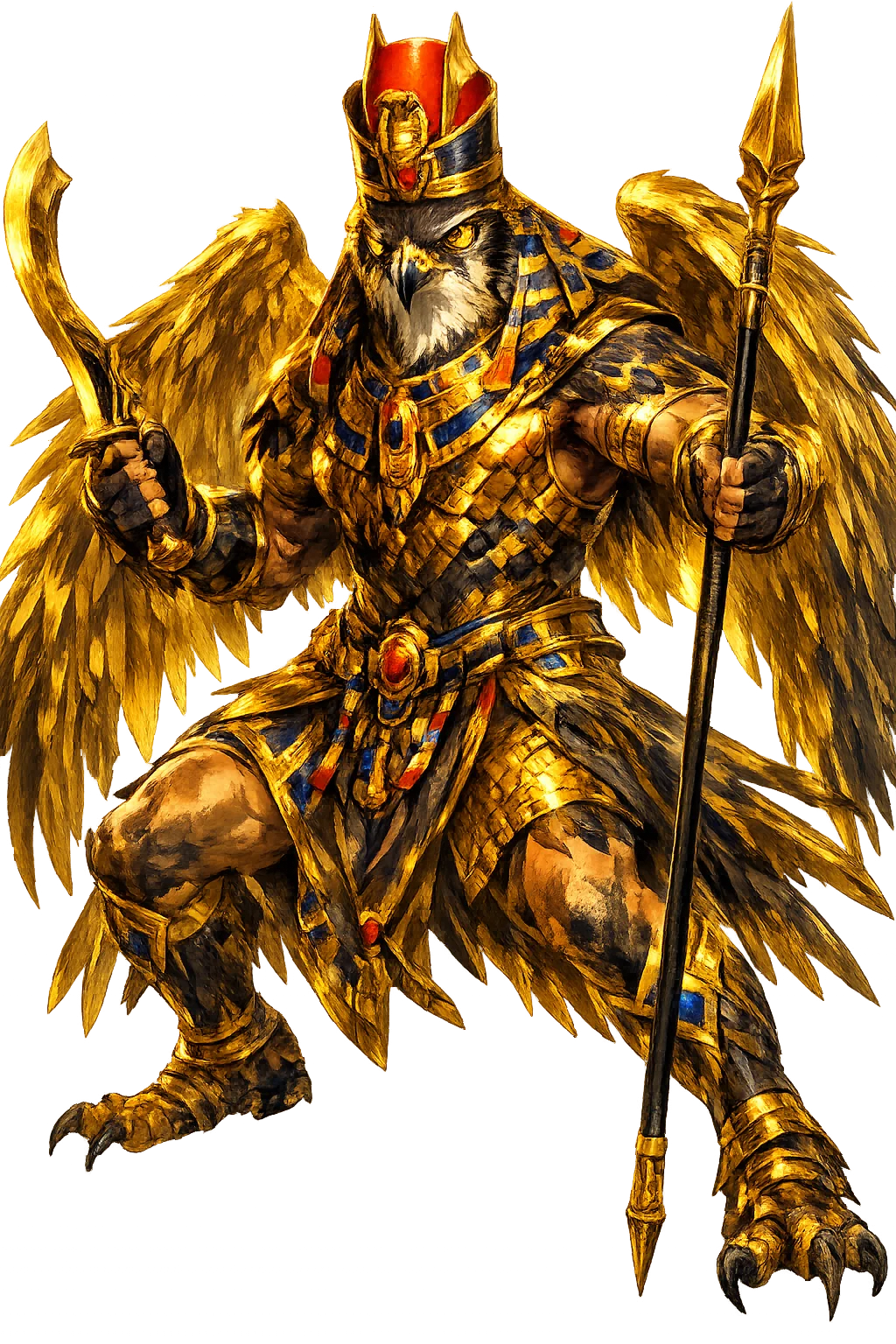
Ḥr is the falcon of the sky, whose eyes are the sun and the moon, whose wings outspread are the heavens, and whose incarnation on earth is the living pharaoh. He is not one god but a constellation of related gods — Horus the Elder, the primordial sky; Horus the Younger, son of Osiris and Isis; and Re-Horakhty, the solar synthesis. Through all his forms he stands for one thing: legitimate authority defending cosmic order against chaos.
PuniCodex restores the name as Ḥr and serves its temple at Ḥr.com. The original preserves one prosodic feature — stress or vowel length — rather than both, which places the name in Tier 2. The plain ASCII form horus survives as a modern convenience imposed by the early domain-name system; the restoration, not the fallback, is the form the project defends as philologically complete.
The Name
The name is attested in Hieroglyphs as 𓅃. Etymologically it means "The Distant One (Egyptian ḥr)".
From Egyptian ḥr, written with the falcon sign and interpreted as 'the distant/high one' or 'falcon'; the original vowels are not recorded in hieroglyphs.
The ASCII form horus survives only because the early domain-name system could not carry diacritics; it is a technological compromise, not an ancient spelling. The Unicode restoration Ḥr recovers the full diacritic detail of the scholarly transliteration directly in the address bar. The original preserves one prosodic feature — stress or vowel length — rather than both, which places the name in Tier 2.
The letter-by-letter transformation runs:
- h → Ḥ — H-with-dot: voiceless pharyngeal
- o → — — Dropped: vowel not written
- r → r — Same
- u → — — Dropped: vowel not written
- s → — — Dropped: not in standard
The project holds the domain Ḥr.com (xn--r-xnm.com) as the canonical home of this name.
Etymology & Roots
The recorded derivation reads: From Egyptian ḥr, written with the falcon sign and interpreted as 'the distant/high one' or 'falcon'; the original vowels are not recorded in hieroglyphs.
The root gloss is "the distant one, falcon."
The reconstruction is classed as attested.
The Original Script
The name is preserved in Hieroglyphs as 𓅃 — Egyptian hieroglyphic, attested Old Kingdom – Late Antiquity, c. 2600 BCE – 400 CE, in Egypt. The script is written right-to-left / top-to-bottom.
The scholarly transliteration is Ḥr (Egyptological conventional), giving the normalized reading Original vocalisation unknown; Egyptological /ˈhaː.rʊs/..
The rendering proceeds step by step:
- The Egyptian name is written 𓅃 in hieroglyphs.
- Hieroglyphs combine logograms, phonograms, and determinatives; the exact function of each sign depends on context.
- Egyptian writing does not record vowels; the vocalised form is a modern convention reconstructed from Coptic and Greek evidence.
- The Unicode restoration Ḥr uses Egyptological alef/ayin and other registrable characters; the hieroglyphic form is not registrable in .com.
The name ḥr is written with the falcon-on-perch hieroglyph (Gardiner G5), often used as a logogram for the god himself. The initial ḥ is a voiceless pharyngeal fricative; the final r is an alveolar liquid. Because Egyptian does not write vowels, the pronunciation has to be reconstructed from Coptic forms such as ϩⲱⲣ and from Greek Ὧρος. The meaning 'distant one' or 'one on high' is well attested.
Pronunciation
The reconstructed pronunciation of the name is /ˈħaːru/ — Egyptological Reconstruction.
Phoneme by phoneme:
- Ḥ- — Voiceless pharyngeal fricative [ħ], the same dry throat-sound that opens Heka and Hu.
- -aː- — Long stressed vowel; the name's peak, carrying the god's height and distance.
- -r- — Alveolar tap or trill [r], like a brief roll of the tongue.
- -u — Final short vowel, reconstructed from Coptic ⲟⲩⲣ (our) / ⲏⲣⲟ (hēro).
For the modern speaker, the closest approximation is: 'HAH-roo' — the first syllable is throaty and drawn out, the second light and ascending, like a falcon rising.
Kindred and historical forms of the name:
- Egyptian — ḥr, 'the distant one' or 'the one on high'
- Coptic — ϩⲱⲣ (hōr) / ⲏⲣⲟ (hēro), 'Horus'
- Greek — Ὧρος (Hōros), borrowed and Hellenised
Horus is Tier 2 because the Egyptian Ḥr preserves length in the first syllable but no stress accent in the Greek sense. The name is onomatopoeically apt: the throaty ḥ and the final u suggest a cry from far above. The Greek borrowing Hōros adds an omega, but the original Egyptian root is simply ḥr.
Mythology
Horus's mythology is the political theology of Egypt made personal. It tells how the rightful heir, born from a murdered father and a resourceful mother, defeats the usurper and restores the throne. The story was never merely entertainment; it was the charter of kingship, replayed in temples for three thousand years.
Elder and Younger (The Two Horuses)
Horus the Elder (Haroeris) is an ancient sky-god, brother of Osiris and Set, whose eyes are the luminaries. Horus the Younger (Harsiese) is the son of Osiris and Isis, the avenger of his father. Over time these figures merged, so that the Horus of Edfu is simultaneously the primordial falcon and the royal heir. The Egyptians themselves were not always precise about the distinction; what mattered was the constellation of meanings gathered under the name.
Horus and Set (The Contendings)
After Set murders Osiris and seizes the throne, Isis hides the infant Horus in the Delta marshes. When he comes of age, Horus challenges Set before the Ennead. Their contest lasts eighty years, filling the satirical Contendings of Horus and Set with trials, tricks, and humiliations. Set tears out Horus's left eye; Horus castrates Set. Finally the tribunal rules for Horus, establishing that legitimate succession triumphs over brute force.
The Wedjat (The Eye Restored)
Thoth restores Horus's damaged eye, creating the wedjat ('the whole one'). In hieratic scribal notation the parts of the eye sign serve as the standard grain-measure fractions 1/2, 1/4, 1/8, 1/16, 1/32, and 1/64 — a real ancient usage, though the popular claim that the parts sum to 63/64 with Thoth magically supplying the rest is a modern embellishment, not an ancient text. The eye becomes the symbol of wholeness recovered, worn on amulets by the living and set upon mummies for the dead.
The Living Horus (Divine Kingship)
From the earliest dynasties, the pharaoh was the living Horus. Upon death he became Osiris; his successor became the new Horus. This cycle bound every reign to the original mythic victory and made the king responsible for maintaining ma'at against the chaos that Set represents. The festival at Edfu annually re-enacted Horus's triumph, renewing the cosmos by re-enacting its founding.
Symbols & Iconography
The falcon-god's attributes are among the oldest and most stable in Egyptian art:
- Falcon — the sky itself and the king's predatory vigilance; the lanner or peregrine is his living form
- Double crown (pschent) — the union of Upper and Lower Egypt under Horus's kingship, worn by every pharaoh as "Living Horus"
- Wedjat eye — "the whole one": the eye torn out by Set and healed by Thoth, Egypt's supreme sign of protection and restored order
- Serekh — the palace-façade frame surmounted by the falcon that encloses the king's oldest title, his Horus-name
- Winged sun disk — the emblem of Horus of Behdet set above temple doorways, the falcon fused with the solar circuit
- Sun disk with wings — Re-Horakhty, Horus fused with the sun-god Re
Archaeology & Evidence
The falcon is present at the state's founding. On the Narmer Palette (c. 3100 BCE, Egyptian Museum Cairo) a falcon — Horus — presents the king with the personified papyrus-land he has subdued, and from Dynasty 0 the falcon-topped serekh frames every royal Horus-name. Hierakonpolis (Nekhen), his most ancient cult city, yielded the Main Deposit with its Early Dynastic falcon statues and the celebrated gold falcon head; the Late Period animal cemeteries, above all the falcon and ibis catacombs of North Saqqara, received votive raptors by the million. The Ptolemaic temple of Horus of Behdet at Edfu, the best-preserved temple in Egypt, carries the full inscriptional cycle of the myth — the winged disk's war against Set's rebels — together with the festival calendar that re-enacted it annually.
Realm & Domain
Ḥr is the falcon of the sky, whose eyes are the sun and the moon, whose wings outspread are the heavens, and whose incarnation on earth is the living pharaoh. He is not one god but a constellation of related gods — Horus the Elder, the primordial sky; Horus the Younger, son of Osiris and Isis; and Re-Horakhty, the solar synthesis. Through all his forms he stands for one thing: legitimate authority defending cosmic order against chaos.
The Sky
Horus soars across the heavens; his right eye is the sun, his left the moon, and his body the luminous air.
Divine Kingship
Every pharaoh is the 'Living Horus'; the Horus-name is the first and oldest of the five royal names.
The Falcon
The lanner or peregrine falcon — swift, far-seeing, and deadly — is Horus's living embodiment.
The Wedjat Eye
The restored eye of Horus is Egypt's supreme symbol of protection, wholeness, and royal health.
Across Cultures
Horus absorbed and was absorbed by many gods. As Re-Horakhty he united the falcon with the solar disk; as Harpocrates he became the finger-to-lips divine child of Greco-Roman Egypt; as Sokar and Montu he shared falcon imagery with other deities of death and war. Plutarch's De Iside et Osiride transmitted the Osiris-Horus myth to the Greek and Roman world, where it influenced conceptions of divine sonship and resurrection. Some later interpreters, from early Christians to modern comparative mythologists, have drawn parallels between Horus and other divine-child figures, though many of these claims are exaggerated or unsupported by Egyptian evidence.
Within the Egyptian tradition, closely related names in the corpus include [[ab|Ꜣb]], [[akh|Ꜣḫ]], [[amun|Ꜣmun]], [[ankh|ꜥnḫ]], [[apep|Ꜥpp]], and [[ba|Bꜣ]].
Cultural Legacy
The wedjat eye is the most durable Egyptian symbol in the modern world: tattooed, cast in gold, and printed on everything from amulets to corporate logos, usually as a generic sign of protection — a direct continuation of its ancient amuletic use. The god himself entered Western esotericism early: Hermetic and alchemical readers of Plutarch's De Iside et Osiride treated Horus as the divine son and avenger, and in 1904 Aleister Crowley made him the namesake of a coming 'Aeon of Horus', the crowned and conquering child of Thelemic cosmology. Egyptology, meanwhile, made 'Horus' a term of art: the Horus-name remains the standard designation of the oldest element of the royal titulary, so that every pharaoh from Narmer onward is filed under the falcon's name.
The Scholarly Record
The account of Ḥr given in this edition rests on the witnesses and reference works listed below. Lexica and etymological dictionaries secure the form and meaning of the name; the literary and religious texts supply the narrative evidence.
- Faulkner, The Ancient Egyptian Pyramid Texts.
- Wörterbuch der ägyptischen Sprache (Wb), ḥr.
- Gardiner, Egyptian Grammar.
- Allen, Genesis in Egypt.
- Plutarch, De Iside et Osiride.
- Pyramid Texts.
- Coffin Texts.
- Book of the Dead, Spell 17.
- The Contendings of Horus and Set.
- Pyramid Texts, Utterances 26–32 (the 'take to yourself the Eye of Horus' offering refrain).
- Allen, J. P. The Ancient Egyptian Pyramid Texts. Atlanta: SBL, 2005.
- Book of the Dead, Spell 125 (Horus presents the justified to Osiris).
- Metternich Stela / Horus Cippi (healing and protective heka of Horus).
A Meditation
Horus is the god of the long view. The falcon sees what the ground-dweller cannot; the king must see beyond his own reign. To call on Horus is to remember that authority is not merely power but rightfulness — the triumph of ma'at over isfet, of inheritance over usurpation, of the whole over the torn.
The myth of Horus and Set is not a simple story of good versus evil. In some periods Set was the protector of Re's bark; in others he was the murderer of Osiris. The conflict is structural: order and disorder are relatives, not strangers, and their contention is what keeps the world awake. Horus wins not because he is strongest but because he is legitimate. That is the Egyptian lesson: cosmic order is maintained not by force alone but by the recognition of rightful place. The restored eye is the image of that order — broken, then made whole, then worn as a pledge that wholeness can be recovered.
The Unicode Restoration
Ḥr is classified as Tier 2: the original preserves at least one philological feature that ASCII cannot encode. The ASCII fallback horus still resolves everywhere, but it is the restored form that carries the name's full information. Across the 5 characters of the name, the restoration adjusts 4: 4 further adjustments (Ḥ, o, u, s). That is the whole thesis of this temple: the marks are the message.
Character by Character
The journey from horus to Ḥr, one character at a time:
- h → Ḥ — H-with-dot: voiceless pharyngeal
- o → o — Dropped: vowel not written
- r → r — Same
- u → u — Dropped: vowel not written
- s → s — Dropped: not in standard
The Domain Name
The restored name is live as a working domain: Ḥr.com, which the DNS carries in punycode form as xn--r-xnm.com — an ASCII-compatible encoding that lets a non-ASCII name travel the global network without breaking older infrastructure. The visitor sees Ḥr; the machines see the encoding. That duality is the engineering compromise on which the entire restoration rests, and it is why a name written the way its own tradition wrote it in Hieroglyphs can now be typed into any browser on earth.
The Egyptian Pantheon
Ḥr is one of 66 entries the PuniCodex lexicon catalogues under the Egyptian pantheon. The Pantheon page gathers the tradition's major figures in one place, and the Lexicon lets you filter all 895 restorations by tradition, tier, or script — the fastest way to see where this name sits among its kin.
Frequently Asked Questions
What does Ḥr mean? The traditional gloss is "The Distant One (Egyptian ḥr)."
Which tradition does Ḥr belong to? Ḥr is catalogued in the Egyptian pantheon of the PuniCodex lexicon.
Why is Ḥr classified as Tier 2? Because the original preserves at least one philological feature that ASCII cannot encode — and the marks in the restored spelling preserve exactly that evidence.
Is Ḥr a working domain? Yes — Ḥr.com resolves today and routes to this temple.
What is the punycode for Ḥr.com? The DNS encoding is xn--r-xnm.com; browsers perform the translation automatically, so visitors only ever see the restored name.
Why This Restoration Matters
Pronunciation turns out to be the heart of the matter. The marks in Ḥr are instructions for the voice, and a web that strips them is a web that mispronounces the past at scale. The restoration hands the instructions back: say it as the evidence suggests, type it as the tradition wrote it, and let the punycode machinery do the quiet translation in between. That is all the PuniCodex project asks of the infrastructure — and everything it asks of you, the reader, is to use the whole name.
Explore Further
This post is one doorway into the temple. The home page carries the full character breakdown and the ambient canvas; the lore page tells the myths in long form; the Scholarly Edition preserves the sources, pronunciation data, and revision history; and the patron wall supports the restoration directly. For the wider map, browse the Lexicon, explore the Pantheon, or return to the PuniCodex blog.
Related Names
Sources
The full scholarly apparatus — every citation, revision, and review — lives in the Scholarly Edition. Key references for this post:
- James P. Allen, Middle Egyptian: An Introduction to the Language and Culture of Hieroglyphs, Cambridge University Press, 2000.
- Faulkner, The Ancient Egyptian Pyramid Texts.
- Wörterbuch der ägyptischen Sprache (Wb), ḥr.
- Gardiner, Egyptian Grammar.
- Gardiner, A. Egyptian Grammar, 3rd ed. Oxford: Griffith Institute, 1957.
- Lexicon authorities for this entry: Faulkner, Wb.