
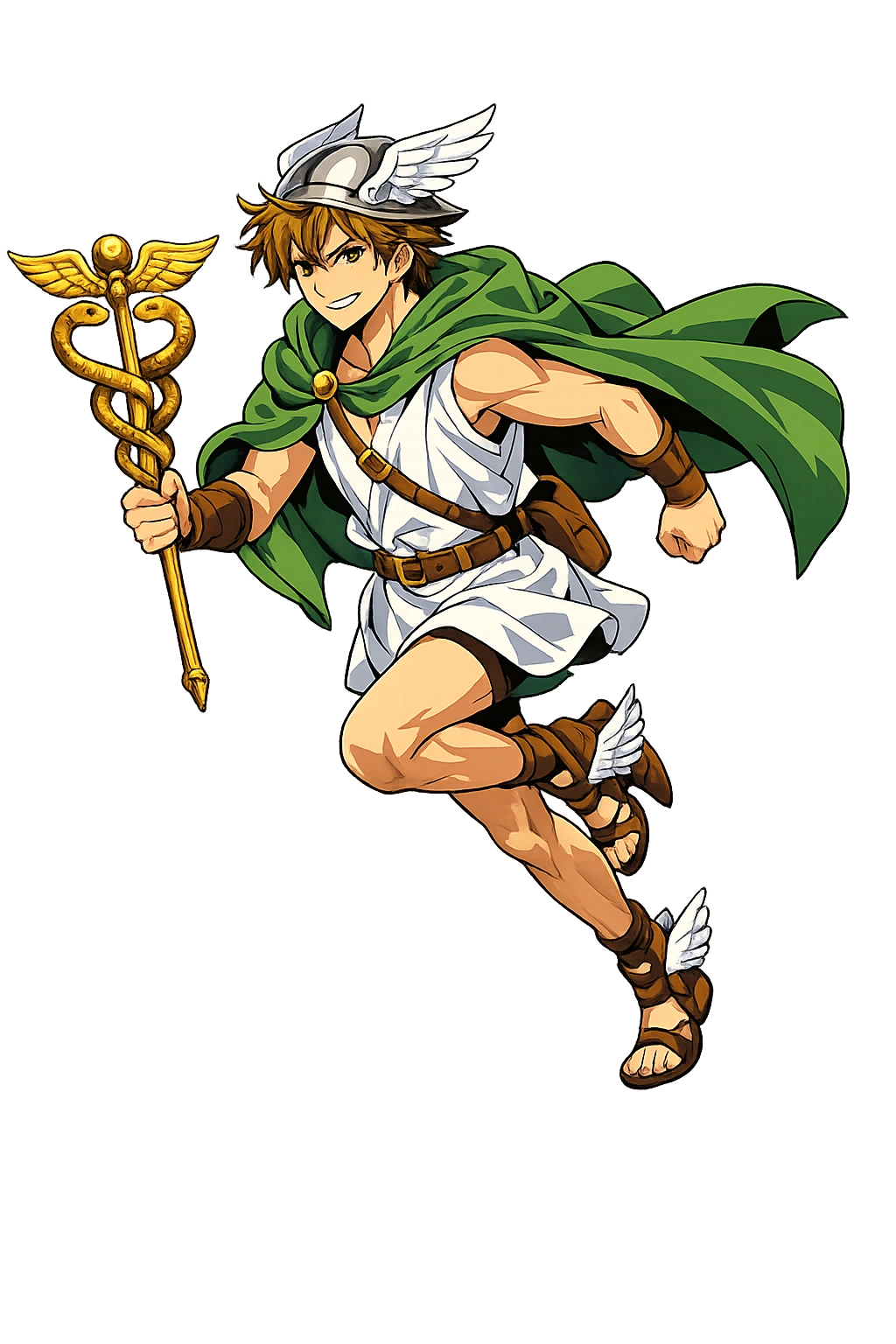
Stress-testing Hermês: do the industry seats hold?
Audit notes, Hermês: we took every seat the atlas claims for this temple and tried to break it against the myths. What survived is below.
At a Glance
- Temple: Hermês
- Pantheon: Greek
- Domain of influence: Messengers, Commerce, Thieves
- Pattern seats: 8
- Sectors touched: Commerce & Governance · Technology & Innovation · Culture & Entertainment
- Strongest seat: Finance, Wealth & Commerce
- Series: The Resonance Files, No. 104 of 271
The Test
Seat 1: Finance, Wealth & Commerce
Claim: God of commerce; the marketplace is his agora. Exhibit: Born in a Cave on Mount Cyllene — Hermês was born to Zeús and the nymph Maia in a remote Arcadian cave.
Verdict: stands. Strip both to their function and the functions match.
Seat 2: Retail & Marketplaces
Claim: God of the marketplace itself — commerce, exchange, and the deal well made. Exhibit: The Lyre for the Herd — Zeús ordered Hermês to return the cattle.
Verdict: holds under load. The correspondence is functional, not decorative.
Seat 3: Communication, Messaging & Logistics
Claim: The messenger god; commerce, travelers, and the routes between. Exhibit: Guide of Souls — Hermês leads the dead to the underworld, earning the title Psychopompos, 'soul-guide.
Verdict: stands. Strip both to their function and the functions match.
Seat 4: Automotive & Mobility
Claim: God of roads and wayfarers; the traveller’s patron, the journey made safe. Exhibit: Born in a Cave on Mount Cyllene — Hermês was born to Zeús and the nymph Maia in a remote Arcadian cave.
Verdict: survives scrutiny. The myth and the trade do the same work.
Seat 5: Mapping & Geospatial
Claim: God of roads and travellers; the hermae were the waymarkers of the ancient road network. Exhibit: The Lyre for the Herd — Zeús ordered Hermês to return the cattle.
Verdict: holds under load. The correspondence is functional, not decorative.
The Control Group
Against the seats that survived, one control: the temple's own summary of its figure — Hermês's myths are almost always about crossing boundaries and getting away with it. The seats do not drift far from it. That is the audit's cleanest result.
The Method, Stated Plainly
None of this is numerology. A seat exists only where the match can be argued from the deity’s documented domains and deeds — weighted, published, and falsifiable. The derivation, the weights, and the challenge process are public on the methodology page. If a seat in this file reads wrong, the atlas itself tells you how to prove it — and the correction becomes part of the record.
For the Ones Who Work There
For a sponsor in finance, wealth & commerce, the fit here is not adjacency — it is inheritance. Your trade already tells this story every working day; the temple simply holds the original. The patron tier and the advertising terms carry the mechanics; the myths above carry the reason.
The File Continues
This is one of 271 Resonance Files — the third dispatch from every flagship temple, where the myths meet the markets. The temple's founding dispatch tells the name's story; its Restoration File tells the spelling's; the blog index holds the whole archive.
Continue the series — previous: Hēraklēs (read it) · next: Hermóðr (read it).
The Resonance Files are argued from the same canonical record as the pattern atlas itself: the lexicon, the lore catalog, and the cited sources. Every seat can be challenged at the methodology page — and the challenge is the point.