The Authentic Orthography
Sacred River, Purification · The River That Fell From Heaven
Unicode restoration and ASCII comparison
गङ्गा
The name in its original Sanskrit form. Gaṅgā (गङ्गा) is attested in the source tradition — “‘swiftgoer’, the river Ganges (personified and considered as the eldest daughter of Himavat and Menā, R. i, 36, 15; as the wife of Śāntanu and mother of Bhīṣma, MBh. i”. Its macron-length vowels and nasal retroflexes carry the full phonetic and orthographic weight of the source tradition.
ganga
Reduced to plain ganga, the name loses everything that made it specific: macron-length vowels and nasal retroflexes. What remains is an ASCII string that machines can parse but that no longer speaks with its original voice.
Gaṅgā
The Unicode restoration recovers what ASCII flattened. Gaṅgā restores macron-length vowels and nasal retroflexes, returning the name to its original written dignity. The domain encodes to Punycode, but the browser displays the truth.
Gaṅgā.com → xn--gag-3oa2758a.com
The non-ASCII characters in Gaṅgā are encoded while the ASCII remains visible. To the DNS, it is Punycode. To humanity, it is Gaṅgā.
How Gaṅgā travels from ancient script to the modern URL
How Gaṅgā was spoken
Purification, Descent, and the Locks of Śiva
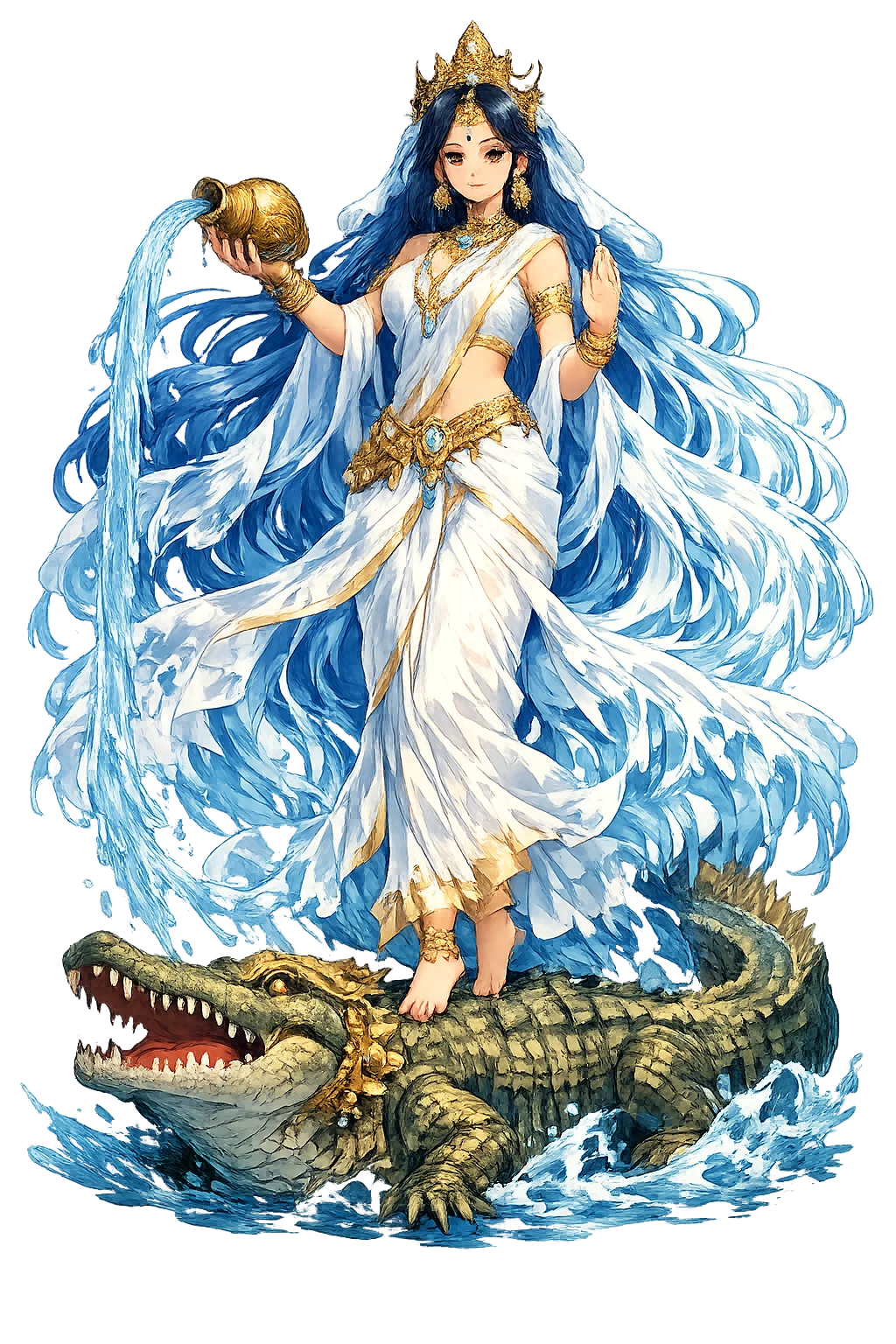
Gaṅgā is the river that is a goddess: brought down from heaven by the sage Bhagīratha to save his ancestors, caught in Śiva's matted locks so the earth would survive her fall, and worshipped ever since at every ford — the holiest water in the world to a billion people.
Gangāvataraṇa: her fall from heaven, broken into seven streams by Śiva's hair.
Her source at Gaumukh in the Himalaya — the ice cave where the Bhāgīrathī is born.
A drop of her water absolves: the cremation grounds of Vārāṇasī keep her oldest bargain.
Her celestial form — the river of heaven mirrored as the river of earth.
Stories of Gaṅgā
Gaṅgā's myths are hydrology as theology: the river's own biography — source, fall, and ford — told as the goddess's descent to save the dead.
King Sāgara's sixty thousand sons were burned to ash by the sage Kapila's glance; only Gaṅgā's water could free their souls. Generation after generation prayed, until Bhagīratha won the boon: the heavenly river would descend. But her fall would shatter the earth — so Śiva stood on Himālaya and took her whole weight on his head, letting her wander a thousand years through the tangles of his hair before she reached the plain, tamed into seven streams.
The Mahābhārata gives her a human marriage: Gaṅgā weds King Śantanu on one condition — never question her. Seven times she drowns her newborn sons in her own waters (they are the Vasus, expiating a curse), and he suffers it; the eighth, he stops her, and she leaves him — keeping the child, Devavrata, who becomes Bhīṣma, the grandsire of the war. The river that saves the dead also gives them back, once.
At Kāśī (Vārāṇasī) she turns north — flowing back toward her source — and the city of Śiva rises on her bank: the one place where dying is not an end but a crossing. The āratī each evening on her ghāts, a thousand lamps on her water, is the oldest continuously performed river-ritual on earth. Every Hindu pilgrimage either ends at her water or carries some of it home.
Gaṅgā is the proof that holiness is a relationship, not a property: the same water is chemistry at the glacier, sacrament at the ghāt, and memory in the diaspora's brass lota. She asks every river's question to every people: what do you owe the water that carries your dead — and who, in your generation, will catch her fall?
Enter Extended Lore