
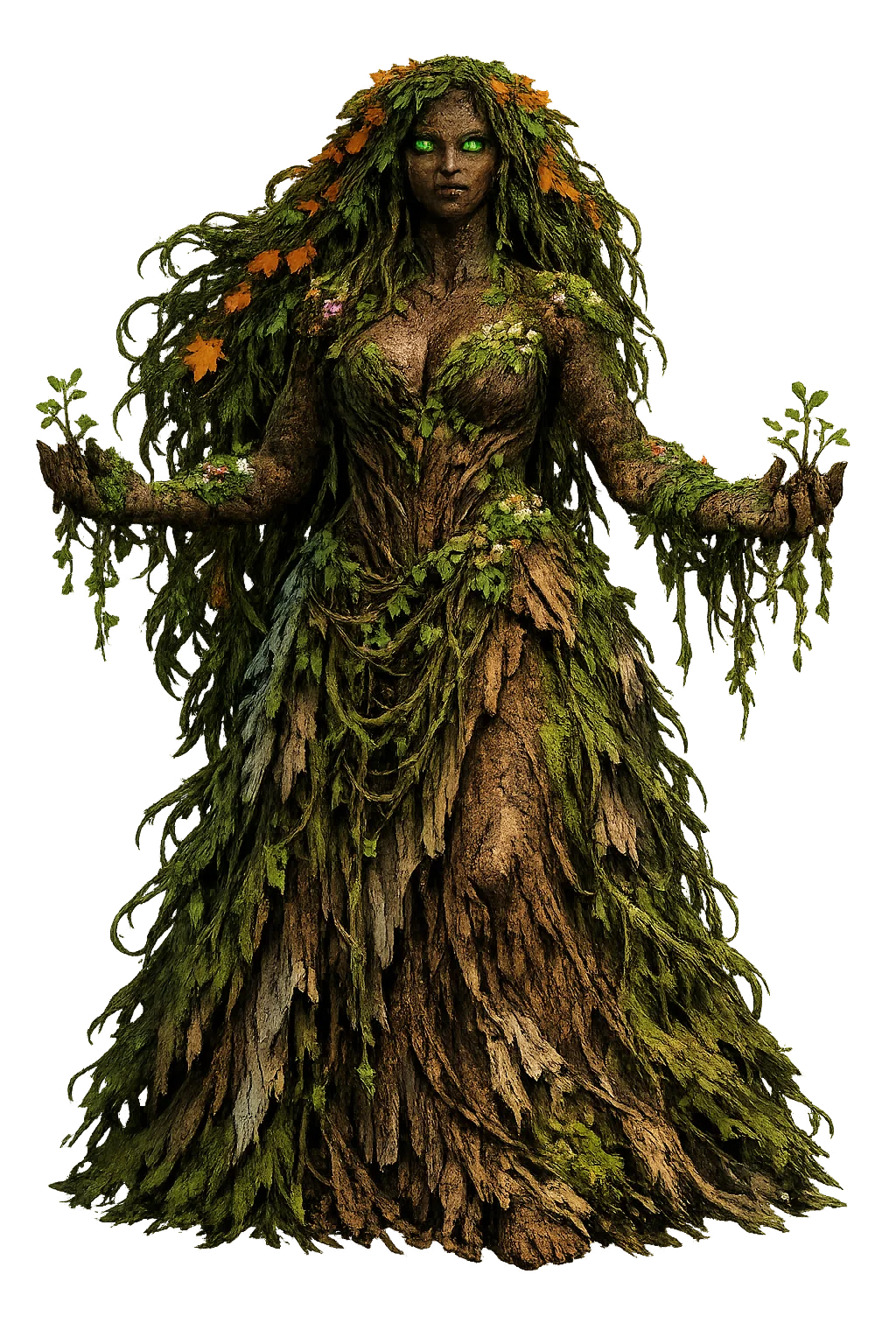
The many faces of Gaîa
No important name has only one face. Gaîa appears as a figure of myth, a scholarly reconstruction, a piece of material culture, a memory carried across languages, and — most recently — a Unicode domain. This post looks at each face in turn: the name and its roots, the Greek original, the reconstructed pronunciation, the mythological record, the symbols and sanctuaries, the cross-cultural afterlife, and the engineering that lets the restored spelling resolve in a browser. Taken together, those faces explain why gaia was never going to be enough — and why the restored form is worth a domain of its own.
At a Glance
- Restored name: Gaîa
- ASCII form: gaia
- Meaning: "Earth (from γαῖα)"
- Domain of influence: Earth, Mother of All
- Pantheon: Greek
- Classification: Tier 1
- Original script: Γαῖα (Greek)
- Live domain: gaîa.com
Overview
Gaîa (gaia — Greek Γαῖα) is the personified Earth of Greek cosmogony: not a goddess who rules the earth but the earth itself as a divine being. In Hesiod's Theogony she arises immediately after Chaos, 'broad-bosomed' (εὐρύστερνος), 'the ever-sure foundation of all the immortals' (Th. 116–118). Without union she bears Ouranós (Sky), the Mountains (Ourea), and Pontos (Sea); with Ouranós she then bears the twelve Titans, the Cyclopes, and the Hundred-Handers, so that the whole divine genealogy descends from her. Hers was the first prophetic seat at Delphi before the oracle passed to Themis, to Phoibe, and finally to Apóllōn.
PuniCodex restores the name as Gaîa and serves its temple at gaîa.com. The Greek Γαῖα carries the circumflex — a single mark recording both the pitch stress and the length of the diphthong αι — and exactly one historically valid Unicode restoration exists, which places the name in Tier 1. The plain ASCII form gaia is a modern fallback imposed by the early domain-name system, not an ancient spelling.
The Name
The name is attested in Greek as Γαῖα, a mostly epic collateral form of the common noun γῆ (Attic; Doric γᾶ), 'earth, land': as the goddess's proper name the epic form prevails, so that she is Γαῖα where the ground beneath the plough is simply γῆ. The etymology is disputed. Beekes regards the word as probably Pre-Greek, part of the Aegean substrate Greek absorbed before Indo-European speakers arrived; M. L. West instead derives it from the Indo-European earth-root dʰéǵʰōm (via gm-ya), the root that otherwise yields Greek χθών and Latin humus.
The restoration Gaîa writes the circumflex of ῖ — Greek pitch falling across the long diphthong αι — as a single registrable character. The letter-by-letter transformation runs:
- g → G — Gamma
- a → a — Alpha
- i → î — Circumflex on iota
- a → a — Alpha
Because the original carries both stress and length, and only this one restoration is historically valid, the name is Tier 1; the ASCII gaia survives only as the domain-name system's fallback. The project holds the domain gaîa.com (xn--gaa-wma.com) as the canonical home of this name.
Etymology & Roots
The recorded derivation reads: Earth (from γαῖα)
The root gloss is "Earth."
The reconstruction is classed as attested.
The Original Script
The name is preserved in Greek as Γαῖα — Greek alphabet (Classical / Attic), attested Ancient Greek, c. 8th century BCE – present, in Greece and the Greek-speaking Mediterranean. The script is written left-to-right.
The scholarly transliteration is Gaîa (Greek alphabet with polytonic accents), giving the normalized reading /ˈɡaː.i.a/.
The rendering proceeds step by step:
- The Greek form Γαῖα is written in the Classical Greek alphabet.
- Letters with acute, grave, or circumflex accents preserve the pitch accent of Ancient Greek.
- Macrons and omegas (η, ω) mark long vowels, a feature lost in the plain ASCII form.
- The Unicode restoration Gaîa encodes the scholarly spelling as a registrable domain name.
Pronunciation
The reconstructed Attic pronunciation of the name is /ɡaɪ.a/ ([ɡâi̯.a]): two syllables, with the pitch accent falling inside the long diphthong αι — the contour that the circumflex on ῖ records.
Phoneme by phoneme:
- Gai- — voiced velar stop γ plus the diphthong αι, close to English 'guy'.
- -a — short, fully open alpha, the unaccented final vowel.
For the modern speaker the closest approximation is 'GUY-ah', with the accent carried by the first syllable.
Kindred and historical forms of the name:
- Attic γῆ (gē), 'earth' — the everyday prose form beside the epic Γαῖα; Doric γᾶ (gā).
- Mycenaean ma-ka — a Linear B sequence in the Pylos tablets read by some scholars as Mā(i) Gā(i), 'Mother Earth'; the identification remains disputed.
- PIE *dʰéǵʰōm — the Indo-European earth-word behind Greek χθών and Latin humus; whether γαῖα itself descends from it is contested (see the-name).
Because Γαῖα preserves both the circumflex stress and the long diphthong αι, and admits exactly one valid restoration, the name is single-tier Tier 1. As a figure she is primordial: older than the Titans, the first power to arise after Chaos.
Mythology
Gaia's myths are cosmogonic: she is the stage on which everything else happens, but she also intervenes whenever the reigning power threatens her children.
First after Chaos
Hesiod's Theogony opens with Chaos, then 'broad-bosomed Earth, the ever-sure foundation of all', then Tartaros and Eros (Th. 116–122). Without mating she bears Ouranós 'equal to herself, to cover her on every side', the Mountains, and Pontos — sky, highlands, and sea externalized from her own body (Th. 126–132).
The Castration of Ouranós
Ouranós hid each child she bore him inside her, and Gaia, strained and grieving, created grey adamant, made a great sickle, and persuaded her youngest son Kronos to ambush his father (Th. 154–182). From the blood that dripped upon her she bore the Erinyes, the Giants, and the ash-tree nymphs (Meliai); from the severed flesh cast into the sea grew Aphrodítē (Th. 183–206). The pattern of Greek cosmogony — each generation overthrown by the next — begins with her weapon.
Gaia at Delphi
Before Apollo, the prophetic seat at Delphi was Earth's: she appointed the nymph Daphnis as her prophetess, and the later tradition of the Eumolpia made her share the oracle with Poseidon before she gave her portion to Themis, who presented it to Apollo. In the prologue of Aeschylus's Eumenides the Pythia herself names Gaia as the first prophet of the shrine (Eum. 1–8).
The Giants and Typhoeus
The sources diverge on the Giants' paternity: Hesiod springs them from the blood of Ouranós (Th. 185), Apollodorus makes Gaia bear them by Sky in anger at the Titans' defeat, and Hyginus names Tartaros as their father. In Apollodorus's war narrative Gaia sought a herb that would make the Giants proof even against mortals, but Zeus gathered it first and summoned Herakles, with whose help the gods won the Gigantomachy (1.6.1). Her youngest child, by Tartaros, was Typhoeus, the monster who came nearest to unseating Zeus (Th. 820–822).
Symbols & Iconography
Gaia's attributes are few and consistent, divided between the instruments of her myths and the emblems of her fertility:
- Sickle of grey adamant — the harpē she created and gave to Kronos for the castration of Ouranós (Th. 159–175).
- Cornucopia and fruits — her inexhaustible fecundity, the same complex as her Athenian cult title Karpophoros, 'bringer of fruits'.
- Serpent — the dark-backed dragon, 'huge monster of the earth', that guarded Earth's prophetic shrine at Delphi until the infant Apollo slew it.
- Omphalos — the 'navel' stone at Delphi marking the earth's center, preserved inside Apollo's own sanctuary.
- The nursing breast — her kourotrophic aspect, Ge Kourotrophos, 'nurse of children', worshipped at Athens.
Gaîa has no Archaic iconographic type: the early Greeks apparently did not picture the earth they stood on. She enters art in the fifth century as a matron half-risen from the ground — the 'Anesidora' of Attic vase painting, a female torso emerging from the soil, sometimes handing the infant Erichthonios to Athénā.
Her most famous sculpted appearance is the Great Frieze of the Pergamon Altar (c. 180–160 BCE), where, in the Gigantomachy, she rises from the earth beside the falling giant Alkyoneus, reaching toward Athénā in a plea the composition makes hopeless.
Roman Tellus continues the type: a reclining matron with cornucopia and children, as on the 'Tellus' panel of the Ara Pacis (13–9 BCE) — though whether that figure is Tellus, Italia, Venus, or Pax is still debated, a reminder that Earth was read through fertility rather than cult.
Epithets & Cult Titles
Her antiquity shows in her formulae: they are cosmic descriptions and cult titles rather than the civic bynames of the Olympians.
- Εὐρύστερνος (eurysternos) — 'broad-bosomed', her standing Hesiodic epithet: 'Gaia broad-bosomed, the ever-sure foundation of all' (Th. 117–118); it survived in cult as Ge Eurysternos at Aegae in Achaea.
- Παμμήτειρα (pammeteira) — 'all-mother', the first word of address in her Homeric hymn: 'I will sing of all-mother Gaia, well-founded, eldest' (HH 30.1–2).
- Πάντων μήτηρ (pantōn mētēr) — 'mother of all', the title under which the manuscripts transmit that hymn (Εἰς Γῆν Μητέρα Πάντων).
- Θεῶν μήτηρ (theōn mētēr) — 'mother of the gods', the hymn's closing salutation: 'Hail, mother of the gods, wife of starry Heaven' (HH 30.17).
- Κουροτρόφος (Kourotrophos) — 'nurse of children', her most concrete cult title, attested for Ge at Athens in the shrine she shared with Demeter Chloe.
The Homeric Hymns
Gaîa has one short hymn, the thirtieth of the collection, 'To Earth the Mother of All' (nineteen lines). It praises her as the eldest being, who feeds every creature on land and sea: 'from you are fine children and fair fruit, mistress, and on you it depends to give life or take it from mortal men.' It closes by asking her, in return for the song, to grant a cheerful heart and prosperity — the oldest surviving Greek prayer to the Earth as a person.
No narrative hymn to her exists; her story is cosmogony itself. Hesiod's Theogony (116–132) makes her the first solid thing after Chaos, mother without mating of Ouranos, the Mountains, and Pontos, and then — with Ouranos — of the Titans, Cyclopes, and Hundred-Handers.
Oracle Sites & Sanctuaries
Gaîa is the one Greek deity whose oracle tradition is genuinely archaic: Delphi was hers before it was Apollo's. In the prologue of Aeschylus's Eumenides the Pythia opens her prayer with Earth, 'the first prophet' (πρωτόμαντις), and recites the succession — Gaia, then Themis, then Phoibe, who yielded the seat to Phoibos Apóllōn. Pausanias records the Delphians' own version: Earth held the seat first, with the nymph Daphnis as prophetess; the Eumolpia of Musaeus had her share the oracle with Poseidon, and she gave her portion to Themis, who presented it to Apollo. Euripides preserves the memory of her guardian: the dark-backed serpent, 'huge monster of the earth', that kept Earth's prophetic shrine until the infant Phoibos killed it.
Other traces of chthonic prophecy:
- Olympia — on the spot called the Gaion stood an ash altar of Ge, where 'in more ancient days' an oracle of Earth was said to have been.
- Aegae (Achaea) — the sanctuary of Ge Eurysternos, with a wooden image among the oldest in Greece and a priestess tested by drinking bull's blood, preserves a chthonic cult that scholars connect with Earth's old oracular power.
Her displacement by the Olympian sky god is the classic case of a chthonic oracle absorbed into an Olympian cult.
Archaeology & Evidence
Earth's cult is materially modest but widely attested. At Delphi, Pausanias preserves the memory that the oracular seat belonged to Earth before Apollo, and the white-marble omphalos stood inside Apollo's own sanctuary as the navel of the earth. At Olympia an ash altar of Ge stood on the spot called the Gaion, where 'in more ancient days' an oracle of Earth was said to have spoken. Near Aegae in Achaea the Gaion of Ge Eurysternos kept 'a wooden image among the very oldest'; its priestess held office only after proving her chastity by drinking bull's blood. At Athens a double shrine of Ge Kourotrophos and Demeter Chloe stood by the entrance to the Acropolis, and the precinct of Earth near the Olympieion was counted among the city's oldest sanctuaries. The sacrificial calendar of the Marathonian Tetrapolis prescribes a pregnant cow for 'Ge in the fields' in the month Poseideon and a sheep for 'Ge by the oracle' in Gamelion — the standard chthonic victims for Earth.
Realm & Domain
Gaia's sphere is the totality of the physical earth and everything born from it; Hesiod's catalogue of her children is a map of the cosmos.
The Living Earth
Mountains, seas, and caves are her body: she bears the Ourea (Mountains) and Pontos (Sea) 'without sweet union of love' (Th. 129–132), and her tremors are earthquakes.
Mother of Gods
With Ouranós she bears the twelve Titans, the Cyclopes, and the Hundred-Handers (Th. 133–153); the entire genealogy of the gods descends from her.
Oracle and Prophet
Earth held the oracular seat at Delphi first, appointing the nymph Daphnis as prophetess; the hexameter poem Eumolpia, ascribed to Musaeus, records that she shared the oracle with Poseidon before yielding her share to Themis.
Revenge and Justice
When Ouranós thrust her children back into her womb, Gaia contrived the sickle of grey adamant and armed Kronos against his father (Th. 154–182).
Scholarly Controversy
Two modern debates attach to her name: whether the Linear B sequence ma-ka attests a Mycenaean cult of 'Mother Gaia' — the reading is disputed — and whether Lovelock's Gaia hypothesis is a scientific theory or a metaphor for ecological interdependence.
Across Cultures
Rome equated Gaia with Terra Mater (Tellus), the earth mother honoured at the Fordicidia of 15 April with the sacrifice of pregnant cows, though Terra never attained Gaia's cosmogonic prominence. In the late Republic the Phrygian Magna Mater (Cybele) was read through the same lens: Lucretius allegorizes the Mother's cult by explaining that the goddess is the earth itself, hung in the air, mother of wild beasts, of crops, and of gods. Modernity revived the name directly: James Lovelock's Gaia hypothesis (1979) — named at the suggestion of his neighbour, the novelist William Golding — proposed the earth as a self-regulating system, and environmental and neo-pagan movements have since made Gaia the personification of the planet itself, a usage that is philosophical rather than cultic.
Kindred figures in the PuniCodex cross-tradition index include Dēmētēr, Ọbalúayé, Bꜣstt, Cōātlīcue, Dāgan, and Ištar, each linked through the shared domains of earth, motherhood, and fertility.
Cultural Legacy
Gaia's root runs through the vocabulary of science: geography, geology, and geometry — literally 'land-measurement' — all descend from γῆ. In the twentieth century her name became a scientific hypothesis: James Lovelock's Gaia: A New Look at Life on Earth (1979) proposed that the biosphere regulates the planet's chemistry and climate like a living system; the name was suggested by the novelist William Golding, and the theory's standing — science or fruitful metaphor — is still debated. Environmental movements and modern goddess spirituality have adopted Gaia as the personification of the living planet and of a primordial feminine principle. This is a revival, not a continuity: in classical times Ge had no major festival of her own and was honoured mostly alongside other gods. Restoring Gaîa restores the first name the Greeks gave to the ground beneath their feet.
The Scholarly Record
The account of Gaîa given in this edition rests on the witnesses and reference works listed below. Lexica and etymological dictionaries secure the form and meaning of the name; the literary and religious texts supply the narrative and cultic evidence.
- Liddell-Scott-Jones Greek-English Lexicon, 9th ed. with 1996 supplement. Full text
- Beekes, Etymological Dictionary of Greek, 2 vols., Brill, 2010. Publisher
- Pape-Benseler, Wörterbuch der griechischen Eigennamen, 3rd ed., 1863. Full text
- Hesiod, Theogony 116–206, 820–822. Full text
- Homeric Hymn 30, To Earth the Mother of All. Full text
- Aeschylus, Eumenides 1–19.
- Pausanias, Description of Greece 1.22.3; 5.14.10; 7.25.13; 10.5.5–6. Full text
- Apollodorus, Library 1.6.1. Full text
- James E. Lovelock, Gaia: A New Look at Life on Earth, Oxford University Press, 1979.
A Meditation
Gaia is the only Greek deity who needs no temple because she is the temple: every mountain, every field, every cave is her body. The Greeks did not worship her by escaping nature but by recognizing that they were already inside her — and they made her the witness of truth itself. At the truce before the duel of Menelaos and Paris a black lamb is sacrificed to Earth and a white one to the Sun (Il. 3.103–104); Hera seals her most solemn oath 'by Earth and wide Heaven above and the down-flowing water of Styx' (Il. 15.36–38).
Modernity has largely forgotten this. We speak of 'the environment' as if it were a surrounding thing, separate from us. Gaia's name reminds us that we are not on the earth but of it. The restoration of her name is more than philology; it is a statement that the planet is not a resource but a presence.
The Unicode Restoration
Gaîa is classified as Tier 1: the original carries both stress and length, and only one valid Unicode restoration exists. The ASCII fallback gaia still resolves everywhere, but it is the restored form that carries the name's full information. Across the 4 characters of the name, the restoration adjusts 1: 1 mark of stress (î). That is the whole thesis of this temple: the marks are the message.
The Domain Name
The restored name is live as a working domain: gaîa.com, which the DNS carries in punycode form as xn--gaa-wma.com — an ASCII-compatible encoding that lets a non-ASCII name travel the global network without breaking older infrastructure. The visitor sees Gaîa; the machines see the encoding. That duality is the engineering compromise on which the entire restoration rests, and it is why a name written the way its own tradition wrote it in Greek can now be typed into any browser on earth.
Why This Restoration Matters
Myth, script, sound, cult, legacy, domain: the faces of Gaîa add up to a single argument — that a name is a record, and records deserve fidelity. The PuniCodex restoration keeps that record in working order: the temple presents it, the Scholarly Edition footnotes it, the lexicon catalogs it, and the domain makes it addressable. gaia will always exist as a fallback. But fallback is not identity. Gaîa is the name; everything else is a convenience.
Explore Further
This post is one doorway into the temple. The home page carries the full character breakdown and the ambient canvas; the lore page tells the myths in long form; the Scholarly Edition preserves the sources, pronunciation data, and revision history; and the patron wall supports the restoration directly. For the wider map, browse the Lexicon, explore the Pantheon, or return to the PuniCodex blog.
Related Names
Sources
The full scholarly apparatus — every citation, revision, and review — lives in the Scholarly Edition. Key references for this post:
- Hesiod, Theogony 116–153.
- Pausanias, Description of Greece 10.5.5–6 (Earth as the first holder of the Delphic oracle).
- Liddell-Scott-Jones Greek-English Lexicon, 9th ed., s.v. γῆ, γαῖα.
- Beekes, Etymological Dictionary of Greek (Brill, 2010), s.v. γῆ — probable Pre-Greek origin.
- Euripides, Iphigenia in Tauris 1243–1248.
- Apollodorus, Library 1.6.1.
- Aeschylus, Eumenides 1–8 (the Pythia's succession: Gaia, Themis, Phoibe, Phoibos).
- Liddell-Scott-Jones Greek-English Lexicon, 9th ed., s.v. γῆ, γαῖα.
- M. L. West, Indo-European Poetry and Myth (Oxford University Press, 2007).
- James E. Lovelock, Gaia: A New Look at Life on Earth (Oxford University Press, 1979).
- Lexicon authorities for this entry: LSJ, Pape-Benseler, Beekes.