
The many faces of Fúxī
No important name has only one face. Fúxī appears as a figure of myth, a scholarly reconstruction, a piece of material culture, a memory carried across languages, and — most recently — a Unicode domain. This post looks at each face in turn: the name and its roots, the Chinese characters original, the reconstructed pronunciation, the mythological record, the symbols and sanctuaries, the cross-cultural afterlife, and the engineering that lets the restored spelling resolve in a browser. Taken together, those faces explain why fuxi was never going to be enough — and why the restored form is worth a domain of its own.
At a Glance
- Restored name: Fúxī
- ASCII form: fuxi
- Meaning: "Hidden one"
- Domain of influence: Culture, Writing, Divination
- Pantheon: Chinese
- Classification: Tier 2
- Original script: 伏羲 (Chinese characters)
- Live domain: fúxī.com
Overview
Fúxī (fuxi) — The First Teacher — belongs to the Chinese tradition, where it is catalogued under the domain "Culture, Writing, Divination". The name means "Hidden one".
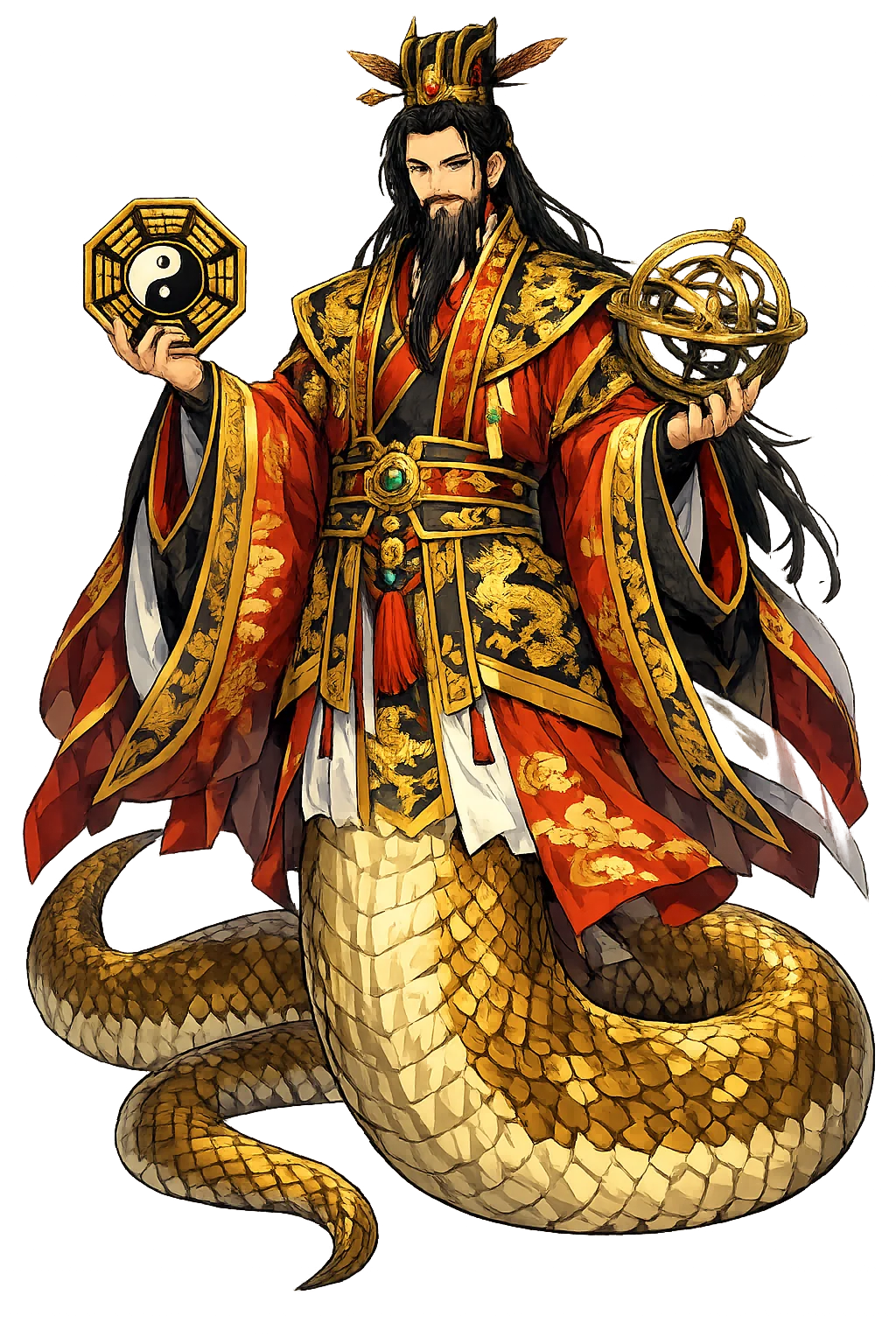
Fúxī is where Chinese civilization says it learned to think: the sage-king who looked up at the heavens, down at the earth, and at the markings on birds and beasts — and abstracted the eight trigrams, the first writing of pattern itself.
PuniCodex restores the name as Fúxī and serves its temple at fúxī.com. The original preserves one prosodic feature — stress or vowel length — rather than both, which places the name in Tier 2. The plain ASCII form fuxi survives as a modern convenience imposed by the early domain-name system; the restoration, not the fallback, is the form the project defends as philologically complete.
The Name
The name is attested in Chinese characters as 伏羲. Etymologically it means "Hidden one".
The ASCII form fuxi survives only because the early domain-name system could not carry diacritics; it is a technological compromise, not an ancient spelling. The Unicode restoration Fúxī recovers both the stress accent and the vowel length of the original directly in the address bar. The original preserves one prosodic feature — stress or vowel length — rather than both, which places the name in Tier 2.
The letter-by-letter transformation runs:
- f → F — Same, capitalized
- u → ú — Stress on u
- x → x — Same
- i → ī — Long vowel
The project holds the domain fúxī.com (xn--fx-rka1r.com) as the canonical home of this name.
The Original Script
The name is written in Chinese characters as 伏羲. This original script is the form against which the ASCII fallback fuxi and the PuniCodex restoration Fúxī are measured: the restoration preserves both its pitch accent and its vowel quantity of the written form, so that a reader typing the modern address still speaks the ancient name.
Written 伏羲: fú (subdue; the man-radical with the hound) plus xī (the ancient graph for sacrificial breath). The compound is attested from Warring States texts onward — the name predates any agreed reading of it, which is itself a mark of antiquity.
Pronunciation
The reconstructed pronunciation of the name is /fu˧˥ ɕi˥/ — Mandarin (Hanyu Pinyin with tones).
For the modern speaker, the closest approximation is: foo-shee, rising tone on fu, high level on xi.
Kindred and historical forms of the name:
- Chinese — 伏羲
- Variant writing — 庖犧 (Páoxī)
- Owned form — Fúxī
Fúxī 伏羲 carries the rising tone on both syllables in Mandarin; older romanizations write Fu-hsi. The first graph 伏 suggests "to subdue, to prostrate," the second 羲 a sacrificial term — a name older than its etymologies, borne by the first of the Three August Ones. The older romanization Fu-hsi records the same syllables; pinyin's x is the alveolo-palatal fricative of modern Mandarin.
Mythology
Fúxī's myths are all acts of notation: he does not fight or flee — he observes, abstracts, and teaches. He is the culture-bringer as draftsman.
Reading the World (The Diagram)
The Yìjīng's Great Treatise records the founding act: Fúxī looked up and contemplated the images of heaven, looked down and contemplated the patterns of earth, contemplated the markings of birds and beasts and the order of the near at hand — and from all three made the eight trigrams, "to comprehend the powers of the spirits and to classify the natures of the ten thousand things." Writing, mathematics, and divination begin as one gesture of attention.
The Dragon-Horse's Map (The River)
Later tradition gives the revelation a courier: a dragon-horse rose from the Yellow River bearing on its back the Hétú, the River Chart — the arrangement of numbers and marks from which Fúxī drew the trigrams. Paired with the Luò River Writing that inspired the Great Plan, the Chart made the Yellow River itself the first text of Chinese civilization.
The Brother-Sister Marriage (The Flood)
In the flood myth recorded among the Miao and in Tang collections, Fúxī and Nǚwā alone survive the waters, taking refuge on Mount Kūnlún. Brother and sister, they divine heaven's will by rolling millstones and watching smoke columns join — and consent to marry, repopulating the drowned world. The myth explains both marriage's institution and humanity's second beginning.
Nets, Music, and Domestication (The Arts)
The tradition credits him with the survival-arts in sequence: knotting cords into nets for fishing and hunting, keeping domestic animals (hence one reading of his name, "subduer of beasts"), making the thirty-five-stringed se zither, and fixing the marriage rites. Civilization, in his legend, is a curriculum — and he is its whole faculty.
Symbols & Iconography
The iconography associated with Fúxī concentrates in a small set of recurring attributes, each a compressed statement about the name:
- The trigrams — Pattern abstracted from nature — the seed of all Chinese correlative thought
- The carpenter's square — His emblem in Han art: the earth-measurer's tool (Nǚwā holds the compass of heaven)
- The dragon-horse — The creature from the Yellow River whose markings revealed the diagram
Archaeology & Evidence
The Wu Liang shrine reliefs (2nd century CE, Shandong) show Fúxī and Nǚwā with serpent bodies entwined, square and compass raised — the canonical image, replicated across Han tomb art from Sichuan to Xinjiang (the famous Astana cemetery banner). The myth's textual archaeology runs from the Zhuangzi and Xunzi mentions to the Tang's flood-cycle records: a steady accretion from sage-king to cosmic progenitor, all preserved in the transmitted classics.
His cult anchored in the northwest: the Fúxī temple at Tianshui (Gansu), founded under the Ming, claims his birthplace and keeps his statue with the trigrams; the city still holds his festival. The Huáiyáng tomb-temple in Henan — the Tàihào Líng, 'tomb of the Great Bright One' — has drawn one of China's largest temple fairs for centuries, a month of pilgrimage in the second lunar month. Both sites make the same claim the classics do: that the pattern-reader of the Yellow River was buried and is honoured on its banks.
Realm & Domain
Fúxī is where Chinese civilization says it learned to think: the sage-king who looked up at the heavens, down at the earth, and at the markings on birds and beasts — and abstracted the eight trigrams, the first writing of pattern itself.
The Eight Trigrams
Bāguà: broken and unbroken lines in threes — the binary alphabet of the Yìjīng, attributed to his observation.
The Net
He taught the people to knot cords into nets — fishing, hunting, and the technology of the snare.
The Serpent Bodies
Han art shows him and Nǚwā as serpents intertwined — the primal pair, measuring square and compass in hand.
Marriage
He instituted the rites of marriage and the bride-price of deer skins — order after the flood.
Across Cultures
He heads most lists of the Three August Ones (Sānhuáng), paired inseparably with Nǚwā — their intertwined serpent forms in Han art echoing, scholars note, the union of measure and generation. Daoist tradition absorbed him as a revealer of the trigrams to the immortal lineages; Confucian tradition kept him as the first historian of pattern. The serpent-pair iconography has been compared by art historians with intertwined pairs from Egypt to India — diffusion debated, the resemblance celebrated.
Within the Chinese tradition, closely related names in the corpus include [[bagua|Bāguà]], [[guanyin|Guānyīn]], [[long|Lóng]], [[mengpo|Méngpó]], [[nuwa|Nǚwā]], and [[pangu|Pángǔ]].
Cultural Legacy
Every reading of the Yìjīng — the book that shaped Confucian statecraft, Daoist alchemy, and Leibniz's binary arithmetic — begins with his act of looking. The eight trigrams appear on the flag of South Korea; the River Chart structures a millennium of cosmological diagrams; and "Fúxī" remains the standard icon for the inventor-ancestor in Chinese cultural memory, the answer to the question of where pattern-thinking began.
The Scholarly Record
The account of Fúxī given in this edition rests on the witnesses and reference works listed below. Lexica and etymological dictionaries secure the form and meaning of the name; the literary and religious texts supply the narrative evidence.
- I Ching (Yijing / Book of Changes), Chinese Text Project, 1000 BCE. Full text
- Shiji (Records of the Grand Historian), Sima Qian; Chinese Text Project, 91 BCE. Full text
- Anne Birrell, Chinese Mythology: An Introduction, Johns Hopkins University Press, 1993.
- Chinese classical texts, Chinese Text Project, 500 BCE. Full text
- Shan Hai Jing (Classic of Mountains and Seas), Chinese Text Project, 400 BCE. Full text
- Chinese folklore, Oral and compiled folk tales, various.
A Meditation
Fúxī is the patron of the second look — the one that sees not the thing but the pattern. His trigrams are only broken and unbroken lines, yet a civilization read everything in them for three thousand years. He asks the observer's question: what in the world are you willing to look at long enough that it begins, at last, to read back?
Leibniz saw the trigrams and recognized binary arithmetic; the information age looked again and found the whole grammar of bits — the broken and unbroken line as zero and one. Whether or not the old sage intended the code, his lesson stands: the world's patterns are legible to whoever looks long enough, and three lines, honestly observed, can hold a civilization's worth of distinctions. The first technology was attention.
The tradition says he looked at the horse's markings and the turtle's shell and saw not omen but order — the world already written, waiting for a reader. Every analysis since, from the Yìjīng's commentaries to the database schema, is his gesture repeated: reduce the world to its honest marks, and the marks will begin to answer.
The Unicode Restoration
Fúxī is classified as Tier 2: the original preserves at least one philological feature that ASCII cannot encode. The ASCII fallback fuxi still resolves everywhere, but it is the restored form that carries the name's full information. Across the 4 characters of the name, the restoration adjusts 2: 1 mark of stress (ú); 1 mark of length (ī). That is the whole thesis of this temple: the marks are the message.
Character by Character
The journey from fuxi to Fúxī, one character at a time:
- f → F — Same, capitalized
- u → ú — Stress on u
- x → x — Same
- i → ī — Long vowel
The Domain Name
The restored name is live as a working domain: fúxī.com, which the DNS carries in punycode form as xn--fx-rka1r.com — an ASCII-compatible encoding that lets a non-ASCII name travel the global network without breaking older infrastructure. The visitor sees Fúxī; the machines see the encoding. That duality is the engineering compromise on which the entire restoration rests, and it is why a name written the way its own tradition wrote it in Chinese characters can now be typed into any browser on earth.
The Chinese Pantheon
Fúxī is one of 46 entries the PuniCodex lexicon catalogues under the Chinese pantheon. The Pantheon page gathers the tradition's major figures in one place, and the Lexicon lets you filter all 915 restorations by tradition, tier, or script — the fastest way to see where this name sits among its kin.
Frequently Asked Questions
What does Fúxī mean? The traditional gloss is "Hidden one."
Which tradition does Fúxī belong to? Fúxī is catalogued in the Chinese pantheon of the PuniCodex lexicon.
Why is Fúxī classified as Tier 2? Because the original preserves at least one philological feature that ASCII cannot encode — and the marks in the restored spelling preserve exactly that evidence.
Is Fúxī a working domain? Yes — fúxī.com resolves today and routes to this temple.
What is the punycode for fúxī.com? The DNS encoding is xn--fx-rka1r.com; browsers perform the translation automatically, so visitors only ever see the restored name.
Typing Fúxī
You do not need a special keyboard to use this restoration. The PuniCodex Type Tool converts the ASCII form fuxi into Fúxī as you type, and the browser extension offers the same conversion inside any text field. Copy the restored form, paste it into the address bar, and the DNS does the rest.
Sister Temples
Other temples in the Chinese pantheon include Mèngzǐ, Pǔtuó, and SūnWùkōng — each with its own restoration story, its own scholarly record, and its own place in the lexicon.
Why This Restoration Matters
Myth, script, sound, cult, legacy, domain: the faces of Fúxī add up to a single argument — that a name is a record, and records deserve fidelity. The PuniCodex restoration keeps that record in working order: the temple presents it, the Scholarly Edition footnotes it, the lexicon catalogs it, and the domain makes it addressable. fuxi will always exist as a fallback. But fallback is not identity. Fúxī is the name; everything else is a convenience.
Explore Further
This post is one doorway into the temple. The home page carries the full character breakdown and the ambient canvas; the lore page tells the myths in long form; the Scholarly Edition preserves the sources, pronunciation data, and revision history; and the patron wall supports the restoration directly. For the wider map, browse the Lexicon, explore the Pantheon, or return to the PuniCodex blog.
Related Names
Sources
The full scholarly apparatus — every citation, revision, and review — lives in the Scholarly Edition. Key references for this post:
- Shiji (Records of the Grand Historian), Sima Qian; Chinese Text Project, 91 BCE.
- Huainanzi, Liu An; Chinese Text Project, 139 BCE.
- I Ching (Yijing / Book of Changes), Chinese Text Project, 1000 BCE.
- Chinese classical texts, Chinese Text Project, 500 BCE.
- Shan Hai Jing (Classic of Mountains and Seas), Chinese Text Project, 400 BCE.
- Anne Birrell, Chinese Mythology: An Introduction, Johns Hopkins University Press, 1993.
- The Tianshui and Huaiyang temple records; Birrell, Chinese Mythology.
- Chinese folklore, Oral and compiled folk tales, various.
- Yijing, Xici zhuan; Shiji (Sānhuáng traditions); Birrell, Chinese Mythology.
- Lexicon authorities for this entry: Shan Hai Jing, Chinese classics.