
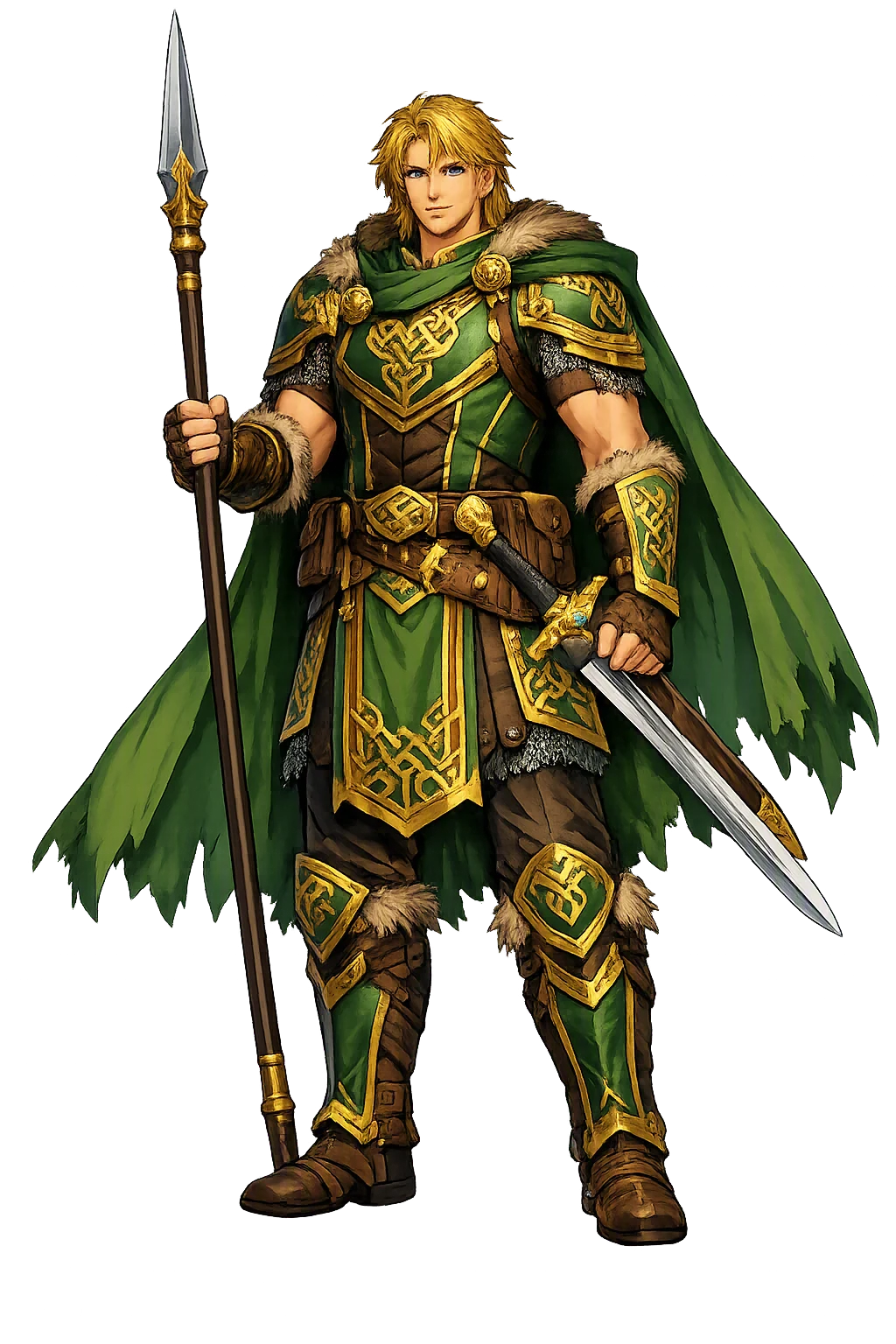
The name Fionn and the world it opens
A name is a door. Fionn opens onto an entire world: the domain of hunter, seer, leader, a Celtic tradition, and centuries of storytelling, worship, and scholarship. This post walks through that world room by room — the name and its roots, the original script, the sound of it, the myths, the symbols, the sites, the afterlife across cultures — and ends at the newest room of all: a Unicode domain that makes the whole structure addressable. fionn gets you to the same building, but only the restored form tells you why it was built.
At a Glance
- Restored name: Fionn
- ASCII form: fionn
- Meaning: "Fair, white"
- Domain of influence: Hunter, Seer, Leader
- Pantheon: Celtic
- Classification: Tier 2
Overview
Fionn (fionn) — Hunter, Seer, Leader · Fair, white — is the great captain of the Fianna, the roving war-band of medieval Irish tradition who hunted and fought on the marches of Ireland under the high king's peace: the boy who burned his thumb on the Salmon of Knowledge and swallowed wisdom with it, the youth who saved Tara from Aillén's Samain fires, and the aging leader who spent sixteen years pursuing Diarmaid and Gráinne across the country he was sworn to protect.
Old Irish writes the name Find — modern Irish Fionn — from the adjective find, 'fair, white', descending from Proto-Celtic windos, the same root as Welsh gwyn and Gaulish Vindo-. His dossier is the fullest of any Irish hero: the Boyhood Deeds give his birth to Muirne after Cumhall's fall at Cnucha, his fostering by the druidess Bodbmall and the warrior-woman Liath Luachra, the salmon of the Boyne, and the earning of his father's heritage; the Fenian lays and the Acallam na Senórach give the long captaincy and its Christian-era memory.
PuniCodex restores the name as Fionn — identical to the ASCII input, because normalized Irish writes no diacritic in this name. The mechanical rule therefore places it in Tier 2: nothing distinctive is lost in transit, a statement about orthography and never about the hero. No domain is claimed: the plain-ASCII fionn.com is registered to a third party outside the collection and is watched for release.
The Name
The name is attested in Old Irish as Find (modern Irish Fionn), the adjective find, 'fair, white', used as a personal name — the tradition explains it by the hero's fairness of hair and skin. The etymological dictionaries derive it from Proto-Celtic windos, 'white', with Welsh gwyn and Gaulish Vindo- (in names such as Vindonissa) as cognates; the same root underlies the Welsh Otherworld huntsman Gwyn ap Nudd, 'white son of Nudd', long compared with Fionn in the handbooks.
The name was not his first. The Boyhood Deeds give his birth-name as Demne, and the renaming is built into the myth: when the boy burned his thumb cooking the Salmon of Knowledge, his master Finn Éces — Finn the poet, who had waited seven years for that fish and believed himself the Finn of the prophecy — declared that Finn must be the boy's name, for it was a Finn who was destined to eat the salmon. The patronymic mac Cumaill, 'son of Cumhall', ties him to the father he never knew, the Fianna captain killed at Cnucha by Goll mac Morna before the child was born.
The ASCII form fionn loses nothing, because the normalized Irish spelling is already plain Latin letters; the restoration is a matter of canonical reference, not rescued diacritics, and the name is classified Tier 2 by the project's mechanical rule.
The letter-by-letter transformation runs:
- f → F — Same, capitalized
- i → i — Same
- o → o — Same
- n → n — Same
- n → n — Same
The project holds no domain for this name: fionn.com is registered to a third party outside the PuniCodex collection and is watched for release. The temple lives at its canonical lexicon address.
The Original Script
The name is preserved in medieval Irish manuscripts in the Latin alphabet as Find (modern Irish Fionn) — Old and Middle Irish in Insular script, attested from the early medieval period in the Fenian lays, the Boyhood Deeds, and the great codices that preserve the Acallam na Senórach. The earlier monumental alphabet, ogham, predates the manuscript tradition, but no attestation of this name has ever been read on an ogham stone; the manuscript form is the primary witness.
The scholarly rendering proceeds step by step:
- Old Irish was written in the Latin alphabet using Insular script from the early medieval period; the spelling Find requires no diacritic.
- The adjective find, 'fair, white', is the name's whole substance; the dictionaries derive it from Proto-Celtic windos, with Welsh gwyn and Gaulish Vindo- as cognates.
- The digraph io of the modern spelling Fionn is Irish's ordinary way of writing the long [iː] before a broad consonant; nothing distinctive is lost in ASCII.
- The Unicode restoration Fionn is therefore identical to the ASCII form apart from the capital; the temple form is a canonical reference, not a rescued spelling.
One caution attaches to the record: the hero's birth-name was Demne, and 'Finn' is itself a name conferred by the salmon episode — the tradition's own note that names are given by deeds, not birth.
Pronunciation
The reconstructed pronunciation of the name is /ˈfʲiːn̪ˠ/ — Modern Irish (Old Irish Find).
Phoneme by phoneme:
- F- — Slender (palatalized) labiodental [fʲ], the Irish f before i, light and lifted toward the palate
- -io- — Long close [iː], the stressed vowel, the 'ee' of 'fleece' held long
- -nn — Broad dental nasal [n̪ˠ], the velarized double-n, tongue against the upper teeth
For the modern speaker, the closest approximation is: 'FEEN' — one syllable; 'Fionn mac Cumhaill' runs roughly 'FEEN mak KOO-il'.
Kindred and historical forms of the name:
- Old Irish — Find mac Cumaill, the manuscripts' form
- Proto-Celtic — *windos, 'white, fair'; Welsh gwyn and Gaulish Vindo- as cognates
- Birth name — Demne, before the salmon renamed him
- Modern Irish — Fionn mac Cumhaill, the unbroken living form
Fionn is Tier 2 because the restoration preserves nothing ASCII loses: the letters of the manuscript form are the letters of the keyboard. The capital alone marks the temple form.
Mythology
Fionn's mythology is the fullest hero-corpus Ireland kept: the Boyhood Deeds that make him wise, the Fenian lays and ballads that make him captain, and the two late romances — the pursuit of Diarmaid and the lay of Oisín — that make him tragic.
The Boy in the Wild (Macgnímartha Finn)
His father Cumhall, captain of the Fianna, abducted Muirne, daughter of the druid Tadg, when her father refused her; Tadg's appeal brought the king's army, and Cumhall fell at the battle of Cnucha to Goll mac Morna of the rival Clann Morna. Muirne bore the child in danger and gave him to two women to rear in secret: Bodbmall the druidess and Liath Luachra the warrior-woman, who raised him in the wild away from his father's enemies. The boy they hid was named Demne.
The Salmon of Knowledge (Macgnímartha Finn)
Demne came to learn poetry from Finn Éces, who had waited seven years on the Boyne for the salmon of knowledge — the fish that fed on the nuts of the nine hazels dropping into the well of Segais, so that all knowledge was in its flesh. The poet set the boy to cook the salmon and forbade him to taste it; a blister rose on its skin, Demne pressed it with his thumb, burned himself, and thrust the thumb into his mouth — and the knowledge was his. Finn Éces, hearing the boy's name was Demne, declared that Finn must be his name now, for it was a Finn who was prophesied to eat the salmon. Ever after, Fionn chewed his thumb to know what was hidden.
Aillén and the Burning of Tara (Macgnímartha Finn)
Every Samain night for twenty-three years, Aillén of the three tongues came out of síd Finnachaidh and burned Tara: his timpán lulled the whole fortress to sleep, and then he breathed fire over the hall. Fionn came to Tara on Samain, and Fíacha mac Conga, his father's companion, gave him a magic spear — hold its point to your forehead and you will not sleep. Wakeful while the court slept, Fionn cast the spear through Aillén as he turned for the síd. Conn Cétchathach restored to him his father's treasure and made him head of the Fianna; Goll mac Morna accepted the peace and became the most loyal of his captains.
The Pursuit of Diarmaid and Gráinne (Tóruigheacht Dhiarmada agus Ghráinne)
In his age Fionn was betrothed to Gráinne, daughter of Cormac mac Airt, but at the feast she gave the company a sleeping-draught and laid a geis on Diarmaid Ó Duibhne to take her away — Diarmaid, who bore a ball seirce, a love-spot no woman could see without loving him. For sixteen years the Fianna hunted the pair the length of Ireland, with Aengus of the Brug shielding Diarmaid where he could, until the tale came to the boar-hunt on Ben Bulben: the beast was Diarmaid's own transformed foster-brother, and it was fated to be his death. Diarmaid killed the boar and took its venom in the doing. Fionn could heal with water carried in his two cupped hands; twice he brought it from the well and let it slip through his fingers, remembering Gráinne, and when Óscar's reproach sent him back the third time, Diarmaid was dead.
Oisín in Tír na nÓg and the Long Memory (Acallam; Laoi Oisín)
Fionn's son Oisín was taken across the sea by Niamh of the Golden Hair, riding behind her on a white horse to Tír na nÓg, the Land of Youth; what he counted as three years there were three hundred in Ireland. Warned on no account to set foot on Irish soil, he returned to find the Fianna gone; the girth broke as he stooped to help men shift a stone, he touched the ground, and three hundred years fell on him at once. The medieval Acallam na Senórach frames the whole Fenian memory on this survival: the old, blind Oisín and Caílte mac Rónáin traveling Christian Ireland with Saint Patrick, naming every hill and ford and telling how it was won.
Symbols & Iconography
Fionn's attributes are a meal, a limb, a weapon, a pair of hounds, and a mountain — the most personal regalia in the Irish corpus:
- The Salmon of Knowledge — An eo fis, the fish that fed on the nuts of the nine hazels over the well of Segais; whoever ate it would know all things — wisdom caught in an instant, meant for another
- The thumb — Burned on the salmon's blister and sucked by reflex; thereafter chewing it summoned the imbas — knowledge held in the body
- The magic spear (birga) — Given by Fíacha mac Conga at Tara; held with its point to the forehead, its enchantment kept a man awake against Aillén's music — vigilance as a weapon
- Bran and Sceólang — His two great hounds, born of his transformed kin — the chase made family
- Ben Bulben — The boar's mountain in Sligo, where Diarmaid died and the healing water slipped through Fionn's fingers
Archaeology & Evidence
Fionn is a textual hero: no ogham stone names him, and his cycle survives in the great Irish codices — the Acallam in the Book of Lismore and its sister manuscripts, the Boyhood Deeds and the Fenian lays across the Laud and Book of Leinster traditions.
His landscape, by contrast, is real and visitable. The salmon of knowledge was caught in the Boyne, the river that bends around Brú na Bóinne — the Newgrange passage-tomb complex (c. 3200 BCE) that the myths make the síd of Aengus, Diarmaid's protector. Tara, the royal seat Aillén burned every Samain, is the hill of Teamhair in County Meath, an Iron Age ceremonial complex of earthworks and standing stones. Ben Bulben, where the boar killed Diarmaid, stands over Sligo as the tales describe it. The Fenian cycle is unusual among Irish corpora for how densely it maps onto ground that can still be walked.
Realm & Domain
Fionn is catalogued under the domain 'Hunter, Seer, Leader' — three words that map exactly onto the three acts of his cycle.
Hunter
The Fianna lived by the chase: war-bands in winter quarters, hunters from Beltane to Samain, bound by tests of speed, woodcraft, and verse. Fionn's hounds Bran and Sceólang, born of his own transformed kin, are the type-case of the Fenian hunt — the wild running at the leader's heel.
Seer
The Salmon of Knowledge made him a seer: thereafter he chewed his thumb and the imbas, the great knowledge that illuminates, came to him. Wisdom-by-taste is the cycle's founding miracle, and the tradition is careful to make it accidental — the fish was seven years promised to another man.
Leader
Captain of the Fianna from the night he killed Aillén and saved Tara, reconciler of his father's killer Goll mac Morna, and commander of the war-band until its destruction at Gabhra — leadership, not solitary prowess, is what separates him from Cú Chulainn, the Ulster Cycle's lone champion.
The Price of Command
The pursuit of Diarmaid and Gráinne is the domain read in reverse: sixteen years of royal authority spent on a personal grudge, ending at Ben Bulben with the water he twice let slip through his fingers.
Across Cultures
Fionn's deepest kin are onomastic and Insular. His name descends from Proto-Celtic windos, 'white, fair', and the handbooks have long set him beside the Welsh Gwyn ap Nudd — 'white son of Nudd', the Otherworld huntsman of Welsh tradition — as two regional developments of a Celtic figure built on the same word: the fair one who rides between this world and the wild.
The more famous comparison is with the Norse corpus: like Sigurðr, who tasted the blood of Fáfnir's heart and understood the speech of birds, Fionn receives a whole mode of knowledge through a single accidental taste. The parallel is a commonplace of the comparative literature, though the two traditions grew the motif independently.
Within Ireland his nearest mirror is Cú Chulainn, the Ulster Cycle's solitary champion set against Fionn's communal war-band: the two heroes divide the Irish heroic imagination between them — the one who dies young and alone against an army, and the one who leads the army and lives to be betrayed by his own memory.
Cultural Legacy
Fionn became, for a century, the most famous Celt in Europe. James Macpherson's Fragments of Ancient Poetry (1760) and Fingal (1762) presented 'Ossian' — Oisín — as the bard of a northern Homer, with Fingal his mighty father; the poems swept the continent, were carried by Napoleon and quoted by Goethe, and set off a running war over their authenticity in which Samuel Johnson demanded the manuscripts and Macpherson never produced them. The Celtic Revival reclaimed the genuine cycle: Lady Gregory's Gods and Fighting Men (1904) brought the Fenian tales into modern English, and Irish scholarship — Meyer's Fianaigecht, Murphy's Duanaire Finn, Dooley and Roe's Acallam translation — rebuilt the cycle from its real witnesses.
In Ireland the name never faded: the volunteer tradition named itself Fianna Éireann after his war-band, the political movement Fianna Fáil — 'the war-band of Ireland' — borrowed the same word, Finn is once again a living given name, and Tír na nÓg remains the Irish idiom for youth that outlasts its bargain.
The Scholarly Record
The account of Fionn given in this edition rests on the witnesses and reference works listed below. The Boyhood Deeds supply the birth, the salmon, and Tara; the Acallam the Fenian memory; the Pursuit of Diarmaid and Gráinne the late romance; the dictionaries and handbooks secure the name.
- Meyer, Kuno, ed. and trans., 'Macgnímartha Finn (The Boyhood Deeds of Fionn)', Revue Celtique 5 (1882), 195–204; Ériu 1 (1904), 180–190.
- Stokes, Whitley, ed., Acallamh na Senórach, Irische Texte IV.1 (Leipzig: Hirzel, 1900).
- Dooley, Ann, and Harry Roe, trans., Tales of the Elders of Ireland (Acallam na Senórach) (Oxford: Oxford University Press, 1999).
- Ní Shéaghdha, Nessa, ed., Tóruigheacht Dhiarmada agus Ghráinne (The Pursuit of Diarmaid and Gráinne), Irish Texts Society 48 (Dublin: Irish Texts Society, 1967).
- MacNeill, Eoin, and Gerard Murphy, ed., Duanaire Finn (The Poem-Book of Fionn), Irish Texts Society (London/Dublin, 1908–53).
- Meyer, Kuno, Fianaigecht, Todd Lecture Series 16 (Dublin: Royal Irish Academy, 1910).
- Comyn, Michael, Laoi Oisín ar Thír na nÓg (The Lay of Oisín in the Land of Youth, 18th c.).
- Dictionary of the Irish Language (Dublin: Royal Irish Academy, 1913–76; electronic ed. eDIL 2019), s.v. find.
- Vendryes, Joseph (gen. ed.), Lexique étymologique de l'irlandais ancien (Dublin: DIAS, 1959–96), s.v. find.
- MacKillop, James, Dictionary of Celtic Mythology (Oxford: Oxford University Press, 1998), s.v. Finn mac Cumaill, Oisín, Tír na nÓg, Gwyn ap Nudd.
- Ó hÓgáin, Dáithí, Fionn mac Cumhaill: Images of the Gaelic Hero (Dublin: Gill and Macmillan, 1988).
- Nagy, Joseph Falaky, The Wisdom of the Outlaw: The Boyhood Deeds of Finn in Gaelic Narrative Tradition (Berkeley: University of California Press, 1985).
- Koch, John T., ed., Celtic Culture: A Historical Encyclopedia, 5 vols. (Santa Barbara: ABC-CLIO, 2006), s.v. Finn mac Cumaill, fían.
- Gregory, Lady Augusta, Gods and Fighting Men (London: John Murray, 1904).
A Meditation
Fionn is the patron of accidental wisdom — of the knowledge you were not supposed to have, caught while doing someone else's cooking. The salmon was seven years promised to Finn Éces, and it went to the kitchen-boy's burned thumb instead; the tradition does not call this theft, and it does not pretend the boy planned it. It says something harder: that readiness is the only part of fortune you can control.
The rest of Fionn's life is the price and use of that gift — the long captaincy, the saved Tara, the sixteen-year pursuit in which knowledge and desire pulled opposite ways and he let the water fall. The Acallam gives him the last word through his son: wisdom is memory kept against time, and it survives only as long as somebody keeps telling it.
The Unicode Restoration
Fionn is classified as Tier 2: the restoration needs no distinctive letters or diacritics its ASCII form would lose. The ASCII fallback fionn still resolves everywhere, but it is the restored form that carries the name's full information. That is the whole thesis of this temple: the marks are the message.
Why This Restoration Matters
A door only matters if people walk through it. The temple is open, and everything behind it — the myths, the scholarship, the canvas, the patrons — hangs on the restored spelling. The PuniCodex project bets that the web will make room for names as they were actually written, and Fionn is one of its standing proofs. Visit, share, cite, type it yourself: each use is a small rehearsal for a web where no name has to hide its marks to be found.
Explore Further
This post is one doorway into the temple. The home page carries the full character breakdown and the ambient canvas; the lore page tells the myths in long form; the Scholarly Edition preserves the sources, pronunciation data, and revision history; and the patron wall supports the restoration directly. For the wider map, browse the Lexicon, explore the Pantheon, or return to the PuniCodex blog.
Related Names
Sources
The full scholarly apparatus — every citation, revision, and review — lives in the Scholarly Edition. Key references for this post:
- Meyer, Kuno, ed. and trans., 'Macgnímartha Finn (The Boyhood Deeds of Fionn)', Revue Celtique 5 (1882), 195–204; Ériu 1 (1904), 180–190.
- Dictionary of the Irish Language (Dublin: Royal Irish Academy, 1913–76; electronic ed. eDIL 2019), s.v. find; Vendryes, Joseph (gen. ed.), Lexique étymologique de l'irlandais ancien (Dublin: DIAS, 1959–96), s.v. find.
- Dooley, Ann, and Harry Roe, trans., Tales of the Elders of Ireland (Acallam na Senórach) (Oxford: Oxford University Press, 1999).
- Meyer, Kuno, ed. and trans., 'Macgnímartha Finn', Revue Celtique 5 (1882); Ériu 1 (1904).
- Lexicon authorities for this entry: Acallam na Senórach, MacKillop.