
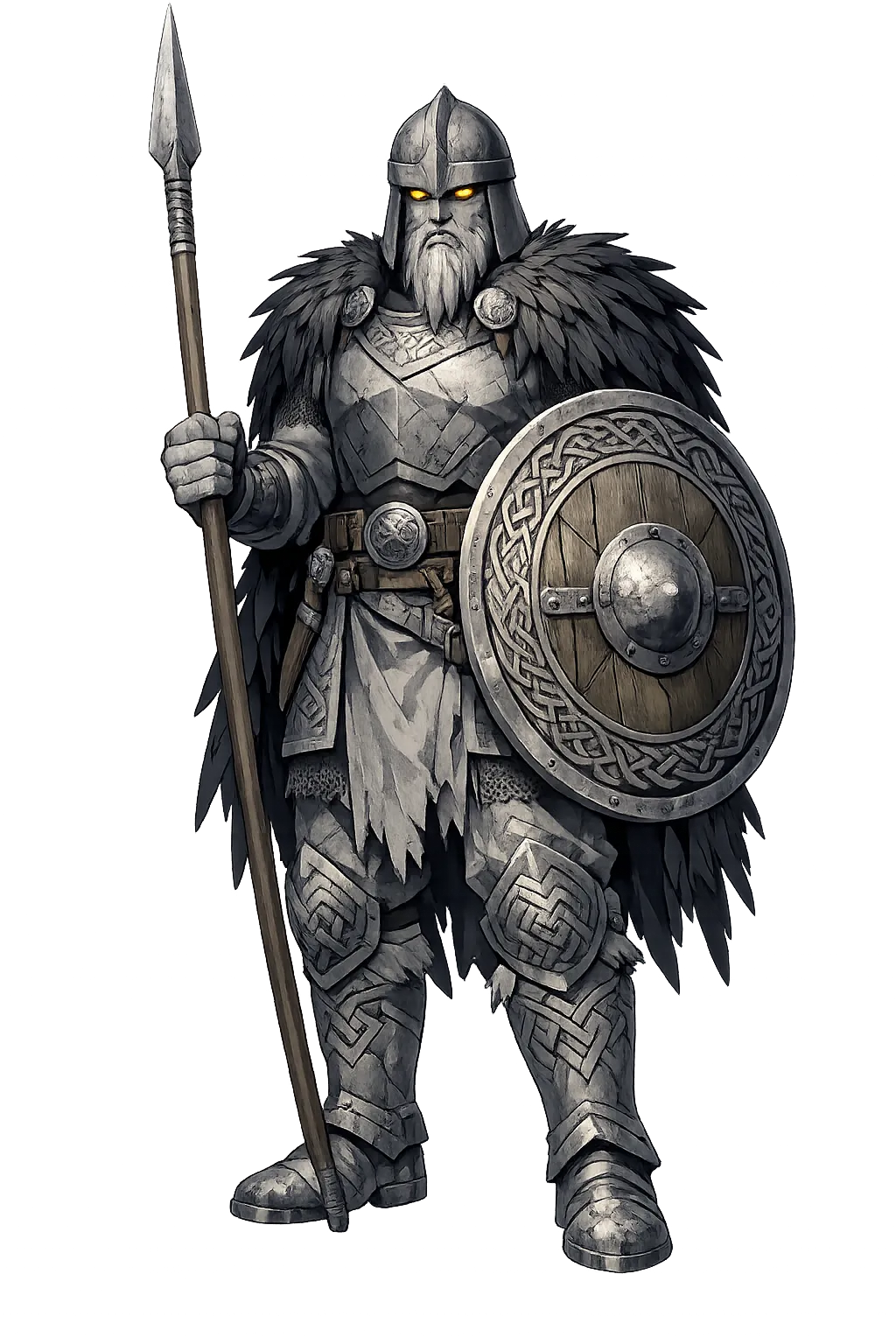
Eggþér: the restoration, the temple, and the world it opens
Every name in this series was once flattened to fit a keyboard. Eggþér is what the evidence put back.
Eggþér is one of the most enigmatic figures in Norse myth. He has no extended story, no family tree, no cult. Yet his single appearance in Völuspá makes him unforgettable: the herdsman on the mound, playing while the world ends. Völuspá 42 describes the scene: 'Eggþér sat on a mound and played his harp; the giantess's watchman gladdened him greatly. There crowed Fjalarr, the bright-red cock, at the gods; the golden-combed one warned the heroes.
That is the figure this file is about — and the temple now standing at its restored name.
At a Glance
- Restored name: Eggþér
- ASCII form: eggther
- Meaning: "Sword guardian"
- Domain of influence: Watchman, Ragnarök Herald
- Pantheon: Norse
- Classification: Tier 1
- Original script: ᛁᚴᚴᚦᛁᚱ
- Series: The Restoration Files, No. 73 of 271
The Name Before the Marks
Strip Eggþér to eggther and one piece of evidence vanishes:
- e → é — Acute on e: the stress position the ASCII form cannot show.
A reader who knows the marks hears the name correctly on the first try. A reader who never sees them never gets the chance.
The Temple That Stands Now
The restored name is not a plaque; it is an address. The temple of Eggþér lives at /sites/eggther/, with its mythology in the lore halls, its peer-reviewed record in the Scholarly Edition, and its place in the pattern atlas on the patterns floor.
The restoration preserves more than the ASCII form can say — stress, length, or a letter the Latin keyboard lost — which places it in Tier-1: mechanically verifiable, information-rich.
Every flagship temple is hand-built to the same standard: the original script displayed with its provenance, the pronunciation reconstructed phoneme by phoneme, the sources named — because a restoration you cannot audit is just a spelling with confidence.
The Archetype at Work
A temple is also a reading of what this figure means — and meanings have addresses in the modern world. The pattern atlas maps Eggþér to the industries its archetype genuinely resonates with, each match argued, weighted, and open to challenge:
- Defense, Military & Security — The watchman who heralds Ragnarök — the original early-warning system.
- Agriculture, Food & Harvest — A hirðir — the herdsman on the howe; the pastoral watch kept to the end of the world.
- Music, Arts & Performance — The harpist of the apocalypse; the calm artist amid catastrophe from Völuspá to Wagner.
The mapping is conservative on purpose: only resonances that can be argued aloud. The rest of the atlas follows the same rule, industry by industry.
In the Sacred Texts
The Norse tradition is not a vibe; it is a library. The Sacred Texts collection holds Poetic Edda and Prose Edda — the primary sources the temple's scholarship is built on, free to read, cross-linked back to the names they mention. The temple is the argument; the texts are the evidence.
The File Continues
This is one of 271 Restoration Files — a second dispatch from every flagship temple in the fleet. The temple's first dispatch tells the founding story of the name; the blog index holds the whole archive.
Continue the series — previous file: Ēa (read it here) · next file: Ēl (read it here).
The Restoration Files are written from the same canonical record as the temples themselves: the lexicon, the lore catalog, the pattern atlas, and the cited scholarly sources. If a file ever disagrees with its temple, the temple is right — tell us, and the file will be corrected.