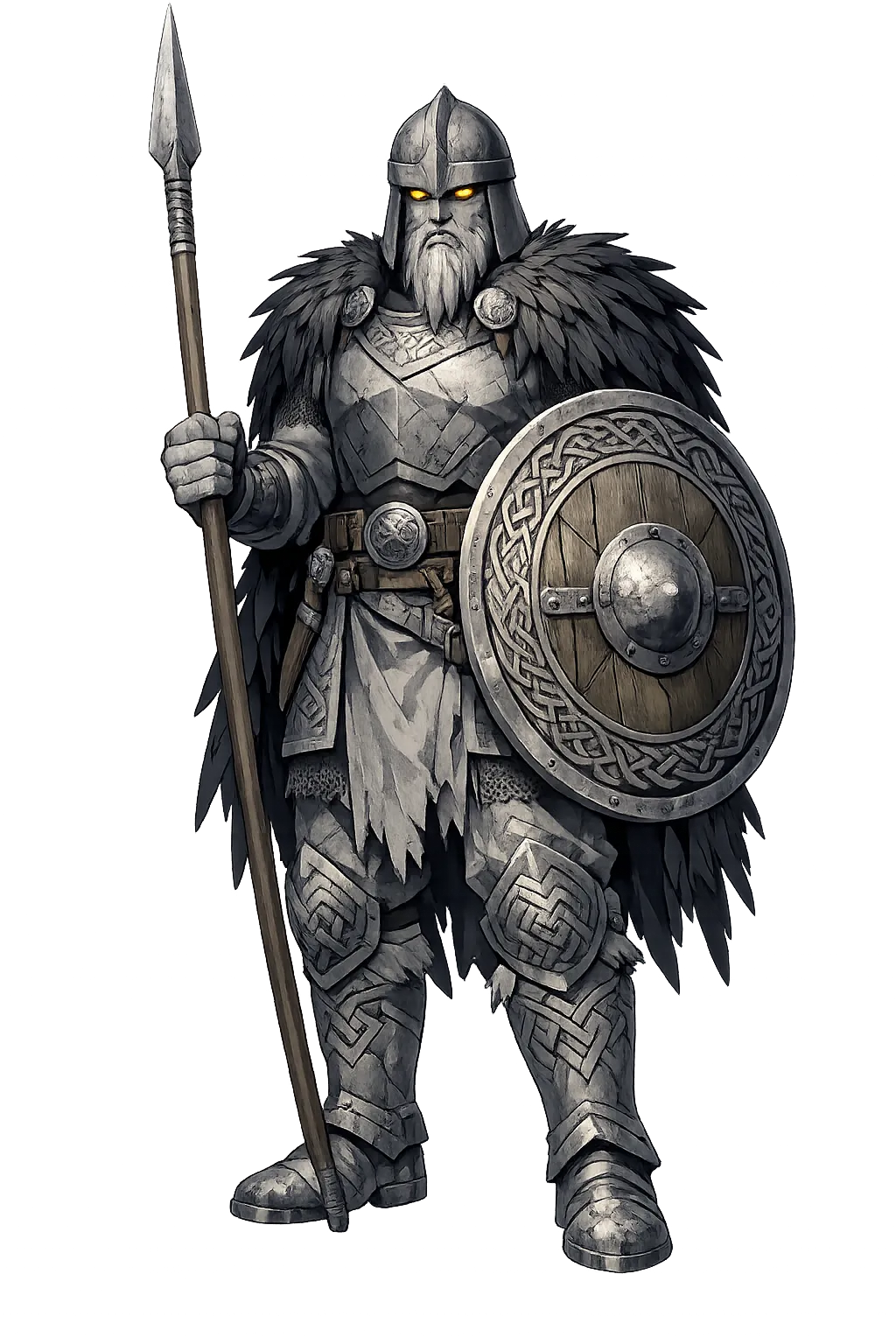
PuniCodex

Extended Lore

ᛁᚴᚴᚦᛁᚱ Eggþér

Etymology · Phonology · Orthography · Cultural Legacy · Primary Sources

Tier 1 Eggþér.com
Eggþér — Watchman, Ragnarök Herald
01

Quick Facts

Essential information about Eggþér, Watchman, Ragnarök Herald

Original Scriptᛁᚴᚴᚦᛁᚱ
Unicode RestorationEggþér
Reconstructed Pronunciation/ˈeɡˌθɛːr/
PantheonNorse
DomainWatchman, Ragnarök Herald
MeaningSword guardian
ClassificationTier 1
Primary DomainEggþér.com
Sacred SymbolsHarp, Grave-mound, Sword or edge, Crimson cock Fjalarr
02

Etymology & Word Family

From original script to Unicode restoration

Original Script ᛁᚴᚴᚦᛁᚱ Eggþér — "Sword guardian"
Unicode Restoration Eggþér Restored stress, length, and script
Modern ASCII eggther Plain-ASCII fallback

Eggþér is Tier 1: the acute on é marks both stress and length on the final syllable, while the geminate gg preserves consonant length. As a minor mythic figure, Eggþér has limited attestations; the reconstruction is based on normalized Old Norse phonology and the Eddic verse context.

03

Unicode Character Breakdown

Character-by-character philological analysis

CharacterUnicodeNameBlockPhonetic Role
EU+0045Latin Capital Letter EBasic LatinSame
gU+0067Latin Small Letter GBasic LatinSame
þU+00FELatin Small Letter ThornLatin-1 SupplementThorn
N/ADropped characterNorse orthographyNot written
éU+00E9Latin Small Letter E with AcuteLatin-1 SupplementAcute on e
rU+0072Latin Small Letter RBasic LatinSame

The Tier 1 classification reflects which ancient features stress, length, or script are preserved in this restoration.

04

Cultural Significance

From ancient cult to modern Unicode

Ancient Domain

Eggþér appears in the sources only once, but the moment is unforgettable. At Ragnarök, he sits on a mound and plays his harp, while the giantess guarding him joyfully proclaims the ruin of the gods. His music is the soundtrack of the world's end — a strange, pastoral prelude to annihilation.

Eggþér in Later Traditions

Eggþér has no clear counterpart outside Norse tradition. His closest relatives are other liminal apocalyptic figures: Heimdallr, who watches at the world's edge and will blow the Gjallarhorn; the giant Hrymr, who steers Naglfar; and the unnamed giantess who keeps watch on a howe. Some interpreters compare him to the medieval figure of the Wild Huntsman or to death-herdsmen in Indo-European folklore. The scene in Völuspá may draw on older apocalyptic imagery shared with Christian and Near Eastern traditions, though the pastoral details are distinctively Norse.

Modern Legacy

Eggþér remains obscure outside specialist scholarship, but the image of a musician playing at the end of the world has resonated across art and literature. Wagnerian opera, fantasy fiction, and apocalyptic poetry have all borrowed the motif of the calm artist amid catastrophe. For modern readers of Völuspá, Eggþér embodies the uncanny quality of Ragnarök: the end of everything announced not by thunder but by a harp.

Unicode Restoration as Cultural Act

Restoring Eggþér in a domain name is more than orthographic accuracy. It is a statement that the internet should recognize the full range of human writing — not only the ASCII keyboard.

05

Frequently Asked Questions

Common questions about Eggþér, Watchman, Ragnarök Herald, and Unicode restoration

01How do you pronounce Eggþér?

In reconstructed pronunciation, Eggþér is /ˈeɡˌθɛːr/ — approximately 'EGG-thair' — crisp 'egg' with a held g, then the breathy 'th' of 'thin' and a long, stressed 'air' ending in a light r..

02What does Eggþér mean?

Eggþér means Sword guardian in the norse tradition.

03What are the symbols of Eggþér?

Eggþér is associated with Harp (The instrument whose music accompanies the fall of the gods), Grave-mound (A seat of death-omens and boundary-crossing between worlds), Sword or edge (If the name contains the element 'egg' (edge), it hints at the blade that cuts the old world apart), Crimson cock Fjalarr (In the same Ragnarök sequence, the cock crows to the giants; Eggþér's music answers that alarm).

04Why restore Eggþér in Unicode?

Plain ASCII eggther strips the stress, length, and script that make the name specific. Unicode restoration returns the name to its original written dignity.

05What is the most important myth about Eggþér?

Völuspá 42 describes the scene: 'Eggþér sat on a mound and played his harp; the giantess's watchman gladdened him greatly. There crowed Fjalarr, the bright-red cock, at the gods; the golden-combed one warned the heroes.' The juxtaposition of music, animals, and apocalypse is haunting. Eggþér is not fighting; he is playing, as if the end of the cosmos were a pastoral occasion.

06

Scholarly Sources

The philological foundations of this restoration

Every claim on this page is grounded in established scholarship. The orthographic restorations follow disciplinary convention. The etymological chain follows the best available reference works. This is not invention — it is resurrection through scholarship.

Lexicography & Philology

  • Cleasby-Vigfusson
  • Zoëga

Primary Texts

  • Poetic Edda: Völuspá 42 (Codex Regius and Hauksbók recensions)
  • Dronke, Ursula, The Poetic Edda, Volume II: Mythological Poems

Archaeology & Art History

  • Material evidence — iconography, inscriptions, and temple archaeology — for Eggþér and related cults.
  • No archaeological find can be linked to Eggþér directly. His myth belongs to the manuscript tradition of the Eddas, above all the Codex Regius of the Poetic Edda (GKS 2365 4to, c. 1270) and Hauksbók (AM 544 4to). The mound on which he sits, however, recalls the thousands of Bronze- and Iron-Age burial mounds of Scandinavia, which were understood as boundary places where the dead remained present in the landscape.

Religious Studies

  • Cleasby & Vigfusson, An Icelandic-English Dictionary (1874), s.v. egg, þér/þjónn
  • Zoëga, A Concise Dictionary of Old Icelandic (1910)
  • Simek, Rudolf, Dictionary of Northern Mythology
  • Lindow, John, Norse Mythology: A Guide to the Gods, Heroes, Rituals, and Beliefs
  • de Vries, Jan, Altgermanische Religionsgeschichte
Return

The Surface Awaits

You have traced the name from its earliest attestation to its Unicode restoration. Now return to the myth. The story is where the name lives.

Back to Lore
Eggþér mascot