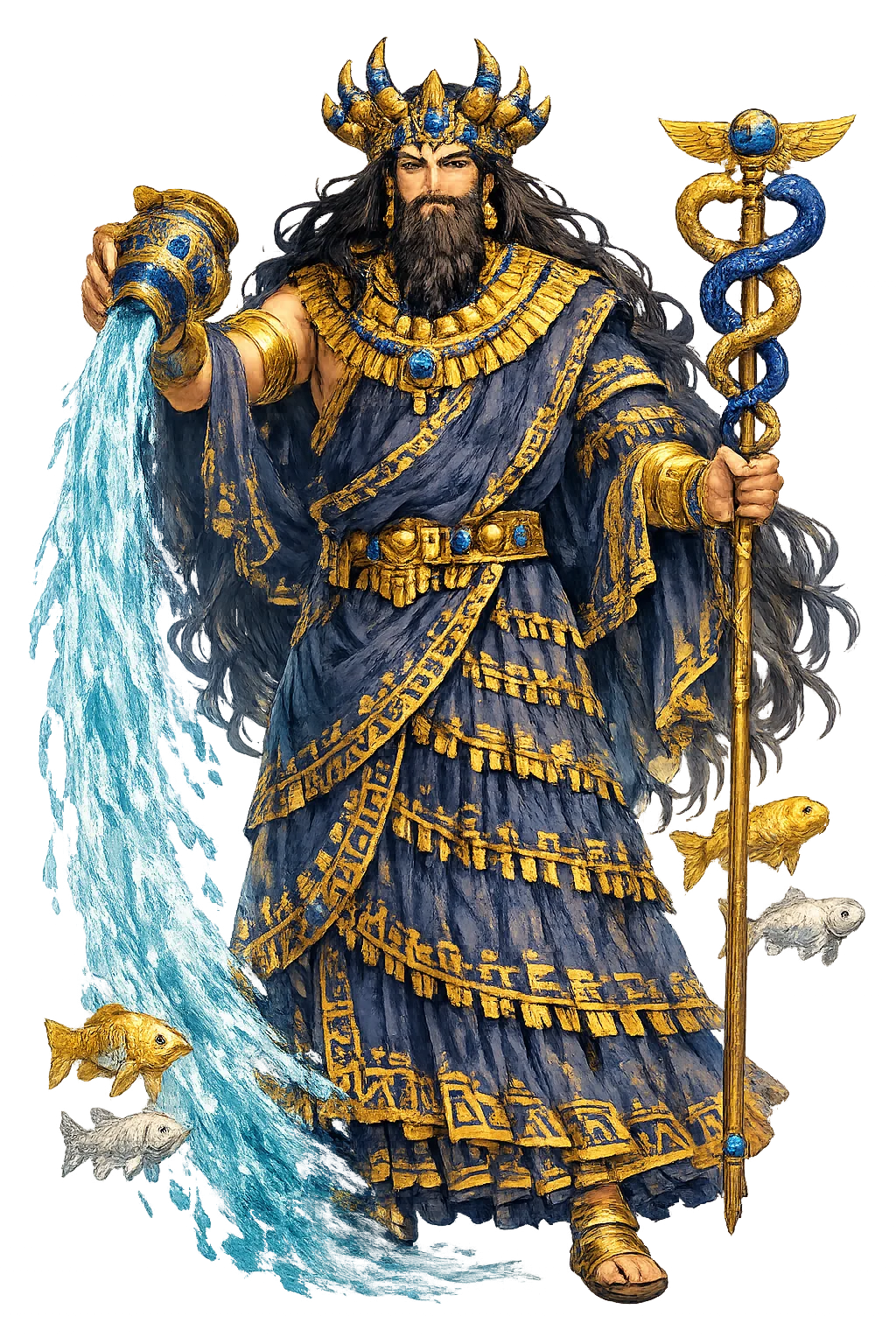
Ēa through the eyes of sculptors, painters, and craftsmen across the ages

Detail of the Akkadian Adda cylinder seal, c. 2300 BCE, showing Ea (Sumerian Enki) with streams of water and fish flowing from his shoulders; behind him stands his two-faced vizier Usimu. British Museum, BM 89115.

Detail of a basalt cultic water basin from the temple courtyard at Assur, reign of Sennacherib, 704–681 BCE, showing the water god Ea (Enki) flanked by priests in fish-skin cloaks. Pergamon Museum, Berlin.

Old Babylonian statue of Ea (Sumerian Enki) enthroned and holding a cup, c. 2004–1595 BCE, probably from Nasiriyah, southern Iraq; two half-human, half-fish creatures recline at the throne base. Iraq Museum, Baghdad.

Old Babylonian terracotta plaque, 19th–17th century BCE, depicting the horned god Ea (Enki) holding a cup from which water overflows. Pergamon Museum, Berlin.

Akkadian marble cylinder seal showing Enki/Ea, god of the freshwater abyss and wisdom, with his two-faced assistant Ushmu and a personal goddess leading the seal owner. Louvre, MNB 1905.

Serpentine Akkadian cylinder seal showing the god Ea (Enki) enthroned with water flowing from his shoulders as other gods bring the captured Anzu bird before him. British Museum, ME 103317.
