The Authentic Orthography
Protection, Strength, War · ‘the inaccessible or terrific goddess’, N. of the daughter of Himavat and wife of Śiva (also called Umā, Pārvatī &c., and mother of Kārttikeya and Gaṇeśa cf. pUjA), TĀr. x, 2
Unicode restoration and ASCII comparison
दुर्गा
The name in its original Sanskrit form. Durgā (दुर्गा) is attested in the source tradition — “‘the inaccessible or terrific goddess’, N. of the daughter of Himavat and wife of Śiva (also called Umā, Pārvatī &c., and mother of Kārttikeya and Gaṇeśa cf. pUjA), TĀr. x, 2”. Its macron-length vowels carry the full phonetic and orthographic weight of the source tradition.
durga
Reduced to plain durga, the name loses everything that made it specific: macron-length vowels. What remains is an ASCII string that machines can parse but that no longer speaks with its original voice.
Durgā
The Unicode restoration recovers what ASCII flattened. Durgā restores macron-length vowels, returning the name to its original written dignity. The domain encodes to Punycode, but the browser displays the truth.
Durgā.com → xn--durg-tsa.com
The non-ASCII characters in Durgā are encoded while the ASCII remains visible. To the DNS, it is Punycode. To humanity, it is Durgā.
How Durgā travels from ancient script to the modern URL
How Durgā was spoken
Protection, Strength, War, and the Destruction of Evil
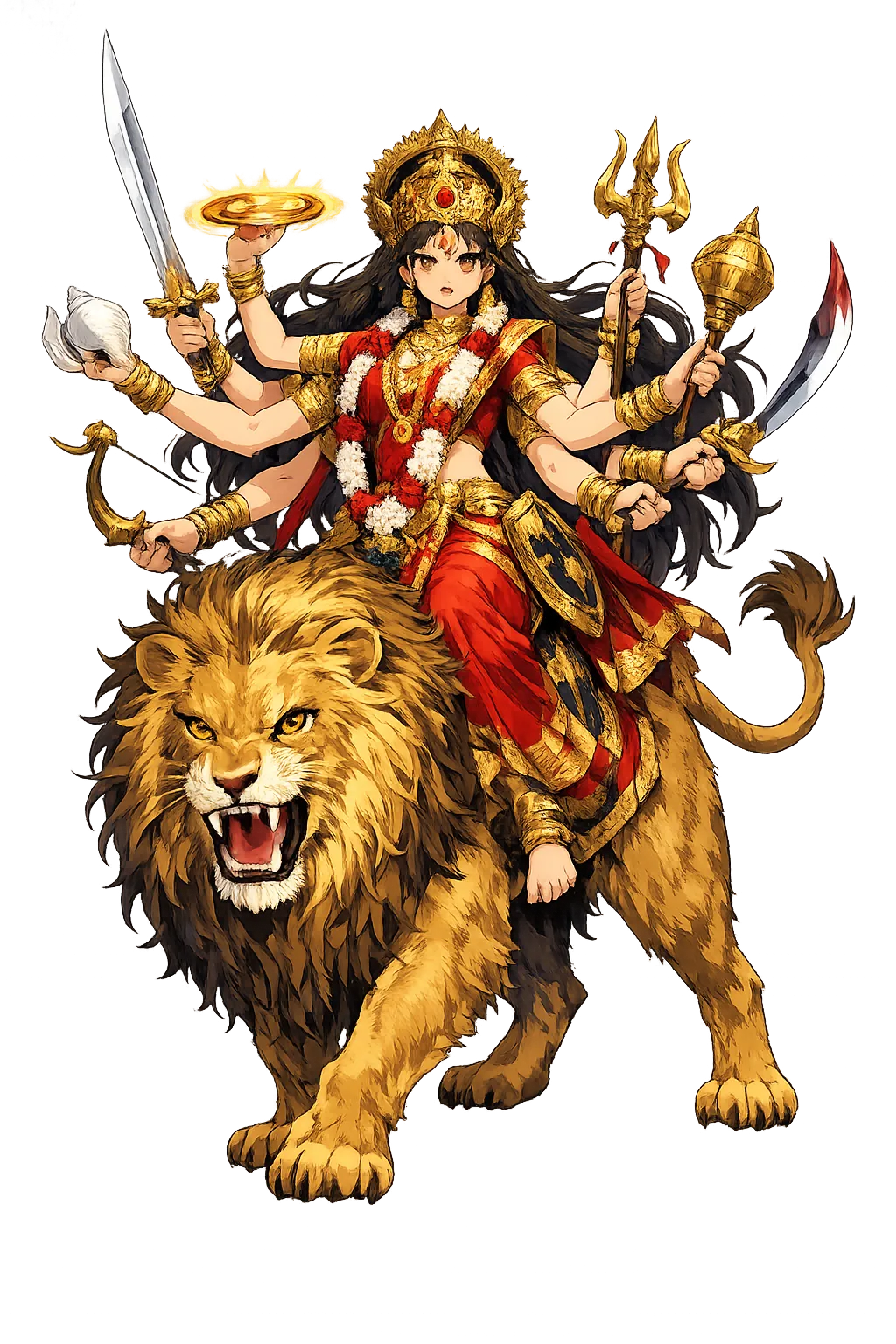
Durgā is the goddess who is beautiful because she is dangerous. Born from the combined radiance of the gods to defeat the buffalo-demon Mahiṣa, she rides a lion, wields ten weapons, and laughs in the face of cosmic chaos. Her name means 'the inaccessible' or 'the fortress': she is hard for enemies to reach and impossible for devotees to lose.
She is also Pārvatī in her fierce aspect, the mountain-goddess transformed into warrior-queen. Her mythology centers on the insight that divine compassion sometimes takes the form of decisive violence against those who threaten the worlds.
She slays the buffalo-demon Mahiṣāsura after a nine-day battle, restoring the gods to heaven.
Each weapon she holds was given by a god, showing that the divine powers unite in her single form.
She rides a lion or tiger, symbolizing sovereign power and the courage that destroys demonic pride.
As Pārvatī she is wife of Śiva and mother of Gaṇeśa and Skanda; her wrath protects her children.
Stories of Durgā
Durgā's mythology reaches its classic form in the Devī-Māhātmya, the 'Glory of the Goddess' embedded in the Mārkaṇḍeya Purāṇa. There she appears when the gods are defeated and the demons rule heaven, earth, and the underworld.
The buffalo-demon Mahiṣāsura had conquered the gods through austerities and battle. Neither Brahmā, Viṣṇu, nor Śiva could defeat him alone. In desperation the gods released their combined energies, which took shape as a blazing woman with ten arms, each holding a weapon given by a god. She rode a lion into battle. For nine days and nights she fought Mahiṣāsura, who shifted between buffalo, lion, elephant, and warrior forms. Finally, as he charged her in buffalo form, she caught him by the mane, pinned him under her foot, and ran her trident through his neck. Heaven was restored, and the gods sang her praises as Mahiṣāsuramardinī, 'Slayer of Mahiṣāsura.'
After Mahiṣāsura, the demon brothers Śumbha and Niśumbha rose to power and demanded that the goddess become their consort. Durgā refused, and from her body sprang Kālī and Caṇḍikā, fierce emanations who devastated the demonic armies. The battle tested not only her martial power but her absolute refusal to submit to any force that opposed dharma.
In later Purāṇic stories, Durgā is identified as the fierce form of Pārvatī, the gentle mountain goddess. When demons threaten the cosmos, her peaceful aspect gives way to this warrior manifestation. This identity preserves the theological insight that the same goddess who nourishes as mother can destroy as protector; love and wrath are not opposed but complementary faces of the divine feminine.
Durgā does not negotiate with evil. She confronts it directly, armed with the gifts of every god and the certainty that chaos must be met with force. This makes her uncomfortable for modern sensibilities trained to value dialogue over combat, but her mythology insists that some threats must be destroyed before conversation becomes possible.
Enter Extended Lore