
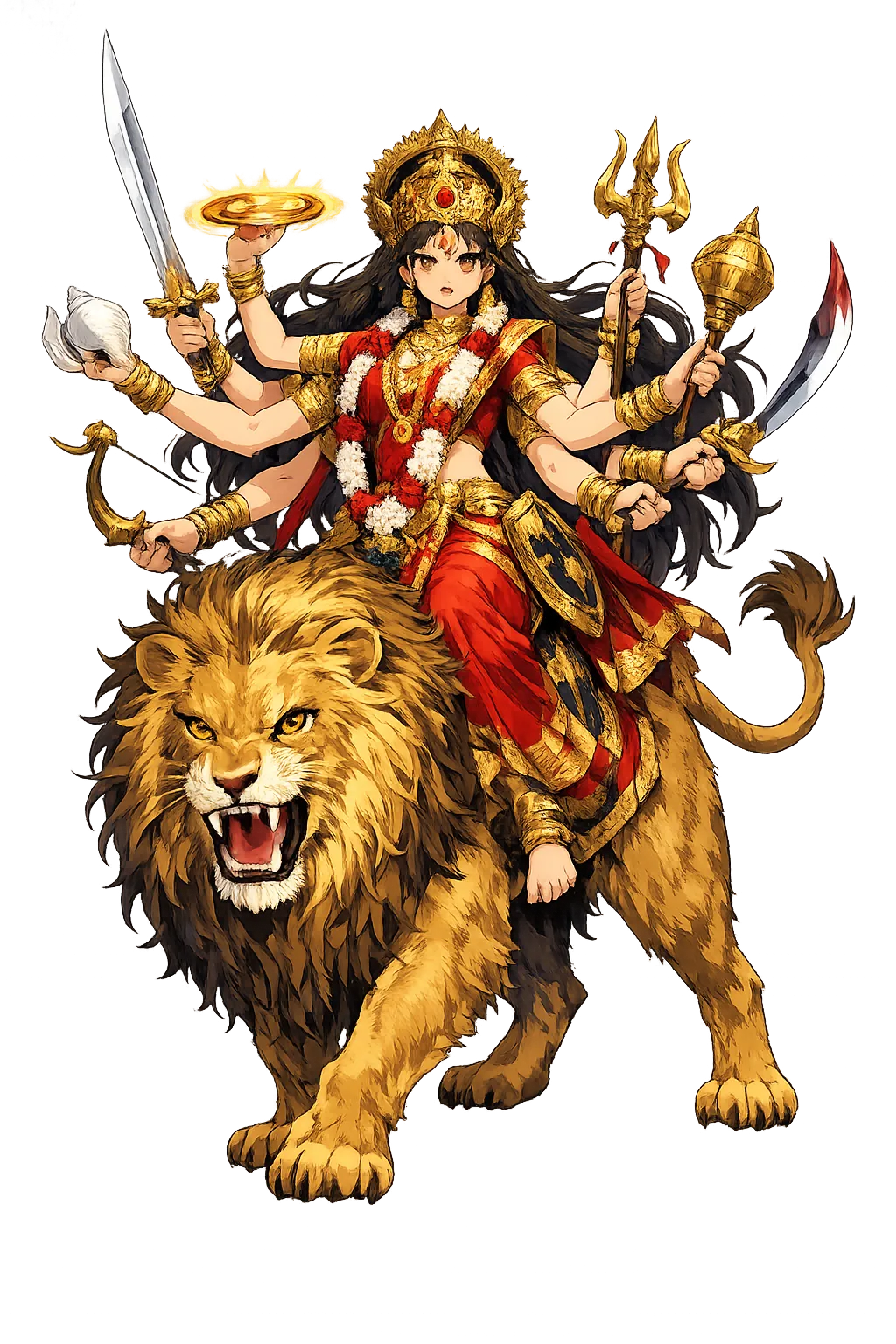
Why Durgā is spelled that way — and what it costs to get it right
There is a version of this name the early internet had to settle for: durga. This is the file on how Durgā replaced it.
Durgā's mythology reaches its classic form in the Devī-Māhātmya, the 'Glory of the Goddess' embedded in the Mārkaṇḍeya Purāṇa. There she appears when the gods are defeated and the demons rule heaven, earth, and the underworld.
At a Glance
- Restored name: Durgā
- ASCII form: durga
- Meaning: "'The Inaccessible One' — the warrior goddess, daughter of Himavat and consort of Śiva, slayer of the buffalo-demon Mahiṣa"
- Domain of influence: Protection, Strength, War
- Pantheon: Sanskrit
- Classification: Tier 1
- Original script: दुर्गा
- Series: The Restoration Files, No. 71 of 271
The Name Before the Marks
Strip Durgā to durga and one piece of evidence vanishes:
- a → ā — Macron: long /aː/: the vowel length the ASCII form cannot show.
None of these marks is decoration. Each one is a fact about how the name was spoken, and each one is checkable against the scholarly record the temple cites.
Spoken, the name runs `/ˈd̪ʊr.ɡaː/` — 'DOOR-gah' — the first vowel is short and rounded like 'u' in 'put'; hold the final 'gah' long.
The Temple That Stands Now
The restored name is not a plaque; it is an address. The temple of Durgā lives at /sites/durga/, with its mythology in the lore halls, its peer-reviewed record in the Scholarly Edition, and its place in the pattern atlas on the patterns floor.
What survives here cannot be shown in ASCII: a feature of the original that the fallback alphabet flattens. That is the Tier-1 test, and this name passes it without argument.
Where the Name Stood First
Images of Durgā Mahiṣāsuramardinī appear from the Gupta period onward and become especially prominent in medieval temple sculpture across India. The great Durgā temples of Bengal, Odisha, Rajasthan, and the Himalayas preserve elaborate iconographic programs of her battles. Bengal's Durgā Pūjā has produced a vast material culture of clay images (pratimā), decorated pandals, and ritual paraphernalia, some of which is now collected in museums. In Nepal, the Taleju temple in Kathmandu and the Durgā temples of the valley reflect her importance in Newar and royal cult. The temple on the web is the newest of these addresses — the first one that fits in a pocket.
The Archetype at Work
The pattern atlas seats this temple in 3 industries, each match argued and weighted: Defense, Military & Security (born from the combined radiance of the gods to slay the buffalo-demon — the fortress no enemy can reach.); Insurance & Protection Services (protection personified; the fortress goddess.); Sports, Fitness & Competition (strength and protection; the warrior goddess of the arena.). The Resonance File reads those seats through the myths themselves.
In the Sacred Texts
The Sanskrit tradition is not a vibe; it is a library. The Sacred Texts collection holds Rig Veda and Ramayana — the primary sources the temple's scholarship is built on. The temple is the argument; the texts are the evidence.
The File Continues
The temple's founding dispatch tells the name's story; its Resonance File reads the myths into the industries; the blog index holds the whole archive.
Continue the series — previous file: Drákōn (read it here) · next file: Ēa (read it here).
The Restoration Files are written from the same canonical record as the temples themselves: the lexicon, the lore catalog, the pattern atlas, and the cited scholarly sources. If a file ever disagrees with its temple, the temple is right — tell us, and the file will be corrected.