
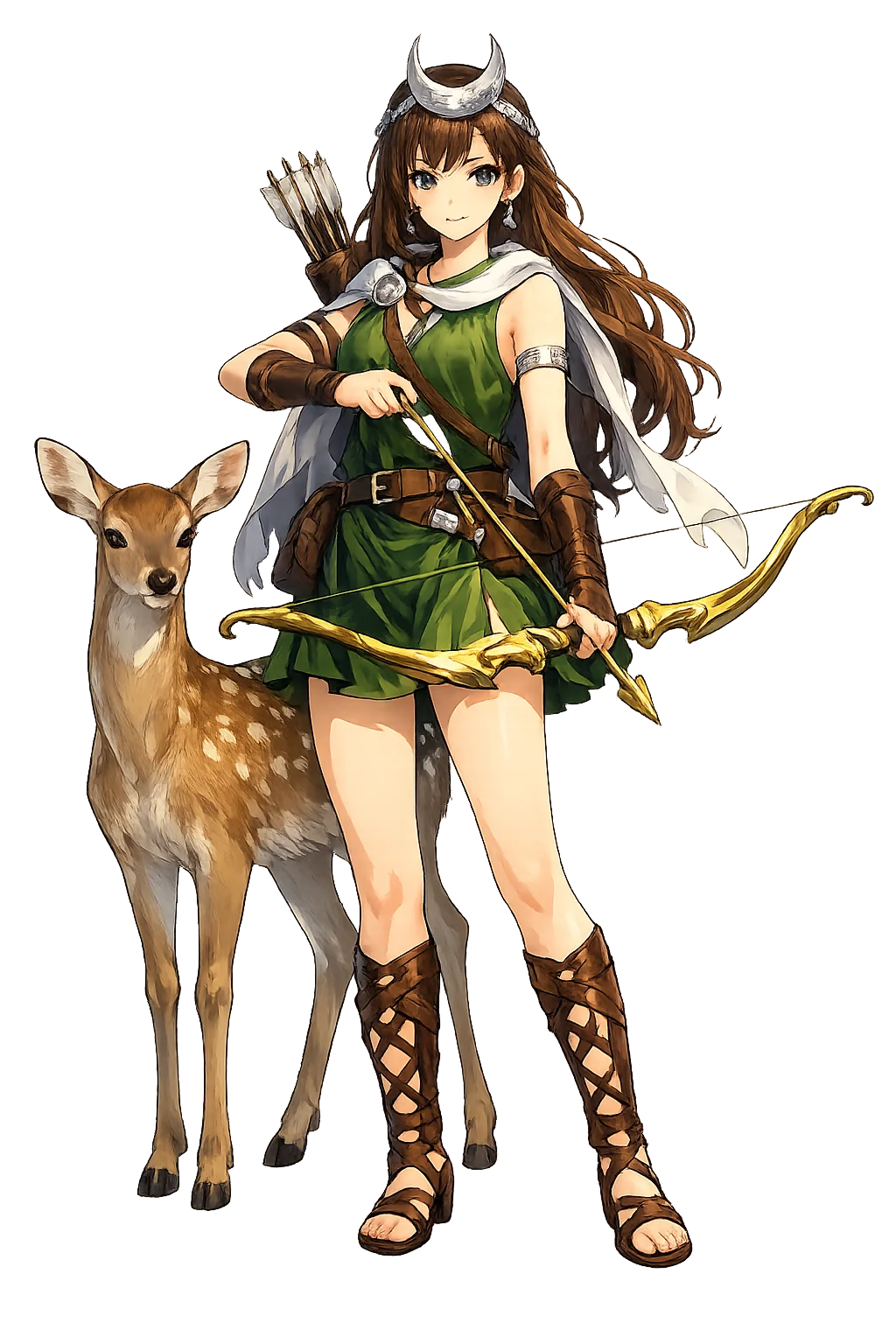
Why Diāna belongs in your address bar
Every address bar is a choice. When you type Diāna, you are not typing a novelty; you are restoring a name that the early DNS, built for English typewriters, could not carry. The plain ASCII form diana is a leftover of that constraint, not the name itself. This post is the long version of the restoration: where the name comes from, how the Original Script tradition wrote it, how it is pronounced, what the myths and the material record preserve, and why its Unicode form now lives as a working domain. The claim throughout is simple — the original spelling is not decoration. It is the name.
At a Glance
- Restored name: Diāna
- ASCII form: diana
- Meaning: "'The bright one, goddess' (from the root *dyēu-, to shine)"
- Domain of influence: Moon, Hunt, Wilderness
- Pantheon: Roman
- Classification: Tier 2
- Live domain: diāna.com
Overview
Diāna (diana) — The Huntress of the Moon — belongs to the Roman tradition, where it is catalogued under the domain "Moon, Hunt, Wilderness". The name means "'The bright one, goddess' (from the root *dyēu-, to shine)".
Diāna is Rome's own goddess before she is Artemis imported: mistress of the wildwood, the moon, and women in labour, whose strangest institution — the priest-king of Nemi who wins his office by murder — haunted anthropology for a century.
PuniCodex restores the name as Diāna and serves its temple at diāna.com. The original preserves one prosodic feature — stress or vowel length — rather than both, which places the name in Tier 2. The plain ASCII form diana survives as a modern convenience imposed by the early domain-name system; the restoration, not the fallback, is the form the project defends as philologically complete.
The Name
No indigenous written attestation survives for this name; Diāna is a scholarly transliteration of the reconstructed spoken form. Etymologically the name means "'The bright one, goddess' (from the root *dyēu-, to shine)".
The ASCII form diana survives only because the early domain-name system could not carry diacritics; it is a technological compromise, not an ancient spelling. The Unicode restoration Diāna recovers the vowel length of the original directly in the address bar. The original preserves one prosodic feature — stress or vowel length — rather than both, which places the name in Tier 2.
The letter-by-letter transformation runs:
- d → D — Same letter
- i → i — Same letter
- a → ā — Macron marks the long vowel
- n → n — Same letter
- a → a — Same letter
The project holds the domain diāna.com (xn--dina-rsa.com) as the canonical home of this name.
The Original Script
The original script for this roman name has not yet been added to PUNICODEX. The form shown is a scholarly transliteration.
The form Diāna is therefore a scholarly transliteration rather than an attested ancient spelling; it encodes the reconstructed sound of the name for modern use, and no mark in it is decorative.
Pronunciation
The reconstructed pronunciation of the name is /diˈaː.na/ — Classical Latin.
For the modern speaker, the closest approximation is: dee-AH-nah, with the long ā on the stressed second syllable.
Kindred and historical forms of the name:
- Latin — Diāna
- Greek twin — Ἄρτεμις
- Owned form — Diāna
Latin Diāna scans with a long i and long final ā; the owned restoration Diāna follows the classical spelling exactly. Roman grammarians connected the name to the shining of the moon (from the same root as Iūpiter's Dyēus, "the bright sky"), making her the feminine face of celestial light.
Mythology
Roman myth largely retells Artemis' stories under Diāna's name — but her cult institutions are Italy's own, older than the stories, and stranger.
Actaeon (The Bath)
Ovid tells it as a warning about seeing: the hunter Actaeon, wandering at noon, stumbles on Diāna bathing in a hidden valley. She splashes him with water — "now you may tell that you saw me, if you can" — and he becomes a stag, torn apart by his own hounds who know only the shape of prey, not the voice of their master.
The King of the Wood (The Grove)
At Nemi, in Diāna's lakeside grove, the priesthood was held by an escaped slave who became rex Nemorensis by plucking a bough from the sacred tree and killing his predecessor in single combat — and who then guarded the tree, sword in hand, against the next challenger. The rite, already archaic in Ovid's day, frames Frazer's entire Golden Bough.
Hippolytus Reborn (The Refuge)
Roman tradition made Nemi the retirement of a Greek ghost: Virbius, the twice-man — Hippolytos, dragged to death by his horses and raised again by Aesculapius — hidden by Diāna in her grove, where no horse may enter. The goddess shelters the chaste hunter her Greek sister could not save.
The Aventine Charter (The Alliance)
Servius Tullius founded Diāna's temple on the Aventine as the federal shrine of the Latin cities — the one cult they shared with Rome as equals. A Sabine's marvel of a cow, sacrificed there by a cunning priest, sealed Rome's primacy: Roman historians tell the story as the moment alliance tipped toward empire.
Symbols & Iconography
The iconography associated with Diāna concentrates in a small set of recurring attributes, each a compressed statement about the name:
- The bow — The hunt and the sudden death of women — her arrows strike gently
- The crescent — The waxing moon she steers as Luna
- The deer — Her sacred animal; the wild that cannot be owned
- The oak of Nemi — The grove whose bough — the Golden Bough — only a runaway slave might break
Epithets & Cult Titles
Her Roman titles map her provinces.
- Trivia — 'of the Three Ways'; the crossroads goddess, where moon, hunt, and underworld meet.
- Lucina — 'she who brings to light'; the childbirth power she shares with Iūnō.
- Nemorensis — 'of the Grove'; her Nemi title, the one Frazer made famous.
- Opifera — 'bringer of aid'; her title as the plebeians' helper.
- Luna — the moon itself; her celestial name in the poets.
- Regina Nemorum — 'queen of the groves'; Horace's title for her.
Oracle Sites & Sanctuaries
Nemi — the sanctuary of Diana Nemorensis in the Alban Hills — was her most famous address: a temple-precinct with theatre and baths above the crater-lake called her Mirror, where the rex Nemorensis kept his murderous watch and where Caligula later floated his pleasure barges. On the Aventine in Rome, her federal temple anchored the Latin League and housed the league's bronze law-pillar, copied by Dionysius. Across Latium her sanctuaries marked the old federal roads — at Aricia, at Tusculum, on Mount Tifata — the network of a goddess older than Rome herself.
Archaeology & Evidence
The sanctuary at Nemi — Diana Nemorensis — preserves its theatre, temple platforms, and the famous votive anatomicals (terracotta wombs and limbs) of her healing cult; the lake itself, a volcanic crater, justified "speculum Dianae." On the Aventine, the federal temple's foundations underlie the modern street. The Nemi ships' remains — bronze heads of wolves and lions, the "Nemi wheels," and lead water pipes stamped CAESARIS — are divided between the Museo delle Navi Romane (partially reconstructed after the fire) and Berlin.
Realm & Domain
Diāna is Rome's own goddess before she is Artemis imported: mistress of the wildwood, the moon, and women in labour, whose strangest institution — the priest-king of Nemi who wins his office by murder — haunted anthropology for a century.
Trivia
"Of the three ways" — her title at the crossroads, where moon, hunt, and underworld meet.
Nemi
The lake called "Diana's Mirror," sacred grove of the rex Nemorensis — the priest who slew the slayer.
The Aventine
Her federal temple, founded by Servius Tullius as the common sanctuary of the Latin League.
Actaeon's Hounds
The hunter who saw her bathing and was run down by his own pack — the wild's answer to the gaze.
Across Cultures
Her fusion with Artemis was total and early, but Diāna kept Italian features Artemis never had: the slave-priest of Nemi, the Aventine's federal politics, and her patronage of the plebeians (her temple was a traditional asylum). In the Middle Ages she became the witch-goddess: canon law condemned women who claimed to ride at night "with Diana," and Charles Leland's Aradia (1899) rebuilt her as the messiah of witchcraft — the root of modern Wicca's Diana.
Within the Roman tradition, closely related names in the corpus include [[ianus|Iānus]], [[iuno|Iūnō]], [[iuppiter|Iūppiter]], [[neptunus|Neptūnus]], [[vulcanus|Vulcānus]], and [[artemis|Ártemis]].
Cultural Legacy
She lends her name to the moon in a hundred poems and to Diana's Mirror at Nemi, where Caligula's pleasure barges — raised in 1929–32, burned in 1944 — gave underwater archaeology its founding drama. Frazer's Golden Bough, the book that created comparative religion as a public genre, begins and ends in her grove. The goddess of the wild remains the emblem of every conservation that is also a hunt.
The Scholarly Record
The account of Diāna given in this edition rests on the witnesses and reference works listed below. Lexica and etymological dictionaries secure the form and meaning of the name; the literary and religious texts supply the narrative evidence.
- Ovid (Publius Ovidius Naso), Metamorphoses / Fasti / Heroides, Loeb Classical Library, 17. Full text
- Lewis & Short, A Latin Dictionary, Oxford, Clarendon Press; Perseus digitization, 1879. Full text
- Varro, De Lingua Latina / Antiquitates Rerum Divinarum, Loeb Classical Library, 45 BCE.
- Horace, Carmina / Opera, Oxford Classical Texts; Loeb, 23 BCE.
- Cicero, Marcus Tullius — collected works, Loeb Classical Library, 43 BCE. Full text
- Cambridge Ancient History, Multiple volumes, 1970. Full text
A Meditation
Diāna is the wild that insists on a temple. Her priest wins office by violence in her most peaceful grove; her deer are protected by being hunted only by her. She asks the oldest question of stewardship: whether anything can be preserved without being owned — and answers with a lake that reflects the moon without holding it.
Her question to every managed wilderness is the lake's own: can you look without touching? The Actaeon myth is not about a peeping hunter but about the gaze that consumes what it sees — and the grove at Nemi, where the priest-king guarded the tree with a sword, admits the paradox outright: some things are protected only by being made dangerous to approach. The wild she keeps is the wild that keeps itself.
The Unicode Restoration
Diāna is classified as Tier 2: the original preserves at least one philological feature that ASCII cannot encode. The ASCII fallback diana still resolves everywhere, but it is the restored form that carries the name's full information. Across the 5 characters of the name, the restoration adjusts 1: 1 mark of length (ā). That is the whole thesis of this temple: the marks are the message.
Character by Character
The journey from diana to Diāna, one character at a time:
- d → D — Same letter
- i → i — Same letter
- a → ā — Macron marks the long vowel
- n → n — Same letter
- a → a — Same letter
The Domain Name
The restored name is live as a working domain: diāna.com, which the DNS carries in punycode form as xn--dina-rsa.com — an ASCII-compatible encoding that lets a non-ASCII name travel the global network without breaking older infrastructure. The visitor sees Diāna; the machines see the encoding. That duality is the engineering compromise on which the entire restoration rests, and it is why a name written the way its own tradition wrote it in Original Script can now be typed into any browser on earth.
The Roman Pantheon
Diāna is one of 6 entries the PuniCodex lexicon catalogues under the Roman pantheon. The Pantheon page gathers the tradition's major figures in one place, and the Lexicon lets you filter all 915 restorations by tradition, tier, or script — the fastest way to see where this name sits among its kin.
Frequently Asked Questions
What does Diāna mean? The traditional gloss is "'The bright one, goddess' (from the root *dyēu-, to shine)."
Which tradition does Diāna belong to? Diāna is catalogued in the Roman pantheon of the PuniCodex lexicon.
Why is Diāna classified as Tier 2? Because the original preserves at least one philological feature that ASCII cannot encode — and the marks in the restored spelling preserve exactly that evidence.
Is Diāna a working domain? Yes — diāna.com resolves today and routes to this temple.
What is the punycode for diāna.com? The DNS encoding is xn--dina-rsa.com; browsers perform the translation automatically, so visitors only ever see the restored name.
Typing Diāna
You do not need a special keyboard to use this restoration. The PuniCodex Type Tool converts the ASCII form diana into Diāna as you type, and the browser extension offers the same conversion inside any text field. Copy the restored form, paste it into the address bar, and the DNS does the rest.
Sister Temples
Other temples in the Roman pantheon include Iānus — each with its own restoration story, its own scholarly record, and its own place in the lexicon.
Why This Restoration Matters
Restoring Diāna is part of a larger effort to make the web multilingual by default. The PuniCodex project does not ask users to learn a new alphabet; it asks the infrastructure to respect the alphabets that already exist. Every section of this post — the script, the sound, the myths, the evidence — converges on the same point: the marks in Diāna are information, and information deserves an address of its own. A single Unicode domain is a small proof, but it is a proof that scales: every name restored makes the next one easier, and every visit to diāna.com is a vote for the restored form.
Explore Further
This post is one doorway into the temple. The home page carries the full character breakdown and the ambient canvas; the lore page tells the myths in long form; the Scholarly Edition preserves the sources, pronunciation data, and revision history; and the patron wall supports the restoration directly. For the wider map, browse the Lexicon, explore the Pantheon, or return to the PuniCodex blog.
Related Names
Sources
The full scholarly apparatus — every citation, revision, and review — lives in the Scholarly Edition. Key references for this post:
- Ovid (Publius Ovidius Naso), Metamorphoses / Fasti / Heroides, Loeb Classical Library, 17.
- Lewis & Short, A Latin Dictionary, Oxford, Clarendon Press; Perseus digitization, 1879.
- Cicero, Marcus Tullius — collected works, Loeb Classical Library, 43 BCE.
- Cambridge Ancient History, Multiple volumes, 1970.
- Varro, De Lingua Latina / Antiquitates Rerum Divinarum, Loeb Classical Library, 45 BCE.
- Horace, Carmina / Opera, Oxford Classical Texts; Loeb, 23 BCE.
- Horace, Carmen Saeculare; Catullus 34 (Diana's hymn).
- Strabo 5.3.12; Dionysius 4.26; the Nemi excavation reports.
- Lexicon authorities for this entry: Lewis & Short, Varro, Horace.