The Authentic Orthography
Creation, Ordinance, Support · The Establisher of Worlds
Unicode restoration and ASCII comparison
धातृ
The name in its original Sanskrit form. Dhātṛ (धातृ) is attested in the source tradition — “'The Ordainer, the Establisher' (from dhā, to place), an Āditya”. Its macron-length vowels carry the full phonetic and orthographic weight of the source tradition.
dhatr
Reduced to plain dhatr, the name loses everything that made it specific: macron-length vowels. What remains is an ASCII string that machines can parse but that no longer speaks with its original voice.
Dhātṛ
The Unicode restoration recovers what ASCII flattened. Dhātṛ restores macron-length vowels, returning the name to its original written dignity. The domain encodes to Punycode, but the browser displays the truth.
Dhātṛ.com → xn--dht-2oa5868a.com
The non-ASCII characters in Dhātṛ are encoded while the ASCII remains visible. To the DNS, it is Punycode. To humanity, it is Dhātṛ.
How Dhātṛ travels from ancient script to the modern URL
How Dhātṛ was spoken
Ordinance, Creation, and the Set-Down World
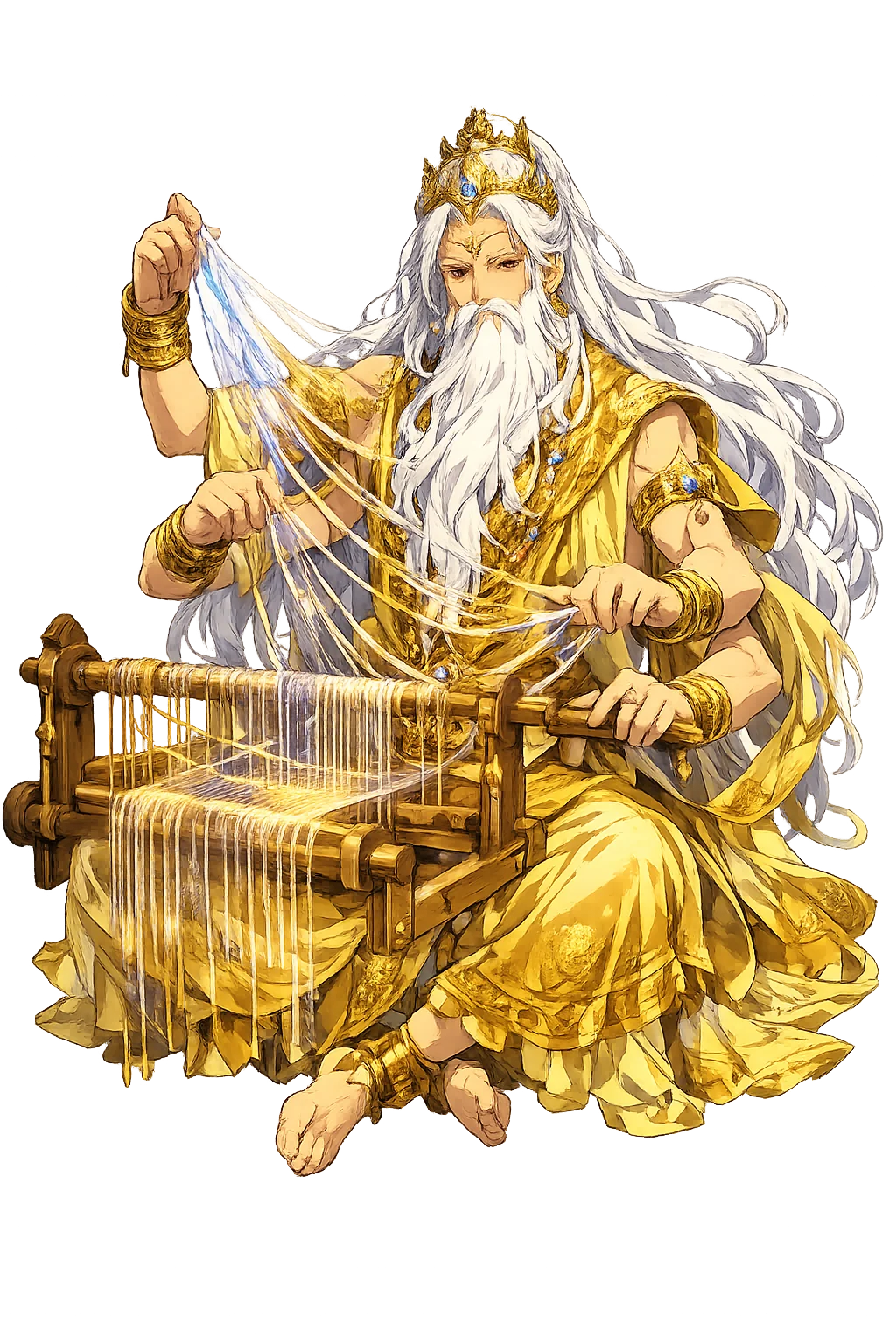
Dhātṛ is the Vedic verb of creation made personal: "the Establisher," the one who sets the sun in the sky and the child in the womb. Where Brahmā would later be a personality, Dhātṛ is still a function radiant with worship — creation as the act of setting-down.
Ṛgveda 10.190: he established heaven and earth, the waters and the light.
Paired with the "Disposer" — the Establisher founds, the Disposer assigns each thing its law.
His root-word: the elements of grammar and of medicine — the set-down units of reality.
He "establishes the embryo" — creation biological as well as cosmic.
Stories of Dhātṛ
Dhātṛ's mythology is the Ṛgveda's creation poetry itself: he appears wherever the text needs not a story but the act — the setting of each thing in its station.
The hymn of creation names the sequence: from fervour was born order and truth, from them the night and the ocean; from the ocean the year, apportioning nights and days. "The Establisher (Dhātṛ), as he had made the sun and moon, established heaven and earth, the mid-air and the light" — creation as a series of settings, each thing fixed where it belongs.
The Atharvaveda and Brāhmaṇas pair him with Vidhātṛ, the Disposer: one founds, one assigns — the joint authors of each being's fate, invoked together at marriage and birth rites. A man's fortune, the texts say, is "written on his forehead" by these two: the Indian image of destiny's inscription begins here.
In the later literature Dhātṛ's offices pass to Brahmā — the names are used almost interchangeably in the epics, "Dhātṛ and Vidhātṛ" becoming a formula for fate itself. It is the quietest succession in religion: the god does not die; his grammar is inherited. Every time the Purāṇas say "as fate ordained," the old Establisher is still at work under his successor's name.
The classical image of Indian fate descends from his pair: Dhātṛ and Vidhātṛ, the texts say, inscribe each child's destiny on the forehead at birth — the lalāṭa-likhitā, the forehead-writing that no effort can erase. The proverb that runs through a thousand stories and films — "what is written will happen" — is his liturgy in miniature: the Establisher has already set down the lines; the drama of life is discovering where they were set.
Dhātṛ is the god of foundations — the moment a thing is set where it will stand. Language, law, the body, the year: all are "establishments" in his grammar. He asks the builder's question beneath every ambition: not what will you make, but where, truly, have you set it down?
Enter Extended Lore