The Authentic Orthography
Earth, Mother of Gods · She of the serpent skirt
Unicode restoration and ASCII comparison
Cōātlīcue
The name survives only in scholarly transliteration. Cōātlīcue is the standard Nahuatl romanisation, documented in academic sources — “She of the serpent skirt”. Its macron-length vowels preserve distinctions lost in plain ASCII.
No indigenous writing system is securely attested for individual nahuatl names. The form shown is a modern scholarly transliteration.
coatlicue
Reduced to plain coatlicue, the name loses everything that made it specific: macron-length vowels. What remains is an ASCII string that machines can parse but that no longer speaks with its original voice.
Cōātlīcue
The Unicode restoration recovers what ASCII flattened. Cōātlīcue restores macron-length vowels, returning the name to its original written dignity. The domain encodes to Punycode, but the browser displays the truth.
Cōātlīcue.com → xn--ctlcue-3za25a6j.com
The non-ASCII characters in Cōātlīcue are encoded while the ASCII remains visible. To the DNS, it is Punycode. To humanity, it is Cōātlīcue.
How Cōātlīcue is preserved in writing
No indigenous writing system is securely attested for individual nahuatl names. The form shown is a modern scholarly transliteration.
Contribute scholarly provenance →How Cōātlīcue was spoken
Earth, Death, and the Serpent Skirt
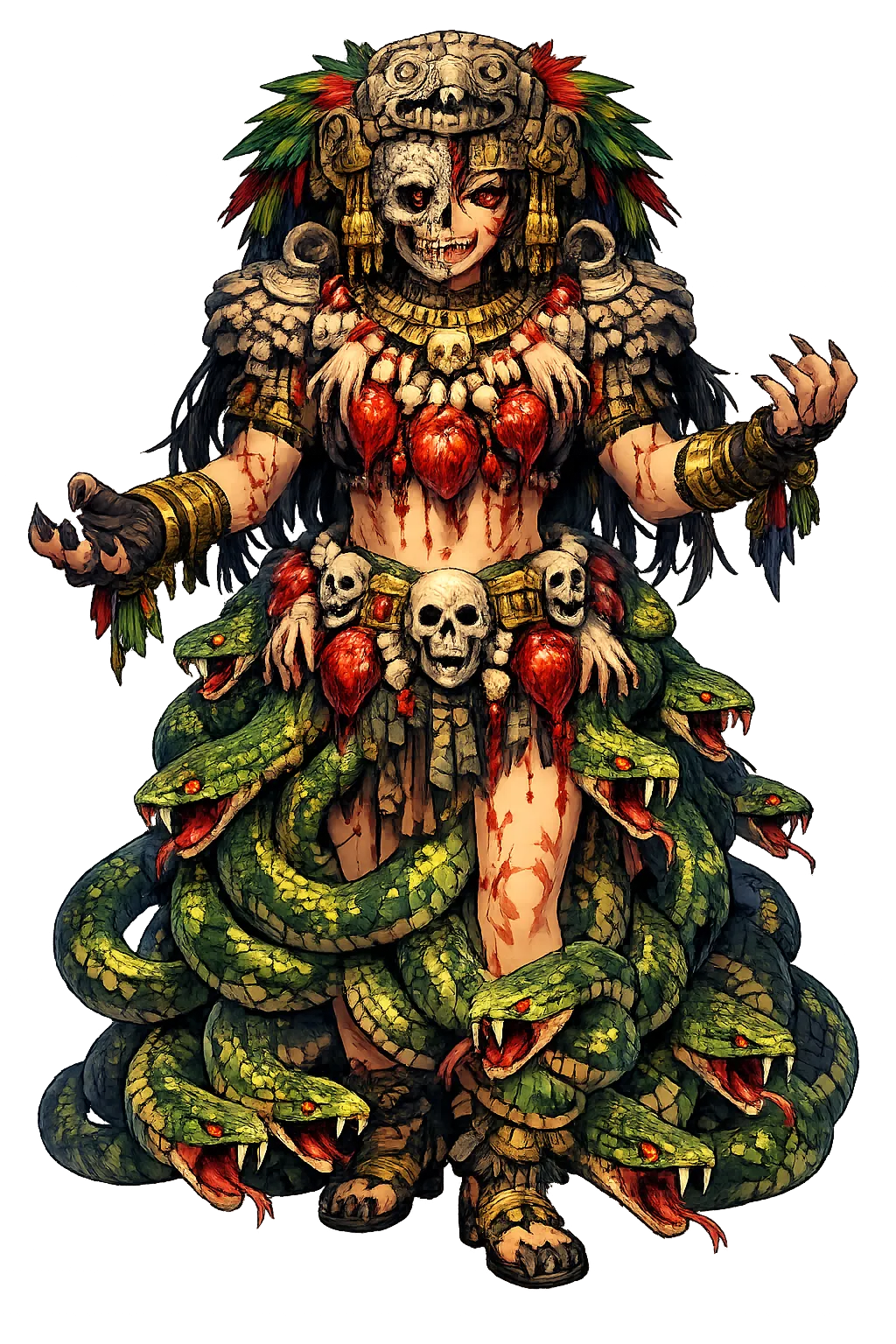
Cōātlīcue is the terrible mother at the center of the Aztec cosmos, the earth goddess whose skirt is made of woven serpents and whose necklace of human hands and hearts proclaims her appetite. She is not a gentle nurturer: she is the devouring ground that receives the dead and the fertile soil that demands blood to bear again. In her image, creation and destruction wear the same face.
She embodies the fertile and unstable earth; her womb births the stars, the moon, and the sun itself.
Called Tēteoh īnnān, she is the progenitor of Huitzilopōchtli, Coyolxāuhqui, and the Centzōn Huītznāhua.
The earth receives corpses and transforms them; her gaping maw and clawed feet mark her as death-in-life.
Blood and hearts are the offerings that sustain her; without them the sun cannot rise and the crops cannot grow.
Stories of Cōātlīcue
Cōātlīcue's best-known myth is the birth of the sun god Huitzilopōchtli, a story of cosmic matricide in which one child is chosen and the others are cast into the sky. The narrative is preserved in the Florentine Codex and colonial Nahuatl histories; it fuses divine genealogy with political theology.
While Cōātlīcue was sweeping on the sacred mountain Coatepec, 'Serpent Mountain,' a ball of feathers descended and she placed it in her bosom. By this she conceived Huitzilopōchtli. Her daughter Coyolxāuhqui and the Centzōn Huītznāhua were enraged at the shame of a mysterious pregnancy and resolved to kill her. At the moment of their attack, Huitzilopōchtli emerged fully armed from his mother's womb, slew Coyolxāuhqui, and scattered the four hundred brothers across the heavens as stars. (Florentine Codex III; Anales de Cuauhtitlan.)
The myth of Huitzilopōchtli's birth was mapped onto the landscape of Tenochtitlan: the Templo Mayor was identified with Coatepec, Cōātlīcue's shrine stood at its base, and the great stone disk of Coyolxāuhqui lay at the foot of Huitzilopōchtli's temple stairway. The narrative thus legitimized the Mexica state by casting its enemies as the defeated celestial rebels.
In some accounts Cōātlīcue is the mother not only of Huitzilopōchtli but of the moon and the stars. Her body is the earth itself; her dismembered or transformed children become the luminous bodies that move above her. The image binds cosmology to agriculture: the sky is born from the earth, and the earth in turn receives the sky's dead.
Cōātlīcue asks us to look at the earth without sentimentality. She is not the passive 'mother nature' of romantic painting; she is the soil that receives corpses, the mountain that gives birth to warriors, the skirt of snakes that moves even when she stands still. To approach her is to accept that fertility and death are not opposites but phases of a single metabolism.
Enter Extended Lore