PuniCodex

Extended Lore

Cōātlīcue

Etymology · Phonology · Orthography · Cultural Legacy · Primary Sources

Tier 1 Cōātlīcue.com
Cōātlīcue — Earth, Mother of Gods
01

Quick Facts

Essential information about Cōātlīcue, Earth, Mother of Gods

Scholarly TransliterationCōātlīcue
Unicode RestorationCōātlīcue
Reconstructed Pronunciation/koː.aːˈtɬiː.kwe/
PantheonNahuatl
DomainEarth, Mother of Gods
MeaningShe of the serpent skirt
ClassificationTier 1
Primary DomainCōātlīcue.com
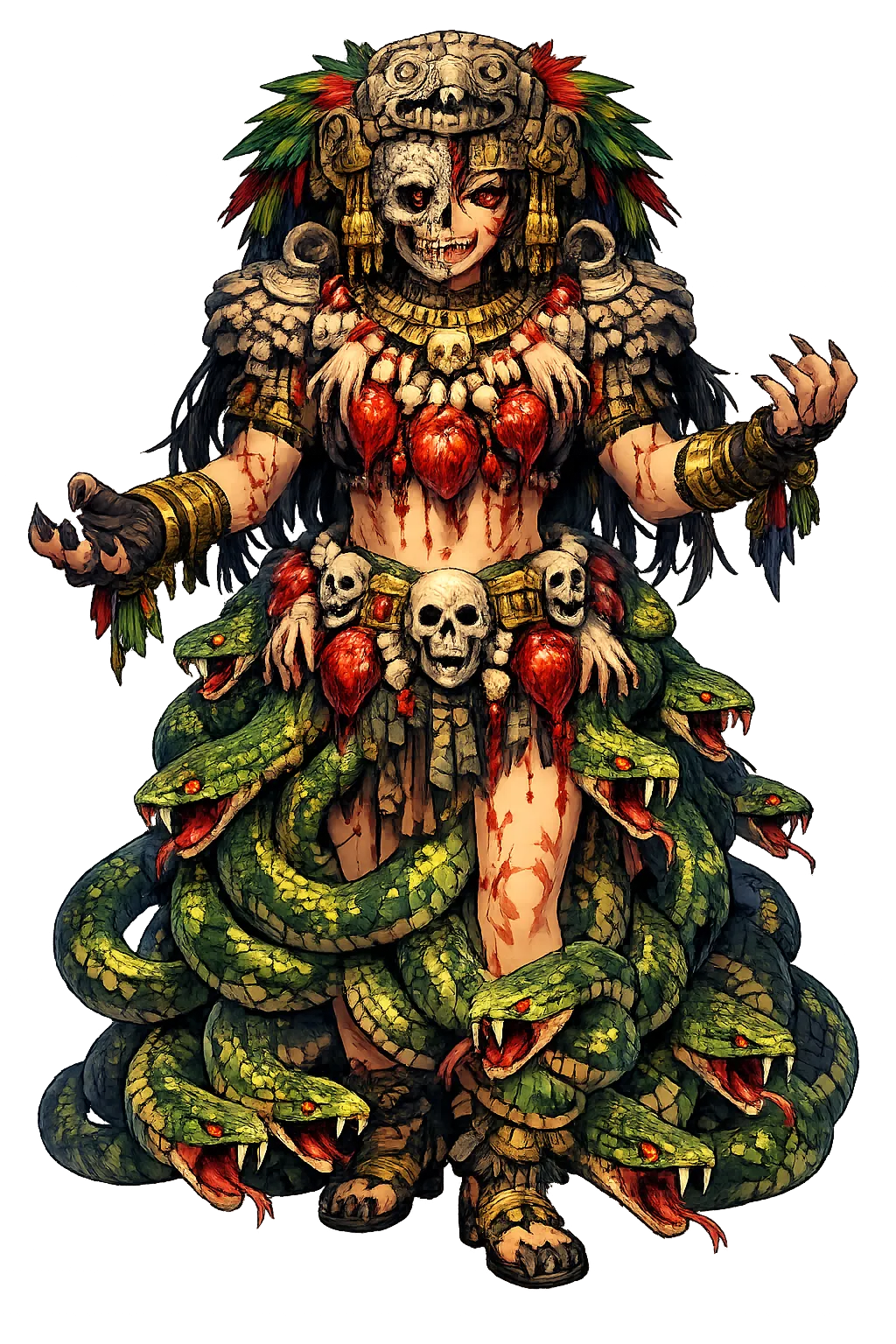
Sacred SymbolsSerpent skirt, Necklace of hands and hearts, Two serpent heads, Clawed feet
02

Etymology & Word Family

From original script to Unicode restoration

Scholarly Transliteration Cōātlīcue Cōātlīcue — "She of the serpent skirt"
Unicode Restoration Cōātlīcue Restored stress, length, and script
Modern ASCII coatlicue Plain-ASCII fallback

Classical Nahuatl vowel length is the key prosodic feature preserved here. The name is transparently composed of cōātl ('snake, serpent') and īcue ('her skirt'), a possessive form of cueitl 'skirt.' The final labiovelar [kwe] is not a diphthong in English terms but a velar stop followed by a labial glide. Tier 1: the three macrons preserve reconstructed long vowels in the first, second, and fourth syllables.

03

Unicode Character Breakdown

Character-by-character philological analysis

CharacterUnicodeNameBlockPhonetic Role
CU+0043Latin Capital Letter CBasic LatinSame
ōU+014DLatin Small Letter O with MacronLatin Extended-AMacron: long vowel
āU+0101Latin Small Letter A with MacronLatin Extended-AMacron: long vowel
tU+0074Latin Small Letter TBasic LatinSame
lU+006CLatin Small Letter LBasic LatinSame
īU+012BLatin Small Letter I with MacronLatin Extended-AMacron: long vowel
cU+0063Latin Small Letter CBasic LatinSame
uU+0075Latin Small Letter UBasic LatinSame
eU+0065Latin Small Letter EBasic LatinSame

The Tier 1 classification reflects which ancient features stress, length, or script are preserved in this restoration.

04

Cultural Significance

From ancient cult to modern Unicode

Ancient Domain

Cōātlīcue is the terrible mother at the center of the Aztec cosmos, the earth goddess whose skirt is made of woven serpents and whose necklace of human hands and hearts proclaims her appetite. She is not a gentle nurturer: she is the devouring ground that receives the dead and the fertile soil that demands blood to bear again. In her image, creation and destruction wear the same face.

Cōātlīcue in Later Traditions

Cōātlīcue overlaps functionally with Tlāltēcuhtli, the 'Lord of the Earth,' and with Tōnantzin, 'Our Mother,' a more generic and venerable earth-mother figure. The Spanish friars frequently interpreted these overlapping female earth powers through the lens of the Virgin Mary, so that the basilica of Guadalupe came to be identified with an ancient sacred site of Tōnantzin. Modern scholars debate whether this was a successful Christian substitution or a subaltern persistence of pre-contact devotion under a new name.

Modern Legacy

The monumental basalt statue of Cōātlīcue unearthed in Mexico City in 1790 became one of the defining images of Aztec art and was displayed alongside the Calendar Stone and the Stone of Tīzoc. She appears in museum exhibitions worldwide as an emblem of Mesoamerican sacred violence and maternal power. In contemporary Mexican and Chicana feminism, Cōātlīcue has been reclaimed as a symbol of indestructible female creativity, the earth that survives conquest and continues to give birth.

Unicode Restoration as Cultural Act

Restoring Cōātlīcue in a domain name is more than orthographic accuracy. It is a statement that the internet should recognize the full range of human writing — not only the ASCII keyboard.

05

Frequently Asked Questions

Common questions about Cōātlīcue, Earth, Mother of Gods, and Unicode restoration

01How do you pronounce Cōātlīcue?

In reconstructed pronunciation, Cōātlīcue is /koː.aːˈtɬiː.kwe/ — approximately 'koh-AH-tlee-kweh' — the 'tl' is one crisp sound, and the macrons stretch the o, a, and i into long vowels..

02What does Cōātlīcue mean?

Cōātlīcue means She of the serpent skirt in the nahuatl tradition.

03What are the symbols of Cōātlīcue?

Cōātlīcue is associated with Serpent skirt (Her identifying garment of intertwined snakes, symbolizing the living, dangerous, regenerative earth), Necklace of hands and hearts (A garland of sacrificial trophies marking her role as receiver of war-dead and tribute), Two serpent heads (Her own head is replaced by facing serpent faces, signifying duality and the gaping maw of the earth), Clawed feet (Talons that can dig and grasp, identifying her with predatory earth powers and burial).

04Why restore Cōātlīcue in Unicode?

Plain ASCII coatlicue strips the stress, length, and script that make the name specific. Unicode restoration returns the name to its original written dignity.

05What is the most important myth about Cōātlīcue?

While Cōātlīcue was sweeping on the sacred mountain Coatepec, 'Serpent Mountain,' a ball of feathers descended and she placed it in her bosom. By this she conceived Huitzilopōchtli. Her daughter Coyolxāuhqui and the Centzōn Huītznāhua were enraged at the shame of a mysterious pregnancy and resolved to kill her. At the moment of their attack, Huitzilopōchtli emerged fully armed from his mother's womb, slew Coyolxāuhqui, and scattered the four hundred brothers across the heavens as stars. (Florentine Codex III; Anales de Cuauhtitlan.)

06

Scholarly Sources

The philological foundations of this restoration

Every claim on this page is grounded in established scholarship. The orthographic restorations follow disciplinary convention. The etymological chain follows the best available reference works. This is not invention — it is resurrection through scholarship.

Lexicography & Philology

  • Karttunen

Primary Texts

  • The Florentine Codex (Sahagún); the Anales de Cuauhtitlan; colonial Nahuatl testimonies and pictorial manuscripts.

Archaeology & Art History

  • Moctezuma, The Great Temple of the Aztecs
  • The most famous image of Cōātlīcue is the 2.5-meter basalt statue discovered near the Cathedral of Mexico City in 1790, now in the National Museum of Anthropology. Excavations at the Templo Mayor have revealed her shrine at the foot of the temple pyramid, the massive Coyolxāuhqui stone disk, and numerous offerings of seashells, coral, and sacrificial remains. The spatial layout of the sacred precinct dramatizes the myth: Coatepec as the temple, Cōātlīcue as its base, and Huitzilopōchtli's shrine above.

Religious Studies

  • Sahagún, Florentine Codex (General History of the Things of New Spain)
  • Anales de Cuauhtitlan
  • Durán, Book of the Gods and Rites and the Ancient Calendar
  • Karttunen, An Analytical Dictionary of Nahuatl
  • Andrews, Introduction to Classical Nahuatl
  • López Austin, The Human Body and Ideology: Concepts of the Ancient Nahuas
  • Klein, 'The Shield Women: Resolution of an Aztec Gender Paradox'
Return

The Surface Awaits

You have traced the name from its earliest attestation to its Unicode restoration. Now return to the myth. The story is where the name lives.

Back to Lore
Cōātlīcue mascot