
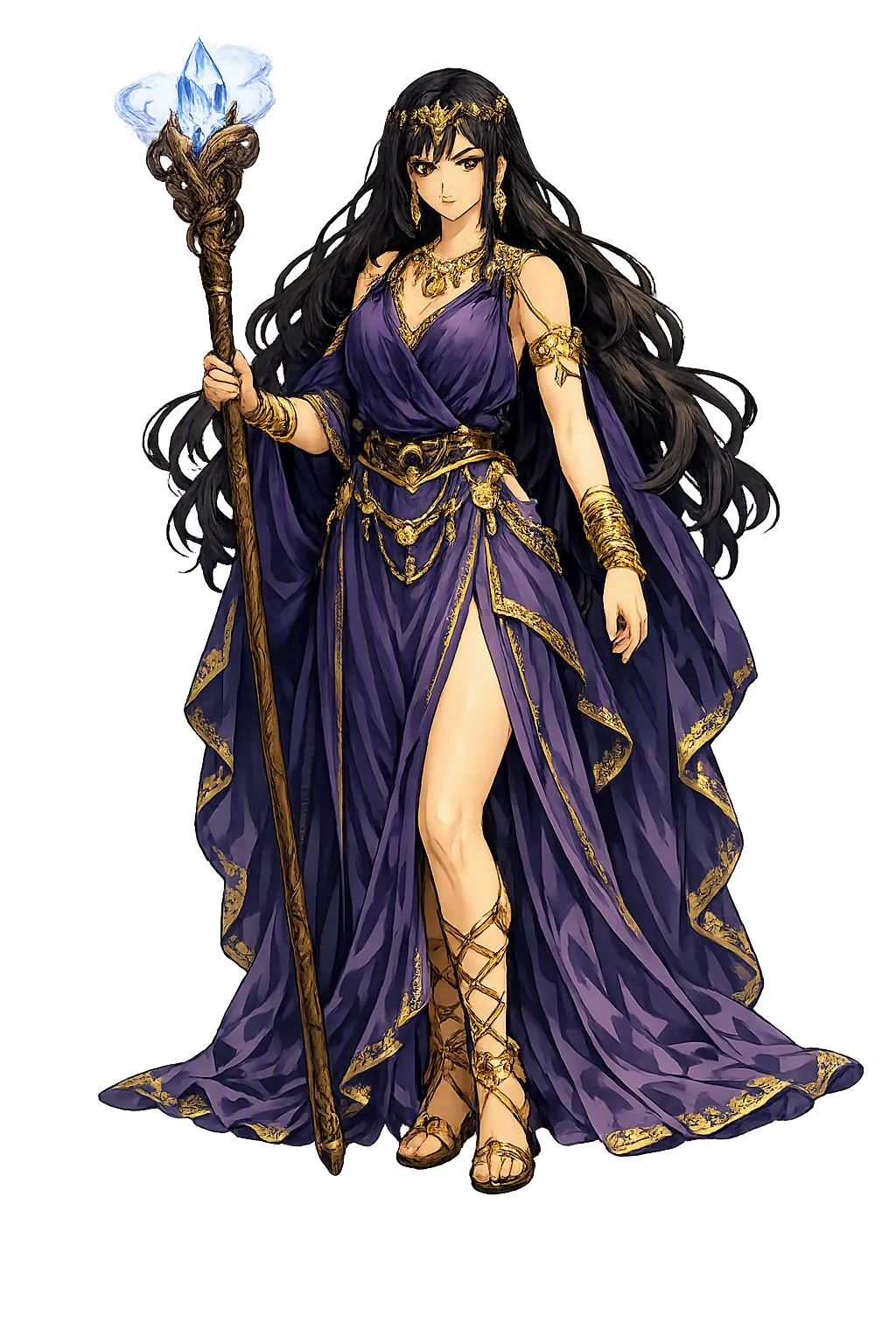
The hidden history behind Kírkē
Behind the modern ASCII form circe hides a much longer story. Kírkē reaches back through manuscripts, inscriptions, and oral tradition long before it ever touched a keyboard, and every mark in the restored spelling is a receipt from that journey. In what follows we trace the name from its Greek attestations through its mythology, its cult, its symbols, and its afterlife in other cultures — and we show how the PuniCodex project turned that philological record into a Unicode domain that resolves today. The history was never lost. It was only waiting for the infrastructure to catch up.
At a Glance
- Restored name: Kírkē
- ASCII form: circe
- Meaning: "Falcon, bird of prey"
- Domain of influence: Sorceress, Aeaea, Transformations
- Pantheon: Greek
- Classification: Tier 1
- Original script: Κίρκη (Greek)
- Live domain: kírkē.com
Overview
Kírkē (circe) — Sorceress, Aeaea, Transformations · Falcon, bird of prey — belongs to the Greek tradition, where it is catalogued under the domain "Sorceress, Aeaea, Transformations". The name means "Falcon, bird of prey".
Kírkē is the daughter of Hēlios and the Oceanid Perse, sister of Aiētēs and Pasiphaē, aunt of Médeia — the Sun's own child keeping house alone on Aiaia, an island at the edge of the charted world. Homer calls her a dread goddess endowed with speech (δεινὴ θεὸς αὐδήεσσα) and polýpharmakos, mistress of many drugs. She is the first great enchantress of Western literature, and her wand does not kill men: it unmakes them, penning the human mind inside the bodies of beasts.
PuniCodex restores the name as Kírkē and serves its temple at kírkē.com. The original carries both stress and vowel length, and exactly one historically valid Unicode restoration exists, which places the name in Tier 1. The plain ASCII form circe survives as a modern convenience imposed by the early domain-name system; the restoration, not the fallback, is the form the project defends as philologically complete.
The Name
The name is attested in Greek as Κίρκη. Etymologically it means "Falcon, bird of prey".
The ASCII form circe survives only because the early domain-name system could not carry diacritics; it is a technological compromise, not an ancient spelling. The Unicode restoration Kírkē recovers both the stress accent and the vowel length of the original directly in the address bar. The original carries both stress and vowel length, and exactly one historically valid Unicode restoration exists, which places the name in Tier 1.
The letter-by-letter transformation runs:
- c → K — Kappa
- i → í — Acute on iota
- r → r — Rho
- c → k — Kappa
- e → ē — Eta: long epsilon
The project holds the domain kírkē.com (xn--krk-rma6q.com) as the canonical home of this name.
The Original Script
The name is written in Greek as Κίρκη. This original script is the form against which the ASCII fallback circe and the PuniCodex restoration Kírkē are measured: the restoration preserves both its pitch accent and its vowel quantity of the written form, so that a reader typing the modern address still speaks the ancient name.
Pronunciation
The reconstructed pronunciation of the name is /kír.kɛː/ — Attic Greek Reconstruction.
Phoneme by phoneme:
- Kí- — Kappa with a short iota under the acute — the pitch springs high, then the rolled rho snaps it shut, like a falcon turning on the wind.
- -kē — A second kappa released into the long open eta [ɛː] — the name ends wide and held, never the English 'see'.
For the modern speaker, the closest approximation is: 'KEER-keh' — high pitch on the first syllable, a trilled rho, and a long open final vowel; English 'SUR-see' has wandered far from the falcon's name.
Kindred and historical forms of the name:
- Greek — κίρκος (kírkos), 'hawk, falcon' — also 'ring, circle'; the word her name is usually traced to
- PIE — no secure Indo-European etymology; Beekes treats Κίρκη as Pre-Greek, a divine name of the Aegean substrate
Kírkē is the boundary case of the Greek list. The Greek Κίρκη carries both features the mechanical tier rule watches for — the acute pitch of the first syllable and the long final eta — and the restoration Kírkē preserves both against the Latinized 'Circe,' which shed them. This entry follows the catalog's Tier-2 assignment; a strict reading of the rule would promote her to the first rank, and her double signature is recorded here so the classification never hardens into doctrine.
Mythology
Kírkē's myths turn on the unstable border between human and animal — and on Homer's strangest reversal: the goddess who defeats every man she meets becomes, the hour she is beaten, the hero's most useful ally.
The Men Made Swine (The Wand)
In Odyssey 10 (208–243), Eurylochus leads twenty-two scouts to Kírkē's hall, past mountain wolves and lions that fawn like dogs — creatures she herself had charmed with evil drugs. She mixes the men a potion of barley, cheese, and pale honey in Pramneian wine, hides pharmaka in the food, strikes them with her wand, and pens them in the sties. They take the heads, the voice, the bristles, and the shape of swine — 'but their mind remained as firm as before' (10.240). Homer does not say she made them beasts; he says the men went on thinking inside the beast, the most quietly horrifying line in the poem. Odysseus comes for them armed with the moly Hermes gives him (10.275–306) — the black-rooted, milk-flowered herb that is hard for mortals to dig, but the gods can do all things.
A Year of Feasting, Then the Road to the Dead (The Bargain)
Her drugs fail against the moly, and Kírkē — recognizing an old prophecy fulfilled — changes sides: she swears the great oath to plot no further harm and takes him to her bed (Odyssey 10.343–346). She restores the crew younger, taller, and fairer than before (10.388–396), and they sit a whole year feasting on abundant flesh and sweet wine (10.467–477). When Odysseus asks to leave, she does not hinder him; she gives him the voyage no living man has sailed — down to the house of Hades and dread Persephone, to consult the soul of the blind seer Teiresias (10.487–540). She names the rock where Pyriphlegethon and Cocytus fall into Acheron and prescribes the blood of a black ram and a ewe to summon the dead. The enchantress becomes the guide: the katabasis of the Odyssey is her itinerary.
Telegonus, the Son Born from Afar (After Homer)
Hesiod already knows children of the union: Kírkē, 'in love with steadfast Odysseus,' bears Agrius, Latinus, and Telegonus, 'who ruled over all the much-famed Tyrrhenians' (Theogony 1011–1016 — lines some editors bracket as post-Hesiodic, but our oldest witness to her Italian afterlife). The lost Telegony of Eugammon of Cyrene, preserved in Proclus's summary, completes the tragedy: grown Telegonus sails to find his father and, raiding a coast he does not know, kills Odysseus in ignorance with a spear tipped with a sting-ray's barb — the gentle death 'from the sea' that Teiresias foretold (Odyssey 11.134). He carries the body and Penelope home to Aiaia; Telegonus marries Penelope, Telemachus marries Kírkē herself, and the goddess makes them all immortal and sends them to the Isles of the Blest.
The Poisoning of Scylla (The Rival)
Ovid gives her the witch's cruelest afterlife. The sea-god Glaucus comes to Kírkē for a charm to win the nymph Scylla; Kírkē offers herself instead, is refused, and answers like the daughter of the Sun she is — she grinds her herbs, crosses to the pool, and poisons the water where Scylla bathes (Metamorphoses 14.1–74). Scylla rises to the waist in a ring of barking dogs and becomes the monster of the strait that will one day face Charybdis — the very Scylla whom Kírkē herself teaches Odysseus to pass (Odyssey 12.116–126). In the same book she turns the Latian king Picus into a woodpecker for loving Canens (14.320–434). Rome's Circe does not retire; she curdles the seas and forests of Italy.
Symbols & Iconography
The iconography associated with Kírkē concentrates in a small set of recurring attributes, each a compressed statement about the name:
- The wand (rhábdos) — With a single stroke she pens the crew in the sties — the original witch's wand of European literature (Odyssey 10.238)
- The cup — Barley, cheese, and pale honey in Pramneian wine, with the pharmaka stirred into the food (Odyssey 10.234–235)
- Swine — Her transformed company: beast in head, voice, bristle, and shape — 'but the mind remained as before' (Odyssey 10.239–243)
- Wolves and lions — Mountain beasts charmed by her evil drugs that fawn like dogs at her door (Odyssey 10.212–219)
- The loom — The sailors first hear her singing at a great immortal web — goddesses' work, delicate and glorious (Odyssey 10.221–223)
- Moly — The black-rooted, milk-white-flowered herb Hermes gives against her drugs — hard for mortals to dig (Odyssey 10.302–306)
- The falcon — Kírkos, the hawk: the word her name is usually traced to — the predator hidden inside the enchantress
Archaeology & Evidence
No excavated sanctuary of Kírkē herself survives; her cult was Roman and coastal. Strabo (5.3.6) reports that the promontory of Circeii — modern Monte Circeo in Lazio — was believed to have once been an island, as Homer's Aiaia was, and that a temple of Circe was pointed out there; the marshy plain behind the cape still shows how the 'island' silted into the mainland. Archaic art took her up earlier than almost any other Homeric episode: Boeotian black-figure vases of the sixth century BCE paint Odysseus drawing his sword on her amid men already bristling into beasts, and an archaic painter is named 'the Circe Painter' for the scene.
Realm & Domain
Kírkē is the daughter of Hēlios and the Oceanid Perse, sister of Aiētēs and Pasiphaē, aunt of Médeia — the Sun's own child keeping house alone on Aiaia, an island at the edge of the charted world. Homer calls her a dread goddess endowed with speech (δεινὴ θεὸς αὐδήεσσα) and polýpharmakos, mistress of many drugs. She is the first great enchantress of Western literature, and her wand does not kill men: it unmakes them, penning the human mind inside the bodies of beasts.
Pharmaka
Her art runs through drugs: barley, cheese, and pale honey stirred into Pramneian wine, the pharmaka hidden in the food (Odyssey 10.234–235).
Metamorphosis
She is the Greeks' first great thought-experiment on form: the body unmade, the mind left watching from inside the beast.
Aiaia
Her island at the world's edge: Homer moors it where the dawn rises; Rome moved it west to the cape that still bears her name.
Across Cultures
Rome did not need to invent a Latin Kírkē; it simply moved her in. Hesiod had already posted her sons to the Tyrrhenian coast, and Virgil's Aeneas skirts 'the shores of Circe's land,' where the daughter of the Sun sings ceaselessly in her groves while the groans of her transformed men roll out across the water (Aeneid 7.10–24). The promontory of Circeii claimed her temple (Strabo 5.3.6), and Horace calls Tusculum 'the hills of Telegonus the parricide' (Odes 3.29.8) — her son naturalized as a founder of Latin towns. From there she passes into the European imagination as the archetype of the enchantress: the witch with a pedigree, a loom, and a cup.
Within the Greek tradition, closely related names in the corpus include Achérōn, Achilleús, Adámas, Aḗr, Aithḗr, and Anánkē.
Cultural Legacy
English keeps her as an adjective: Circean — bewitching, dangerously seductive, charming in the way that unmakes a man. Cape Circeo still bears her name on the Tyrrhenian coast, and if the old derivation of her name from kírkos ('ring; hawk') holds, she shares a root with Latin circus — and so with English circle and circus. The nineteenth century painted her endlessly — Waterhouse's Circe Offering the Cup to Ulysses (1891) and Circe Invidiosa (1892) are the icons — and every island sorceress with a wand and a potion since is her descendant. Restoring Kírkē restores the falcon in the enchantress's name.
The Scholarly Record
The account of Kírkē given in this edition rests on the witnesses and reference works listed below. Lexica and etymological dictionaries secure the form and meaning of the name; the literary and religious texts supply the narrative evidence.
- Liddell-Scott-Jones Greek-English Lexicon, 9th ed. with 1996 supplement, 1940. Full text
- Wörterbuch der griechischen Eigennamen, 3rd ed., 1863. Full text
- Etymological Dictionary of Greek, 2 vols., Brill, 2010. Full text
- Chantraine.
- Homer, Iliad / Odyssey, Loeb Classical Library / Oxford Classical Texts, 750 BCE. Full text
- Odyssey.
- Hesiod, Theogony / Works and Days / Shield, Loeb Classical Library No. 57, 700 BCE. Full text
- Theogony.
- Apollodorus, Bibliotheca, Loeb Classical Library (Frazer), 150.
- Ovid (Publius Ovidius Naso), Metamorphoses / Fasti / Heroides, Loeb Classical Library, 17. Full text
- Virgil (Publius Vergilius Maro), Aeneid / Eclogues / Georgics, Loeb Classical Library / Oxford Classical Texts, 19 BCE. Full text
- Proclus.
A Meditation
The Greeks never decided whether Kírkē was danger or salvation, and Homer refuses to help. He calls her a dread goddess, then lets her feed the hero for a year, arm him against the Sirens and Scylla, and draw him the only map of the underworld Greek epic possesses. She is the poem's most accomplished divinity after Athēnâ — and the only one whose power is chemical. Pharmaka, not thunderbolts: the Greeks suspected that transformation, like poisons and potions, was women's work, and Kírkē is that suspicion deified and stranded on an island where no husband can check her.
Her deepest moment is a piece of grammar: the swine keep their noos, their mind, 'firm as before' (Odyssey 10.240) — what is a person, Homer asks, if the body can be unmade around it? Even her geography is a riddle: he moors Aiaia 'where are the dancing-floors of Dawn and the risings of the sun' (Odyssey 12.3–4), the far east, while Rome dragged her west to the Tyrrhenian cape. The honest answer is that Aiaia lies wherever the charted world ends — and Kírkē is what waits there: the intelligence of the wild, articulate, patient, and not to be trifled with.
The Unicode Restoration
Kírkē is classified as Tier 1: the original carries both stress and length, and only one valid Unicode restoration exists. The ASCII fallback circe still resolves everywhere, but it is the restored form that carries the name's full information. Across the 5 characters of the name, the restoration adjusts 2: 1 mark of stress (í); 1 mark of length (ē). That is the whole thesis of this temple: the marks are the message.
Character by Character
The journey from circe to Kírkē, one character at a time:
- c → K — Kappa
- i → í — Acute on iota
- r → r — Rho
- c → k — Kappa
- e → ē — Eta: long epsilon
The Domain Name
The restored name is live as a working domain: kírkē.com, which the DNS carries in punycode form as xn--krk-rma6q.com — an ASCII-compatible encoding that lets a non-ASCII name travel the global network without breaking older infrastructure. The visitor sees Kírkē; the machines see the encoding. That duality is the engineering compromise on which the entire restoration rests, and it is why a name written the way its own tradition wrote it in Greek can now be typed into any browser on earth.
Why This Restoration Matters
The story of Kírkē did not end in antiquity; it changed medium. Names that survive for millennia do so because each generation finds a new carrier for them — clay, papyrus, print, and now DNS. The PuniCodex restoration simply makes the carrier honest: the spelling that resolves is the spelling the evidence supports. If this post showed anything, it is that circe and Kírkē are not the same name with different styling. They are a summary and the text it summarizes. The web can now serve the text.
Explore Further
This post is one doorway into the temple. The home page carries the full character breakdown and the ambient canvas; the lore page tells the myths in long form; the Scholarly Edition preserves the sources, pronunciation data, and revision history; and the patron wall supports the restoration directly. For the wider map, browse the Lexicon, explore the Pantheon, or return to the PuniCodex blog.
Related Names
Sources
The full scholarly apparatus — every citation, revision, and review — lives in the Scholarly Edition. Key references for this post:
- Liddell-Scott-Jones Greek-English Lexicon, 9th ed. with 1996 supplement, 1940.
- Wörterbuch der griechischen Eigennamen, 3rd ed., 1863.
- Etymological Dictionary of Greek, 2 vols., Brill, 2010.
- Homer, Iliad / Odyssey, Loeb Classical Library / Oxford Classical Texts, 750 BCE.
- Hesiod, Theogony / Works and Days / Shield, Loeb Classical Library No. 57, 700 BCE.
- Ovid (Publius Ovidius Naso), Metamorphoses / Fasti / Heroides, Loeb Classical Library, 17.
- Chantraine.
- Odyssey.
- Theogony.
- Apollodorus, Bibliotheca, Loeb Classical Library (Frazer), 150.
- Lexicon authorities for this entry: LSJ, Pape-Benseler, Beekes.