
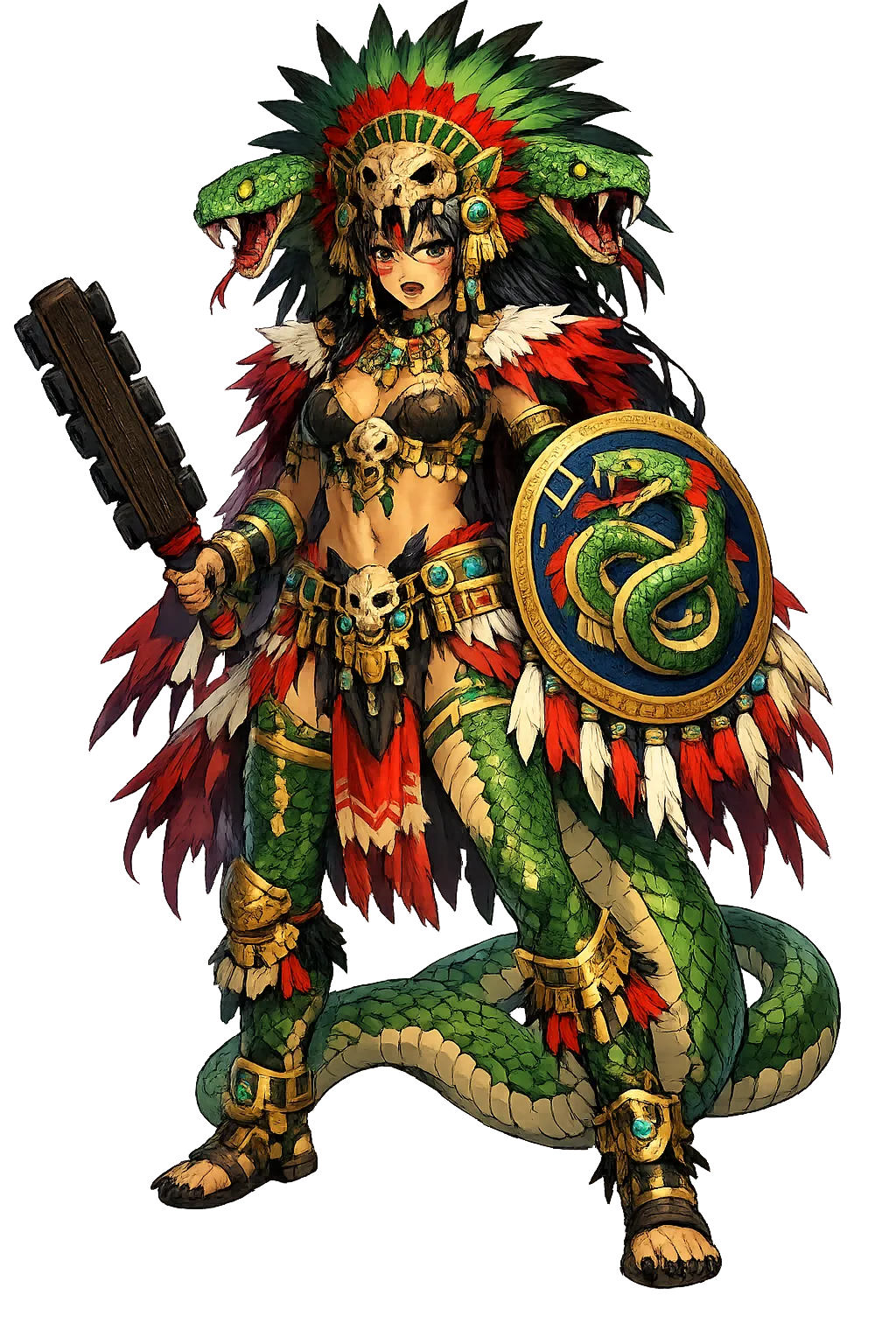
Pronouncing Cihuacōātl: a guide for the curious
Saying Cihuacōātl aloud is harder than reading it on a screen, and more rewarding. The restored spelling is a compressed pronunciation guide: every accent and macron is an instruction. This post unpacks those instructions — the reconstructed sound, the phoneme-by-phoneme record, the kindred forms in neighboring languages — and then zooms out to the full record around the name: its Nahuatl transcription writing, its mythology, its cult, and its modern life as a Unicode domain. Whether you arrive as a linguist, a reader of myth, or a domainer, you will leave able to say the name the way the evidence suggests it was said — and able to type it the way it was written.
At a Glance
- Restored name: Cihuacōātl
- ASCII form: cihuacoatl
- Meaning: "Snake Woman"
- Domain of influence: Childbirth, Motherhood, Earth
- Pantheon: Nahuatl
- Classification: Tier 2
- Live domain: cihuacōātl.com
Overview
Cihuacōātl (cihuacoatl) — "Snake Woman" — is one of the principal mother goddesses of the Mexica pantheon, a deity of childbirth and midwifery who is simultaneously reckoned a fierce omen of war and death. She was venerated as patroness of Culhuacan and its Chalmeca people and was paired or identified with the goddess Quilaztli.
Her character is double. In the birthing chamber she is the divine midwife to whom laboring women cry out, patroness of midwives and of the sweatbath where they practiced; in the street she is the weeping woman of the crossroads, the ghostly mother who — in the myth — abandoned her son Mixcōātl and found a sacrificial flint in his place. Women who died in first childbirth, the mocihuaquetzque ("those who died as women in war"), belonged to her sphere and escorted the sun from zenith to sunset as the feared cihuapipiltin.
The word also served as a political title: the cihuacōātl of Tenochtitlan was the state's second-ranking official, borne most famously by Tlacaēllel.
PuniCodex restores the name as Cihuacōātl, preserving the lexical long vowels (cihuā-tl + cōā-tl) that sixteenth-century orthography left unmarked; because the restoration carries a single prosodic feature — vowel length — the name is classed Tier 2. The temple is served at cihuacōātl.com.
The Name
The name is a transparent Classical Nahuatl compound of cihuātl "woman" and cōātl "serpent," hence "Snake Woman" (Karttunen: cihuā-tl, cōā-tl). It is no modern coinage: the name is attested in the earliest alphabetic records of Nahuatl — Sahagún's Florentine Codex writes cioa coatl and cioacoatl, and Durán writes Cihuacoatl — in a sixteenth-century orthography that had no device for vowel length.
The macrons of Cihuacōātl are the modern lexicographic restoration of that length, following the conventions of Karttunen and Andrews; the plain ASCII form cihuacoatl perpetuates the colonial spelling and survives in the domain-name system only because that system could not carry diacritics. The same compound functioned in Nahuatl as a common noun and as a state title — cihuacōātl, the "Woman-Snake" official of Tenochtitlan. Because the restored name carries one prosodic feature (vowel length) rather than a combination, it is classed Tier 2.
The letter-by-letter transformation runs:
- c → C — Same, capitalized
- i → i — Same
- h → h — Same
- u → u — Same
- a → a — Same
- c → c — Same
- o → ō — Macron on o
- a → ā — Macron on a
- t → t — Same
- l → l — Same
The project holds the domain cihuacōātl.com (xn--cihuactl-m7a37e.com) as the canonical home of this name.
The Original Script
Pre-conquest Nahua writing was logosyllabic: its signs stood for whole words and could be reinforced with phonetic complements, but the system did not spell out continuous phonetic text, and it possessed no convention for recording vowel length. Within that record Cihuacōātl is present chiefly as an image — the skeletal-jawed, serpent-framed goddess of the Codex Borgia group and the Codex Borbonicus — rather than as a spelled name.
The spelled attestations are colonial: Sahagún's Nahuatl-speaking scribes wrote the name in the Latin alphabet as cioa coatl. The form Cihuacōātl is therefore a modern scholarly transliteration that restores the attested long vowels of cihuā-tl and cōā-tl to the written word; no mark in it is decorative.
Pronunciation
The reconstructed pronunciation of the name is /siː.waˈkoː.aːtɬ/ — Classical Nahuatl Reconstruction.
Phoneme by phoneme:
- Cih- — Voiceless alveolar fricative [s] plus close front [i], a hissing opening that identifies the 'woman' element.
- -ua- — Rounded [w] plus open [a], the glide linking cihua- 'woman' to the snake element.
- -cō- — Voiceless velar stop [k] plus long back rounded [oː]; c before back vowels is /k/ in Classical Nahuatl.
- -ātl — Long open [aː] plus lateral affricate [tɬ]; final -tl is a single released sound.
For the modern speaker, the closest approximation is: 'see-wah-KOH-ahtl' — the first vowel is long, the 'c' is a hard 'k,' and the final -tl is one crisp tongue-stop.
Kindred and historical forms of the name:
- Classical Nahuatl — Cihuacōātl — from cihuātl 'woman' + cōātl 'snake, serpent'
- Title and office — Cihuacōātl was also the title of a high-ranking Mexica official, 'Woman-Snake,' the second voice of the ruler
- Modern spelling — Cihuacoatl, the conventional form that drops the macrons
The name is a transparent compound of cihuātl ('woman') and cōātl ('snake'). The same word was used as a political title, the Cihuacōātl or 'Woman-Snake,' a high official of the Mexica state. In religion, Cihuacōātl is a powerful goddess of childbirth, maternity, and the dangers that attend both. Tier 2: the macrons preserve vowel length, but the name lacks the additional feature needed for Tier 1 status.
Mythology
Cihuacōātl's mythology is preserved in the birth rituals recorded by Sahagún and in the widespread Mexican legend of the weeping woman. She is both a beneficent guardian and a terrifying ghost, a duality that reflects the high mortality of childbirth in the pre-modern world.
The Midwives' Prayer (Ritual myth)
Sahagún's informants describe how midwives addressed the newborn as a captive taken in battle and invoked Cihuacōātl as the divine protectress of the birthing chamber. The afterbirth was buried as an offering, and the child was ritually presented to the gods. Cihuacōātl's presence ensured that the dangerous passage from womb to world ended in life rather than death. (Florentine Codex VI.)
The Cihuapipiltin and the Crossroads (Ghost legend)
Women who died in childbirth were believed to become cihuapipiltin, 'noble women,' powerful spirits who wandered at night. They appeared at crossroads, weeping for their lost children, and could seize men or foretell disaster. A myth preserved in the colonial chronicles gives the pattern its etiology: Cihuacōātl herself bore the god Mixcōātl, abandoned the infant at a crossroads, and returned to weep for him, finding only a sacrificial flint knife in his place. Over time this figure merged with Spanish colonial lore to produce La Llorona, one of the most enduring figures of Mexican folklore.
The Cihuacōātl of Tenochtitlan (State office)
The title Cihuacōātl was also borne by a senior Mexica official, sometimes described as a 'vice-ruler' or chief counselor; Tlacaēllel held it under four successive rulers of the fifteenth century. The title's association with a powerful female deity suggests that the office carried sacred as well as administrative authority, perhaps overseeing internal order and justice while the tlātoāni managed external affairs.
Symbols & Iconography
The iconography associated with Cihuacōātl concentrates in a small set of recurring attributes, each a compressed statement about the name:
- Serpent — The snake element shared with Cōātlīcue, linking her to earth powers and regeneration
- Warrior's spears and shield — In the manuscripts she appears as a fierce, skull-faced old woman armed like a soldier, for childbirth itself was reckoned a battle in which the mother 'took a captive'
- Child swaddling-clothes — Midwives' equipment associated with her protection of births
- Crossroads at night — The liminal space where she appears as a weeping woman carrying a dead child
- Cihuapipiltin spirits — The 'noble women' who died in childbirth and became fierce omens and warriors of the sun
Archaeology & Evidence
Cihuacōātl left no monument as securely identified as the great Cōātlīcue of the Templo Mayor. A celebrated stone statue in the Museo Nacional de Antropología — a woman framed within the gaping jaws of a serpent — is conventionally labelled Cihuacōātl, but such identifications rest on iconographic comparison rather than inscriptions and remain debated. Her clearest iconographic record is pictorial: the skeletal-faced, serpent-associated goddess of the Codex Borgia group. On the ground her cult is documented chiefly through texts — the midwives' ritual speeches of Florentine Codex Book 6 and Durán's description of her temple and image — and through the small ceramic female figurines of household contexts; the crossroads shrines where offerings were made to the cihuapipiltin have left no excavated example.
Realm & Domain
Cihuacōātl is the divine midwife and the spectral woman who haunts the crossroads. In one aspect she protects women in labor; in another she wanders at night weeping for children who died unbaptized into life. She embodies the dangerous threshold between pregnancy and birth, life and death, the domestic hearth and the wild road.
Goddess of Childbirth
She aids women in labor and receives the afterbirth; midwives call upon her and make offerings.
Protector of Midwives
The tēntitl 'midwife' served as her human representative; birthing rituals invoked her power.
The Weeping Woman
La Llorona, the wailing specter of crossroads and waterways, descends partly from Cihuacōātl lore.
Fate and Threshold
She governs the dangerous moment when a new life crosses from the spirit world into the body.
Across Cultures
Cihuacōātl merges in popular memory with La Llorona, the weeping woman of crossroads and rivers, and with the Virgin Mary in her sorrowful or protective aspects. The cihuapipiltin spirits share traits with the Celtic-Spanish banshee and with other worldwide figures of the woman who died in childbirth. In Nahuatl religion she is closely related to Cōātlīcue and Tlāltēcuhtli, forming a cluster of serpent-and-earth maternal powers.
Within the Nahuatl tradition, closely related names in the corpus include [[coatlicue|Cōātlīcue]], [[huitzilopochtli|Huitzilopōchtli]], [[itzpapalotl|Itzpapālōtl]], [[mictlantecutli|Mictlāntēcutli]], [[quetzalcoatl|Quetzalcōātl]], and [[tlaloc|Tlāloc]].
Cultural Legacy
Cihuacōātl survives most visibly in La Llorona, a figure known throughout Mexico and the U.S.-Mexico borderlands. The weeping woman at the water's edge, mourning children lost to drowning, violence, or history, carries the ancient goddess into contemporary song, film, and political allegory.
The manuscript anchor of this descent is precise: the sixth of the eight omens catalogued in Book 12 of the Florentine Codex is a woman heard weeping in the night streets of Tenochtitlan before the conquest, crying 'O my children, where am I to take you?' — an apparition long identified with the goddess. Twentieth-century folklore scholarship, and later feminist and Chicana writers, have reclaimed both Cihuacōātl and La Llorona as figures of maternal grief and female autonomy, reading the weeping woman as the suppressed voice of indigenous women rather than a mere bogey.
The Scholarly Record
The account of Cihuacōātl given in this edition rests on the witnesses and reference works listed below. The sixteenth-century Nahuatl and Spanish chronicles (Sahagún, Durán) supply the primary evidence for cult and myth; the modern dictionaries (Karttunen, Andrews) secure the phonological form of the name; and the interpretive studies (López Austin, Nuttini and Roberts, Pérez) trace the goddess's afterlife in colonial and modern folklore.
- Sahagún, Florentine Codex.
- Durán, Book of the Gods and Rites.
- Karttunen, An Analytical Dictionary of Nahuatl.
- Andrews, Introduction to Classical Nahuatl.
- López Austin, The Human Body and Ideology.
- Nuttini and Roberts, Bloodsucking Witchcraft.
- Pérez, 'La Llorona: A Mexican Medea'.
A Meditation
Cihuacōātl lives at the threshold. She is the goddess you call when the door between life and death is swinging open and a child is trying to pass through. For most of human history, that door was wider than it is now; many women and infants did not survive the crossing. Cihuacōātl is the divine witness to that grief.
Her later form as La Llorona shows how ancient goddesses become ghosts, and how ghosts become moral lessons. But beneath the cautionary tale is something older and more tender: the recognition that birth is a battle, that mothers are warriors, and that some losses echo forever along the roads and rivers. To speak her name with the long vowels restored is to remember that this was once a goddess, not merely a bogey.
The Unicode Restoration
Cihuacōātl is classified as Tier 2: the original preserves at least one philological feature that ASCII cannot encode. The ASCII fallback cihuacoatl still resolves everywhere, but it is the restored form that carries the name's full information. Across the 10 characters of the name, the restoration adjusts 2: 2 marks of length (ō, ā). That is the whole thesis of this temple: the marks are the message.
Character by Character
The journey from cihuacoatl to Cihuacōātl, one character at a time:
- c → C — Same, capitalized
- i → i — Same
- h → h — Same
- u → u — Same
- a → a — Same
- c → c — Same
- o → ō — Macron on o
- a → ā — Macron on a
- t → t — Same
- l → l — Same
The Domain Name
The restored name is live as a working domain: cihuacōātl.com, which the DNS carries in punycode form as xn--cihuactl-m7a37e.com — an ASCII-compatible encoding that lets a non-ASCII name travel the global network without breaking older infrastructure. The visitor sees Cihuacōātl; the machines see the encoding. That duality is the engineering compromise on which the entire restoration rests, and it is why a name written the way its own tradition wrote it in Nahuatl transcription can now be typed into any browser on earth.
The Nahuatl Pantheon
Cihuacōātl is one of 28 entries the PuniCodex lexicon catalogues under the Nahuatl pantheon. The Pantheon page gathers the tradition's major figures in one place, and the Lexicon lets you filter all 895 restorations by tradition, tier, or script — the fastest way to see where this name sits among its kin.
Frequently Asked Questions
What does Cihuacōātl mean? The traditional gloss is "Snake Woman."
Which tradition does Cihuacōātl belong to? Cihuacōātl is catalogued in the Nahuatl pantheon of the PuniCodex lexicon.
Why is Cihuacōātl classified as Tier 2? Because the original preserves at least one philological feature that ASCII cannot encode — and the marks in the restored spelling preserve exactly that evidence.
Is Cihuacōātl a working domain? Yes — cihuacōātl.com resolves today and routes to this temple.
What is the punycode for cihuacōātl.com? The DNS encoding is xn--cihuactl-m7a37e.com; browsers perform the translation automatically, so visitors only ever see the restored name.
Typing Cihuacōātl
You do not need a special keyboard to use this restoration. The PuniCodex Type Tool converts the ASCII form cihuacoatl into Cihuacōātl as you type, and the browser extension offers the same conversion inside any text field. Copy the restored form, paste it into the address bar, and the DNS does the rest.
Sister Temples
Other temples in the Nahuatl pantheon include Mayāhuel, Mictlāntēcutli, and Quetzalcōātl — each with its own restoration story, its own scholarly record, and its own place in the lexicon.
Why This Restoration Matters
Pronunciation turns out to be the heart of the matter. The marks in Cihuacōātl are instructions for the voice, and a web that strips them is a web that mispronounces the past at scale. The restoration hands the instructions back: say it as the evidence suggests, type it as the tradition wrote it, and let the punycode machinery do the quiet translation in between. That is all the PuniCodex project asks of the infrastructure — and everything it asks of you, the reader, is to use the whole name.
Explore Further
This post is one doorway into the temple. The home page carries the full character breakdown and the ambient canvas; the lore page tells the myths in long form; the Scholarly Edition preserves the sources, pronunciation data, and revision history; and the patron wall supports the restoration directly. For the wider map, browse the Lexicon, explore the Pantheon, or return to the PuniCodex blog.
Related Names
Sources
The full scholarly apparatus — every citation, revision, and review — lives in the Scholarly Edition. Key references for this post:
- Sahagún, Florentine Codex, Book 6 (Rhetoric and Moral Philosophy).
- Miller and Taube, An Illustrated Dictionary of the Gods and Symbols of Ancient Mexico and the Maya (Thames & Hudson, 1993).
- Alvarado Tezozómoc, Crónica Mexicana.
- Karttunen, An Analytical Dictionary of Nahuatl.
- Andrews, Introduction to Classical Nahuatl.
- Lexicon authorities for this entry: Sahagún.