
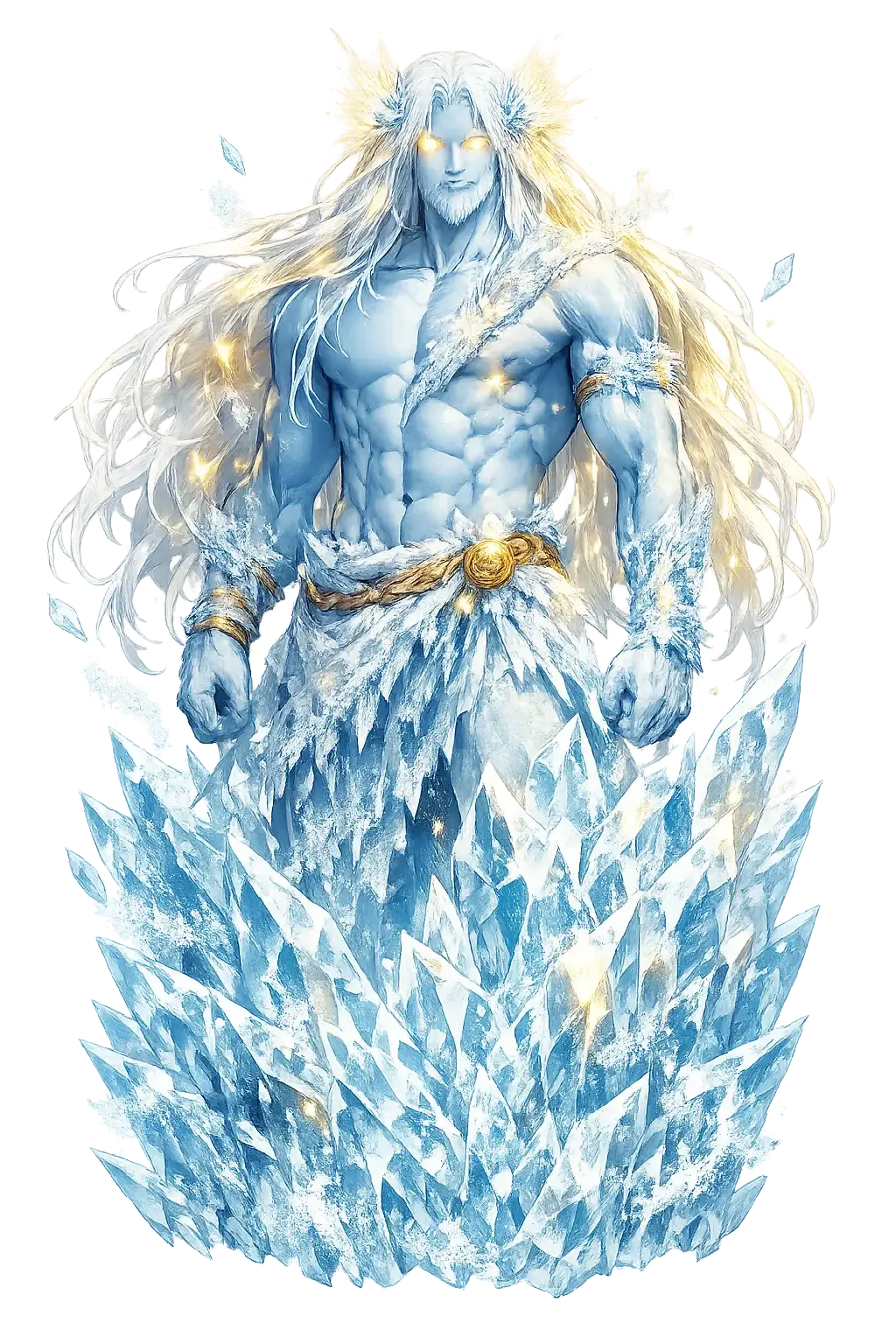
The name Búri and the world it opens
A name is a door. Búri opens onto an entire world: the domain of first god of the norse pantheon, progenitor of the æsir, a Norse tradition, and centuries of storytelling, worship, and scholarship. This post walks through that world room by room — the name and its roots, the original script, the sound of it, the myths, the symbols, the sites, the afterlife across cultures — and ends at the newest room of all: a Unicode domain that makes the whole structure addressable. buri gets you to the same building, but only the restored form tells you why it was built.
At a Glance
- Restored name: Búri
- ASCII form: buri
- Meaning: "In the Prose Edda, Búri is the primeval ancestor born from the salty rime, father of Borr and grandfather of Óðinn."
- Domain of influence: First God of the Norse Pantheon, Progenitor of the Æsir
- Pantheon: Norse
- Classification: Tier 2
- Original script: ᛒᚢᚱᛁ (Younger Futhark)
- Live domain: búri.com
Overview
Búri (buri) — First God of the Norse Pantheon, Progenitor of the Æsir · In the Prose Edda, Búri is the primeval ancestor born from the salty rime, father of Borr and grandfather of Óðinn. — belongs to the Norse tradition, where it is catalogued under the domain "First God of the Norse Pantheon, Progenitor of the Æsir". The name is attested only in Snorri's Prose Edda, where Búri is the primeval ancestor born from the salty rime, father of Borr and grandfather of Óðinn.
Búri is the first god in Norse mythology, the ancestor from whom all the Æsir descend. He was not born but revealed: the primeval cow Auðumla licked the salty rime of Niflheimr until a human shape emerged. From Búri came Burr, from Burr came Óðinn, Vili, and Vé, and from them came the world as we know it.
PuniCodex restores the name as Búri and serves its temple at búri.com. The original preserves one prosodic feature — stress or vowel length — rather than both, which places the name in Tier 2. The plain ASCII form buri survives as a modern convenience imposed by the early domain-name system; the restoration, not the fallback, is the form the project defends as philologically complete.
The Name
The name is attested in Younger Futhark as ᛒᚢᚱᛁ. It survives in a single medieval source, Snorri's Prose Edda, where Búri is named as the father of Burr and grandfather of Óðinn.
The lexicon records a speculative reconstruction to Proto-Indo-European bʰew-, 'to be, become', by way of the Old Norse verb búa, 'to dwell, prepare'. The reference works treat the etymology as unresolved: proposals include a derivative meaning 'producer, begetter', but none commands consensus, and the speculation should not be mistaken for a settled word-origin.
Cognate forms proposed under that derivation:
- búa (norse) — to dwell, to be
- be (english) — to exist
The ASCII form buri survives only because the early domain-name system could not carry diacritics; it is a technological compromise, not an ancient spelling. The Unicode restoration Búri recovers the stress accent of the original directly in the address bar. The original preserves one prosodic feature — stress or vowel length — rather than both, which places the name in Tier 2.
The letter-by-letter transformation runs:
- b → B — Same, capitalized
- u → ú — Acute marks stress on u
- r → r — Same
- i → i — Same
Attested and derived spellings of the name:
- búri.com — owned form: Owned domain form
- buri — ASCII form: Plain ASCII form
The project holds the domain búri.com (xn--bri-8na.com) as the canonical home of this name.
Etymology & Roots
The recorded derivation reads: Old Norse Búri, possibly from a root meaning "producer, begetter" (compare Old Norse búa "to dwell, to be").
The reconstructed proto-form is *bʰew- (proto-indo-european), glossed as "to be, become".
The reconstruction is classed as speculative.
Kindred forms recorded in the lexicon:
- búa (norse) — to dwell, to be
- be (english) — to exist
The Original Script
The name is preserved in Younger Futhark as ᛒᚢᚱᛁ — Old Norse runic, attested Viking Age, c. 800–1100 CE, in Scandinavia. The script is written left-to-right.
The scholarly transliteration is Búri.
The rendering proceeds step by step:
- ᛒ (bjarkan) writes /b/.
- ᚢ (úr) writes /u/ and /ú/.
- ᚱ (reið) writes /r/.
- ᛁ (ís) writes /i/.
- The runic spelling reflects normalized Old Norse Búri; Younger Futhark does not distinguish short and long vowels.
No runic inscription names the god: the futhark form is a scholarly normalization of the name transmitted by Snorri's prose, not an epigraphic attestation, and the acute accent marking vowel length is an editorial convention with no runic counterpart.
Pronunciation
The reconstructed pronunciation of the name is /ˈbuːri/ — Old Norse Reconstruction.
Phoneme by phoneme:
- B- — Voiced bilabial stop [b], the same as English 'b'.
- -ú- — Long close back rounded vowel [uː], marked by the acute accent for stress and length.
- -ri — Trilled alveolar [r] plus short close front [i].
For the modern speaker, the closest approximation is: 'BOO-ree' — hold the 'oo' long and stress it, then finish with a quick trilled r and short 'ee'.
Kindred and historical forms of the name:
- Old Norse — Búri, the first god licked free from the salty rime by the primeval cow Auðumla
- Proposed etymology — Possibly from búa, 'to dwell, to be, to produce'; the meaning is uncertain and should not be treated as established
- Lineage — Father of Burr/Borr; grandfather of Óðinn, Vili, and Vé
Búri is Tier 2: the acute on ú marks stress and length, but the name has no additional length mark or circumflex. The etymology is uncertain; the lexicon records a speculative connection to a root meaning 'to be, become' and the Old Norse verb búa. We describe attested cosmogony rather than claiming a settled word-origin.
Mythology
Búri has no adventures, no conflicts, no cult. His entire myth is cosmogonic: he is the first divine being, the point at which the inanimate cosmos becomes personal. Everything that follows in Norse mythology follows from his emergence.
The Licking of the Rime (Gylfaginning)
In Gylfaginning, Snorri tells how the primeval cow Auðumla licked the salty stones of Niflheimr. On the first day, hair appeared; on the second, a head; on the third, a whole man. This was Búri. He was beautiful, great, and the father of Burr, whose sons — Óðinn, Vili, and Vé — slew the giant [[ymir|Ymir]] and fashioned the world from his body.
The Line of the Æsir (Genealogy)
Búri → Burr → Óðinn, Vili, Vé. That simple genealogy underwrites the legitimacy of the Æsir. Unlike the giants, who descend from Ymir, the gods descend from a being who emerged without violence from the ice. It is a myth of clean origin in contrast to the bloody origin of the giants.
From Ice to God (Cosmogony)
The Norse cosmos begins in the meeting of fire and ice: the sparks of Múspell meet the rime of [[niflheimr|Niflheimr]], and the thawing drops form Ymir, the first giant. Búri appears independently, licked from the rime by Auðumla. The two primeval beings — giant and god — set up the antagonism that will drive the entire mythology. Völuspá's 'Burr's sons', who lift the lands from the sea, take the poetic genealogy back one generation but not two; Búri himself belongs to Snorri's prose account alone.
Symbols & Iconography
No depiction of Búri survives from the Viking Age: his 'iconography' is a set of motifs abstracted from Snorri's single chapter about him, not a visual tradition:
- Salt rime — The icy substance from which Búri was licked into shape, the raw matter of Niflheimr
- Primeval cow Auðumla — The nourisher whose licking revealed the first god, herself formed from the dripping rime
- Genealogical tree — The root of the Æsir family, from which Burr, Óðinn, and all later gods branch
- Ice and thaw — The cosmogonic transition from frozen chaos to living divinity
Later illustrations of the licking scene exist in modern Edda editions, but they illustrate the text rather than preserve any older image.
Archaeology & Evidence
No archaeological find names Búri, and none is expected: a figure attested in a single prose chapter had no cult, and cult is what leaves dedications, place-names, and images. His attestation is entirely literary, dependent on the Prose Edda of Snorri Sturluson and its medieval manuscript witnesses — above all Codex Regius, Codex Wormianus, and Codex Upsaliensis, all thirteenth- and fourteenth-century Icelandic codices. Scandinavian rock art and Bronze-Age imagery do include cattle and solar motifs, but none can be securely linked to Búri or to Auðumla, and connecting them would be speculation. The cosmogonic scene he anchors — the primeval cow, the rime, the emergence of the first being — belongs to the mythic imagination rather than to material cult.
Realm & Domain
Búri is the first god in Norse mythology, the ancestor from whom all the Æsir descend. He was not born but revealed: the primeval cow Auðumla licked the salty rime of Niflheimr until a human shape emerged. From Búri came Burr, from Burr came Óðinn, Vili, and Vé, and from them came the world as we know it.
Born from the Rime
Licked free from the ice of Niflheimr by the primeval cow Auðumla.
Father of Burr
His son Borr/Burr fathers Óðinn, Vili, and Vé — the 'Burr's sons' who raise the earth in Völuspá.
Progenitor of the Æsir
Every major god of the Norse pantheon traces descent from him.
Primeval Form
A human-shaped god emerging from the inanimate ice, the first animate divine being.
Across Cultures
Búri has no direct counterpart in other Germanic or Indo-European traditions, but his emergence from ice through the action of a primeval cow resembles other cosmogonic motifs in which the first being is shaped from inanimate matter or nourished by a bovine creature. Comparisons have been made to the Vedic primeval bull, the Iranian Gavaevodata, and various Indo-European cow/cosmogony figures; the parallel is suggestive but unproven, and Auðumla herself has no clear pedigree beyond Snorri. Auðumla's licking of Búri from the rime has also invited comparison with creation-through-licking in Finno-Ugric and other northern Eurasian traditions. Medieval Christian readers, including Snorri, often framed such stories as euhemerized or rationalized accounts of pre-Christian cosmology.
Within the Norse tradition, closely related names in the corpus include [[alfheimr|Álfheimr]], [[eggther|Eggþér]], [[helheimr|Helheimr]], [[jormungandr|Jǫrmungandr]], [[jotunheimr|Jötunheimr]], and [[midgardr|Miðgarðr]].
Cultural Legacy
Búri's reception is inseparable from the reception of Snorri's cosmogony: because his only attestation is Gylfaginning 6, every retelling that opens the Norse world with fire meeting ice inherits him. Standard modern retellings follow Snorri's sequence exactly — Kevin Crossley-Holland's The Norse Myths (1980), for example, opens its creation cycle with Auðumla licking the first man free from the rime. The scene's strange gentleness — a human shape revealed by a cow's patient tongue rather than by violence — has made it a stock subject of modern Edda illustration and a favored image in popular accounts of Norse creation. In modern Heathenry Búri is occasionally honored as the divine ancestor and first spark of consciousness in the frozen cosmos, though he has no cult precedent in the sources themselves.
The Scholarly Record
The account of Búri given in this edition rests on the witnesses and reference works listed below. Lexica and etymological dictionaries secure the form and meaning of the name; the literary and religious texts supply the narrative evidence.
- Snorri Sturluson, Prose Edda: Gylfaginning (Búri licked from the rime by Auðumla).
- Cleasby & Vigfusson, An Icelandic-English Dictionary (1874), s.v. Búri, búa.
- Zoëga, A Concise Dictionary of Old Icelandic (1910), s.v. Búri.
- de Vries, Jan, Altgermanische Religionsgeschichte.
- Simek, Rudolf, Dictionary of Northern Mythology.
- Lindow, John, Norse Mythology: A Guide to the Gods, Heroes, Rituals, and Beliefs.
A Meditation
Búri is the god before the gods. He has no personality because he is not yet a person; he is the moment when the cosmos becomes aware of itself. His son, grandson, and great-grandsons will do all the fighting, creating, and destroying. Búri's only act is to be.
That is enough. Every lineage needs a beginning, and Búri is the beginning of the Æsir. He reminds us that even the mightiest pantheons trace back to a single emergence: a shape in the ice, a cow's patient tongue, the first thaw. Snorri gives him no second chapter; the whole tradition rests on a few lines of one thirteenth-century book, and perhaps that suits a figure whose entire act is to begin. Before war, before wisdom, before thunder — there is simply being, beautiful and unexplained.
The Unicode Restoration
Búri is classified as Tier 2: the original preserves at least one philological feature that ASCII cannot encode. The ASCII fallback buri still resolves everywhere, but it is the restored form that carries the name's full information. Across the 4 characters of the name, the restoration adjusts 1: 1 mark of stress (ú). That is the whole thesis of this temple: the marks are the message.
Name Variations
The lexicon records 2 additional forms of the name:
- búri.com (owned) — Owned domain form
- buri (ascii) — Plain ASCII form
The temple uses Búri as the primary form: it is the spelling that best balances philological accuracy with the practical limits of DNS.
Character by Character
The journey from buri to Búri, one character at a time:
- b → B — Same, capitalized
- u → ú — Acute marks stress on u
- r → r — Same
- i → i — Same
The Domain Name
The restored name is live as a working domain: búri.com, which the DNS carries in punycode form as xn--bri-8na.com — an ASCII-compatible encoding that lets a non-ASCII name travel the global network without breaking older infrastructure. The visitor sees Búri; the machines see the encoding. That duality is the engineering compromise on which the entire restoration rests, and it is why a name written the way its own tradition wrote it in Younger Futhark can now be typed into any browser on earth.
The Norse Pantheon
Búri is one of 86 entries the PuniCodex lexicon catalogues under the Norse pantheon. The Pantheon page gathers the tradition's major figures in one place, and the Lexicon lets you filter all 895 restorations by tradition, tier, or script — the fastest way to see where this name sits among its kin.
Frequently Asked Questions
What does Búri mean? The traditional gloss is "In the Prose Edda, Búri is the primeval ancestor born from the salty rime, father of Borr and grandfather of Óðinn.."
Which tradition does Búri belong to? Búri is catalogued in the Norse pantheon of the PuniCodex lexicon.
Why is Búri classified as Tier 2? Because the original preserves at least one philological feature that ASCII cannot encode — and the marks in the restored spelling preserve exactly that evidence.
Is Búri a working domain? Yes — búri.com resolves today and routes to this temple.
What is the punycode for búri.com? The DNS encoding is xn--bri-8na.com; browsers perform the translation automatically, so visitors only ever see the restored name.
Typing Búri
You do not need a special keyboard to use this restoration. The PuniCodex Type Tool converts the ASCII form buri into Búri as you type, and the browser extension offers the same conversion inside any text field. Copy the restored form, paste it into the address bar, and the DNS does the rest.
Why This Restoration Matters
A door only matters if people walk through it. búri.com is open, and everything behind it — the myths, the scholarship, the canvas, the patrons — hangs on the restored spelling. The PuniCodex project bets that the web will make room for names as they were actually written, and Búri is one of its standing proofs. Visit, share, cite, type it yourself: each use is a small rehearsal for a web where no name has to hide its marks to be found.
Explore Further
This post is one doorway into the temple. The home page carries the full character breakdown and the ambient canvas; the lore page tells the myths in long form; the Scholarly Edition preserves the sources, pronunciation data, and revision history; and the patron wall supports the restoration directly. For the wider map, browse the Lexicon, explore the Pantheon, or return to the PuniCodex blog.
Related Names
Sources
The full scholarly apparatus — every citation, revision, and review — lives in the Scholarly Edition. Key references for this post:
- Poetic Edda (Eddukvæði), ed. Neckel-Kuhn; trans. Carolyn Larrington, Oxford World's Classics (2014); Codex Regius c. 1270.
- Snorri Sturluson, Prose Edda, trans. Anthony Faulkes, Everyman / Viking Society for Northern Research; composed c. 1220.
- Zoëga, A Concise Dictionary of Old Icelandic, Oxford, 1910.
- Snorri Sturluson, Prose Edda: Gylfaginning 6 (Búri licked from the rime by Auðumla).
- Cleasby & Vigfusson, An Icelandic-English Dictionary (1874), s.v. Búri, búa.
- Simek, Rudolf, Dictionary of Northern Mythology, s.v. Búri (etymology uncertain).
- Poetic Edda: Völuspá 4 ('Burr's sons' raised the lands from the sea).
- Lexicon authorities for this entry: Poetic Edda, Prose Edda, Zoëga.