
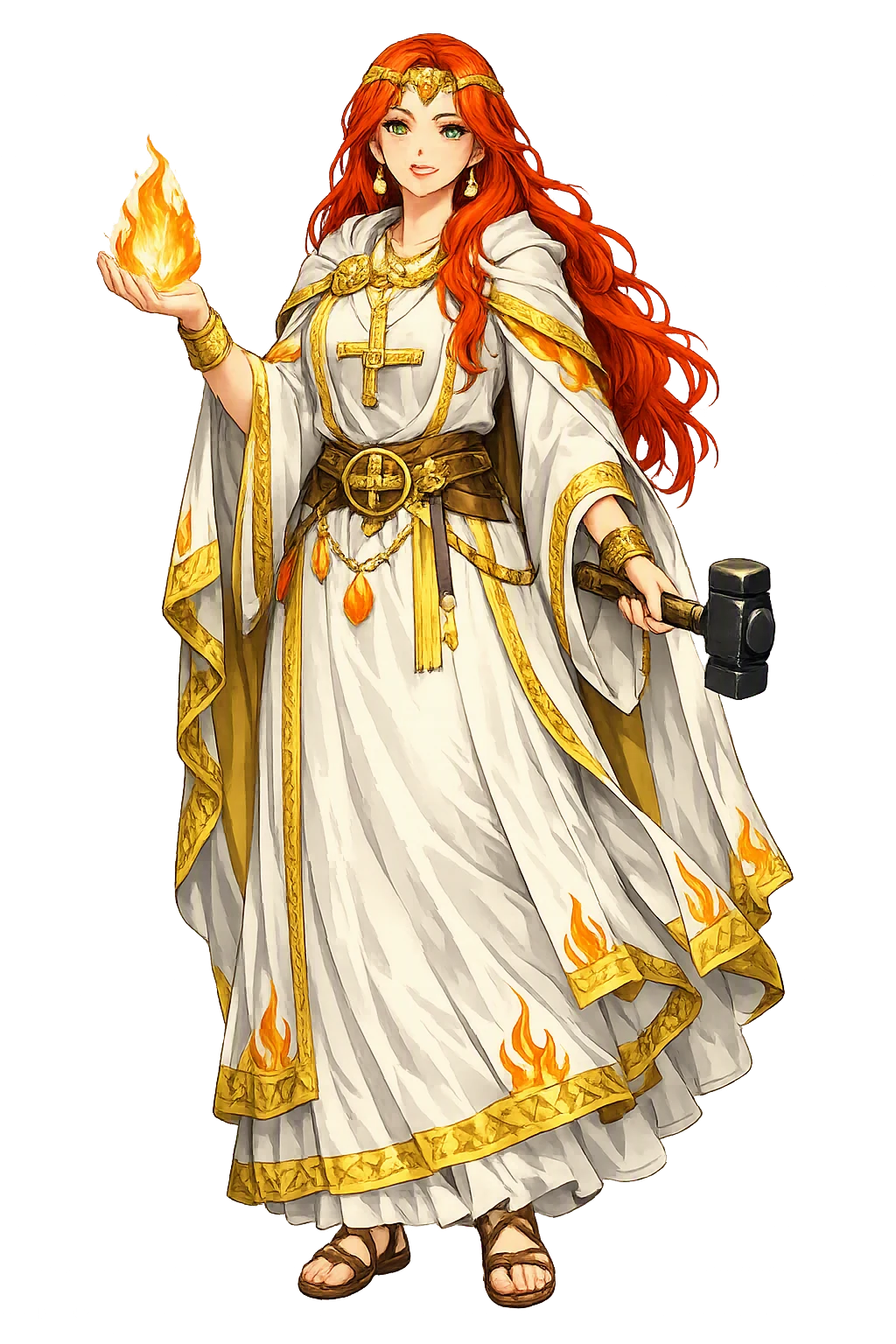
How Brigid got its accent back
The ASCII form brigid is missing something. Brigid restores the marks the source language used to distinguish this name from a thousand others — and those marks change how the name is read, pronounced, and understood. This post explains, with the full scholarly record behind it, what each restored mark preserves: the Celtic transcription evidence, the reconstructed sound, the myths the name carries, and the classification logic that separates Tier 1 restorations from Tier 2. By the end, the marks in Brigid will look less like ornaments and more like what they are — recovered evidence, pinned back in its proper place.
At a Glance
- Restored name: Brigid
- ASCII form: brigid
- Meaning: "The Exalted One (from Old Irish Brigit)"
- Domain of influence: Poetry, Healing, Smithcraft, Fire
- Pantheon: Celtic
- Classification: Tier 2
Overview
Brigid (brigid) — Poetry, Healing, Smithcraft, Fire · The Exalted One — is the triple goddess of medieval Irish tradition: Brigit the poetess, daughter of the Dagda, whom Cormac's Glossary pairs with two sisters of the same name — Brigit the woman of smithcraft and Brigit the female physician — so that the forge, the well, and the word all answer to a single divine name. The Lebor Gabála Érenn places her in the house of the Dagda among the Túatha Dé Danann, and Cath Maige Tuired gives her the corpus's most terrible dignity: when her son Ruadán dies on the field of the Second Battle of Mag Tuired, her lament is the first keening heard in Ireland.
Her feast is Imbolc, the first of February — the season Cormac glosses as oimelc, 'ewe's milk', when the flocks come into milk at the turning of the year — and at Kildare a fire burned for her that Giraldus Cambrensis describes around 1188: hedged so no man might cross, tended by nineteen nuns in nightly turn, and on the twentieth night committed to Brigid herself, its ashes never increasing though the wood is always consumed.
PuniCodex keeps the temple for this name without a domain: the plain-ASCII brigid.com is registered to a third party outside the collection and is watched for release. The normalized Old Irish form Brigit is already plain ASCII — no diacritic or distinctive letter survives for the restoration to recover — which places the name in Tier 2 by the project's mechanical rule. The temple's claim is scholarly, not territorial: the name and its sources, in full.
The Name
The name is attested in Old Irish as Brigit (genitive Brigte). It descends from Proto-Celtic Brigantī, 'the Exalted One', a feminine derivative of the root brig- 'high, lofty' — the same element that produced the tribal name Brigantes of northern Britain, the Romano-British goddess Brigantia, the Gaulish divine name Brigindu, and place-names such as Brigantium (modern Bregenz and La Coruña). The standard comparison with Sanskrit bṛhatī, feminine of bṛhant-* 'high, exalted', shows the etymology's Indo-European depth; among scholars it is one of the least contested in Celtic onomastics.
The modern English spelling Brigid and the normalized Old Irish Brigit are already plain ASCII: no diacritic, and no distinctive letter that the ASCII alphabet cannot write. There is therefore nothing for a Unicode restoration to recover — only the capital distinguishes the temple's form from the input — and the name is classified Tier 2 by the project's mechanical rule. This is a fact about orthography, not standing: the name's fame vastly outruns its spelling.
The letter-by-letter transformation runs:
- b → B — Same, capitalized
- r → r — Same
- i → i — Same
- g → g — Same
- i → i — Same
- d → d — Same
The project holds no domain for this name: brigid.com was registered by a third party decades ago in the ordinary way and is watched for release. This temple claims none.
The Original Script
The name is preserved in the medieval Irish manuscripts in the Latin alphabet, written in Insular script — the Irish bookhand — as Brigit, attested in Old Irish from the early medieval period in the glossaries, the Mythological Cycle, and the saints' Lives. The script is written left-to-right; the older Ogham alphabet would have notched the name ᚁᚏᚔᚌᚔᚈ (B-R-I-G-I-T), but that rendering is a normalized reconstruction — no Ogham stone records the theonym.
The scholarly rendering proceeds step by step:
- Old Irish was written in the Latin alphabet in Insular minuscule; spelling varies across manuscripts between Brigit, Briget, and related forms.
- The normalized scholarly form is Brigit, genitive Brigte, from Proto-Celtic *Brigantī 'the Exalted One'.
- No diacritic is required: the Old Irish spelling carries no long vowel and no distinctive letter, so the ASCII form Brigid is orthographically complete.
- The temple therefore claims no restoration and no domain: brigid.com is held by a third party outside the collection and watched for release.
The single caution that attaches is etymological honesty: the derivation from *brig- 'high' is the standard and near-uncontested account, but the leap from name-element to the goddess's original character — exalted by height, by rank, or by fire — is inference, and the texts do not say.
Pronunciation
The reconstructed pronunciation of the Old Irish name is /ˈbrʲiɣʲitʲ/ — Old Irish Reconstruction.
Phoneme by phoneme:
- Br- — Voiced bilabial stop [b] and slender (palatalized) trill [rʲ]; Old Irish consonants came in broad and slender pairs, and the r of Brigit was slender, as it remains in modern Irish
- -i- — Short front [i]; in the later language the vowel lengthened, giving modern Irish Bríd
- -g- — Voiced velar fricative [ɣ] between vowels: not the hard stop of English 'big' but a soft continuant, the regular lenited value of Old Irish medial g
- -id — Short front [i] and slender final [dʲ]; the modern form keeps exactly this ending, /bʲrʲiːdʲ/
For the modern speaker, the closest approximation is: 'BRIJ-id' — like 'bridge' split into two syllables, the g softened toward a gargled continuant. The modern Irish form Bríd is simply pronounced 'breed'.
Kindred and historical forms of the name:
- Old Irish — Brigit (genitive Brigte), daughter of the Dagda
- Proto-Celtic — *Brigantī, 'the Exalted One', source also of Brigantia and the Brigantes
- Modern Irish — Bríd, the living form of goddess and saint alike
- Scottish Gaelic / Manx — Brìde / Breeshey
- Watched form — brigid.com, held outside the collection; no form owned
Brigid is Tier 2 because the restoration has nothing to restore: the Old Irish spelling survives into ASCII whole.
Mythology
Brigid's mythology is a small dossier of exact testimonies rather than a cycle of adventures: the genealogists know her family, the battle-tale knows her grief, and the glossary knows her triad.
The Dagda's Daughter (Lebor Gabála Érenn)
The Book of Invasions files her in the house of the Dagda: Brigit the poetess, daughter of the good god of the cauldron, among the Túatha Dé Danann — the divine race whose eponymous ancestress is Danu. The same tradition marries her to Bres, the half-Fomorian king whose beautiful face and niggardly rule provoked the great war, and gives her a son, Ruadán: the Exalted One stands by marriage and blood on both sides of the conflict.
The First Keening in Ireland (Cath Maige Tuired)
In the Second Battle of Mag Tuired — the tale in which Lug leads the Túatha Dé Danann against the Fomorians — Ruadán is sent to spy on the divine smith Goibniu and hurls a spear at him; the smith casts it back, and Ruadán goes to his father to die. Brigit comes to the field and bewails her son, and the text is explicit: hers was the first keening and the first whistling for grief heard in Ireland. The goddess of the word is the one who taught Ireland what a mother says at a grave.
Three Sisters, One Name (Sanas Cormaic)
Cormac's Glossary (c. 900) preserves the triad on which her whole modern image rests: Brigit the poetess, daughter of the Dagda, had two sisters, Brigits also — Brigit the woman of smithcraft and Brigit the female physician — from whose names all the Irish used to call a goddess Brigit. Whether three figures or one goddess's three provinces, the entry is the witness every later account follows.
The Fire at Kildare (Giraldus Cambrensis)
Gerald of Wales, c. 1188, describes the Kildare fire as a wonder of his own day: hedged against men, tended by nineteen nuns in nightly turn, and on the twentieth night committed to Brigid with the words 'guard your fire, it is yours' — burning always, its ashes never increasing. He records it as a marvel of the saint's church; the hedge, the nineteen keepers, and the unashing flame have never been doubted to belong to an older hearth.
Symbols & Iconography
Brigid's iconography is drawn from the texts and from living custom rather than from ancient images — no pre-Christian representation of the goddess survives:
- The sacred flame of Kildare — the perpetual fire that neither dies nor accumulates ash: patronage that outlasts the night-watch of its keepers
- The anvil and the forge — the smith-sister's province: skill that gives raw metal a lasting form, as poetry gives raw speech one
- The holy well — the leech-sister's province: healing drawn from the ground, still visited at the hundreds of wells of St Brigit
- Fea and Femen, the two oxen — the Dagda's daughter's beasts in Cath Maige Tuired, with the plains Mag Fea and Mag Femen named for them: wealth and the working land
- The rush cross — St Brigid's cross, woven on Imbolc eve: the small loom on which the goddess's feast was carried into the saint's day
Archaeology & Evidence
Brigit herself is unattested in pre-Christian Irish material: no Ogham stone, votive deposit, or image names the goddess, and Ireland's Iron Age left no cult site securely hers.
Her name's material record lies across the water. Romano-British inscriptions honour Brigantia from the Wall country — most famously the relief from Birrens (Dumfriesshire), where the goddess stands with Minerva's globe, spear, and mural crown — and a Gaulish inscription from Volnay (Côte-d'Or) invokes Brigindu, the same name-element on the Continent.
In Ireland the evidence is ecclesiastical and customary: the monastic site of Kildare (Cill Dara, 'church of the oak'), with its round tower and its memory of the perpetual fire Giraldus describes, and the hundreds of holy wells dedicated to St Brigit, whose rag-trees and cure customs are the living deposit of the leech-sister's province.
Realm & Domain
Brigid is catalogued under the domain "Poetry, Healing, Smithcraft, Fire" — the triad of Cormac's Glossary plus the undying flame of her Kildare hearth.
Poetry
Brigit banfhiled, Brigit the woman-poet, is the Glossary's first sister: patroness of filidecht, the learned poetic craft, and of the word made durable — fittingly, her own one great speech-act in the texts is the invention of lamentation.
Smithcraft
Brigit goband, the woman of smithcraft, holds the forge-province of the triad — the divine smith's art that her own myth-world practices in Goibniu of the Túatha Dé Danann.
Healing
Brigit légach, the female physician, completes the triad; her province survives in the cure customs of the hundreds of Irish holy wells that bear the saint's name.
Fire
The perpetual fire of Kildare, hedged from men and tended by nineteen keepers, is the visible form of all three: a craft-flame that neither fails nor accumulates ash.
Across Cultures
Brigid's syncretic life runs in two directions. Across the water, her name is one with Brigantia, the goddess of Roman Britain honoured in inscriptions from the Wall country and portrayed on the Birrens relief with Minerva's globe and spear — the interpretatio romana pairing the exalted one with the Roman goddess of craft and war-wisdom. The tribal Brigantes and the Gaulish Brigindu carry the same name-element, and the comparison with Sanskrit bṛhatī shows how deep the root runs.
Within Ireland, the identification is Christian: Brigit of Kildare, the sixth-century saint whose feast falls on Imbolc and whose church kept the perpetual fire. Cogitosus's Life of Brigit (c. 650), our earliest substantial Life of any Irish saint, presents wonder-tales in which the saint's patronage of poets, smiths, and the poor uncannily covers the goddess's provinces. Whether saint succeeded goddess, goddess was Christianized into saint, or two figures fused in one name, the sources do not decide — and Mac Cana and Koch both counsel holding the question open. What is certain is the continuity: the Exalted One never left Ireland's calendar.
Within the pantheon, her closest kin are the Dagda (her father), Lug (the many-skilled master of all arts at Mag Tuired), and Danu (ancestress of the Túatha Dé Danann).
Cultural Legacy
No Celtic deity has a longer unbroken afterlife. Imbolc is still celebrated as St Brigid's Day — Lá Fhéile Bríde — and since 2023 it has been a public holiday in the Republic of Ireland, the first named for a woman. Rushes are still woven into Brigid's crosses on the eve of the feast and hung above doors; the holy wells of St Brigit, with their rag-trees and cure customs, keep the leech-sister's province in living folk practice.
Modern paganism and Celtic Reconstructionism restored the goddess explicitly, keeping Imbolc as the feast of the returning light and of the three crafts, and claiming her patronage for poets, smiths, and healers alike. And the name itself — Brigid, Bridget, Bríd — never ceased to be given to Irish daughters, carrying the Proto-Celtic word for exaltation into every generation since the Iron Age.
The Scholarly Record
The account of Brigid given in this edition rests on the witnesses and reference works listed below. Cormac's Glossary and the Mythological Cycle supply the goddess's testimony; Giraldus and Cogitosus the Kildare tradition; the etymological and encyclopaedic works secure the name and its cognates.
- Sanas Cormaic (Cormac's Glossary), s.v. Brigit, oimelc; ed. Kuno Meyer, Anecdota from Irish Manuscripts IV (Halle: Niemeyer, 1912).
- Lebor Gabála Érenn, ed. and trans. R. A. S. Macalister, 5 vols., Irish Texts Society (Dublin, 1938–56).
- Cath Maige Tuired, ed. and trans. Elizabeth A. Gray, Irish Texts Society 52 (Naas, 1982).
- Giraldus Cambrensis, Topographia Hiberniae II.34–36, ed. J. J. O'Meara, PRIA 52 C (1949).
- Cogitosus, Vita Sanctae Brigitae; trans. Connolly and Picard, JRSAI 117 (1987).
- Vendryes, Joseph, Lexique étymologique de l'irlandais ancien (Dublin: DIAS, 1959–), s.v. Brigit.
- Jackson, Kenneth H., Language and History in Early Britain (Edinburgh: Edinburgh University Press, 1953).
- Mac Cana, Proinsias, Celtic Mythology (London: Hamlyn, 1970).
- Koch, John T., ed., Celtic Culture: A Historical Encyclopedia (Santa Barbara: ABC-CLIO, 2006), s.v. Brigit, Brigantia, Imbolc.
- Thurneysen, Rudolf, A Grammar of Old Irish, trans. Binchy and Bergin (Dublin: DIAS, 1946).
A Meditation
Brigit is the rare goddess whose three provinces are one act seen from three sides. The smith and the poet do the same thing: they take what is raw — ore, breath — and by heat and pressure give it a form that outlasts them. The healer does it too, coaxing the broken body back toward the shape it was made for. Cormac's three sisters are really a single lesson: making is sacred wherever it happens, at the anvil, on the tongue, or at the sickbed.
Her fire at Kildare, hedged and watched and never consumed, is the emblem of that lesson — a flame tended by nineteen keepers that still belongs, on the twentieth night, to the name itself. Craft, kept in common, does not go out.
The Unicode Restoration
Brigid is classified as Tier 2: the restoration needs no distinctive letters or diacritics its ASCII form would lose. The ASCII fallback brigid still resolves everywhere, but it is the restored form that carries the name's full information. That is the whole thesis of this temple: the marks are the message.
Why This Restoration Matters
The marks in Brigid were never lost; they were only waiting for a carrier that could hold them. Now that the carrier exists, the burden flips: every use of brigid is a choice to leave evidence on the table. The PuniCodex temple keeps the restored form in circulation — as a domain, a dataset entry, and a scholarly argument — so that the choice to use it stays easy. Accent by accent, macron by macron, that is how the original names come back: not with a single grand gesture, but with a spelling that finally works everywhere.
Explore Further
This post is one doorway into the temple. The home page carries the full character breakdown and the ambient canvas; the lore page tells the myths in long form; the Scholarly Edition preserves the sources, pronunciation data, and revision history; and the patron wall supports the restoration directly. For the wider map, browse the Lexicon, explore the Pantheon, or return to the PuniCodex blog.
Related Names
Sources
The full scholarly apparatus — every citation, revision, and review — lives in the Scholarly Edition. Key references for this post:
- Sanas Cormaic (Cormac's Glossary), s.v. Brigit, oimelc; ed. Kuno Meyer, in Anecdota from Irish Manuscripts IV (Halle: Niemeyer, 1912).
- Lebor Gabála Érenn, ed. and trans. R. A. S. Macalister, 5 vols., Irish Texts Society (Dublin, 1938–56), on Brigit the poetess, daughter of the Dagda.
- Cath Maige Tuired, ed. and trans. Elizabeth A. Gray, Irish Texts Society 52 (Naas, 1982), §§125–131 (Ruadán's death and Brigit's keening).
- Giraldus Cambrensis, Topographia Hiberniae II.34–36 (the perpetual fire of Kildare), ed. J. J. O'Meara, 'Giraldus Cambrensis in Topographia Hibernie', Proceedings of the Royal Irish Academy 52 C (1949).
- Lexicon authorities for this entry: Vendryes.