The Authentic Orthography
Bearer of the Heavens · Enduring, suffering (from τλάω)
Unicode restoration and ASCII comparison
Ἄτλας
The name in its original Greek form. Átlas (Ἄτλας) is attested in the source tradition — “Enduring, suffering (from τλάω)”. Its acute accents carry the full phonetic and orthographic weight of the source tradition.
atlas
Reduced to plain atlas, the name loses everything that made it specific: acute accents. What remains is an ASCII string that machines can parse but that no longer speaks with its original voice.
Átlas
The Unicode restoration recovers what ASCII flattened. Átlas restores acute accents, returning the name to its original written dignity. The domain encodes to Punycode, but the browser displays the truth.
Átlas.com → xn--tlas-4na.com
The non-ASCII characters in Átlas are encoded while the ASCII remains visible. To the DNS, it is Punycode. To humanity, it is Átlas.
How Átlas travels from ancient script to the modern URL
Greek Ἄτλας; from τλάω “to endure, suffer"; the Titan who holds up the heavens.
Bearer of the Heavens
The Unicode restoration Átlas preserves Greek stress and length; the ASCII form atlas loses these features.
How Átlas was spoken
Strength, Endurance, Astronomy, and the Western Edge
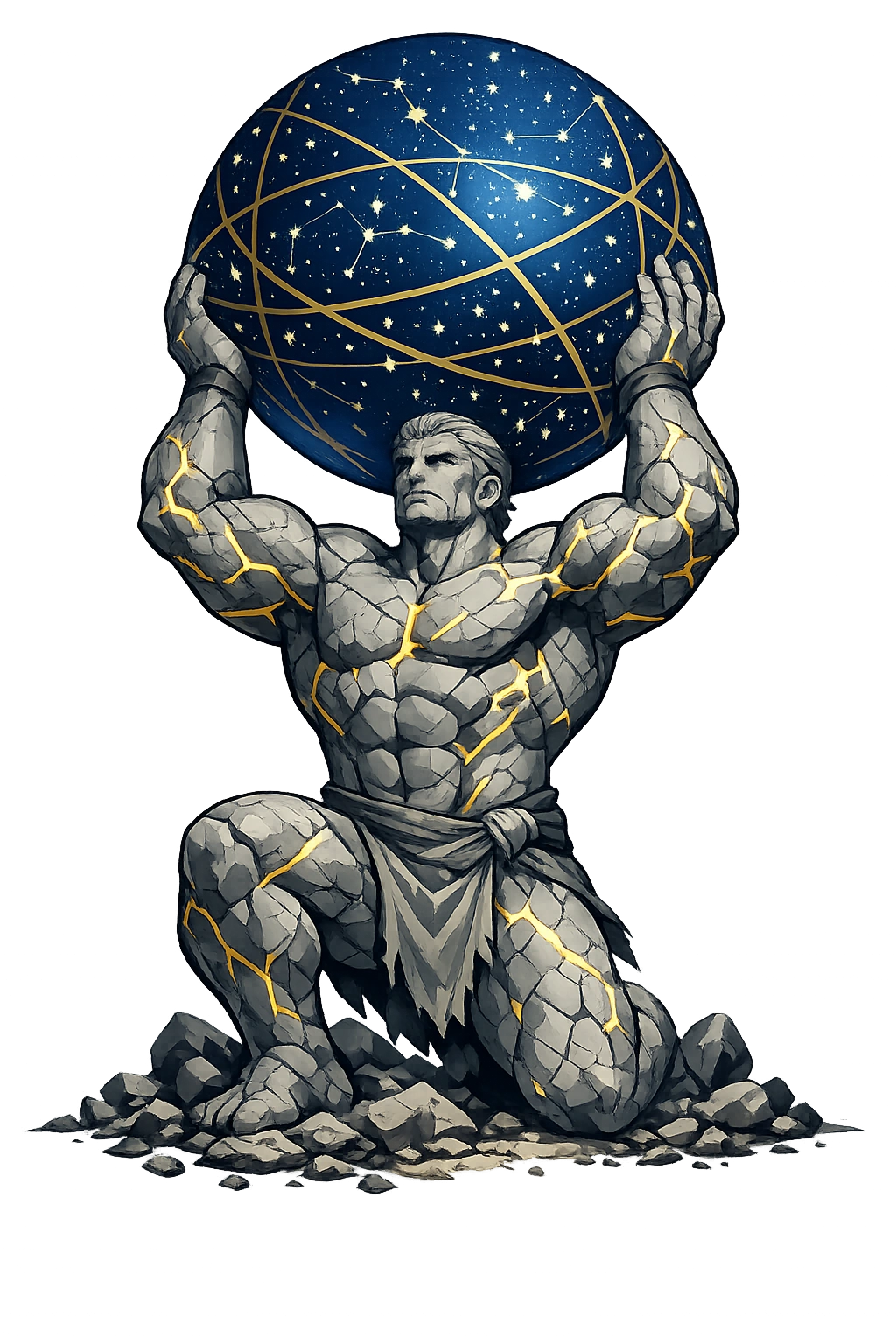
Átlas is the Titan who holds up the sky. He is not a villain but a defeated rebel, condemned to bear the celestial sphere on his shoulders for eternity. His endurance becomes a kind of heroism: he does not triumph, but he does not collapse.
He holds the sky aloft, keeping heaven and earth apart so that the cosmos can exist.
His punishment is eternal labor; his virtue is that he endures it without complaint.
He knows the stars; his daughters the Hesperides tend the garden of the western sky.
He stands at the edge of the known world, where the sun sets and the ocean begins.
Stories of Átlas
Átlas belongs to the older generation of gods. His myths are few because he is fixed in place, but his presence shapes the geography and cosmology of the Greek world.
Átlas was one of the leading Titans in the war against Zeús and the Olympians. When the Titans were defeated, Zeús singled him out for the heaviest punishment: he must hold up the sky for all time. Other Titans were imprisoned in Tartaros; Átlas was given a task that required constant, conscious effort. His punishment is a form of forced usefulness.
Átlas's daughters, the Hesperides, guarded a garden at the western edge of the world where a tree bore golden apples. One of Heraklēs' labors was to fetch these apples. In some versions Heraklēs took the burden temporarily from Átlas's shoulders while the Titan fetched the apples; in others Heraklēs tricked him into resuming the burden. The garden is the furthest place, where day ends and the marvelous begins.
When Perseus passed through the west on his way back from slaying Medousa, he encountered Átlas and asked for hospitality. Átlas refused, fearing the prophecy that a son of Zeús would steal his golden apples. Perseus showed him the Gorgon's head, and Átlas was turned to stone — becoming the Atlas Mountains in North Africa. The myth explains a geographical feature while dramatizing the Titan's final immobility.
The figure of Átlas holding a sphere was so iconic that Renaissance cartographers put him on the cover of books of maps. By the sixteenth century, a book of maps was called an 'atlas.' Thus the Titan's punishment became the modern symbol of geographical knowledge — the man who holds the world became the man who knows it.
Átlas is the god of the weight that does not end. He is not punished with pain but with labor — the same labor, forever. There is no transformation, no reward, no release. Yet he is not entirely pitiable. His burden is also his identity: without it, he is just another defeated Titan.
Enter Extended Lore