
How Átlas got its accent back
The ASCII form atlas is missing something. Átlas restores the marks the source language used to distinguish this name from a thousand others — and those marks change how the name is read, pronounced, and understood. This post explains, with the full scholarly record behind it, what each restored mark preserves: the Greek evidence, the reconstructed sound, the myths the name carries, and the classification logic that separates Tier 1 restorations from Tier 2. By the end, the marks in Átlas will look less like ornaments and more like what they are — recovered evidence, pinned back in its proper place.
At a Glance
- Restored name: Átlas
- ASCII form: atlas
- Meaning: "Enduring, suffering (from τλάω)"
- Domain of influence: Bearer of the Heavens
- Pantheon: Greek
- Classification: Tier 2
- Original script: Ἄτλας (Greek)
- Live domain: átlas.com
Overview
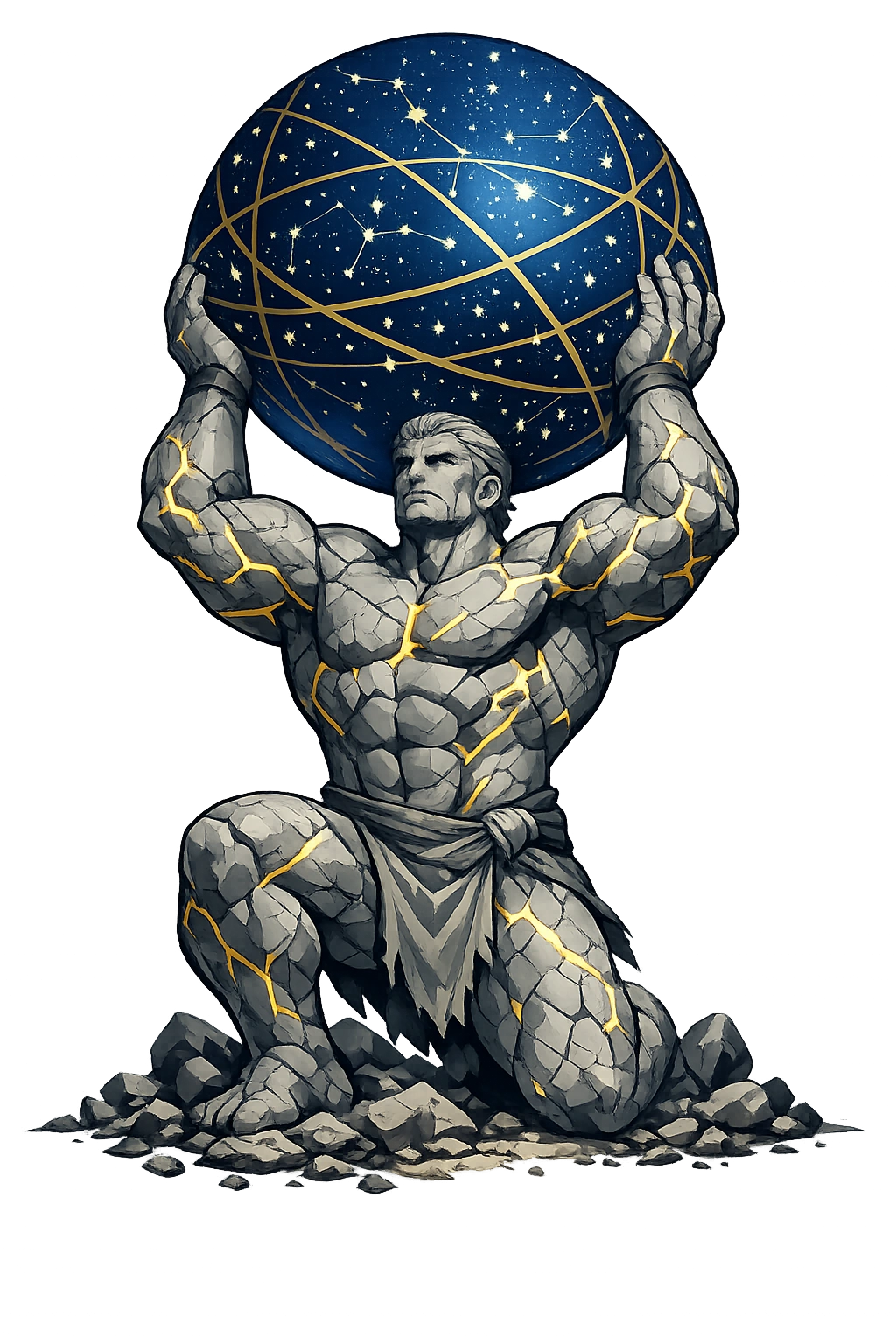
Átlas (atlas) is the Titan condemned to hold up the sky: son of Iapetos and Klymene, brother of Promētheus, Menoitios, and Epimētheus (Hesiod, Theogony 507–511). Hesiod stations him 'by strong necessity' at the ends of the earth, holding the wide heaven on head and tireless hands in front of the clear-voiced Hesperides — a portion allotted him by Zeús (Theogony 517–520). Homer preserves a complementary image: 'baleful-minded Átlas', father of Kalypsō, who knows all the depths of the sea and holds the tall pillars that keep earth and heaven apart (Odyssey 1.52–54).
His domain in this lexicon is "Bearer of the Heavens". He is not a villain but a defeated power whose punishment is usefulness: the cosmos stands because he does not put it down.
PuniCodex restores the name as Átlas and serves its temple at átlas.com. The Greek original preserves one prosodic feature — the acute accent on the first syllable — but contains no long vowel, which places the name in Tier 2. The plain ASCII form atlas is a modern convenience imposed by the early domain-name system; the restoration, not the fallback, is the form the project defends as philologically complete.
The Name
The name is attested in Greek as Ἄτλας, already in both Hesiod and Homer (Theogony 509; Odyssey 1.52). The traditional scholarly gloss, 'Enduring, suffering (from τλάω)', derives it from the verb τλάω, 'to endure, to bear': the name is the 'Endurer', a fitting title for the figure who bears the sky. Modern etymologists are less confident, and Beekes doubts a Greek derivation of the name altogether.
The ASCII form atlas survives only because the early domain-name system could not carry diacritics; it is a technological compromise, not an ancient spelling. The Unicode restoration Átlas recovers the pitch accent of the original directly in the address bar. The Greek original preserves one prosodic feature — the acute on the first syllable — but contains no long vowel, which places the name in Tier 2.
The letter-by-letter transformation runs:
- a → Á — Acute on alpha
- t → t — Tau
- l → l — Lambda
- a → a — Short alpha
- s → s — Sigma
The project holds the domain átlas.com (xn--tlas-4na.com) as the canonical home of this name.
Etymology & Roots
The recorded derivation reads: Enduring, suffering (from τλάω)
The root gloss is "Enduring, suffering."
The reconstruction is classed as attested.
The Original Script
The name is preserved in Greek as Ἄτλας — Greek alphabet (Classical / Attic), attested Ancient Greek, c. 8th century BCE – present, in Greece and the Greek-speaking Mediterranean. The script is written left-to-right.
The scholarly transliteration is Átlas (Greek alphabet with polytonic accents), giving the normalized reading /ˈat.las/.
The rendering proceeds step by step:
- The Greek form Ἄτλας is written in the Classical Greek alphabet.
- Letters with acute, grave, or circumflex accents preserve the pitch accent of Ancient Greek.
- Macrons and omegas (η, ω) mark long vowels, a feature lost in the plain ASCII form.
- The Unicode restoration Átlas encodes the scholarly spelling as a registrable domain name.
Pronunciation
The reconstructed pronunciation of the name is /ˈat.las/ — Attic Greek Reconstruction.
Phoneme by phoneme:
- Át- — short alpha with acute pitch plus tau; the accent falls on the first syllable.
- -las — lambda, short alpha, final sigma; a level, heavy second syllable.
For the modern speaker, the closest approximation is: 'AT-lass' — the first syllable pitched high, as if lifting; the second level and heavy.
Kindred and historical forms of the name:
- Greek — τλάω (tláō), 'to endure, to bear' — the verb from which the name has traditionally been derived
- PIE — *telh₂- 'to bear, support' — the proposed Indo-European root of τλάω, though Beekes disputes a Greek etymology for the name itself
- Atlantic — the sea 'of Átlas', named from the mountain at the western edge of the known world that bore his name (Herodotus 4.184)
Átlas is Tier 2 because the Greek Ἄτλας bears an acute accent on its first syllable but contains no long vowel: it preserves one prosodic feature rather than both, and the restoration accordingly marks stress alone. The name's short, heavy sound fits the burden it denotes.
Mythology
Átlas belongs to the older generation of gods, and his myths are few because he is fixed in place; but his station shapes the geography and cosmology of the whole Greek world.
The Titanomachy
Hesiod does not say what Átlas did in the war of the gods; he records only the sentence — to hold the wide heaven at the ends of the earth (Theogony 517–520). Roman mythography fills the gap: in Hyginus's account of the Titanomachy Átlas was the Titans' leader, and when the rest were cast into Tartarus Jove set the vault of the sky on him (Fabulae 150).
The Apples of the Hesperides
For his eleventh labor Hēraklēs had to fetch the golden apples guarded beyond Ocean by the Hesperides and a hundred-headed dragon. On Promētheus's advice he did not go himself: he took the sky on his own shoulders and sent Átlas. When Átlas returned with three apples and offered to deliver them to Eurystheus himself, Hēraklēs asked him to hold the sky a moment while he made a pad for his head — and walked off with the apples. 'But some say' he killed the guardian serpent and picked them himself (Apollodorus 2.5.11).
Perseus and the Petrification
Ovid tells how Perseus, flying home from the Gorgon, sought hospitality from Átlas, 'Iapetionides', king of the world's western edge. Átlas, remembering Themis's oracle that a son of Jupiter would one day spoil his golden tree, drove the stranger off; Perseus turned away and showed Médousa's head. 'As great as he was, Átlas became a mountain': his beard and hair turned to forests, his shoulders and hands to ridges, his head to the summit, his bones to stone — 'and all heaven with its stars came to rest upon him' (Metamorphoses 4.627–662). The myth explains a geographical feature while fixing the Titan in his final immobility.
The Name of the Map-Book
Renaissance cosmographers made the burden-bearer their emblem. Mercator titled his great collection Atlas sive Cosmographicae Meditationes (completed 1595), choosing Átlas as the mythical master of the sphere, and within a generation a book of maps was simply 'an atlas' — the Titan's punishment becoming the symbol of geographical knowledge itself.
Symbols & Iconography
The attributes of Átlas all render the single fact of the burden: what he bears, where he bears it, and what it cost him.
- Celestial sphere — the wide heaven he supports 'by strong necessity' at the ends of the earth (Hesiod, Theogony 517–520)
- Pillars — Homer's 'tall pillars' that keep earth and heaven apart (Odyssey 1.53–54)
- The mountain — Ovid's aition: petrified by Perseus with Médousa's head, his beard and hair becoming forests, his shoulders ridges, his bones stone (Metamorphoses 4.655–662)
- Apples of the Hesperides — the golden fruit of the garden at his western station, guarded by a dragon and, in some accounts, by his own daughters (Hyginus, Astronomica 2.3; Apollodorus 2.5.11)
- The bowed posture — in art, the kneeling or stooping stance under the globe, canonized by the Farnese statue
Átlas enters Greek art through the Hēraklēs cycle. On a metope of the Temple of Zeus at Olympia (c. 460 BCE) he returns with the apples of the Hesperides while the hero cushions the sky and Athénā assists. Attic red-figure vases of the fifth century BCE repeat the encounter, painting him as a bearded giant bearing the apple branch. The type culminates in the Roman Farnese Atlas (Naples, MAN inv. 6374), a second-century CE marble whose celestial globe preserves the oldest complete map of the Greek constellations. Imperial coins and reliefs eventually fuse the Titan with his mountain.
Epithets & Cult Titles
Átlas never received cult, so he has no hymnic epithets; the epic tradition supplies a handful of formulaic descriptors.
- ὀλοόφρων (olóophrōn) — 'baleful-minded, destructive of counsel'; the Odyssey's standing adjective for the father of Kalypsō.
- κρατερόφρων (krateróphrōn) — 'stout-hearted, steadfast-minded'; Hesiod's adjective for the Titan of the burden.
- pillar-holder — the Odyssey's description of him holding the 'tall pillars' that part earth and heaven functions as a fixed title rather than an ornament.
Later poets add only ornamental variations on the burden theme.
The Homeric Hymns
No Homeric Hymn to Átlas survives; the hymnic corpus never addresses the Titan, and within Homer he belongs to the Odyssey alone. His earliest hexameter attestations are Hesiodic and Homeric. In the Theogony he is born 'Átlas, stout-hearted' (κρατερόφρονα) to Iapetos and Klymene (509), and he stands at the ends of the earth holding the wide heaven 'by strong necessity' on head and tireless hands, stationed before the clear-voiced Hesperides — the portion allotted him by counsellor Zeús (517–520). The Odyssey twice names him as Kalypsō's father: 'baleful-minded Átlas' (ὀλοόφρονος), who knows all the depths of the sea and holds the tall pillars that keep earth and heaven apart (1.52–54; 7.245). These compact epic notices — a station, a burden, a daughter — are the entire archaic dossier on him.
Oracle Sites & Sanctuaries
No oracle of Átlas is attested, and no Greek city maintained a temple or priesthood of the Titan; his religious footprint is geographic rather than liturgical. The mountain that bore his name was itself venerated: Herodotus reports that the North African Átlas is slender and conical and so high that its summit is never free of cloud, winter or summer, 'and the people of the country call it the pillar of heaven' (4.184). Euhemerist tradition made the region his kingdom: Diodorus describes a culture-hero Átlas ruling the Atlantic coast, who named both his people and his mountain and taught mankind the 'doctrine of the sphere' (3.60). The garden of the Hesperides tied him to the fabulous edge of the earth rather than to any historical sanctuary, and the western strait the Greeks called the Pillars of Hēraklēs marked the limit of the world his figure guarded — the Phoenicians of Necho's circumnavigation returned through it (Herodotus 4.42).
Archaeology & Evidence
No cult of Átlas is attested, so his material record is representational. The earliest monumental image is the east metope of the Temple of Zeús at Olympia (c. 470–456 BCE): Hēraklēs cushions the sky while Átlas brings the apples of the Hesperides, Athénā helping to bear the weight. A generation earlier, the lost Chest of Kypselos at Olympia — described panel by panel by Pausanias — already showed 'Átlas supporting, just as the story has it, heaven and earth upon his shoulders; he is also carrying the apples of the Hesperides', with Hēraklēs approaching (5.18.4). The type culminates in the Roman Farnese Atlas (Naples, MAN inv. 6374), a second-century CE marble after a Hellenistic original, whose celestial globe preserves the oldest complete depiction of the classical constellations. The Titan's only 'cult site' is the mountain itself: Herodotus (4.184) records the cloud-capped North African peak the people of the country called the pillar of heaven.
Realm & Domain
Átlas's mythic domain is the western edge of the world and the architecture of the sky.
The Celestial Sphere
He holds the wide heaven 'by strong necessity' at the ends of the earth, standing with head and tireless hands — a station allotted him by Zeús (Hesiod, Theogony 517–520). Homer's variant gives him not the heaven itself but the 'tall pillars' that keep earth and heaven apart (Odyssey 1.52–54).
Endurance
His punishment is not pain but labor without end. Later euhemerists rationalized the burden as knowledge: Diodorus reports that Átlas 'perfected the science of astrology and was the first to publish to mankind the doctrine of the sphere', so that men said the whole heaven rested on his shoulders (3.60.1–2).
The Western Boundary
He stands where the sun sets. Herodotus records the North African mountain named for him — slender and conical, its summit never free of cloud — 'and the people of the country call it the pillar of heaven' (Histories 4.184). Beyond it lay the garden of the Hesperides, in some accounts tended by his own daughters (Hyginus, Astronomica 2.3, citing Pherecydes).
Astronomy
As master of the sphere he became the mythical discoverer of astronomy; Mercator's choice of his figure for a book of maps (1595) then gave the word 'atlas' to cartography itself.
Across Cultures
Átlas had no Roman counterpart; the Romans kept the Greek name and the Greek image, and Roman mythography (Hyginus, Fabulae 150; Ovid, Metamorphoses 4) mainly embellishes the Hesiodic dossier. Late antique and Hellenistic rationalism recast him as a culture hero: Diodorus makes him a king of the far west who named his people and his mountain and 'first published the doctrine of the sphere' (3.60). The Renaissance made him the emblem of cosmography: the Farnese Atlas, a second-century CE marble in Naples, carries the oldest complete representation of the Greek constellations, and from Mercator's Atlas (1595) the Titan's name passed to every book of maps. Modern usage has scattered the name widely: the Atlas Mountains of North Africa, the lunar crater Atlas near the crater Hercules, and the first cervical vertebra that bears the skull all preserve it.
Within the PuniCodex corpus, the directly linked temples are his brother Promētheus, his adversary-liberator Hēraklēs, and Perseus and Médousa, the agents of his petrification.
Cultural Legacy
Átlas is the archetype of the burden-bearer, and the image of the giant stooped under the world is among the most persistent in Western art — from the Olympia metope and the Farnese marble to the frontispieces of atlases. The word itself conquered geography through Mercator (1595); anatomy borrowed it for the vertebra that bears the skull; and Ayn Rand's Atlas Shrugged (1957) turned the figure into a modern political parable of the productive few who carry the world. Restoring the accent in Átlas restores the name of the being whose strength is endurance: he does not triumph, but he does not collapse (Theogony 517–520).
The Scholarly Record
The account of Átlas given in this edition rests on the witnesses and reference works listed below. Lexica and etymological dictionaries secure the form and meaning of the name; the literary and religious texts supply the narrative evidence.
- Liddell-Scott-Jones Greek-English Lexicon, 9th ed. with 1996 supplement, 1843. Full text
- Etymological Dictionary of Greek, 2 vols., Brill, 2010. Full text
- Wörterbuch der griechischen Eigennamen, 3rd ed., 1863. Full text
- Hesiod, Theogony, Loeb Classical Library No. 57, 700 BCE. Full text
- Homer, Odyssey.
- Apollodorus, Library.
- Gantz, Early Greek Myth.
A Meditation
Átlas is the god of the weight that does not end. He is not punished with pain but with labor — the same labor, forever. There is no transformation, no reward, no release. Yet he is not entirely pitiable. His burden is also his identity: without it, he is just another defeated Titan.
The Greeks set him at the edge of the world and then steadily moved the edge westward; each age redrew the map and left Átlas standing where it ended. That is why his name, of all the Titans', survives in ordinary speech: the atlas on the desk is his burden domesticated, the sky exchanged for the earth. The modern world has many Atlases: caregivers, essential workers, anyone whose effort keeps the structure upright. The restoration of his name is a recognition that some forms of greatness are not dramatic but sustaining — the willingness to hold what would otherwise fall.
The Unicode Restoration
Átlas is classified as Tier 2: the original preserves at least one philological feature that ASCII cannot encode. The ASCII fallback atlas still resolves everywhere, but it is the restored form that carries the name's full information. Across the 5 characters of the name, the restoration adjusts 1: 1 mark of stress (Á). That is the whole thesis of this temple: the marks are the message.
The Domain Name
The restored name is live as a working domain: átlas.com, which the DNS carries in punycode form as xn--tlas-4na.com — an ASCII-compatible encoding that lets a non-ASCII name travel the global network without breaking older infrastructure. The visitor sees Átlas; the machines see the encoding. That duality is the engineering compromise on which the entire restoration rests, and it is why a name written the way its own tradition wrote it in Greek can now be typed into any browser on earth.
Why This Restoration Matters
The marks in Átlas were never lost; they were only waiting for a carrier that could hold them. Now that the carrier exists, the burden flips: every use of atlas is a choice to leave evidence on the table. The PuniCodex temple keeps the restored form in circulation — as a domain, a dataset entry, and a scholarly argument — so that the choice to use it stays easy. Accent by accent, macron by macron, that is how the original names come back: not with a single grand gesture, but with a spelling that finally works everywhere.
Explore Further
This post is one doorway into the temple. The home page carries the full character breakdown and the ambient canvas; the lore page tells the myths in long form; the Scholarly Edition preserves the sources, pronunciation data, and revision history; and the patron wall supports the restoration directly. For the wider map, browse the Lexicon, explore the Pantheon, or return to the PuniCodex blog.
Related Names
Sources
The full scholarly apparatus — every citation, revision, and review — lives in the Scholarly Edition. Key references for this post:
- Hesiod, Theogony 507–520.
- Wörterbuch der griechischen Eigennamen, 3rd ed., 1863.
- Liddell-Scott-Jones Greek-English Lexicon, 9th ed. with 1996 supplement, 1843, s.v. Ἄτλας, τλάω.
- Etymological Dictionary of Greek, 2 vols., Brill, 2010, s.v. Ἄτλας.
- Homer, Odyssey 1.52–54.
- W. Sidney Allen, Vox Graeca: A Guide to the Pronunciation of Classical Greek, 3rd ed., Cambridge University Press, 1987.
- Herodotus, Histories 4.184.
- Diodorus Siculus, Library 3.60.1–2.
- Lexicon authorities for this entry: LSJ, Pape-Benseler, Beekes.