
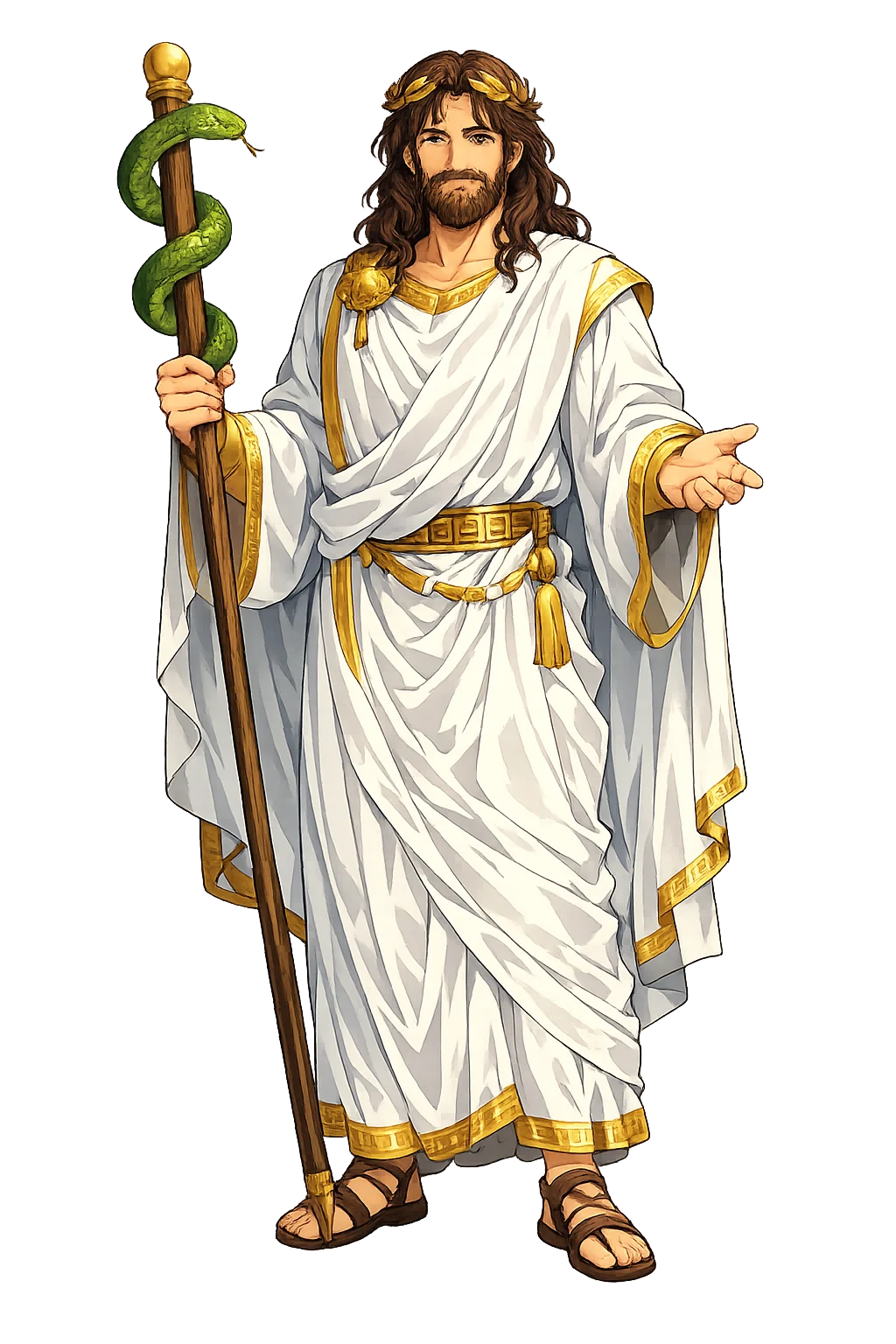
Why Asklēpiós is spelled that way — and what it costs to get it right
There is a version of this name the early internet had to settle for: asklepios. This is the file on how Asklēpiós replaced it.
Born from catastrophe — cut from the womb of the dying Korōnis by his father Apóllōn — Asklēpiós was raised by the centaur Cheirōn, who taught him the pharmaka of roots and the surgery of the knife.
At a Glance
- Restored name: Asklēpiós
- ASCII form: asklepios
- Meaning: "Uncertain; possibly related to ἀσκαλαβώτης (lizard) or a pre-Greek healing root"
- Domain of influence: Medicine, Healing, Renewal
- Pantheon: Greek
- Classification: Tier 1
- Original script: Ἀσκληπιός
- Series: The Restoration Files, No. 39 of 271
The Name Before the Marks
The name is attested as Ἀσκληπιός, as LSJ and Homeric Hymns preserve it. On the evidence, it means "Uncertain; possibly related to ἀσκαλαβώτης (lizard) or a pre-Greek healing root".
Strip Asklēpiós to asklepios and 2 pieces of evidence vanish:
- e → ē — Macron marks the long vowel: the vowel length the ASCII form cannot show.
- o → ó — Stress mark (acute/tone): the stress position the ASCII form cannot show.
None of these marks is decoration. Each one is a fact about how the name was spoken, and each one is checkable against the scholarly record the temple cites.
Spoken, the name runs `/a.skliː.pi.ós/` — ah-SKLAY-pee-OSS, with the stress on the ultima and a long ē.
The Temple That Stands Now
The restored name is not a plaque; it is an address. The temple of Asklēpiós lives at /sites/asklepios/, with its mythology in the lore halls, its peer-reviewed record in the Scholarly Edition, and its place in the pattern atlas on the patterns floor.
What survives here cannot be shown in ASCII: a feature of the original that the fallback alphabet flattens. That is the Tier-1 test, and this name passes it without argument.
Where the Name Stood First
The sanctuary at Epidaurus — a UNESCO World Heritage site — preserves the abaton, the circular tholos (possibly the god's labyrinthine "dance floor" designed by Polykleitos), and the theatre where healed patients watched drama as therapy. The iamata stelai (IG IV².1 121–124), the surviving late-4th-century-BCE originals, list some seventy cures. At Kos, the terraced Asklepieion adjoins the Hippocratic plane tree's descendants; at Rome the Tiber Island temple's travertine snake-prow survives. The temple on the web is the newest of these addresses — the first one that fits in a pocket.
The Archetype at Work
The pattern atlas seats this temple in 3 industries, each match argued and weighted: Biotech, Longevity & Life Sciences (he healed so well that Zeús destroyed him for emptying the underworld — the physician who pressed the boundary of death itself.); Healthcare, Pharma & Medicine (the surgeon-son of Apóllōn whose sanctuaries were antiquity’s hospitals; his snake-entwined staff still hangs over every pharmacy.); Yoga, Meditation & Holistic Wellness (incubation sanctuaries were antiquity’s wellness retreats — sleep, dream, cure.). The Resonance File reads those seats through the myths themselves.
In the Sacred Texts
The Greek tradition is not a vibe; it is a library. The Sacred Texts collection holds Theogony, Homeric Hymns, and Works and Days — the primary sources the temple's scholarship is built on. The temple is the argument; the texts are the evidence.
The File Continues
The temple's founding dispatch tells the name's story; its Resonance File reads the myths into the industries; the blog index holds the whole archive.
Continue the series — previous file: Asía (read it here) · next file: Aštart (read it here).
The Restoration Files are written from the same canonical record as the temples themselves: the lexicon, the lore catalog, the pattern atlas, and the cited scholarly sources. If a file ever disagrees with its temple, the temple is right — tell us, and the file will be corrected.