
How Asklēpiós got its accent back
The ASCII form asklepios is missing something. Asklēpiós restores the marks the source language used to distinguish this name from a thousand others — and those marks change how the name is read, pronounced, and understood. This post explains, with the full scholarly record behind it, what each restored mark preserves: the Greek evidence, the reconstructed sound, the myths the name carries, and the classification logic that separates Tier 1 restorations from Tier 2. By the end, the marks in Asklēpiós will look less like ornaments and more like what they are — recovered evidence, pinned back in its proper place.
At a Glance
- Restored name: Asklēpiós
- ASCII form: asklepios
- Meaning: "Uncertain; possibly related to ἀσκαλαβώτης (lizard) or a pre-Greek healing root"
- Domain of influence: Medicine, Healing, Renewal
- Pantheon: Greek
- Classification: Tier 1
- Original script: Ἀσκληπιός (Greek)
- Live domain: asklēpiós.com
Overview
Asklēpiós (asklepios) — The Physician of the Gods — belongs to the Greek tradition, where it is catalogued under the domain "Medicine, Healing, Renewal". The name means "Uncertain; possibly related to ἀσκαλαβώτης (lizard) or a pre-Greek healing root".
Asklēpiós is the only hero whose skill frightened the gods: the surgeon-son of Apóllōn who healed so well that Zeús destroyed him for emptying the underworld. His sanctuaries were the hospitals of the ancient world, and his snake-entwined staff still hangs over every pharmacy on earth.
PuniCodex restores the name as Asklēpiós and serves its temple at asklēpiós.com. The original carries both stress and vowel length, and exactly one historically valid Unicode restoration exists, which places the name in Tier 1. The plain ASCII form asklepios survives as a modern convenience imposed by the early domain-name system; the restoration, not the fallback, is the form the project defends as philologically complete.
The Name
The name is attested in Greek as Ἀσκληπιός. Etymologically it means "Uncertain; possibly related to ἀσκαλαβώτης (lizard) or a pre-Greek healing root".
The ASCII form asklepios survives only because the early domain-name system could not carry diacritics; it is a technological compromise, not an ancient spelling. The Unicode restoration Asklēpiós recovers both the stress accent and the vowel length of the original directly in the address bar. The original carries both stress and vowel length, and exactly one historically valid Unicode restoration exists, which places the name in Tier 1.
The letter-by-letter transformation runs:
- a → A — Same letter
- s → s — Same letter
- k → k — Same letter
- l → l — Same letter
- e → ē — Macron marks the long vowel
- p → p — Same letter
- i → i — Same letter
- o → ó — Stress mark (acute/tone)
- s → s — Same letter
Attested and derived spellings of the name:
- Asklēpios — macron-only form: LSJ convention: length only, no stress mark
The project holds the domain asklēpiós.com (xn--asklpis-q0a9z.com) as the canonical home of this name.
The Original Script
The name is written in Greek as Ἀσκληπιός. This original script is the form against which the ASCII fallback asklepios and the PuniCodex restoration Asklēpiós are measured: the restoration preserves both its pitch accent and its vowel quantity of the written form, so that a reader typing the modern address still speaks the ancient name.
Pronunciation
The reconstructed pronunciation of the name is /a.skliː.pi.ós/ — Attic Greek.
For the modern speaker, the closest approximation is: ah-SKLAY-pee-OSS, with the stress on the ultima and a long ē.
Kindred and historical forms of the name:
- Greek — Ἀσκληπιός
- Latin — Aesculapius
- English — Asclepius
- Owned form — Asklēpiós
Attic Ἀσκληπιός places the acute on the final syllable; the η is unambiguously long, so the stacked macron-acute of the ideal form ḗ is philologically defensible. The owned form Asklēpiós follows the house rule against stacked marks while preserving both features across two characters.
Mythology
Born from catastrophe — cut from the womb of the dying Korōnis by his father Apóllōn — Asklēpiós was raised by the centaur Cheirōn, who taught him the pharmaka of roots and the surgery of the knife.
The Child of the Pyre (The Birth)
Apóllōn, having killed Korōnis for her infidelity, snatched the unborn child from her funeral fire and gave him to Cheirōn. The healing god thus begins between death and rescue: Pindar sings that the centaur taught him to cure "those suffering from nature's wounds."
Raising the Dead (The Transgression)
Given the Gorgon's blood by Athēnā — one side destroying, one side saving — Asklēpiós raised the dead, Hippolytos among them in the Roman telling. Zeús struck him with the thunderbolt for disturbing the order of nature; Apóllōn avenged him by killing the Kyklōpes, and Zeús finally raised the physician among the stars.
The Sleep that Cures (The Cult)
At Epidaurus, Kos, and Pergamon, the sick purified themselves, slept in the abaton, and dreamed the god's prescription — or woke healed by the sacred snakes that roamed the dormitory. The inscribed iamata record real names and afflictions: the largest surviving archive of ancient patient testimony.
A Cock for Asklēpiós (The Last Words)
Plato records Sócrates' final sentence: "Krito, we owe a cock to Asklēpiós — pay it, do not forget." The dying philosopher thanked the healing god as if death itself were the cure for life — the god's strangest and most famous offering.
Symbols & Iconography
The iconography associated with Asklēpiós concentrates in a small set of recurring attributes, each a compressed statement about the name:
- The serpent — Renewal through the shed skin; the chthonic knowledge of roots and venoms
- The staff — The physician's walking stick; authority without weaponry
- The dog — The wound-licking guardian of the sanctuary floor
- The cock — The vigil-bird sacrificed to him — Sócrates' famous last debt
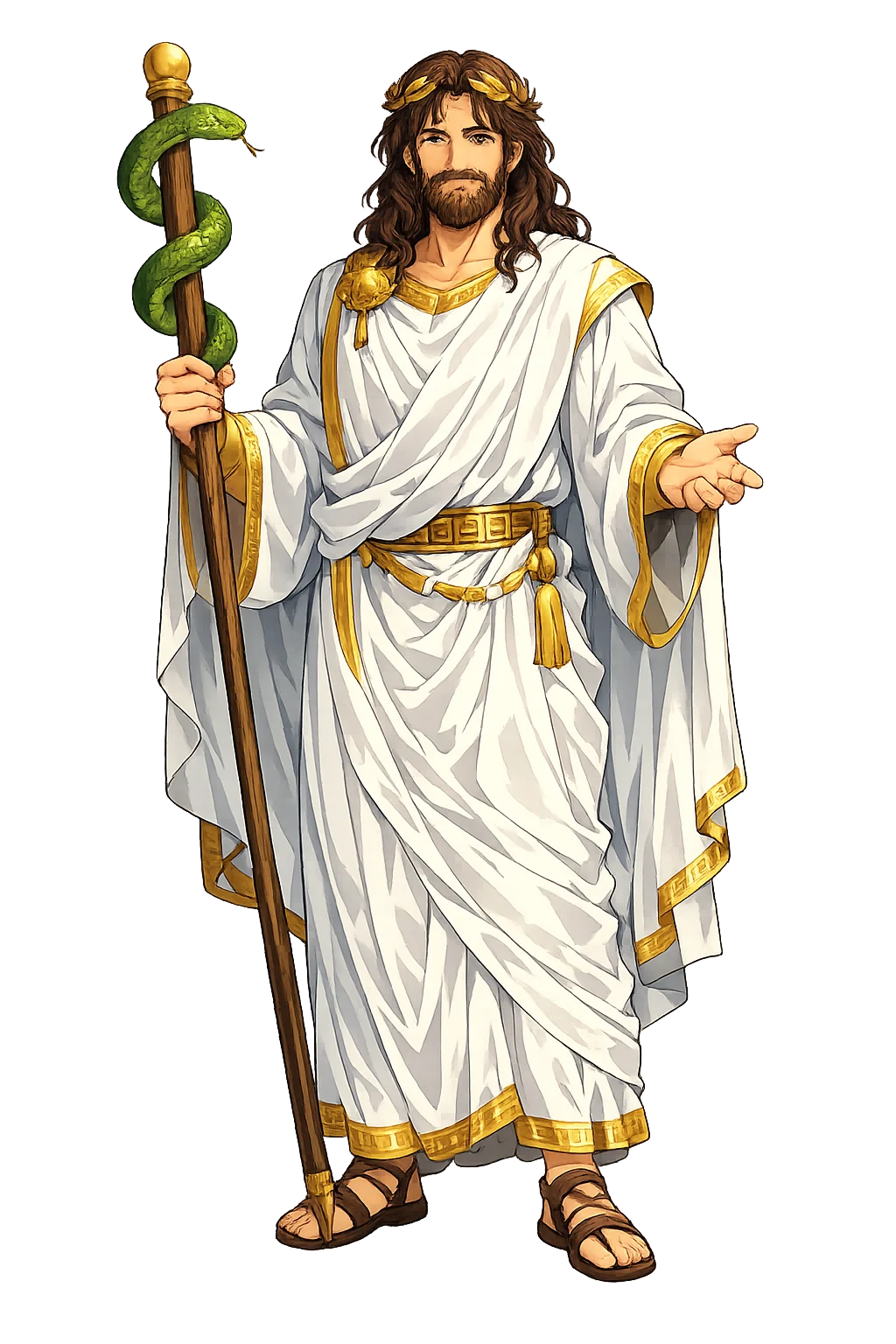
The god's image is one of antiquity's most stable: a bearded, humane figure leaning on the serpent-entwined staff, often with a dog at his feet and his daughter Hygieia beside him. The Giustiniani Stele type defines his classical look; Epidaurus' votive reliefs show him receiving worshippers or touching patients. On coins of Epidaurus, Pergamon, and the Tiber Island he appears seated with the staff; the Roman Aesculapius adds the globe. The single snake on the staff — never two — is the iconographic rule that still distinguishes his emblem from Hermês' caduceus.
Epithets & Cult Titles
The healer's titles map the geography and the ethics of his cult.
- Σωτήρ (Sōtḗr) — 'the Saviour'; the title under which whole cities prayed to him in plague.
- Παιάν (Paiā́n) — 'the Healer'; the paean-cry of the therapeutic liturgy, shared with Apóllōn.
- Ἀλεξίκακος (Alexíkakos) — 'Averter of Evil'; his apotropaic face in civic cult.
- Ἐπιδαύριος (Epidaúrios) — 'of Epidaurus'; the sanctuary-title carried wherever his cult spread.
- Αὔλιος (Aúlios) — 'of the Court'; his title at Sparta as house-physician of the state.
In Rome the same god signed as Aesculapius Augustus — the healer raised to imperial rank.
The Homeric Hymns
The sixteenth Homeric Hymn is addressed to him entire: "I begin to sing of Asklēpiós, physician of diseases, son of Apóllōn, whom Korōnis bore in the Dotian plain — a joy to mortals, a soother of cruel pains." The brevity of the hymn (five lines) matches the god's character: he needs no narrative, only the office. The hymn's pairing of craft and compassion — the healer as a gift rather than a hero — became the template for the Hippocratic ideal, and the paean sung at his incubation sanctuaries borrowed its meter directly from the Homeric tradition.
Oracle Sites & Sanctuaries
His sanctuaries were medicine's first hospitals. Epidaurus, the mother-shrine, drew patients from the whole Mediterranean; its abaton dormitory, tholos, stadium, and theatre survive as the complete ancient therapeutic landscape. Kos joined the cult to the Hippocratic school; its terraced Asklepieion overlooks the straits to Asia Minor. Pergamon became the empire's second Epidaurus — Galen's home ground — with its own theatre and sacred spring. In Rome, the Tiber Island temple (from 291 BCE) turned the cult's founding legend into urban geography: the island was later shaped and paved as a ship, with an obelisk for a mast.
Archaeology & Evidence
The sanctuary at Epidaurus — a UNESCO World Heritage site — preserves the abaton, the circular tholos (possibly the god's labyrinthine "dance floor" designed by Polykleitos), and the theatre where healed patients watched drama as therapy. The iamata stelai, re-erected from Roman copies of the 4th-century-BCE originals, list some seventy cures. At Kos, the terraced Asklepieion adjoins the Hippocratic plane tree's descendants; at Rome the Tiber Island temple's travertine snake-prow survives.
Realm & Domain
Asklēpiós is the only hero whose skill frightened the gods: the surgeon-son of Apóllōn who healed so well that Zeús destroyed him for emptying the underworld. His sanctuaries were the hospitals of the ancient world, and his snake-entwined staff still hangs over every pharmacy on earth.
The Rod
A single serpent on a staff — the true emblem of medicine, distinct from Hermês' two-snaked caduceus.
Epidaurus
The greatest healing sanctuary of antiquity, where patients slept among sacred snakes and dogs.
Incubation
Temple sleep: the god visited dreams and prescribed the cure, recorded on the iamata tablets.
The Thunderbolt
Zeús' answer to resurrection — the line past which even healing becomes transgression.
Across Cultures
Rome imported him wholesale in 293–291 BCE: the Sibylline Books prescribed his cult during a plague, an embassy fetched a sacred snake from Epidaurus, and the snake swam ashore on the Tiber Island — where a temple of Aesculapius, shaped in memory like a ship, stood within the year. In Ptolemaic Egypt he merged with the deified vizier Imhotep, whose own healing cult at Saqqara and Memphis Greeks openly called "the Egyptian Asklēpiós."
Within the Greek tradition, closely related names in the corpus include [[hygieia|Hygíeia]], [[acheron|Achérōn]], [[achilleus|Achilleús]], [[adamas|Adámas]], [[aer|Aḗr]], and [[aither|Aithḗr]].
Cultural Legacy
The Rod of Asklēpiós — one snake, one staff — is the emblem of the World Health Organization, the American Medical Association, and thousands of medical schools, endlessly confused with the caduceus of Hermês (commerce and negotiation). The Hippocratic tradition at Kos inherited his sanctuary; Galen began his career as a physician to gladiators at Pergamon's Asklepieion. "Asklepios" remains the living name of hospitals, journals, and medical AI projects alike.
The Scholarly Record
The account of Asklēpiós given in this edition rests on the witnesses and reference works listed below. Lexica and etymological dictionaries secure the form and meaning of the name; the literary and religious texts supply the narrative evidence.
- Liddell-Scott-Jones Greek-English Lexicon, 9th ed. with 1996 supplement, 1843. Full text
- Homeric Hymns, Oxford Classical Texts (Allen); Loeb, 550 BCE.
- Pindar, Victory Odes (Olympian, Pythian, Nemean, Isthmian), Loeb Classical Library, 438 BCE. Full text
- Pausanias, Description of Greece, Loeb Classical Library, 180. Full text
- Plato, Dialogues, Loeb Classical Library / Oxford Classical Texts, 348 BCE. Full text
- Apollodorus, Bibliotheca, Loeb Classical Library (Frazer), 150.
- Cambridge Ancient History, Multiple volumes, 1970. Full text
A Meditation
Asklēpiós is the god of the second opinion. He stands at the exact border between what may be cured and what must be accepted, and the thunderbolt that killed him marks medicine's eternal question: not whether we can, but whether we should. Every healer who has ever weighed risk against hope has stood inside his sanctuary.
The Unicode Restoration
Asklēpiós is classified as Tier 1: the original carries both stress and length, and only one valid Unicode restoration exists. The ASCII fallback asklepios still resolves everywhere, but it is the restored form that carries the name's full information. Across the 9 characters of the name, the restoration adjusts 2: 1 mark of stress (ó); 1 mark of length (ē). That is the whole thesis of this temple: the marks are the message.
Name Variations
The lexicon records 1 additional form of the name:
- Asklēpios (macron-only) — LSJ convention: length only, no stress mark
The temple uses Asklēpiós as the primary form: it is the spelling that best balances philological accuracy with the practical limits of DNS.
Character by Character
The journey from asklepios to Asklēpiós, one character at a time:
- a → A — Same letter
- s → s — Same letter
- k → k — Same letter
- l → l — Same letter
- e → ē — Macron marks the long vowel
- p → p — Same letter
- i → i — Same letter
- o → ó — Stress mark (acute/tone)
- s → s — Same letter
The Domain Name
The restored name is live as a working domain: asklēpiós.com, which the DNS carries in punycode form as xn--asklpis-q0a9z.com — an ASCII-compatible encoding that lets a non-ASCII name travel the global network without breaking older infrastructure. The visitor sees Asklēpiós; the machines see the encoding. That duality is the engineering compromise on which the entire restoration rests, and it is why a name written the way its own tradition wrote it in Greek can now be typed into any browser on earth.
The Greek Pantheon
Asklēpiós is one of 268 entries the PuniCodex lexicon catalogues under the Greek pantheon. The Pantheon page gathers the tradition's major figures in one place, and the Lexicon lets you filter all 915 restorations by tradition, tier, or script — the fastest way to see where this name sits among its kin.
Frequently Asked Questions
What does Asklēpiós mean? The traditional gloss is "Uncertain; possibly related to ἀσκαλαβώτης (lizard) or a pre-Greek healing root."
Which tradition does Asklēpiós belong to? Asklēpiós is catalogued in the Greek pantheon of the PuniCodex lexicon.
Why is Asklēpiós classified as Tier 1? Because the original carries both stress and length, and only one valid Unicode restoration exists — and the marks in the restored spelling preserve exactly that evidence.
Is Asklēpiós a working domain? Yes — asklēpiós.com resolves today and routes to this temple.
What is the punycode for asklēpiós.com? The DNS encoding is xn--asklpis-q0a9z.com; browsers perform the translation automatically, so visitors only ever see the restored name.
Typing Asklēpiós
You do not need a special keyboard to use this restoration. The PuniCodex Type Tool converts the ASCII form asklepios into Asklēpiós as you type, and the browser extension offers the same conversion inside any text field. Copy the restored form, paste it into the address bar, and the DNS does the rest.
Sister Temples
Other temples in the Greek pantheon include Teûcer, Thánatos, and Theōría — each with its own restoration story, its own scholarly record, and its own place in the lexicon.
Why This Restoration Matters
The marks in Asklēpiós were never lost; they were only waiting for a carrier that could hold them. Now that the carrier exists, the burden flips: every use of asklepios is a choice to leave evidence on the table. The PuniCodex temple keeps the restored form in circulation — as a domain, a dataset entry, and a scholarly argument — so that the choice to use it stays easy. Accent by accent, macron by macron, that is how the original names come back: not with a single grand gesture, but with a spelling that finally works everywhere.
Explore Further
This post is one doorway into the temple. The home page carries the full character breakdown and the ambient canvas; the lore page tells the myths in long form; the Scholarly Edition preserves the sources, pronunciation data, and revision history; and the patron wall supports the restoration directly. For the wider map, browse the Lexicon, explore the Pantheon, or return to the PuniCodex blog.
Related Names
Sources
The full scholarly apparatus — every citation, revision, and review — lives in the Scholarly Edition. Key references for this post:
- Liddell-Scott-Jones Greek-English Lexicon, 9th ed. with 1996 supplement, 1843.
- Pindar, Victory Odes (Olympian, Pythian, Nemean, Isthmian), Loeb Classical Library, 438 BCE.
- Pausanias, Description of Greece, Loeb Classical Library, 180.
- Plato, Dialogues, Loeb Classical Library / Oxford Classical Texts, 348 BCE.
- Cambridge Ancient History, Multiple volumes, 1970.
- Homeric Hymns, Oxford Classical Texts (Allen); Loeb, 550 BCE.
- Apollodorus, Bibliotheca, Loeb Classical Library (Frazer), 150.
- Edelstein & Edelstein, Asclepius: Testimonies (1945).
- Homeric Hymn 16 (to Asclepius).
- Lexicon authorities for this entry: LSJ, Homeric Hymns, Pausanias.