
The hidden history behind Árgos
Behind the modern ASCII form argos hides a much longer story. Árgos reaches back through manuscripts, inscriptions, and oral tradition long before it ever touched a keyboard, and every mark in the restored spelling is a receipt from that journey. In what follows we trace the name from its Greek attestations through its mythology, its cult, its symbols, and its afterlife in other cultures — and we show how the PuniCodex project turned that philological record into a Unicode domain that resolves today. The history was never lost. It was only waiting for the infrastructure to catch up.
At a Glance
- Restored name: Árgos
- ASCII form: argos
- Meaning: "Shining, swift"
- Domain of influence: Vigilance, Hera's Watcher
- Pantheon: Greek
- Classification: Tier 2
- Original script: Ἄργος (Greek)
- Live domain: árgos.com
Overview
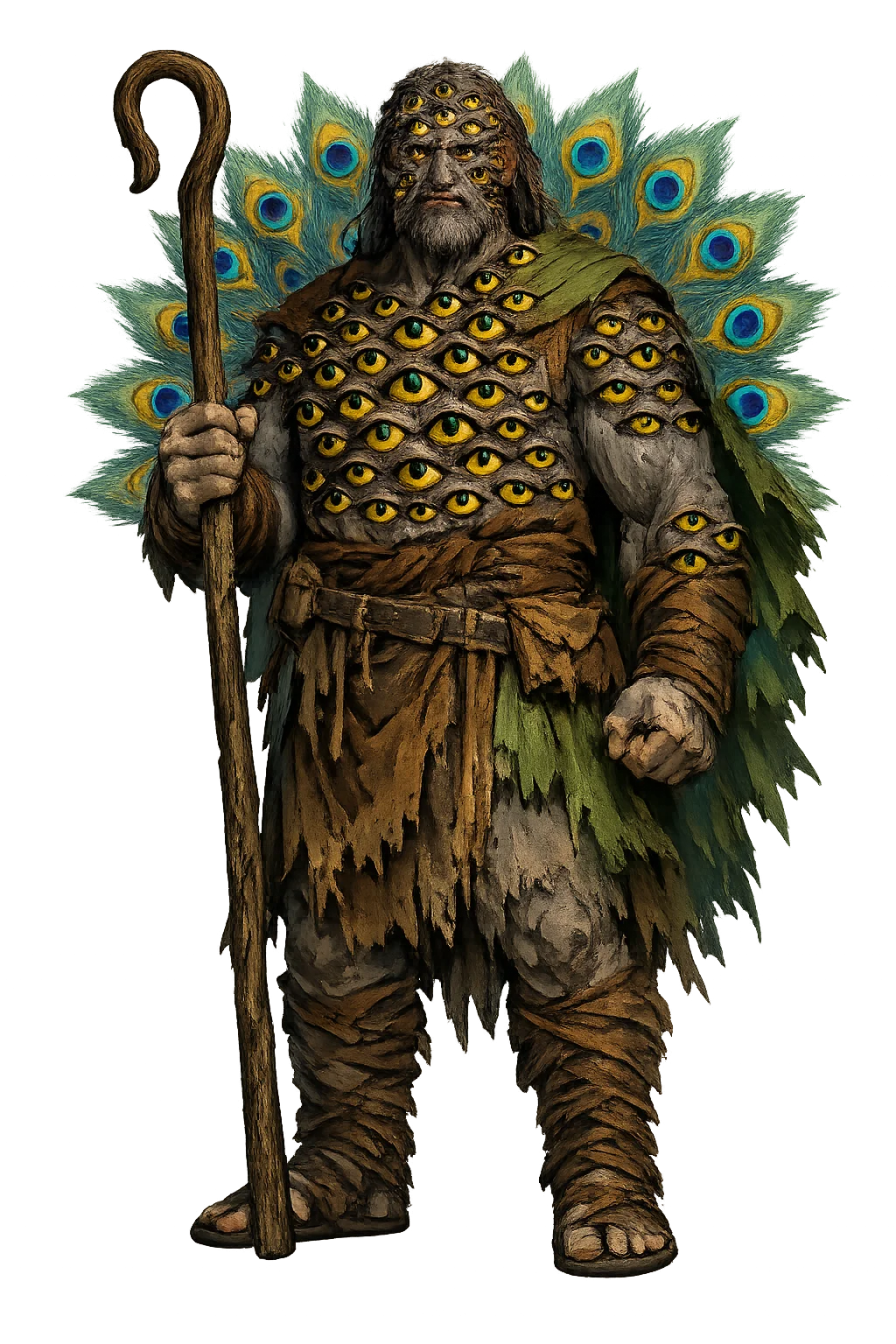
Árgos (argos) — The All-Seeing · Hera's Hundred-Eyed Watcher — belongs to the Greek tradition, where it is catalogued under the domain "Vigilance, Hera's Watcher". The name means "Shining, swift."
Árgos Panoptes is the perfect sentinel of Greek myth: a giant whose body was set with eyes that slept only in relays, so that some were always open. Hera chose him to guard the cow that had been Io, and his story — watchfulness, its cost, and its strange afterlife in feathers — is one of the oldest the Greeks told, already old when Homer sang.
PuniCodex restores the name as Árgos and serves its temple at árgos.com. The original carries only one of the two prosodic features — stress, without distinctive vowel length — which places the name in Tier 2. The plain ASCII form argos survives as a modern convenience; the restoration, not the fallback, is the form the project defends as philologically complete.
The Name
The name is attested in Greek as Ἄργος, from the adjective ἀργός, 'shining, white, gleaming' — and, by the flash of motion, 'swift'. Greek grammar keeps its two famous bearers apart: the giant is masculine, ὁ Ἄργος with genitive Ἄργου, while the city of the Argolid is neuter, τὸ Ἄργος. The watcher is not the only mythic Árgos either — tradition knows an Árgos who built the Argo and an Árgos who gave the city its name — but the giant Panoptes, 'the All-Seeing', is the figure this temple restores, the one whose name Homer already preserved in Hermês's oldest epithet.
Etymology & Roots
The name's family, as the canonical sources give it:
- Greek adjective: ἀργός, 'shining, white, gleaming' — and, by the flash of motion, 'swift'
- Greek noun: ἄργυρος, 'silver', from the same root
- PIE: *h₂erǵ-, 'white, shining', whence also Latin argentum
- Epithet: Πανόπτης (Panoptēs), 'the All-Seeing', his fixed title in the myth
The root is one of the brightest in the Indo-European lexicon: *h₂erǵ- names what glints — silver in Greek and Latin, and quickness of foot in the Homeric formula for swift dogs, κύνες ἀργοί. The ship Argo itself, the 'swift' one, carries the same root. To call the watcher Árgos was to name him for the flash of light on an open eye. The poets preferred his other name: Panoptēs, 'the All-Seeing', a compound of pân, 'all', and the root of óps, 'eye' — the same compound English later borrowed for the Panopticon.
The Original Script
The original is Ἄργος: alpha with an acute accent, rho, gamma, omicron, final sigma. The acute does all the distinguishing work — it fixes the stress on the first syllable, ÁR-gos, the flash falling forward exactly where the name's meaning says it should. Both vowels are short: no eta, no omega, no diphthong. That single accent mark is therefore the whole difference between the restoration and the ASCII form, and it is why the name classifies as Tier 2 — one prosodic feature preserved, not two. The restoration Árgos keeps the mark; everything else in the spelling the Latin alphabet already carried honestly.
Pronunciation
Árgos is Tier 2 because the Greek Ἄργος carries only the acute stress; both vowels are short, so a single feature separates the restoration from ASCII. The name belongs to the giant Argos Panoptes, Hera's watcher — not to the city of the Argolid, though the two share the shining root.
The reconstructed Attic sound is /ár.gos/ — 'AR-goss', two short syllables, stress forward, like a light snapping on. Three phonemes carry the name:
- Á- — alpha with acute pitch: a bright, open attack; the whole name flashes on its first syllable.
- -r- — rolled alveolar rho: the quick turn at the name's center.
- -gos — voiced velar gamma with short omicron and final sigma: clipped, unlenited, watchful.
Mythology
Árgos exists within a single great story — the wanderings of Io — but it is one of the oldest stories the Greeks told, already old when Homer gave Hermês the epithet Argeiphontēs, 'Slayer of Árgos'.
Hera Sets the Watch (The Appointment)
Zeús loved Io, daughter of the river-god Inachos, and to hide her from Hera — so the common telling runs — she was changed into a white cow. Hera was not deceived. She asked for the cow as a gift, and set over it Árgos Panoptes, the all-seeing giant, who tethered his prisoner to an olive tree in the grove of Mycenae and watched her without rest.
The Herdsman Who Never Sleeps (The Watch)
Árgos kept Io as a cowherd keeps a beast: by day she grazed under his eyes, by night she was bound. The poets dwell on the horror of it — a princess eating grass, a guard with nowhere to look away. Aeschylus makes him the many-eyed herdsman whose vigil not even the earth could bury.
Hermês Argeiphontēs (The Slaying)
Zeús sent Hermês to end it. Disguised as a shepherd, the god played the syrinx and told, in Ovid's account, the very story of how the pipes were made — the tale of Syrinx — until one by one the hundred eyes grew heavy and closed. Then Hermês drew the curved sword and struck off the watcher's head. The epithet Argeiphontēs, 'Slayer of Árgos', clung to him forever after.
The Eyes on the Peacock (The Memorial)
Hera took the eyes of her dead servant and set them in the tail of her peacock, where they gleam like jewels. But she did not forgive the prisoner: she sent a gadfly to sting Io into madness and drive her over the world — past the Bosporos, the 'cow's crossing' that bears her name still, to Egypt, where Zeús restored her with a touch.
Symbols & Iconography
The objects the tradition hangs on Árgos all turn on seeing:
- The hundred eyes — vigilance that never wholly sleeps.
- The peacock — Hera's bird; the eyes on its tail are his memorial.
- The white cow — Io transformed, the charge he was set to guard.
- The herdsman's staff — his gear as a common cowherd on the roads of the Argolid.
- The curved sword — the harpē of Hermês, by which the watcher was finally put to sleep.
The Eyes in Art
Greek painters solved the problem of the 'all-seeing' body with a single brilliant device: they seeded the giant's skin with eyes. Attic and South Italian vases of the fifth and fourth centuries BCE show him exactly so — a herdsman leaning on his staff beside the cow Io, his arms, chest, and legs maculate with watching, or falling beneath the sword of a traveling god in a broad-brimmed hat. The scene of the slaying was a favorite: it let the painter show every eye at once, open for the last time. The eye-covered Árgos remains one of the most recognizable bodies in Greek iconography, proof that the myth was as much a picture as a story.
Archaeology & Evidence
Árgos Panoptes had no cult and no temple; the Greeks themselves knew him as a figure of the primeval Argolid, and his material presence is pictorial. Attic and South Italian vases of the fifth and fourth centuries BCE show him exactly as the poets describe — a herdsman whose body is seeded with eyes, standing guard over the cow Io, or falling beneath Hermês's sword. His landscape survives: the Heraion of Argos, the great sanctuary of his mistress, and the olive grove of Mycenae where the sources place his watch. The myth's honesty is part of its interest — the all-seeing watcher left nothing behind but pictures of his own watching.
Realm & Domain
Árgos Panoptes is the perfect sentinel of Greek myth: a giant whose body was set with eyes that slept only in relays, so that some were always open. Hera chose him to guard the cow that had been Io. He is the myth's meditation on watchfulness — its power, its cost, and its strange afterlife in feathers.
The Hundred Eyes
Ovid gives him a hundred eyes ringed about his head; the tragedians make him many-eyed, and later art covers his whole body with them. Two slept while the others watched.
Hera's Guard
Chosen by the queen of heaven herself to watch Io — the one servant whose vigilance could be trusted absolutely.
The Sleepless Watch
His eyes took turns at rest; there was no hour, no dusk, no dawn in which the prisoner was unseen.
The Peacock's Tail
Slain by Hermês, he was memorialized by his mistress: Hera set his eyes on the tail of her bird, where they watch still.
Across Cultures
Árgos never became a god and was never identified with foreign deities; his afterlife is in the natural world and in language. Rome kept him as Argus — Ovid's account in the Metamorphoses is the fullest surviving version — and made the transfer of his eyes the aition, the explanatory myth, of the peacock's plumage. Later readers saw in his hundred eyes the starry sky itself, set as heaven's watchman over the world. His name also lives disguised in Hermês's oldest epithet: Argeiphontēs appears already in the Iliad, proof that the story of the slain watcher was archaic before Homer sang.
Cultural Legacy
English keeps him in the phrase 'argus-eyed', watchful beyond fatigue. Newspapers across the English-speaking world took the name The Argus — the all-seeing press — and naturalists gave it to the argus pheasant, whose feathers are spotted with eyes in exact obedience to the myth. Every camera grid and sensor network re-enacts him: Árgos is the mythic ancestor of all surveillance, and his fate is its parable. The watcher who saw everything was undone by music and a story — the oldest recorded defeat of total vigilance by art.
A Meditation
There is a peculiar pathos in Árgos. He is the one figure in the Io story without desire: Zeús wants, Hera rages, Io suffers, but Árgos only watches. He is duty itself, a creature made of attention. The myth does not call him wicked; Hera's grief for him is real, and his memorial is beautiful. Yet the story knows that perfect vigilance is a kind of death-in-life — a mind with no interior, no sleep, no dream.
And so the manner of his fall matters. He is not overpowered; no hero wrestles him down. He is lulled — by music, and by a story about the music. The hundred eyes close one after another, like lamps in a city at midnight, and in the last of them the sword is already falling. It is the most civilized killing in Greek myth, and the most ominous: attention can be sung to sleep. Hera could preserve his eyes, but not his seeing. The peacock's tail is the most gorgeous surveillance apparatus in the world, and it watches nothing at all.
The Unicode Restoration
Árgos is classified as Tier 2: the original carries only one of the two prosodic features — stress or vowel length — not both. The ASCII fallback argos still resolves everywhere, but it is the restored form that carries the name's full information. Across the 5 characters of the name, the restoration adjusts 1: 1 mark of stress (Á). That is the whole thesis of this temple: the marks are the message.
Character by Character
The journey from argos to Árgos, one character at a time:
- a → Á — Acute on a
- r → r — r same
- g → g — g same
- o → o — o same
- s → s — s same
The Domain Name
The restored name is live as a working domain: árgos.com, which the DNS carries in punycode form as xn--rgos-4na.com — an ASCII-compatible encoding that lets a non-ASCII name travel the global network without breaking older infrastructure. The visitor sees Árgos; the machines see the encoding. That duality is the engineering compromise on which the entire restoration rests, and it is why a name written the way its own tradition wrote it in Greek can now be typed into any browser on earth.
The Greek Pantheon
Árgos is one of 266 entries the PuniCodex lexicon catalogues under the Greek pantheon. The Pantheon page gathers the tradition's major figures in one place, and the Lexicon lets you filter all 925 restorations by tradition, tier, or script — the fastest way to see where this name sits among its kin.
Frequently Asked Questions
What does Árgos mean? The traditional gloss is "Shining, swift."
Which tradition does Árgos belong to? Árgos is catalogued in the Greek pantheon of the PuniCodex lexicon.
Why is Árgos classified as Tier 2? Because the original carries only one of the two prosodic features — stress or vowel length — not both — and the marks in the restored spelling preserve exactly that evidence.
Is Árgos a working domain? Yes — árgos.com resolves today and routes to this temple.
What is the punycode for árgos.com? The DNS encoding is xn--rgos-4na.com; browsers perform the translation automatically, so visitors only ever see the restored name.
Typing Árgos
You do not need a special keyboard to use this restoration. The PuniCodex Type Tool converts the ASCII form argos into Árgos as you type, and the browser extension offers the same conversion inside any text field. Copy the restored form, paste it into the address bar, and the DNS does the rest.
Sister Temples
Other temples in the Greek pantheon include Krónos, Ládōn, and Lḗthē — each with its own restoration story, its own scholarly record, and its own place in the lexicon.
Why This Restoration Matters
The story of Árgos did not end in antiquity; it changed medium. Names that survive for millennia do so because each generation finds a new carrier for them — clay, papyrus, print, and now DNS. The PuniCodex restoration simply makes the carrier honest: the spelling that resolves is the spelling the evidence supports. If this post showed anything, it is that argos and Árgos are not the same name with different styling. They are a summary and the text it summarizes. The web can now serve the text.
Explore Further
This post is one doorway into the temple. The home page carries the full character breakdown and the ambient canvas; the lore page tells the myths in long form; the Scholarly Edition preserves the sources, pronunciation data, and revision history; and the patron wall supports the restoration directly. For the wider map, browse the Lexicon, explore the Pantheon, or return to the PuniCodex blog.
Related Names
Sources
The full scholarly apparatus — every citation, revision, and review — lives in the Scholarly Edition. Key references for this post:
- Scholarly reference
- Lexicon authorities for this entry: Apollodorus, Ovid.