
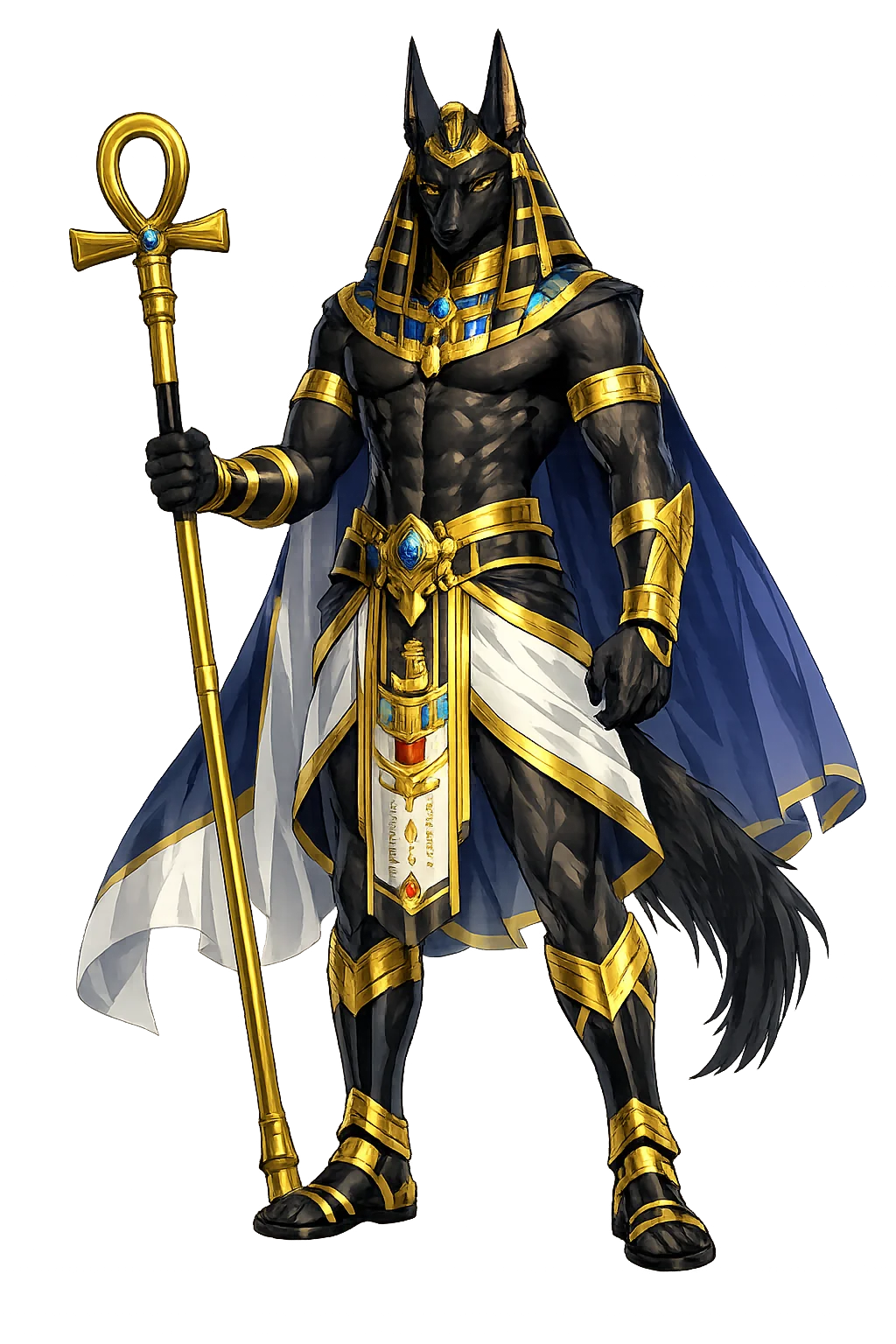
The hidden history behind ꜣnpw
Behind the modern ASCII form anubis hides a much longer story. ꜣnpw reaches back through manuscripts, inscriptions, and oral tradition long before it ever touched a keyboard, and every mark in the restored spelling is a receipt from that journey. In what follows we trace the name from its Hieroglyphs attestations through its mythology, its cult, its symbols, and its afterlife in other cultures — and we show how the PuniCodex project turned that philological record into a Unicode domain that resolves today. The history was never lost. It was only waiting for the infrastructure to catch up.
At a Glance
- Restored name: ꜣnpw
- ASCII form: anubis
- Meaning: "He who is upon his sacred mountain"
- Domain of influence: Mummification, Afterlife, Jackals
- Pantheon: Egyptian
- Classification: Tier 2
- Original script: 𓃢 (Hieroglyphs)
- Live domain: ꜣnpw.com
Overview
Jnpw (anubis) — He Who Is Upon His Mountain — belongs to the Egyptian tradition, where it is catalogued under the domain "Mummification, Afterlife, Jackals". The name means "He who is upon his sacred mountain".
ꜣnpw is the oldest funeral god of Egypt: lord of the necropolis before Osiris ever ruled it, master of embalming, and the steady hand at the scales where every human heart is weighed against a feather. His black jackal watches from the edge of the desert where the dead were always buried.
PuniCodex restores the name as Jnpw and serves its temple at ꜣnpw.com. The original preserves one prosodic feature — stress or vowel length — rather than both, which places the name in Tier 2. The plain ASCII form anubis survives as a modern convenience imposed by the early domain-name system; the restoration, not the fallback, is the form the project defends as philologically complete.
The Name
The name is attested in Hieroglyphs as 𓃢. Etymologically it means "He who is upon his sacred mountain".
The ASCII form anubis survives only because the early domain-name system could not carry diacritics; it is a technological compromise, not an ancient spelling. The Unicode restoration Jnpw recovers the full diacritic detail of the scholarly transliteration directly in the address bar. The original preserves one prosodic feature — stress or vowel length — rather than both, which places the name in Tier 2.
The letter-by-letter transformation runs:
- a → J — Alef: glottal stop
- n → n — Same
- u → p — P: bilabial stop
- b → — — Dropped: not in standard
- i → w — W: bilabial glide
- s → — — Dropped: final suffix
Attested and derived spellings of the name:
- Anúbis — alternate stress, scholarly variant: Acute on upsilon: alternate stress position
The project holds the domain ꜣnpw.com (xn--npw-lk3l.com) as the canonical home of this name.
The Original Script
The name is preserved in Hieroglyphs as 𓃢 — Egyptian hieroglyphs, attested Egyptian hieroglyphic, c. 3200 BCE – 4th century CE, in Nile Valley, Egypt. The script is written right-to-left / top-to-bottom / multidirectional.
The scholarly transliteration is Jnpw (Egyptological transliteration), giving the normalized reading Original vocalisation unknown; Egyptological /aː.ˈnuː.bɪs/..
The rendering proceeds step by step:
- Recumbent jackal (𓃢) as ideogram and determinative
- Full phonetic spelling can include 𓇋𓈖𓊪𓅱
- God of mummification and guide of the dead
The name is written ꜣ-n-p-w with the recumbent jackal (Gardiner E16) as determinative, over the hotep offering sign in the fuller orthographies. The Greeks heard it as Anoubis; Coptic preserved it as Anoup. The jackal is not decorative: it is the god himself, present in his own spelling.
Pronunciation
The reconstructed pronunciation of the name is /jaːˈnaː.paw/ — Egyptological (from jnpw).
For the modern speaker, the closest approximation is: The name is a consonant skeleton: j-n-p-w; the Greeks vocalized it as Anubis.
Kindred and historical forms of the name:
- Egyptian — ꜣnpw
- Greek — Ἄνουβις
- Coptic — Anoup
- Owned form — ꜣnpw
Egyptian ꜣnpw is conventionally vocalized "Anupu" or "Anup"; the Greek rendering Anoubis gives English "Anubis." The initial ꜣ (aleph, Gardiner G1) is a glottal consonant Egyptology once ignored and now transcribes — the restoration ꜣnpw keeps the ancient consonantal skeleton exactly as the hieroglyphs write it.
Mythology
In the earliest religion ꜣnpw simply is the god of the dead; when the Osiris cycle rose, he was written into it — as embalmer, son, and guide — without ever losing his seniority at the grave.
The First Embalming (The Wrapping)
When Set dismembered Osiris and Isis gathered the pieces, it was ꜣnpw who washed, anointed, and wrapped the god's body — the first mummy, the prototype of every burial thereafter. Egyptian priests performed the rite wearing his jackal mask, and the liturgy addresses the dead as "Osiris," while the hands doing the work are Anubis' own.
The Feather of Maat (The Judgment)
The Book of the Dead's spell 125 fixes his most famous office: in the Hall of the Two Truths, ꜣnpw leads the deceased before the scales, steadies the beam as the heart is weighed against Maat's feather of truth, and announces the reading to Thoth, who records it. A heart heavy with lies is thrown to Ammit, the devourer — his is the hand that lets that happen, or prevents it.
Son of Nephthys (The Lineage)
Later tradition (Plutarch's On Isis and the Egyptian sources behind it) makes him the son of Osiris and Nephthys, exposed and raised by Isis — a hidden child of the very murder he would spend eternity repairing. Earlier texts give him humbler parentage, sometimes the cow-goddess Hesat: theologies changed, but his place at the grave never did.
Opener of the Ways (The Guide)
His title Wp-w3wt — Wepwawet's title too, "Opener of the Ways" — marks his oldest function: the pathfinder through the Duat. On coffins and tomb walls he leans over the bier, one hand on the wrapped body, not as a threat but as the ferryman: no soul reaches the Field of Reeds without his escort through the dark.
Symbols & Iconography
The iconography associated with Jnpw concentrates in a small set of recurring attributes, each a compressed statement about the name:
- The black jackal — Black as the fertile Nile silt and the embalmed flesh — the colour of rebirth, not evil
- The flail — His authority over the necropolis as its shepherd
- The scales — Judgment made precise — his unwavering hand at the beam
- The imiut fetish — The headless skin on a pole — the embalmer's ancient emblem, older than his myths
Archaeology & Evidence
Tutankhamun's tomb (KV62) yielded the Anubis shrine: a life-size black wooden jackal, gilded ears and collar, guarding the canopic equipment — now in Cairo. The Anubeion at Saqqara, excavated over decades, preserves catacombs of mummified dogs and jackals offered to him — estimates run to millions of animals across Egypt's canine catacombs. Vignettes of spell 125, with his hand on the scales, survive in hundreds of Books of the Dead, from the papyrus of Ani in the British Museum to the papyrus of Hunefer.
His great cult centre was Cynopolis — 'Dog City' — in Middle Egypt, where the Greeks noted the dogs kept sacred in his temple. The Anubeion at Saqqara, excavated beside the Serapeum, preserves his other world: catacombs filled with millions of mummified dogs and jackals, votive offerings of pilgrims from the Late Period to the Roman era. In Greco-Roman Alexandria the temple of Hermanubis fused him with Hermês, and Apuleius describes his black-and-gold mask leading the Isiac procession — the Egyptian jackal marching, fully at home, through a Greek city.
Realm & Domain
ꜣnpw is the oldest funeral god of Egypt: lord of the necropolis before Osiris ever ruled it, master of embalming, and the steady hand at the scales where every human heart is weighed against a feather. His black jackal watches from the edge of the desert where the dead were always buried.
The Jackal
The desert canid seen at the graves' edge — feared for what it digs, honoured as the grave's defender.
The Weighing
He steadies the scales in the Hall of Two Truths: heart against Maat's feather, exact to the grain.
The Embalmer
He wrapped Osiris himself — the first mummy — and every priestly embalmer wore his mask.
The Psychopomp
"Foremost of the Westerners" — guide of souls through the night roads of the dead.
Across Cultures
The Greeks, finding a god who guides souls, fused him with Hermês: Hermanubis had temples of his own in Alexandria and Rome, jackal-headed with the kerykeion in hand. Isis' Roman mysteries kept him as mystagogue — Apuleius describes his black-and-gold mask in the Isiac procession at Cenchreae. Early Coptic tradition quietly absorbed him into the psychopomp figure of the archangel Michael, weigher of souls.
Kindred figures in the PuniCodex cross-tradition index include [[hades|Hádēs]] (underworld / death), [[hermes|Hermês]] (psychopomp), [[kanaloa|Kānāloa]] (underworld / death), [[ker|Kēr]] (underworld / death), [[mot|Mōt]] (underworld / death), and [[persephone|Persephonē]] (underworld / death).
Cultural Legacy
He is, for most of the world, the face of ancient Egypt: Tutankhamun's black jackal shrine — the recumbent Anubis atop his portable chest — is among the most reproduced objects on earth. Mummification cinema, from Karloff to modern franchises, works his territory; and every modern scale-icon of justice unconsciously borrows the pose of his beam. Egyptologists note the supreme irony: feared as a horror-movie monster, he was antiquity's most trusted guardian.
The Scholarly Record
The account of Jnpw given in this edition rests on the witnesses and reference works listed below. Lexica and etymological dictionaries secure the form and meaning of the name; the literary and religious texts supply the narrative evidence.
- A Concise Dictionary of Middle Egyptian, Griffith Institute, 1962. Full text
- H. te Velde, Seth, God of Confusion, Brill, Probleme der Ägyptologie 6, 1967.
- Alan H. Gardiner, Egyptian Grammar: Being an Introduction to the Study of Hieroglyphs, Griffith Institute / Oxford University Press (3rd ed. 1957), 1927. Full text
- James P. Allen, Middle Egyptian: An Introduction to the Language and Culture of Hieroglyphs, Cambridge University Press, 2000. Full text
- D. Bonneau, La Crue du Nil, Librairie C. Klincksieck, Paris, 1964.
- Egyptology (modern Egyptological scholarship), UCLA Encyclopedia of Egyptology / field standard, ongoing. Full text
A Meditation
ꜣnpw is the god of careful hands. At the two moments a person is most helpless — the body's unmaking and the heart's examination — he is the one who touches gently and reads honestly. Civilizations are judged, the Egyptians believed, by how they treat the dead; he is the god of that judgment, in both senses.
The Unicode Restoration
ꜣnpw is classified as Tier 2: the original preserves at least one philological feature that ASCII cannot encode. The ASCII fallback anubis still resolves everywhere, but it is the restored form that carries the name's full information. Across the 6 characters of the name, the restoration adjusts 5: 5 further adjustments (J, p, b, w, s). That is the whole thesis of this temple: the marks are the message.
Name Variations
The lexicon records 1 additional form of the name:
- Anúbis (alt-stress) — Acute on upsilon: alternate stress position
The temple uses ꜣnpw as the primary form: it is the spelling that best balances philological accuracy with the practical limits of DNS.
Character by Character
The journey from anubis to ꜣnpw, one character at a time:
- a → J — Alef: glottal stop
- n → n — Same
- u → p — P: bilabial stop
- b → b — Dropped: not in standard
- i → w — W: bilabial glide
- s → s — Dropped: final suffix
The Domain Name
The restored name is live as a working domain: ꜣnpw.com, which the DNS carries in punycode form as xn--npw-lk3l.com — an ASCII-compatible encoding that lets a non-ASCII name travel the global network without breaking older infrastructure. The visitor sees ꜣnpw; the machines see the encoding. That duality is the engineering compromise on which the entire restoration rests, and it is why a name written the way its own tradition wrote it in Hieroglyphs can now be typed into any browser on earth.
The Egyptian Pantheon
ꜣnpw is one of 67 entries the PuniCodex lexicon catalogues under the Egyptian pantheon. The Pantheon page gathers the tradition's major figures in one place, and the Lexicon lets you filter all 915 restorations by tradition, tier, or script — the fastest way to see where this name sits among its kin.
Frequently Asked Questions
What does ꜣnpw mean? The traditional gloss is "He who is upon his sacred mountain."
Which tradition does ꜣnpw belong to? ꜣnpw is catalogued in the Egyptian pantheon of the PuniCodex lexicon.
Why is ꜣnpw classified as Tier 2? Because the original preserves at least one philological feature that ASCII cannot encode — and the marks in the restored spelling preserve exactly that evidence.
Is ꜣnpw a working domain? Yes — ꜣnpw.com resolves today and routes to this temple.
What is the punycode for ꜣnpw.com? The DNS encoding is xn--npw-lk3l.com; browsers perform the translation automatically, so visitors only ever see the restored name.
Typing ꜣnpw
You do not need a special keyboard to use this restoration. The PuniCodex Type Tool converts the ASCII form anubis into ꜣnpw as you type, and the browser extension offers the same conversion inside any text field. Copy the restored form, paste it into the address bar, and the DNS does the rest.
Sister Temples
Other temples in the Egyptian pantheon include Ḫp, Mꜣꜥtkꜣ, and Mntw — each with its own restoration story, its own scholarly record, and its own place in the lexicon.
Why This Restoration Matters
The story of ꜣnpw did not end in antiquity; it changed medium. Names that survive for millennia do so because each generation finds a new carrier for them — clay, papyrus, print, and now DNS. The PuniCodex restoration simply makes the carrier honest: the spelling that resolves is the spelling the evidence supports. If this post showed anything, it is that anubis and ꜣnpw are not the same name with different styling. They are a summary and the text it summarizes. The web can now serve the text.
Explore Further
This post is one doorway into the temple. The home page carries the full character breakdown and the ambient canvas; the lore page tells the myths in long form; the Scholarly Edition preserves the sources, pronunciation data, and revision history; and the patron wall supports the restoration directly. For the wider map, browse the Lexicon, explore the Pantheon, or return to the PuniCodex blog.
Related Names
Sources
The full scholarly apparatus — every citation, revision, and review — lives in the Scholarly Edition. Key references for this post:
- A Concise Dictionary of Middle Egyptian, Griffith Institute, 1962.
- Alan H. Gardiner, Egyptian Grammar: Being an Introduction to the Study of Hieroglyphs, Griffith Institute / Oxford University Press (3rd ed. 1957), 1927.
- James P. Allen, Middle Egyptian: An Introduction to the Language and Culture of Hieroglyphs, Cambridge University Press, 2000.
- Egyptology (modern Egyptological scholarship), UCLA Encyclopedia of Egyptology / field standard, ongoing.
- H. te Velde, Seth, God of Confusion, Brill, Probleme der Ägyptologie 6, 1967.
- Faulkner, A Concise Dictionary of Middle Egyptian.
- Hannig, Ägyptisches Wörterbuch.
- Wb, jnpw.
- Lexicon authorities for this entry: Faulkner, Wb.