The Authentic Orthography
Phonological Reconstruction, Sky, Heaven, Kingship · Reconstruction node for the Sumerian/Akkadian sky god Anu: the circumflex marks a discussable vowel length, not a canonical spelling claim.
Unicode restoration and ASCII comparison
𒀭𒀀𒉡
The name in its original Mesopotamian form. Anû (𒀭𒀀𒉡) is attested in the source tradition — “Reconstruction node for the Sumerian/Akkadian sky god Anu: the circumflex marks a discussable vowel length, not a canonical spelling claim.”. Its original diacritics and script distinctions carry the full phonetic and orthographic weight of the source tradition.
anu
Reduced to plain anu, the name loses everything that made it specific: original diacritics and script distinctions. What remains is an ASCII string that machines can parse but that no longer speaks with its original voice.
Anû
The Unicode restoration recovers what ASCII flattened. Anû restores original diacritics and script distinctions, returning the name to its original written dignity. The domain encodes to Punycode, but the browser displays the truth.
Anû.com → xn--an-vka.com
The non-ASCII characters in Anû are encoded while the ASCII remains visible. To the DNS, it is Punycode. To humanity, it is Anû.
How Anû travels from ancient script to the modern URL
Sumerian an “sky, heaven"; the name Anû is the Akkadianised form of the Sumerian sky-god, with the long vowel indicating a conventional Akkadian pronunciation.
Sky, Heaven, Kingship
The Unicode restoration Anû preserves vowel length; the cuneiform form is not registrable in .com.
How Anû was spoken
Sky, Sovereignty, and Divine Ancestry
The name is written 𒀭𒀀𒉡. Standard Assyriology transliterates it as Anu. But the length of the final vowel in the Sumerian/Akkadian romanization remains an open question — and it is here, in the space between the written sign and the spoken sound, that this temple operates. This node of PuniCodex is dedicated to the phonological reconstruction and didactic grammar of the ancient Near East. We mark vowel length not because it is certain, but because it is discussable. The circumflex is a question mark made visible.
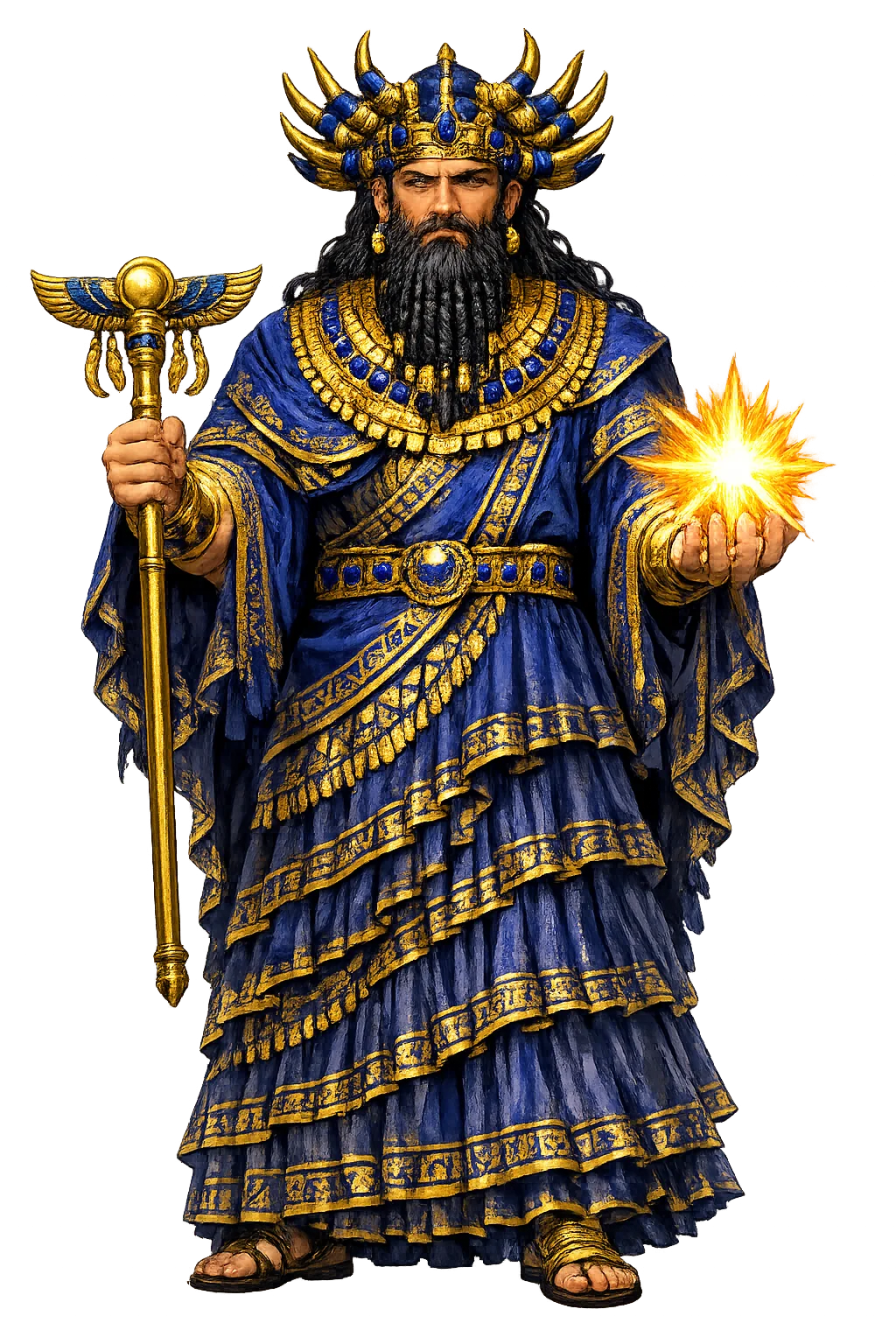
Anû is nevertheless the Sumerian sky god, the great above whose name simply means 'sky, heaven'. In the Mesopotamian pantheon he is the ultimate source of authority, the father of Enlil and the divine ancestor from whom kingship descends. His temple at Uruk, the Eanna, was one of the most sacred sites in Sumer.
Anû's domain is the heavens themselves, the bright upper region from which the gods receive their authority.
As the highest god, Anû bestowed the kingship upon earthly rulers and validated their cosmic mandate.
Father of Enlil and source of the great gods; the genealogical root of the Mesopotamian pantheon.
The topmost heaven, the meeting place of the divine assembly where destinies were decreed.
Stories of Anû
Anû is more principle than protagonist in surviving myth. He presides, decrees, and authorizes rather than adventuring. Yet his few active appearances establish the entire cosmic order.
In Sumerian cosmogony, Anû occupies the highest heaven. The god-list tradition makes him the father of Enlil, who in turn rules the earth and air, and of Ea/Enki, lord of the freshwater abyss. The three great gods divide the cosmos: Anû the sky, Enlil the storm and command, Ea the subterranean waters.
When Ishtar/Inanna complains to Anû that Gilgamesh has rejected and insulted her, Anû at first refuses to send the Bull of Heaven. Ishtar threatens to break open the gates of the underworld and let the dead outnumber the living. Anû relents and gives her the celestial bull, which Gilgamesh and Enkidu slay.
The Eanna, 'House of Heaven', was Anû's great temple at Uruk. Its name joins e₂ 'house' and an 'heaven', and its ziggurat raised the god toward his own sky. The city's hymns celebrate Anû as the source of Uruk's prestige and the foundation of its kingship.
Names are not merely labels; they are compressed worlds. Anû carries within it a Mesopotamian understanding of the sky as sovereign source, and also a philological question mark: the circumflex asks how the final vowel was spoken, not how it must be written. Unicode restoration returns that world to readable form and keeps the conversation open.
Enter Extended Lore