
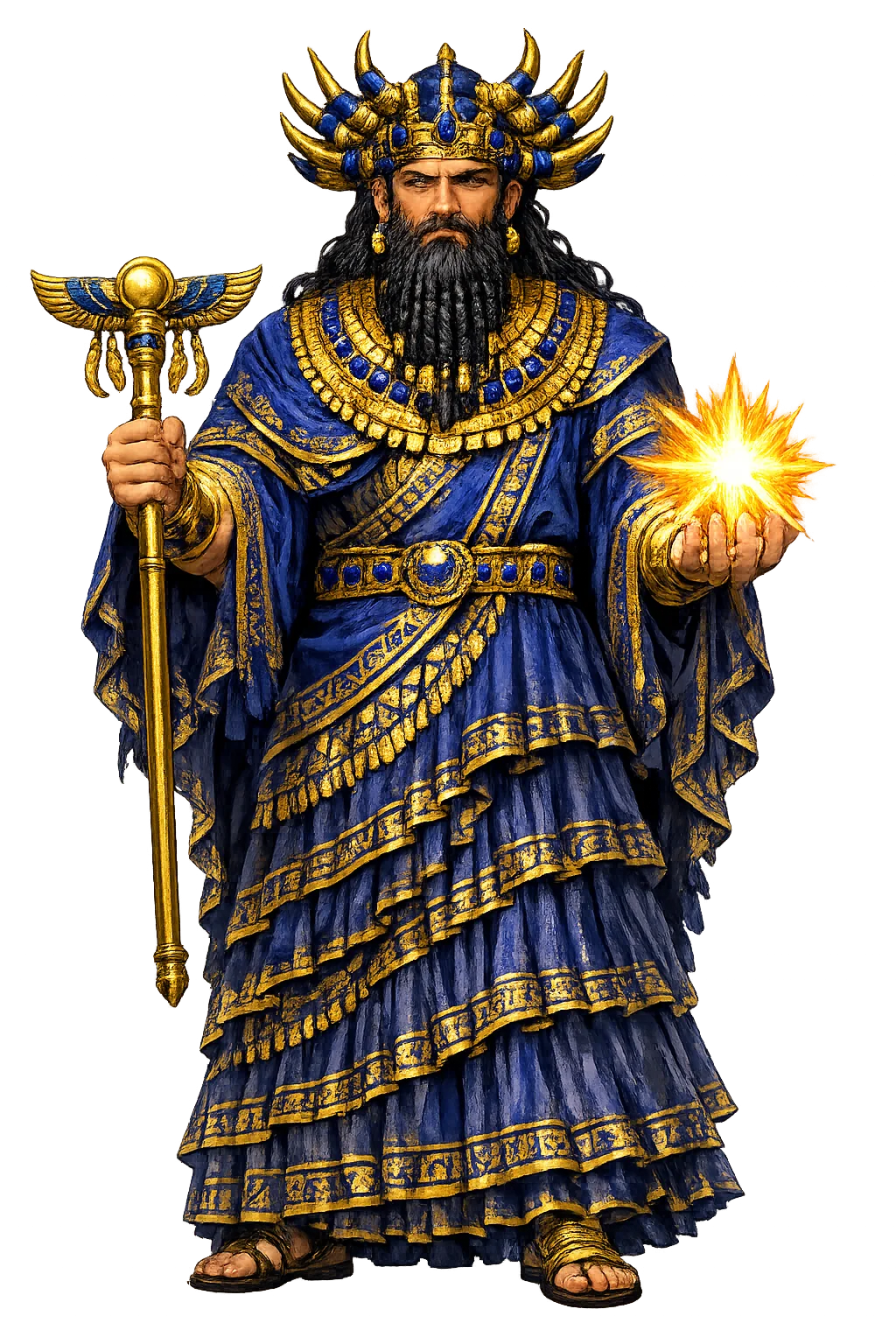
The hidden history behind Anû
Behind the modern ASCII form anu hides a much longer story. Anû reaches back through manuscripts, inscriptions, and oral tradition long before it ever touched a keyboard, and every mark in the restored spelling is a receipt from that journey. In what follows we trace the name from its Cuneiform attestations through its mythology, its cult, its symbols, and its afterlife in other cultures — and we show how the PuniCodex project turned that philological record into a Unicode domain that resolves today. The history was never lost. It was only waiting for the infrastructure to catch up.
At a Glance
- Restored name: Anû
- ASCII form: anu
- Meaning: "Reconstruction node for the Sumerian/Akkadian sky god Anu: the circumflex marks a discussable vowel length, not a canonical spelling claim."
- Domain of influence: Phonological Reconstruction, Sky, Heaven, Kingship
- Pantheon: Mesopotamian
- Classification: Tier 2
- Original script: 𒀭𒀀𒉡 (Cuneiform)
- Live domain: Anû.com
Overview
Anû (anu) — Sumerian An, 'sky, heaven' — is the sky god and first ancestor of the Mesopotamian pantheon. The canonical god-list An = Anum opens with him, and the star-sign 𒀭 (dingir) that prefixes every theonym in cuneiform is his name and his element. Kingship descends from him through his son [[enlil|Enlīl]], and his sanctuary at Uruk, the Eanna ('House of Heaven'), was for three millennia one of the most sacred precincts of Sumer. In myth he acts rarely but decisively: it is Anû who holds, and under threat releases, the Bull of Heaven in Gilgamesh Tablet VI.
The name is written 𒀭𒀀𒉡. Standard Assyriology writes Anu; the circumflex on the final vowel of Anû marks a discussable, reconstructed length — a question kept visible, not a canonical spelling — and places the name in Tier 2.
PuniCodex serves the temple at Anû.com; the plain ASCII anu is the fallback the early domain system imposed, not an ancient spelling.
The Name
The name is attested in Cuneiform as 𒀭𒀀𒉡. Etymologically it means "Reconstruction node for the Sumerian/Akkadian sky god Anu: the circumflex marks a discussable vowel length, not a canonical spelling claim.".
The reconstructed proto-form is Anu (sumerian, "sky, heaven"). Standard Assyriology transliterates the sky god as Anu (𒀭𒀀𒉡). The Sumerian sign sequence means 'sky, heaven,' and Anu remained king of the gods in Akkadian tradition. The length of the final vowel in the Akkadian/Sumerian romanization is reconstructed, not sign-given; the circumflex on Anû is a pedagogical mark that makes that open question visible, not a claim of canonical spelling.
Cognate forms across related languages:
- 𒀭𒀀𒉡 (Anu) (Sumerian) — sky, heaven
- Anu (Akkadian) — king of the gods
The ASCII form anu survives only because the early domain-name system could not carry diacritics; it is a technological compromise, not an ancient spelling. The Unicode restoration Anû recovers the vowel length of the original directly in the address bar. The original preserves one prosodic feature — stress or vowel length — rather than both, which places the name in Tier 2.
The letter-by-letter transformation runs:
- a → A — Same, capitalized
- n → n — Same
- u → û — Circumflex: a visible question mark — the length of Anu's final vowel is discussable, not certain
Attested and derived spellings of the name:
- anû — owned form: Lowercase owned domain form
- Anu — ASCII form: Standard unmarked Assyriological transliteration
The project holds the domain Anû.com (xn--an-vka.com) as the canonical home of this name.
Etymology & Roots
The recorded derivation reads: Standard Assyriology transliterates the sky god as Anu (𒀭𒀀𒉡). The Sumerian sign sequence means 'sky, heaven,' and Anu remained king of the gods in Akkadian tradition. The length of the final vowel in the Akkadian/Sumerian romanization is reconstructed, not sign-given; the circumflex on Anû is a pedagogical mark that makes that open question visible, not a claim of canonical spelling.
The reconstructed proto-form is Anu (sumerian), glossed as "sky, heaven".
The reconstruction is classed as disputed.
Kindred forms recorded in the lexicon:
- 𒀭𒀀𒉡 (Anu) (Sumerian) — sky, heaven
- Anu (Akkadian) — king of the gods
The Original Script
The name is preserved in Cuneiform as 𒀭𒀀𒉡 — Sumero-Akkadian cuneiform, attested Sumerian / Old Babylonian – Neo-Assyrian, c. 2600–600 BCE, in Mesopotamia. The script is written left-to-right / top-to-bottom.
The scholarly transliteration is Anû (Sumerian logogram + Akkadian scholarly), giving the normalized reading /aːˈnuː/.
The rendering proceeds step by step:
- The name is written 𒀭𒀀𒉡 in cuneiform.
- Sumerian logograms may be read with Akkadian values; the divine determinative 𒀭 marks theonyms.
- Macrons in the Unicode restoration mark long vowels inferred from Akkadian and Sumerian convention.
- The Unicode restoration Anû is registrable in .com; the cuneiform form is not supported in the .com IDN table.
Pronunciation
The reconstructed pronunciation of the name is /aːnu/ — Sumerian/Akkadian Reconstruction.
Phoneme by phoneme:
- ā- — Long open vowel [aː], the wide sky-vowel that opens the name upward.
- -n- — Voiced alveolar nasal [n], the firmament's axis.
- -u — Long close back rounded vowel [uː], marked by the circumflex in the Unicode restoration.
For the modern speaker, the closest approximation is: 'AH-noo' — draw out the first and final vowels; the name rises and settles like the dome of heaven.
Kindred and historical forms of the name:
- Sumerian — 𒀭𒀀𒉡 (Anu), the sky god written with the divine determinative dingir
- Akkadian — Anu, king of the gods and father of the great gods
Anû is Tier 2 because the circumflex over the final u does not record a canonical Greek-style stress or a universally agreed long vowel. It is a pedagogical mark: a visible question that invites discussion about how the name was pronounced in Sumerian and Akkadian. Standard Assyriology writes Anu; the Unicode form Anû belongs to PuniCodex's phonological reconstruction hub.
Mythology
Anû is more principle than protagonist in surviving myth. He presides, decrees, and authorizes rather than adventuring. Yet his few active appearances establish the entire cosmic order.
The Exaltation of Anû (Kingship in Heaven)
In Sumerian cosmogony, Anû occupies the highest heaven. The god-list tradition makes him the father of Enlil, who in turn rules the earth and air, and of Ea/Enki, lord of the freshwater abyss. The three great gods divide the cosmos: Anû the sky, Enlil the storm and command, Ea the subterranean waters.
Anû and the Bull of Heaven (Epic of Gilgamesh)
When Ishtar/Inanna complains to Anû that Gilgamesh has rejected and insulted her, Anû at first refuses to send the Bull of Heaven. Ishtar threatens to break open the gates of the underworld and let the dead outnumber the living. Anû relents and gives her the celestial bull, which Gilgamesh and Enkidu slay.
The Eanna of Uruk (Temple Theology)
The Eanna, 'House of Heaven', was Anû's great temple at Uruk. Its name joins e₂ 'house' and an 'heaven', and its ziggurat raised the god toward his own sky. The city's hymns celebrate Anû as the source of Uruk's prestige and the foundation of its kingship.
Symbols & Iconography
Anû's emblems are those of rank rather than narrative; his persona is authority itself, not adventure:
- The star sign 𒀭 (dingir) — his name written as a star; the same sign becomes the determinative prefixed to every god's name, so that all divinity is, graphically, a particle of An.
- Horned crown — the tiered headdress (agâ) of divinity; the crown of Anû is the supreme exemplar, attributed to other gods and to kings only in hymn and simile.
- Bull — the Bull of Heaven, Gugalanna, is his to give or withhold, as Gilgamesh Tablet VI shows; the animal figures the sky's generative and destructive strength.
- The high temple — the ziggurat terrace at Uruk, where the White Temple of the late fourth millennium stood raised toward his sky, the oldest monumental high temple known.
- Ziggurat summit — The high temple platforms that reached toward Anû's sky.
Archaeology & Evidence
Anû's material record centers on Uruk (modern Warka). The Anu Ziggurat, a terrace begun in the Ubaid period and massively raised in the late fourth millennium BCE, carried the White Temple — named for its whitewashed mudbrick — whose tripartite cella plan is the ancestor of the later Eanna precinct and the oldest monumental high temple in Mesopotamia.
Excavations by the Deutsche Orient-Gesellschaft from 1912 onward exposed the Eanna sequence and recovered the archaic tablets of the Uruk IV level, among the earliest written documents known. In the Seleucid period the city's last builders raised the Bīt Rēš ('Head Temple') and the Irigal for Anû and Antu — among the final monumental acts of cuneiform religion, documented by the Hellenistic Uruk archives.
Realm & Domain
The name is written 𒀭𒀀𒉡. Standard Assyriology transliterates it as Anu. But the length of the final vowel in the Sumerian/Akkadian romanization remains an open question — and it is here, in the space between the written sign and the spoken sound, that this temple operates. This node of PuniCodex is dedicated to the phonological reconstruction and didactic grammar of the ancient Near East: vowel length is marked not because it is certain, but because it is discussable — the circumflex is a question mark made visible.
Anû is nevertheless the Sumerian sky god, the great above whose name simply means 'sky, heaven'. In the Mesopotamian pantheon he is the ultimate source of authority, the father of Enlil and the divine ancestor from whom kingship descends. His temple at Uruk, the Eanna, was one of the most sacred sites in Sumer.
The Sky
Anû's domain is the heavens themselves, the bright upper region from which the gods receive their authority.
Kingship
As the highest god, Anû bestowed the kingship upon earthly rulers and validated their cosmic mandate.
Divine Ancestor
Father of Enlil and source of the great gods; the genealogical root of the Mesopotamian pantheon.
Cosmic Summit
The topmost heaven, the meeting place of the divine assembly where destinies were decreed.
Across Cultures
The Unicode form Anû is a reconstruction node: standard Assyriology writes Anu, while the circumflex makes visible the open question of final-vowel length. In later Mesopotamian theology Anû was sometimes merged with Enlil or paired with Antu, his consort. Hittite and Hurrian sources know him as the sky-father Anu, while West Semitic El shares his role as supreme divine patriarch. Greek writers occasionally equated Anû with Uranus, the personified sky, though the equation is more typological than historical.
Within the Mesopotamian tradition, closely related names in the corpus include [[apsu|Apsû]], [[ashur|Aššur]], [[ea|Ēa]], [[enlil|Enlīl]], [[ishtar|Ištar]], and [[shamash|Šamaš]].
Cultural Legacy
The legacy of Anû is quiet but structural. The cuneiform sign for 'god' is his name: every theonym written in Mesopotamia for three thousand years carries the star of An as its silent prefix. In the Hurro-Hittite Kingship in Heaven cycle his overthrow by Kumarbi — Anu flees skyward, his attacker bites off his genitals — preserves the oldest written succession myth, sky-father displaced by a rival storm-god, whose outline Hesiod's Theogony repeats with Ouranos, Kronos, and Zeus; scholars treat the parallel as the clearest case of Anatolian mediation between Mesopotamian and Greek theogony.
In Seleucid Uruk his cult, long eclipsed by Enlīl and Marduk, was rebuilt on a monumental scale: the Bīt Rēš and the Irigal rose for Anû and his consort Antu, and the city's last cuneiform archives document the revival — the final flowering of Mesopotamian temple religion closing, fittingly, under the sky god of Uruk.
The Scholarly Record
The account of Anû given in this edition rests on the witnesses and reference works listed below. Lexica and etymological dictionaries secure the form and meaning of the name; the literary and religious texts supply the narrative evidence.
- Electronic Text Corpus of Sumerian Literature, Oxford Oriental Institute, 1998. Full text
- Black & Green, Gods, Demons and Symbols of Ancient Mesopotamia.
- George, House Most High: The Temples of Ancient Mesopotamia.
- The Assyrian Dictionary of the Oriental Institute of the University of Chicago, 21 vols., Oriental Institute, Chicago (completed 2010), 1956. Full text
- Epic of Gilgamesh, Tablet VI.
- Sumerian Temple Hymns.
A Meditation
The shortest names carry the largest claims. An is simply the Sumerian word for 'sky' — and it is also the first name in the canonical god-lists, the sign by which cuneiform marks every other god, and the dedication of the temple that gave Uruk its pride. The word for the world above became the word for the divine itself.
The circumflex on Anû adds a second, humbler lesson: even for the best-attested god of the pantheon, the modern vowel mark is an inference, not a reading taken straight off the signs. The restoration keeps the inference visible, which is the most the evidence allows.
The Unicode Restoration
Anû is classified as Tier 2: the original preserves at least one philological feature that ASCII cannot encode. The ASCII fallback anu still resolves everywhere, but it is the restored form that carries the name's full information. Across the 3 characters of the name, the restoration adjusts 1: 1 mark of length (û). That is the whole thesis of this temple: the marks are the message.
Name Variations
The lexicon records 2 additional forms of the name:
- anû (owned) — Lowercase owned domain form
- Anu (ascii) — Standard unmarked Assyriological transliteration
The temple uses Anû as the primary form: it is the spelling that best balances philological accuracy with the practical limits of DNS.
Character by Character
The journey from anu to Anû, one character at a time:
- a → A — Same, capitalized
- n → n — Same
- u → û — Circumflex: a visible question mark — the length of Anu's final vowel is discussable, not certain
The Domain Name
The restored name is live as a working domain: Anû.com, which the DNS carries in punycode form as xn--an-vka.com — an ASCII-compatible encoding that lets a non-ASCII name travel the global network without breaking older infrastructure. The visitor sees Anû; the machines see the encoding. That duality is the engineering compromise on which the entire restoration rests, and it is why a name written the way its own tradition wrote it in Cuneiform can now be typed into any browser on earth.
The Mesopotamian Pantheon
Anû is one of 30 entries the PuniCodex lexicon catalogues under the Mesopotamian pantheon. The Pantheon page gathers the tradition's major figures in one place, and the Lexicon lets you filter all 895 restorations by tradition, tier, or script — the fastest way to see where this name sits among its kin.
Frequently Asked Questions
What does Anû mean? The traditional gloss is "Reconstruction node for the Sumerian/Akkadian sky god Anu: the circumflex marks a discussable vowel length, not a canonical spelling claim.."
Which tradition does Anû belong to? Anû is catalogued in the Mesopotamian pantheon of the PuniCodex lexicon.
Why is Anû classified as Tier 2? Because the original preserves at least one philological feature that ASCII cannot encode — and the marks in the restored spelling preserve exactly that evidence.
Is Anû a working domain? Yes — Anû.com resolves today and routes to this temple.
What is the punycode for Anû.com? The DNS encoding is xn--an-vka.com; browsers perform the translation automatically, so visitors only ever see the restored name.
Typing Anû
You do not need a special keyboard to use this restoration. The PuniCodex Type Tool converts the ASCII form anu into Anû as you type, and the browser extension offers the same conversion inside any text field. Copy the restored form, paste it into the address bar, and the DNS does the rest.
Why This Restoration Matters
The story of Anû did not end in antiquity; it changed medium. Names that survive for millennia do so because each generation finds a new carrier for them — clay, papyrus, print, and now DNS. The PuniCodex restoration simply makes the carrier honest: the spelling that resolves is the spelling the evidence supports. If this post showed anything, it is that anu and Anû are not the same name with different styling. They are a summary and the text it summarizes. The web can now serve the text.
Explore Further
This post is one doorway into the temple. The home page carries the full character breakdown and the ambient canvas; the lore page tells the myths in long form; the Scholarly Edition preserves the sources, pronunciation data, and revision history; and the patron wall supports the restoration directly. For the wider map, browse the Lexicon, explore the Pantheon, or return to the PuniCodex blog.
Related Names
Sources
The full scholarly apparatus — every citation, revision, and review — lives in the Scholarly Edition. Key references for this post:
- The Assyrian Dictionary of the Oriental Institute of the University of Chicago, 21 vols., Oriental Institute, Chicago (completed 2010), 1956.
- Electronic Text Corpus of Sumerian Literature, Oxford Oriental Institute, 1998.
- Litke, A Reconstruction of the Assyro-Babylonian God-Lists, AN: dA-nu-um and AN: Anu šá amēli (Yale, 1998).
- George, House Most High: The Temples of Ancient Mesopotamia.
- George, The Babylonian Gilgamesh Epic: Introduction, Critical Edition and Cuneiform Texts (Tablet VI).
- Black & Green, Gods, Demons and Symbols of Ancient Mesopotamia.
- Lexicon authorities for this entry: ETCSL, Black-Green, CAD.