
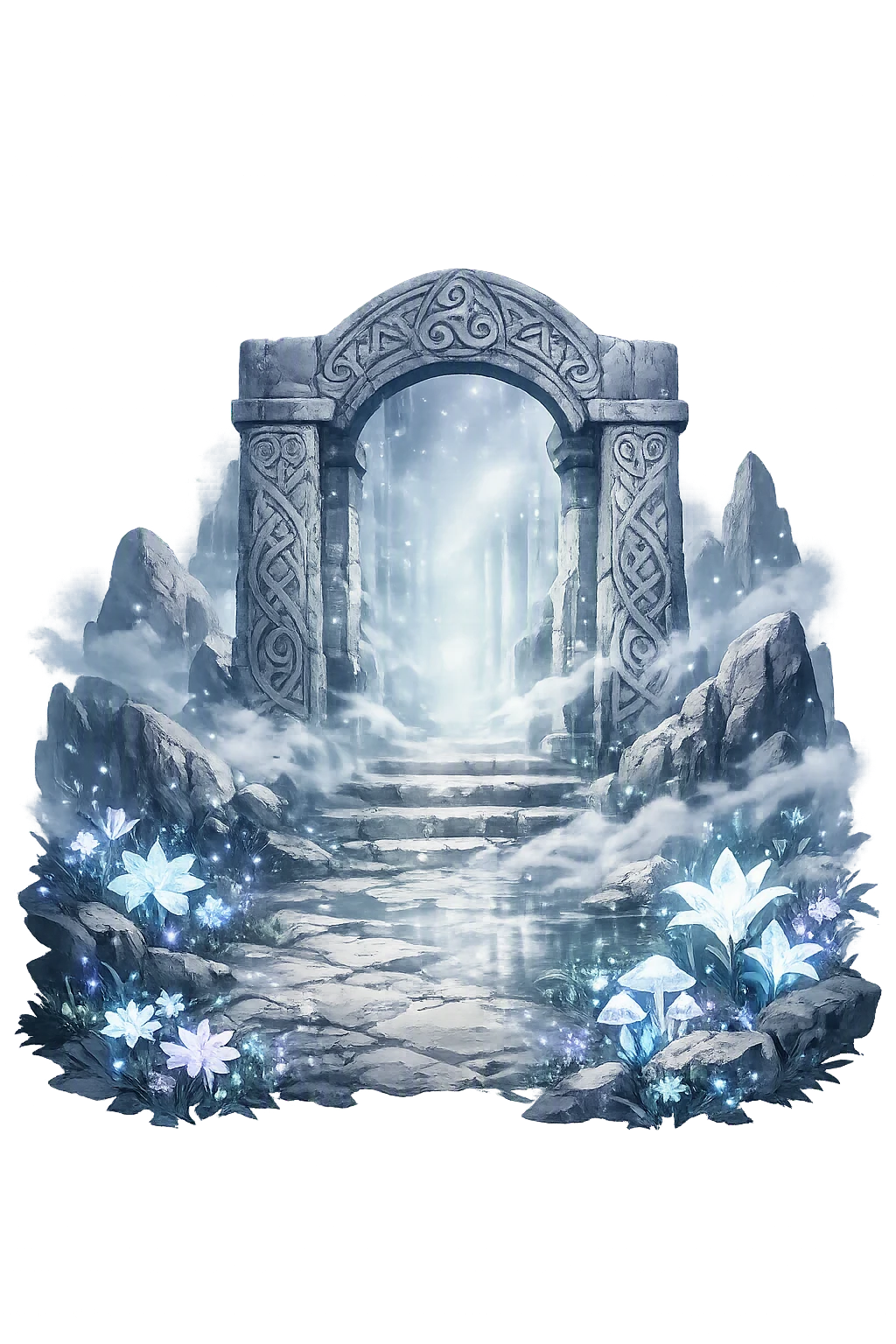
The hidden history behind Annwn
Behind the modern ASCII form annwn hides a much longer story. Annwn reaches back through manuscripts, inscriptions, and oral tradition long before it ever touched a keyboard, and every mark in the restored spelling is a receipt from that journey. In what follows we trace the name from its Celtic transcription attestations through its mythology, its cult, its symbols, and its afterlife in other cultures — and we show how the PuniCodex project turned that philological record into a Unicode domain that resolves today. The history was never lost. It was only waiting for the infrastructure to catch up.
At a Glance
- Restored name: Annwn
- ASCII form: annwn
- Meaning: "The deep, the abyss"
- Domain of influence: Otherworld, Underworld
- Pantheon: Celtic
- Classification: Tier 2
Overview
Annwn (annwn) — Otherworld, Underworld · the deep, the abyss — is the Welsh Otherworld of the Mabinogi and the oldest Welsh poetry: the realm where Arawn rules a court of unsurpassed plenty, where Arthur sailed in Prydwen for the cauldron of the Head of Annwn and lost all but seven of his men, and where Gwyn ap Nudd rides with the hunt that keeps the demons of the deep from destroying this world.
The name is the place: Middle Welsh annwfn resolves as an- + dwfn, 'the un-deep, the very deep' — the abyss beneath the world, glossed by the University of Wales dictionary simply as 'the otherworld, the abyss'. It is first met on the page in the opening episode of the First Branch of the Mabinogi, where Pwyll of Dyfed offends Arawn at the hunt in Glyn Cuch and pays the debt with a year spent ruling Annwn in the king's own shape — earning for his reward the title Pwyll Pen Annwn, 'Head of Annwn'.
PuniCodex restores the name as Annwn — identical to the ASCII input, because normalized Welsh writes no diacritic in this name. The mechanical rule therefore places it in Tier 2: nothing distinctive is lost in transit, a statement about orthography and never about the realm. No domain is claimed: the plain-ASCII annwn.com is registered to a third party outside the collection and is watched for release.
The Name
The name is attested in Middle Welsh as annwfn — the spelling of the Book of Taliesin and the Mabinogi manuscripts, where final -f- writes the voiced fricative [v] — and in the normalized modern spelling Annwn used for the Otherworld ever since. The University of Wales dictionary glosses the word 'the otherworld, the abyss', and the standard analysis resolves it as the prefix an- (negative or intensifying) + dwfn, 'deep': the un-deep, the very deep — the meaning this lexicon carries, 'the deep, the abyss'.
The popular gloss 'not-world' — an- + a form of byd/gwyn heard in the sounds — is a later reinterpretation rather than the philology; the manuscript word is built on dwfn, and the abyss, not negation, is the image the texts use: a realm below, entered at a ford or a hunting-clearing, from which voyages return diminished or not at all.
The ASCII form annwn loses nothing, because the normalized Welsh spelling is already plain Latin letters; the restoration is therefore a matter of canonical reference, not rescued diacritics, and the name is classified Tier 2 by the project's mechanical rule.
The letter-by-letter transformation runs:
- a → A — Same, capitalized
- n → n — Same
- n → n — Same
- w → w — Same
- n → n — Same
The project holds no domain for this name: annwn.com is registered to a third party outside the PuniCodex collection and is watched for release. The temple lives at its canonical lexicon address.
The Original Script
The name is preserved in medieval Welsh manuscripts in the Latin alphabet as annwfn — Middle Welsh in Insular script, attested from the Book of Taliesin (early fourteenth century) onward, with the Mabinogi and Culhwch witnesses in the White Book of Rhydderch and the Red Book of Hergest. Welsh has used the Latin alphabet throughout its written history; the earlier epigraphic record is Latin and ogham memorial stones, neither of which preserves this word.
The scholarly rendering proceeds step by step:
- Middle Welsh writes the name annwfn, the f writing the voiced fricative [v]; the normalized modern spelling is Annwn.
- The dictionary analysis resolves the compound as an- + dwfn, 'deep' — 'the un-deep, the very deep'; the gloss 'not-world' is a later popular reinterpretation of the same sounds.
- The letter w is a full vowel in Welsh ([ʊ]); nothing in the spelling requires a diacritic, so nothing distinctive is lost in ASCII.
- The Unicode restoration Annwn is therefore identical to the ASCII form apart from the capital; the temple form is a canonical reference, not a rescued spelling.
One caution attaches to the record: the 'f' of the manuscript form is consonantal [v], but the modern normalized spelling drops it — a regular outcome of Welsh final-consonant loss, not an editorial liberty.
Pronunciation
The modern Welsh pronunciation of the name is /ˈanʊn/ — Modern Welsh.
Phoneme by phoneme:
- A- — Short open [a], stressed on the first syllable, as Welsh penultimate stress demands in a two-syllable word
- -nn- — Geminate alveolar nasal [nː], written double and held longer than a single English n
- -w- — The letter w is here a full vowel: short high back rounded [ʊ], the 'oo' of English 'put' — never a consonant
- -n — Final alveolar nasal [n], closing the word cleanly
For the modern speaker, the closest approximation is: 'AN-oon' — two syllables, the first stressed, the w sounded as a short 'oo'.
Kindred and historical forms of the name:
- Middle Welsh — Annwfn, the manuscript spelling, the f writing the voiced [v] of the lenited final consonant
- Modern Welsh — Annwn, the normalized living form
- The compound — an- + dwfn, 'the un-deep, the very deep'
- The title it generated — Pen Annwn, 'Head of Annwn', borne by Pwyll after his year in the realm and by the Otherworld's cauldron-master in the Taliesin poem
Annwn is Tier 2 because the restoration preserves nothing ASCII loses: the letters of the normalized form are the letters of the keyboard. The capital alone marks the temple form.
Mythology
Annwn's dossier is concentrated in four witnesses — the First Branch of the Mabinogi, the Taliesin poem Preiddeu Annwfn, the hunting catalogue of Culhwch ac Olwen, and the Welsh Life of St Collen.
The Year in Annwn (Pwyll Pendefig Dyfed)
Hunting in Glyn Cuch, Pwyll of Dyfed drives a strange pack off a stag — hounds gleaming white, with red ears — and feeds his own dogs on the kill. The pack's master is Arawn, a king of Annwn, and the debt is settled by a bargain: the two exchange shapes and kingdoms for a year and a day, and at the year's end Pwyll must strike down Arawn's rival Hafgan, who can be killed by one blow only. Pwyll rules Annwn in Arawn's likeness, lies chaste beside Arawn's queen every night of the year, strikes Hafgan once at the ford and refuses the second blow, and returns to Glyn Cuch to trade shapes back. The friendship is sealed with gifts, and Pwyll is ever after called Pwyll Pen Annwn — Head of Annwn.
The Spoils of Annwfn (Book of Taliesin)
Preiddeu Annwfn, spoken by the poet Taliesin himself, is the oldest Arthurian Otherworld raid. Arthur sails in Prydwen against the fortresses of the deep — Caer Sidi, Caer Pedryfan, Caer Wydyr — for the cauldron of the Head of Annwfn, kindled by the breath of nine maidens and rimmed with pearls, which will not boil a coward's food. The refrain tolls after each fortress: except seven, none returned from Caer Sidi.
Gwyn ap Nudd and the Demons (Culhwch ac Olwen)
The hunting catalogue of Culhwch ac Olwen names the realm's huntsman: Gwyn ap Nudd, 'in whom God set the essence of the demons of Annwn, lest this world be destroyed' — conscripted to the hunt of Twrch Trwyth because without him it cannot be done. The same tale fixes his standing quarrel with Gwythyr ap Greidawl over Creiddylad daughter of Lludd: Arthur judged that the two fight for her every May Day until the Day of Judgment.
The Court on the Tor (Buchedd Collen)
The Life of St Collen gives Annwn its local address: Gwyn ap Nudd, king of Annwn and of the Fair Folk, keeps a castle of utmost splendour on Glastonbury Tor and feasts the saint on dishes beyond earthly measure — until Collen's holy water disperses castle, court, and king, leaving him standing on the green hill.
Symbols & Iconography
Annwn's attributes are the few fixed images the Welsh tradition never varies — each a boundary made visible:
- The cauldron of Pen Annwn — Kindled by the breath of nine maidens, its rim set with pearls, and ruled by the law of Otherworld vessels: it will not boil the food of a coward
- The white hounds with red ears — Arawn's pack at Glyn Cuch, gleaming white with red ears: the colours Welsh tradition gives every creature out of the Otherworld
- Caer Sidi and the fortresses — The revolving castle and its sisters, the Otherworld as fortifications that must be won rather than visited
- Prydwen — Arthur's ship on the raid of Preiddeu Annwfn: three full loads went into the deep, and except seven none returned
- The year's exchange — Arawn and Pwyll trading shapes, kingdoms, and beds for a year and a day: the Otherworld close enough to wear a man's face
Archaeology & Evidence
Annwn is a wholly textual realm: no inscription invokes it, and the Romano-British epigraphy of Wales is silent on the Otherworld by name. Its manuscript witnesses, however, are exact. The Mabinogi survives complete in the White Book of Rhydderch (c. 1350) and the Red Book of Hergest (c. 1400), the two great codices of medieval Welsh prose; Preiddeu Annwfn is preserved uniquely in the Book of Taliesin (National Library of Wales, Peniarth MS 2, early fourteenth century); and Culhwch ac Olwen comes down in a White Book fragment and the full Red Book text.
The one site the tradition ties to Annwn is Glastonbury Tor, Gwyn ap Nudd's seat in Buchedd Collen. Excavations on the Tor in the 1960s found sub-Roman and early medieval occupation beneath the ruins of the medieval church of St Michael — real archaeology on the hill, though none of it speaks to the Otherworld, whose only true location is the text.
Realm & Domain
Annwn is catalogued under the domain 'Otherworld, Underworld' — the two registers in which the texts actually present it.
Otherworld
Annwn is first of all a court: Arawn's realm of unsurpassed plenty, where the feast never fails and the hall is hung with gold and jewels — the place Pwyll ruled for a year in another man's shape and found so well ordered that he never wished to leave it. The Taliesin poem gives it architecture: Caer Sidi and its sister fortresses, the revolving castles of the deep that Arthur's men assaulted and mostly never left.
Underworld
But the name means the deep, and the texts keep the darkness in it. Annwn is the home of the demons over whom God set Gwyn ap Nudd, 'lest this world be destroyed'; its creatures — the white red-eared hounds, the treasures that will not serve a coward — cross into this world only at its edges, and what is taken from it is paid for.
The Feast and the Hunt
Two activities define the realm in every source: the feast, boundless but testing — the cauldron of the Head of Annwn will not boil a coward's food — and the hunt, which in Annwn is not sport but custody, the riding-out that keeps the deep's worst inhabitants leashed.
Across Cultures
Annwn's clearest kin are Irish, and the comparison is structural rather than genealogical: no Irish text knows the name, but the síd of the Túatha Dé Danann matches its profile point for point. The standing parallel is the cauldron: the Dagda's cauldron of Murias, from which no company ever went away unsatisfied, is the Irish face of the vessel of plenty that in Wales becomes the cauldron of the Head of Annwn — and Mac Cana sets the two side by side as one Celtic figure-type. The Irish Otherworld of the immrama and echtrai — Mag Mell, Emain Ablach under Manannán, lands without grief, sorrow, or death — supplies the same profile of plenty and suspended age that the Welsh sources give Annwn.
Within the Welsh corpus itself, Annwn's borders touch the other Otherworldly episodes of the Mabinogi: the Dyfed of Rhiannon and the enchanted Desolation of Manawydan are told in the same idiom of a world one courtesy away from ours. The Christian redactors re-labelled without restructuring: by Buchedd Collen, Gwyn ap Nudd's court could be dismissed as a demonic glamour while every detail of the feast was preserved intact — and Culhwch had already made the demons of Annwn a standing threat that only Gwyn's custody restrains.
Cultural Legacy
Preiddeu Annwfn stands at the head of the Arthurian tradition: the raid on the fortresses of the deep is older than every romance of the Grail, and scholars from Loomis onward have read the quest for the cauldron of the Head of Annwn — a vessel of plenty that tests the worthy — as the Grail story's deepest Welsh root. The comparison with the Dagda's cauldron and the Welsh pairperi keeps Annwn at the centre of every account of the Celtic vessel of plenty.
In Welsh itself the name never went anywhere: Annwn remains the living word for the Otherworld, and the white red-eared hounds became the Cŵn Annwn of later folklore, the pack whose crying in the night sky foretells a death. Gwyn ap Nudd rode out of the texts into modern Druidry and pagan practice as the great huntsman of the Welsh tradition, and Glastonbury Tor — crowned now by the stump of St Michael's tower — still carries his court in the popular imagination. Modern editions and translations — Williams's Pedeir Keinc, Davies's Oxford Mabinogion, Haycock's Taliesin poems — have made the realm a fixed point of Celtic studies.
The Scholarly Record
The account of Annwn given in this edition rests on the witnesses and reference works listed below. The Mabinogi supplies the narrative spine; Preiddeu Annwfn and Culhwch ac Olwen the poem and the hunt; Buchedd Collen the saint's-life witness; the dictionaries and encyclopedias secure the name.
- Davies, Sioned, trans., The Mabinogion (Oxford: Oxford University Press, 2007).
- Williams, Ifor, ed., Pedeir Keinc y Mabinogi (Cardiff: University of Wales Press, 1930).
- Haycock, Marged, ed. and trans., Legendary Poems from the Book of Taliesin (Aberystwyth: CMCS, 2007), Preiddeu Annwfn.
- Evans, J. Gwenogvryn, ed., Facsimile and Text of the Book of Taliesin (Llanbedrog, 1910).
- Bromwich, Rachel, and D. Simon Evans, eds., Culhwch and Olwen: An Edition and Study (Cardiff: University of Wales Press, 1992).
- Buchedd Collen (The Life of St Collen), in Baring-Gould, S., and J. Fisher, The Lives of the British Saints, vol. 2 (London: Honourable Society of Cymmrodorion, 1908).
- Geiriadur Prifysgol Cymru / A Dictionary of the Welsh Language (Cardiff: University of Wales Press, 1950–2002), s.v. annwfn, dwfn.
- Mac Cana, Proinsias, Celtic Mythology (London: Hamlyn, 1970).
- Koch, John T., ed., Celtic Culture: A Historical Encyclopedia, 5 vols. (Santa Barbara: ABC-CLIO, 2006), s.v. Annwfn, Preiddeu Annwfn, Gwyn ap Nudd.
- MacKillop, James, Dictionary of Celtic Mythology (Oxford: Oxford University Press, 1998), s.v. Annwn, Arawn, Gwyn ap Nudd, Cŵn Annwn.
- Rahtz, Philip, and Lorna Watts, Glastonbury: Myth and Archaeology (Stroud: Tempus, 2003).
A Meditation
Annwn is the rare Otherworld whose name tells you where it is: an- + dwfn, the un-deep, the very deep — not a land over the sea or under a hill but the depth beneath the world, the place the surface world is the skin of. The tradition never pretends it is far away. Pwyll stumbles into it on an ordinary hunt by breaking an ordinary courtesy; it lies a year's shape-shift away, close enough for two kings to trade faces and governments across it.
And its gifts all carry a price exacted in courage. The feast is boundless, but the cauldron will not boil a coward's food; the voyage is possible, but except seven none returned; the hunt rides out, but it rides to keep the demons of the deep leashed for the world's sake. Annwn is the Celtic imagination's answer to the question of what lies underneath: plenty without limit, behind a door that opens only once — and a word for it, five plain letters, that still means the deep.
The Unicode Restoration
Annwn is classified as Tier 2: the restoration needs no distinctive letters or diacritics its ASCII form would lose. The ASCII fallback annwn still resolves everywhere, but it is the restored form that carries the name's full information. That is the whole thesis of this temple: the marks are the message.
Why This Restoration Matters
The story of Annwn did not end in antiquity; it changed medium. Names that survive for millennia do so because each generation finds a new carrier for them — clay, papyrus, print, and now DNS. The PuniCodex restoration simply makes the carrier honest: the spelling that resolves is the spelling the evidence supports. If this post showed anything, it is that annwn and Annwn are not the same name with different styling. They are a summary and the text it summarizes. The web can now serve the text.
Explore Further
This post is one doorway into the temple. The home page carries the full character breakdown and the ambient canvas; the lore page tells the myths in long form; the Scholarly Edition preserves the sources, pronunciation data, and revision history; and the patron wall supports the restoration directly. For the wider map, browse the Lexicon, explore the Pantheon, or return to the PuniCodex blog.
Related Names
Sources
The full scholarly apparatus — every citation, revision, and review — lives in the Scholarly Edition. Key references for this post:
- Davies, Sioned, trans., The Mabinogion (Oxford: Oxford University Press, 2007), Pwyll Pendefig Dyfed.
- Geiriadur Prifysgol Cymru / A Dictionary of the Welsh Language (Cardiff: University of Wales Press, 1950–2002), s.v. annwfn.
- Koch, John T., ed., Celtic Culture: A Historical Encyclopedia, 5 vols. (Santa Barbara: ABC-CLIO, 2006), s.v. Annwfn.
- Evans, J. Gwenogvryn, ed., Facsimile and Text of the Book of Taliesin (Llanbedrog, 1910).
- Lexicon authorities for this entry: Mabinogion, MacKillop.