
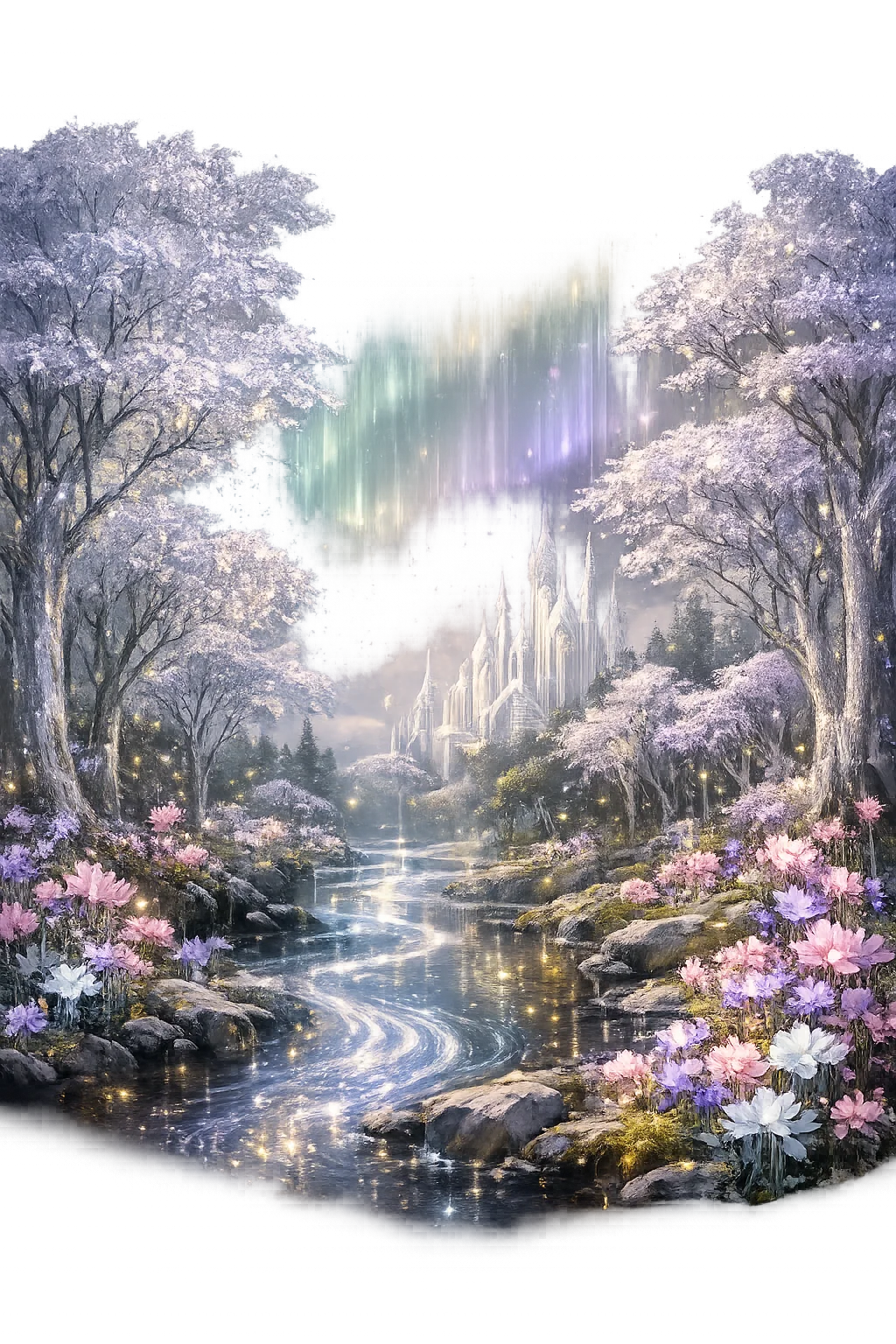
The many faces of Álfheimr
No important name has only one face. Álfheimr appears as a figure of myth, a scholarly reconstruction, a piece of material culture, a memory carried across languages, and — most recently — a Unicode domain. This post looks at each face in turn: the name and its roots, the Younger Futhark original, the reconstructed pronunciation, the mythological record, the symbols and sanctuaries, the cross-cultural afterlife, and the engineering that lets the restored spelling resolve in a browser. Taken together, those faces explain why alfheimr was never going to be enough — and why the restored form is worth a domain of its own.
At a Glance
- Restored name: Álfheimr
- ASCII form: alfheimr
- Meaning: "Elf-home (from álfr + heimr)"
- Domain of influence: Realm of the Light Elves
- Pantheon: Norse
- Classification: Tier 2
- Original script: ᛅᛚᚠᚼᛁᛘᚱ (Younger Futhark)
- Live domain: álfheimr.com
Overview
Álfheimr (Old Norse Álfheimr, 'elf-home', from álfr 'elf' + heimr 'home, world') is the realm of the light elves in Norse cosmology. Its two primary attestations frame everything securely known about it: in Grímnismál 5 the gods give Álfheimr to Freyr 'in ancient days' as a tooth-gift (tannfé), the customary present on a child's first tooth; in Snorri's Gylfaginning the realm is home to the ljósálfar, 'light elves', who are 'fairer than the sun to look upon'. Beyond these passages the record is thin: no Eddic poem is set in Álfheimr, no cult site dedicated to the álfar is archaeologically identified, and it is the being álfr — preserved in personal names, sacrifice-accounts, and charms — rather than the place that the medieval evidence actually documents.
PuniCodex restores the name as Álfheimr and serves its temple at álfheimr.com. The acute accent on Á marks the long, stressed first vowel of the Old Norse compound; no second prosodic feature is marked, which places the name in Tier 2. The ASCII fallback alfheimr is a convenience of the early domain-name system, not an ancient spelling.
The Name
The name is rendered in Younger Futhark as ᛅᛚᚠᚼᛁᛘᚱ. Since the sixteen-rune futhark does not distinguish long from short vowels, the runic string cannot itself record the long á that the normalized form carries; the reconstruction rests on the manuscript tradition. Etymologically Álfheimr is a transparent Old Norse compound meaning 'elf-home'.
The Proto-Germanic ancestor of the compound is albaz + haimaz: albaz 'elf' (cf. Old English ælf) and haimaz 'home, village' (cf. Gothic haims). The lexical heart of the name is thus the being, not the place.
The ASCII form alfheimr survives only because the early domain-name system could not carry diacritics; it is a technological compromise, not an ancient spelling. The Unicode restoration Álfheimr recovers the stress accent of the original directly in the address bar. The acute on Á marks the long, stressed first vowel; no second prosodic feature is marked, which places the name in Tier 2.
The letter-by-letter transformation runs:
- a → Á — Acute accent on initial a
- l → l — Same
- f → f — Same
- h → h — Same
- e → e — Same
- i → i — Same
- m → m — Same
- r → r — Same
The project holds the domain álfheimr.com (xn--lfheimr-gwa.com) as the canonical home of this name.
Etymology & Roots
The recorded derivation reads: PGmc albaz "elf" + haimaz "home". The world of the light elves.
The reconstructed proto-form is *albaz + haimaz* (proto-indo-european), glossed as "elf + home".
The reconstruction is classed as attested.
The Original Script
The name is preserved in Younger Futhark as ᛅᛚᚠᚼᛁᛘᚱ — Germanic runic, attested Viking Age, c. 800–1100 CE, in Scandinavia. The script is written left-to-right, top-to-bottom.
The scholarly transliteration is Álfheimr (normalized Old Norse), giving the normalized reading /ˈaːlf.hɛi̯mr/.
The rendering proceeds step by step:
- The Younger Futhark form ᛅᛚᚠᚼᛁᛘᚱ provides a Viking-Age runic attestation or normalized reconstruction.
- Younger Futhark has only sixteen runes and does not distinguish short/long vowels or voiced/voiceless stops.
- The normalized Old Norse form is based on 13th-century manuscript tradition (Poetic and Prose Eddas).
- The Unicode restoration Álfheimr requires only the accented vowel á, which the .com registry admits through punycode (álfheimr.com = xn--lfheimr-gwa.com).
Pronunciation
The reconstructed pronunciation of the name is /ˈɑːlvˌhɛi̯mr/ — Old Norse Reconstruction.
Phoneme by phoneme:
- Ál- — Long stressed [ɑː] plus voiced alveolar lateral [l] and voiced labiodental [v]; álfr means 'elf'
- -fhei- — Diphthong [ɛi̯] — a rising glide from open-mid to close front, the standard Old Norse ei sound
- -mr — Bilabial nasal [m] plus tapped or trilled [r]; final -r is the masculine nominative ending
For the modern speaker, the closest approximation is: 'AHLV-haymr' — stress the first syllable like 'owl' without the w, then a quick 'lv-haymer' with a rolled final r.
Kindred and historical forms of the name:
- Old English — ælf, the same being, preserved in the royal name Ælfrēd, 'elf-counsel'
- German — Alptraum, literally 'elf-dream', a distant echo of elf-influenced sleep
- Old Norse — álfar, the light elves themselves, fairer than the sun to look upon
Old Norse á is a long back vowel, and ei is a diphthong; the acute accent on Á marks stress and length together. The form Álfheimr is Tier 2 because it preserves the acute (stress) but the remaining vowels are short or diphthongal and carry no length mark.
Mythology
Álfheimr is the luminous realm of the álfar, the light elves whose presence glimmers at the edge of the divine world. In Snorri Sturluson's cosmology it counts among the heavenly stations, gifted to the Vanir god Freyr as a teething present. The light elves are said to be fairer than the sun to look upon, associated with fertility, beauty, and the subtle powers that move beneath the surface of the natural world. The light elves of Álfheimr hover at the boundary between gods and ancestral spirits. Later folklore merged them with landvættir, huldufólk, and the fair folk of Scandinavian tradition, so that Álfheimr became less a single realm than a way of naming the luminous Otherworld that borders every farm and fjord. As a district name, Álfheimar also designated the historical borderland between the Gautelfr and Raumelfr rivers of south-eastern Norway.
Freyr's Inheritance (Grímnismál)
In Grímnismál 5 the gods give Álfheimr to Freyr when he cuts his first tooth, and Snorri retells the gift in prose. This infant gift becomes a sovereign realm, binding the fertility god to the elven world; modern scholarship reads the association as deep, since the poems so often pair Æsir and álfar where Vanir might be expected that the two kin-groups may once have been nearly synonymous.
The gift marks Freyr's transition from divine child to lord of a distinct cosmic territory. Freyr's ownership also explains why later Scandinavian folk tradition so often links elves with agricultural prosperity: the same god who blesses fields also governs their realm.
The Dwarf's Catalogue (Alvíssmál)
Alvíssmál, 'The Sayings of All-Wise', is structured around a journey from under the earth to the world above. The dwarf Alvíss comes to claim Þórr's daughter, whom he says was promised to him, and the thunder-god delays him through the night by asking what things are called among different peoples. Alvíss names the same object — earth, heaven, moon, sun, cloud, wind, sea, fire, forest, night, and seed — according to the speech of gods, men, giants, and elves.
The elves' vocabulary is one of the catalogues, testimony to the Norse sense that Álfheimr possessed its own idiom and its own way of naming the world. When dawn catches the dwarf above ground, the poem confirms the old idea that sunlight is fatal to dwarfs; the light elves, by contrast, dwell in its radiance.
Symbols & Iconography
No Viking-Age image can be securely read as a picture of the elf-realm, so Álfheimr's symbolic vocabulary is built from the beings and objects the texts attach to it:
- Freyr's boar Gullinbursti — The golden-bristled beast linking elven prosperity to Vanir fertility
- Sun-disc above a meadow — Light-elves are 'fairer than the sun'; the disc marks their radiant world
- Elf-hill (hóll) — The mound of Kormáks saga, where blood sacrifice to the elves is prescribed for healing
- Sheaf of grain — Agricultural blessing attributed to Freyr and the elven powers of growth
- Tannfé, the tooth-gift — The customary present on a child's first tooth by which the gods granted Freyr the realm
- Elf-mound (álfhóll) — The grass-covered howe where álfar dwell at the edge of human farms
- Silver branch with bells — The Otherworld token granting passage to the luminous realms
Archaeology & Evidence
No cult site, temple, or votive deposit can be securely assigned to the álfar; the evidence for elf-belief is onomastic and textual rather than monumental. Compounded Álf- names — the district Álfheimar between the Gautelfr and Raumelfr rivers, and a dense stratum of Scandinavian personal names such as Álfríkr, Álfgeirr, and Álfhildr — map the being's currency across the Viking-Age speech community. The elite world in which such beliefs circulated is materially preserved in the great ship burials of the Oslofjord: the Oseberg burial, dendrochronologically dated to 834 CE, and the somewhat later Gokstad burial, both furnished with grave goods of exceptional range. The clearest ritual testimony is literary rather than excavated: Sigvatr Þórðarson's Austrfararvísur (c. 1018–19) records a Swedish household refusing the poet entry because an álfablót, a sacrifice to the elves, was in progress, and Kormáks saga prescribes smearing sacrificial blood on an elf-hill to heal wounds.
Realm & Domain
Álfheimr is defined in the sources by what it contains and to whom it belongs: the light elves who people it, and the Vanir god Freyr who received it as a tooth-gift. Four testimonies frame the realm's medieval profile.
Light Elves
The álfar of Álfheimr are said to be fairer than the sun to look upon, associated with fertility and subtle natural power.
Freyr's Inheritance
The gods gave Álfheimr to Freyr when he cut his first tooth, binding the Vanir god to the elven realm.
Alvíssmál Catalogue
The dwarf Alvíss records the elves' own names for sun, moon, and earth, testifying to Álfheimr's distinct voice.
Luminous Otherworld
Later folklore merged the light elves with landvættir and huldufólk, a radiant realm bordering every farm.
Across Cultures
The elf-complex is one of the most syncretic areas of Germanic belief, and Álfheimr stands at its centre. The álfar of the Eddas were never systematized in antiquity: the poems repeatedly couple Æsir and álfar as the two kinds of supernatural beings, and modern scholarship — most fully Alaric Hall's study of Anglo-Saxon elf-belief — argues that álfar and Vanir were at times practically identified, which would make Álfheimr less a separate country than the Vanir sphere under another name. In Anglo-Saxon England the same being appears in the medical charms: the metrical charm Wið færstice of the Lacnunga names æse and ylfe side by side as agents of the 'shooting' pains of elf-shot, evidence that a pan-Germanic elf-belief crossed the North Sea long before the Eddas were written down. Christianization recast rather than erased the complex: in Iceland the álfar subsided into the landvættir, the land-spirits whose protection the early law attributed to Úlfljótr in Landnámabók enforces, and eventually into the huldufólk of modern folklore, while the name Álfheimr itself survives as literary geography and as the Norwegian district Álfheimar.
Within the Norse tradition, closely related names in the corpus include [[buri|Búri]], [[eggther|Eggþér]], [[helheimr|Helheimr]], [[jormungandr|Jǫrmungandr]], [[jotunheimr|Jötunheimr]], and [[midgardr|Miðgarðr]].
Cultural Legacy
Álfheimr's modern life flows through three channels. The first is the light-elf lineage of scholarship and letters: Snorri's ljósálfar, 'fairer than the sun', stand behind the luminous elves of nineteenth-century fairy-lore and, through it, the Calaquendi — the Elves of the Light in Tolkien's legendarium, whose author knew the Eddic material intimately and drew the light/dark elf opposition directly from Snorri. The second is living Nordic folklore, where the álfar's descendants, the Icelandic huldufólk, retain enough public standing that construction projects are still occasionally rerouted around formations said to be elf-dwellings — the dispute over a road through the Gálgahraun lava field outside Reykjavík in 2013–14 being the best-documented recent case. The third is the games and fantasy industry, which adopted the realm wholesale: Álfheim appears as a playable world in Santa Monica Studio's God of War (2018), and 'Alfheim' names the elf-realm of Reki Kawahara's Sword Art Online (ALfheim Online) as well as elf-countries across Western fantasy. The Unicode restoration keeps the medieval compound, not the ASCII flattening, attached to this reception history.
The Scholarly Record
The account of Álfheimr given in this edition rests on the witnesses and reference works listed below. Lexica and etymological dictionaries secure the form and meaning of the name; the literary and religious texts supply the narrative evidence.
- The Poetic Edda (Grímnismál, Alvíssmál); Snorri Sturluson, Prose Edda (Gylfaginning, Skáldskaparmál).
- Simek, Rudolf. Dictionary of Northern Mythology, trans. Angela Hall. Cambridge: D. S. Brewer, 1993.
- de Vries, Jan. Altnordisches etymologisches Wörterbuch. 2nd ed. Leiden: Brill, 1962.
- Poetic Edda: Alvíssmál (the dwarf Alvíss names things as they are called among gods, men, giants, and elves).
- Snorri Sturluson, Edda: Gylfaginning (the light elves and dark elves of Álfheimr).
- Hall, Alaric. Elves in Anglo-Saxon England: Matters of Belief, Health, Gender and Identity. Woodbridge: Boydell, 2007.
A Meditation
A heimr is a home: the Old Norse cosmos is mapped as a set of homesteads — Ásgarðr, Miðgarðr, Jötunheimr, Álfheimr — each named for its household rather than its landscape. Álfheimr is the one homestead the gods gave away, and the manner of the gift is telling: a tannfé, the small customary present for a child's first tooth, the kind of gift that binds families rather than states. The cosmology of the Eddas is thus written in the language of kinship and property law, not of abstract geography. To restore the name Álfheimr with its long, stressed first vowel is to restore the address exactly as the medieval sources wrote it: the home of the elves, given to a god while he was still cutting teeth.
The Unicode Restoration
Álfheimr is classified as Tier 2: the original preserves at least one philological feature that ASCII cannot encode. The ASCII fallback alfheimr still resolves everywhere, but it is the restored form that carries the name's full information. Across the 8 characters of the name, the restoration adjusts 1: 1 mark of stress (Á). That is the whole thesis of this temple: the marks are the message.
Character by Character
The journey from alfheimr to Álfheimr, one character at a time:
- a → Á — Acute on initial alpha
- l → l — Same
- f → f — Same
- h → h — Same
- e → e — Same
- i → i — Same
- m → m — Same
- r → r — Same
The Domain Name
The restored name is live as a working domain: álfheimr.com, which the DNS carries in punycode form as xn--lfheimr-gwa.com — an ASCII-compatible encoding that lets a non-ASCII name travel the global network without breaking older infrastructure. The visitor sees Álfheimr; the machines see the encoding. That duality is the engineering compromise on which the entire restoration rests, and it is why a name written the way its own tradition wrote it in Younger Futhark can now be typed into any browser on earth.
The Norse Pantheon
Álfheimr is one of 86 entries the PuniCodex lexicon catalogues under the Norse pantheon. The Pantheon page gathers the tradition's major figures in one place, and the Lexicon lets you filter all 895 restorations by tradition, tier, or script — the fastest way to see where this name sits among its kin.
Why This Restoration Matters
Myth, script, sound, cult, legacy, domain: the faces of Álfheimr add up to a single argument — that a name is a record, and records deserve fidelity. The PuniCodex restoration keeps that record in working order: the temple presents it, the Scholarly Edition footnotes it, the lexicon catalogs it, and the domain makes it addressable. alfheimr will always exist as a fallback. But fallback is not identity. Álfheimr is the name; everything else is a convenience.
Explore Further
This post is one doorway into the temple. The home page carries the full character breakdown and the ambient canvas; the lore page tells the myths in long form; the Scholarly Edition preserves the sources, pronunciation data, and revision history; and the patron wall supports the restoration directly. For the wider map, browse the Lexicon, explore the Pantheon, or return to the PuniCodex blog.
Related Names
Sources
The full scholarly apparatus — every citation, revision, and review — lives in the Scholarly Edition. Key references for this post:
- Poetic Edda, Grímnismál 5; Snorri Sturluson, Edda, Gylfaginning (the light elves of Álfheimr).
- Simek, Rudolf. Dictionary of Northern Mythology, trans. Angela Hall. Cambridge: D. S. Brewer, 1993, s.v. álfr, Álfheimr.
- Barnes, Michael P. Runes: A Handbook. Woodbridge: Boydell, 2012.
- de Vries, Jan. Altnordisches etymologisches Wörterbuch. 2nd ed. Leiden: Brill, 1962, s.v. álfr, heimr.
- Lexicon authorities for this entry: Cleasby-Vigfusson, Zoëga.