
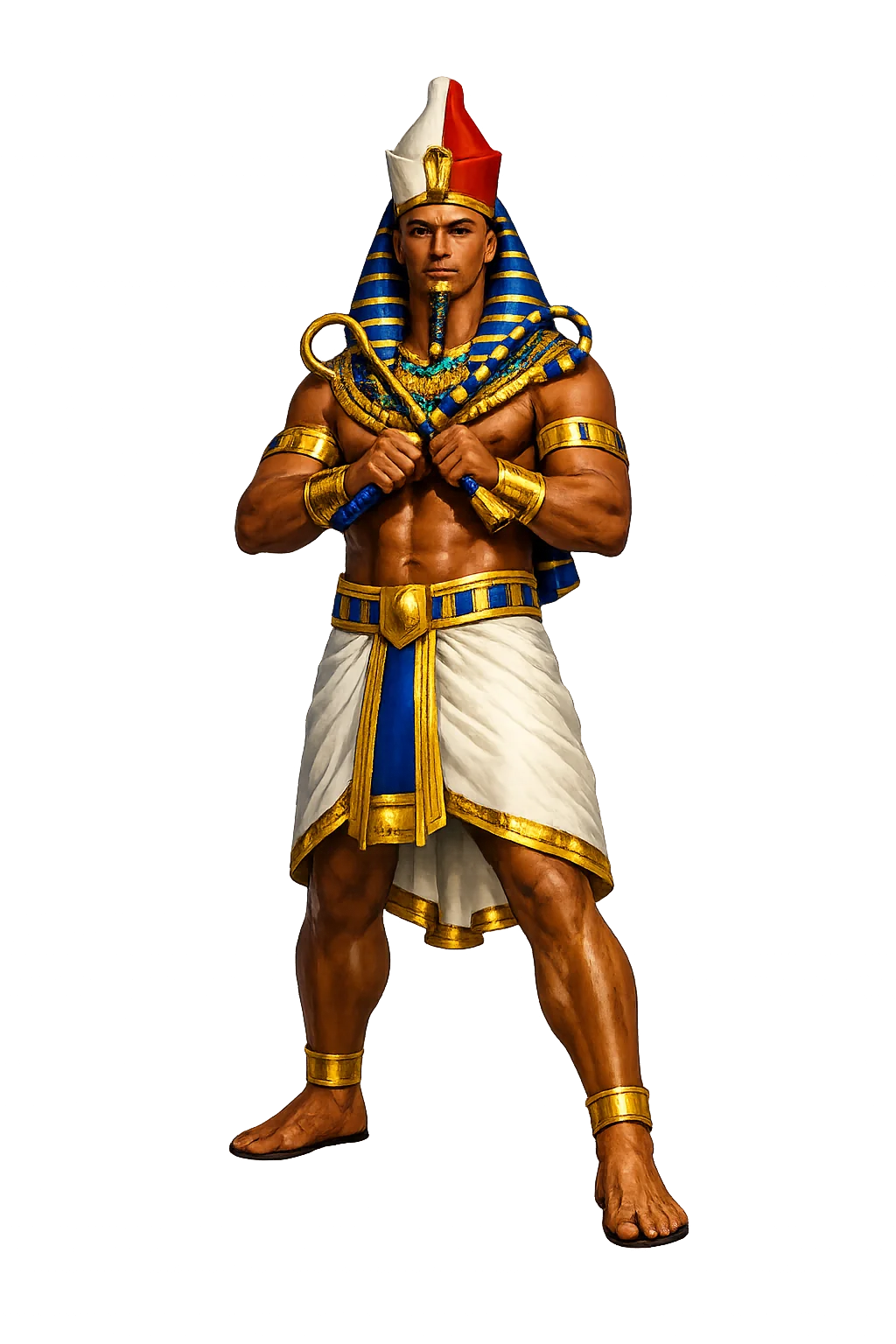
The hidden history behind Aígyptos
Behind the modern ASCII form aigyptos hides a much longer story. Aígyptos reaches back through manuscripts, inscriptions, and oral tradition long before it ever touched a keyboard, and every mark in the restored spelling is a receipt from that journey. In what follows we trace the name from its Greek attestations through its mythology, its cult, its symbols, and its afterlife in other cultures — and we show how the PuniCodex project turned that philological record into a Unicode domain that resolves today. The history was never lost. It was only waiting for the infrastructure to catch up.
At a Glance
- Restored name: Aígyptos
- ASCII form: aigyptos
- Meaning: "From Egyptian Ḥwt-kꜣ-ptḥ ("House of the Ka of Ptah")"
- Domain of influence: Personified Egypt, the Black Land
- Pantheon: Greek Location
- Classification: Tier 1
- Original script: Αἴγυπτος (Greek)
- Live domain: aígyptos.com
Overview
Aígyptos (aigyptos) is the Greek name of Egypt — of the Nile valley, and in Homer of the river itself, at whose waters Menelaus must sacrifice before he can sail home. Greek borrowed the word from Egyptian Ḥwt-kꜣ-ptḥ, 'House of the Ka of Ptah', the temple-name of Memphis at the Delta's apex, so that the whole land came to be called after one sanctuary of the creator god.
Myth made the name a man as well as a land: Aígyptos, son of Bēlos and brother of Danaos, whose fifty sons were slain, all but one, on their wedding night by the Danaïdes — a charter of dynastic blood between Egypt and Argos. To the geographers, Aígyptos was the Black Land renewed by the inundation, the country Herodotus judged 'the gift of the river.'
PuniCodex restores the name as Aígyptos and serves its temple at aígyptos.com. The acute accent records the Greek pitch accent on the diphthong, and exactly one historically valid Unicode restoration exists, which places the name in Tier 1. The plain ASCII form aigyptos survives as a modern convenience imposed by the early domain-name system; the restoration, not the fallback, is the form the project defends as philologically complete.
The Name
The name is attested in Greek as Αἴγυπτος. Etymologically it means "From Egyptian Ḥwt-kꜣ-ptḥ ("House of the Ka of Ptah")".
The reconstructed proto-form is ḥwt-kꜣ-ptḥ (proto-afro-asiatic, "temple of the ka of Ptah"). From Egyptian Ḥwt-kꜣ-ptḥ "Temple of the Ka of Ptah" (Memphis). Greek Aígyptos.
The ASCII form aigyptos survives only because the early domain-name system could not carry diacritics; it is a technological compromise, not an ancient spelling. The Unicode restoration Aígyptos recovers the stress accent of the original directly in the address bar. The original carries both stress and vowel length, and exactly one historically valid Unicode restoration exists, which places the name in Tier 1.
The letter-by-letter transformation runs:
- a → A — Alpha
- i → í — Acute on iota (diphthong ai)
- g → g — Gamma
- y → y — Upsilon
- p → p — Pi
- t → t — Tau
- o → o — Short omicron
- s → s — Sigma
The project holds the domain aígyptos.com (xn--agyptos-7ya.com) as the canonical home of this name.
Etymology & Roots
The recorded derivation reads: From Egyptian Ḥwt-kꜣ-ptḥ "Temple of the Ka of Ptah" (Memphis). Greek Aígyptos.
The reconstructed proto-form is *ḥwt-kꜣ-ptḥ (proto-afro-asiatic), glossed as "temple of the ka of Ptah".
The reconstruction is classed as attested.
The Original Script
The name is preserved in Greek as Αἴγυπτος — Greek alphabet (Classical / Attic), attested Ancient Greek, c. 8th century BCE – present, in Greece and the Greek-speaking Mediterranean. The script is written left-to-right.
The scholarly transliteration is Aígyptos (Greek alphabet with polytonic accents), giving the normalized reading /ai̯ˈɡyp.tos/.
The rendering proceeds step by step:
- The Greek form Αἴγυπτος is written in the Classical Greek alphabet.
- Letters with acute, grave, or circumflex accents preserve the pitch accent of Ancient Greek.
- Macrons and omegas (η, ω) mark long vowels, a feature lost in the plain ASCII form.
- The Unicode restoration Aígyptos encodes the scholarly spelling as a registrable domain name.
Pronunciation
The reconstructed pronunciation of the name is /aɪ̯ˈɡyp.tos/ — Ancient Greek Reconstruction.
Phoneme by phoneme:
- ai- — Diphthong [aɪ̯] — a bright glide from open [a] to close [i], as in Greek αἴγ- (goat)
- -gyp- — Voiced velar stop [ɡ] followed by front rounded [y] (like French u) and voiceless stop [p]
- -tos — Voiceless [t] plus short [o] and voiceless fricative [s]; the final -s is the Greek nominative ending
For the modern speaker, the closest approximation is: 'eye-GOO-ptoss' — the first syllable glides like 'eye', the second keeps a tight, rounded 'oo' before the crisp 'ptoss'.
Kindred and historical forms of the name:
- Egyptian — Ḥwt-kꜣ-ptḥ, the Pharaonic name of Memphis from which Greek Aígyptos was borrowed
- Latin — Aegyptus, the Roman adaptation used by poets and geographers
- Coptic — Ⲁⲓⲅⲩⲡⲧⲟⲥ (Aiguptos), preserving the Greek pronunciation in Egyptian Christian usage
Greek Aígyptos is a Tier-1 restoration in the project's classification: the acute on the first syllable preserves the Greek pitch accent, and the diphthong αἴ scans long, as diphthongs do in Greek verse. The original Egyptian name was consonantal and had no Greek-style accent; the acute records only how Greek speakers pronounced the loan.
Mythology
In Greek geographic and mythic imagination, Aígyptos is far more than a river valley on a map; it is the personified land of the Black Soil, the mysteriēs-bearer of an ancient world that Greek poets believed predated their own gods. Herodotus called Egypt “the gift of the Nile,” but Greek tradition also made it a storehouse of primeval wisdom, where kings became gods, temples preserved secrets from before the Flood, and the river itself rose like a creator without need of rain. By the Hellenistic period, this wonder had produced thriving cults of Isis and Serapis from Alexandria to Athens, translating Pharaonic ritual into a Mediterranean religious language that Romans would carry as far as Britain and the Rhine frontier. The name Aígyptos thus carries the weight of Greek wonder before an African empire they both admired and feared. Greek writers from Aeschylus to Plutarch returned to Egypt as a stage for divine dramas: the Nile's flood became a metaphor for creation, Memphis a rival to Delphi, and the pyramids silent proof of a kingdom older than memory. The very alphabet that Greeks used to spell Aígyptos had once, some believed, been borrowed from Pharaonic priests.
The Descent from Io (Hesiodic Genealogy)
In the Greek genealogical tradition preserved by Hesiod and later mythographers, Aígyptos is named after Aígyptos the son of Bēlos and the brother of Danaos. Their fifty sons and fifty daughters—the Aigyptioi and Danaïdes—were betrothed in a mass wedding that ended in blood. On their wedding night, the Danaïdes, led by Hypermnēstrā, slew all but one of the Aigyptioi, and their punishments became a fixture of the underworld. This myth turns Egypt into a land born from a fratricidal exodus, linking the Black Land forever to stories of exile, vengeance, and dynastic strife.
The Wisdom of the Priests (Herodotean Wonder)
Herodotus opens Book 2 of his Histories with a deliberate shift in tone: Egypt, he insists, is the place where chronology runs backward, where the priests can recite three hundred forty-one generations of high priests, and where the Nile behaves unlike any other river known to Greeks. For him, Aígyptos is not merely territory but a challenge to Greek assumptions about nature and time. The land becomes a mirror in which Greece sees its own youth reflected against Egypt's antique gravity.
Later Greek and Roman writers—Diodorus, Plutarch, and the Neoplatonists—doubled down on this image, claiming that Greek lawgivers, philosophers, and mystery rites had traveled up the Nile to learn at Egyptian shrines. Whether historical or romantic, the idea made Aígyptos the symbolic birthplace of civilization itself, a role it still plays whenever antiquity is imagined as a ladder leading eastward to the Nile.
Symbols & Iconography
The iconography associated with Aígyptos concentrates in a small set of recurring attributes, each a compressed statement about the name:
- Nile flood (ḥꜥpy) — The annual inundation that turned the 'black land' fertile and recreated the cosmos
- Pyramidion — The Benben-like capstone symbolising eternal kingship and solar ascent
- Papyrus scroll — Egypt as the classical storehouse of primeval writing and priestly wisdom
- Isiac sistrum — The rattle of Isis, carried across the Mediterranean as Egypt's best-known cult emblem
- Lotus and papyrus columns — Architectural emblems of the Two Lands united under divine kingship
Archaeology & Evidence
No cult or temple of the personified Aígyptos is attested; the name served geography and genealogy, not worship. The material record belongs to the land that bore the name. At Memphis, modern Mit Rahina, stand the remains of the great enclosure of Ptah whose Egyptian title — Ḥwt-kꜣ-ptḥ — Greek borrowed as the country's name; colossal statuary and the alabaster sphinx still mark the ground. Naukratis in the western Delta, the licensed Greek trading post under Amasis in the sixth century BCE, preserves the earliest permanent Greek footprint in Egypt: potteries, temples of Aphrodite and the Dioskouroi, and a scarab factory, first uncovered by Petrie in 1884-85.
Realm & Domain
As a personified land, Aígyptos gathers what the Greeks saw when they looked south: the black silt of the Nile, the temple-name of Memphis fossilized in the country's name, the reputed wisdom of its priests, and the annual flood that re-enacted creation.
The Black Land
Aígyptos personifies the fertile Nile valley, the "black land" (kmt) renewed each year by the river's silt.
House of the Ka of Ptah
The name itself encodes Memphis theology: Ḥwt-kꜣ-ptḥ, the estate where the creator's vital force dwells.
Wisdom of the Priests
Greek writers from Herodotus to Plutarch imagined Egypt as a repository of primeval knowledge older than Greece.
Nile Inundation
The annual flood was creation re-enacted: without it, the Black Land returned to desert, and order collapsed.
Across Cultures
Greek religion met Egypt not by replacing its gods but by translating them. Herodotus already reads the Nile's theology through Greek names — Amun as Zeus, Isis as Demeter, Ptah as Hephaestus — the interpretatio graeca that made Egypt legible to outsiders. The Ptolemies institutionalized the exchange: Sarapis, the composite cult fashioned under Ptolemy I from the Osirian-Apis tradition and Greek anthropomorphic form, became the dynastic god of Alexandria, and Plutarch preserves the story of his deliberate introduction. Isis followed the trade winds: her sanctuaries stood on Delos, at the Piraeus, and at Pompeii, and her mysteries supply the climax of Apuleius' Metamorphoses. After 30 BCE the name itself changed register, as Aegyptus became the emperors' personal province — the land Greek wonder had made famous now administered from Rome. The ram-horned Zeus Ammon of the western desert belongs to the same translation, continued at the neighboring temple of Libyē.
Cultural Legacy
Aígyptos never ceased to attract. Rome shipped obelisks across the Mediterranean and built its own pyramid for Caius Cestius; Renaissance scholars strained over Horapollo's hieroglyphic handbook; Napoleon's savants produced the Description de l'Égypte, and Champollion's decipherment of 1822 finally let the land read its own oldest records. The name itself bred descendants: the Copts of Egypt take their name, through Arabic qibṭ, from Greek Aígyptos — the word for the land became the word for its Christian people. To restore the accented form is to keep that genealogy visible: not the modern state alone, but the Greek word that carried an African temple-name around the world.
The Scholarly Record
The account of Aígyptos given in this edition rests on the witnesses and reference works listed below. Lexica and etymological dictionaries secure the form and meaning of the name; the literary and religious texts supply the narrative evidence.
- Homer. Iliad and Odyssey; Hesiod. Theogony and Works and Days.
- Beekes, R. S. P. Etymological Dictionary of Greek. Leiden: Brill, 2010.
- Herodotus, Histories Book 2 (the Egyptian logos).
- Diodorus Siculus, Bibliotheca historica Book 1 (Egyptian antiquities and the Nile).
- Plato, Timaeus (Egyptian priests and the story of Solon).
- Plutarch, De Iside et Osiride (Greek treatise on Egyptian religion).
A Meditation
To sit with the name Aígyptos is to watch one word travel farther than most empires. A temple-name of Memphis — the house where the creator god's vital force dwelt — became in Greek mouths the name of a river, a land, and finally an entire idea of antiquity. The acute accent of the restored form is the trace of that journey: an Egyptian consonant-skeleton fitted with Greek vowels, Greek stress, and Greek wonder. The restoration asks only that the traveller be spelled as the Greeks who coined the name wrote it. And the journey did not end with the Greeks: the same word, pressed through Arabic qibṭ, survives today as the name of Egypt's Christian people — proof that a well-carried name outlasts every empire that tried to own it.
The Unicode Restoration
Aígyptos is classified as Tier 1: the original carries both stress and length, and only one valid Unicode restoration exists. The ASCII fallback aigyptos still resolves everywhere, but it is the restored form that carries the name's full information. Across the 8 characters of the name, the restoration adjusts 1: 1 mark of stress (í). That is the whole thesis of this temple: the marks are the message.
Character by Character
The journey from aigyptos to Aígyptos, one character at a time:
- a → A — Alpha
- i → í — Acute on iota (diphthong ai)
- g → g — Gamma
- y → y — Upsilon
- p → p — Pi
- t → t — Tau
- o → o — Short omicron
- s → s — Sigma
The Domain Name
The restored name is live as a working domain: aígyptos.com, which the DNS carries in punycode form as xn--agyptos-7ya.com — an ASCII-compatible encoding that lets a non-ASCII name travel the global network without breaking older infrastructure. The visitor sees Aígyptos; the machines see the encoding. That duality is the engineering compromise on which the entire restoration rests, and it is why a name written the way its own tradition wrote it in Greek can now be typed into any browser on earth.
The Greek Location Pantheon
Aígyptos is one of 24 entries the PuniCodex lexicon catalogues under the Greek Location pantheon. The Pantheon page gathers the tradition's major figures in one place, and the Lexicon lets you filter all 895 restorations by tradition, tier, or script — the fastest way to see where this name sits among its kin.
Frequently Asked Questions
What does Aígyptos mean? The traditional gloss is "From Egyptian Ḥwt-kꜣ-ptḥ ("House of the Ka of Ptah")."
Which tradition does Aígyptos belong to? Aígyptos is catalogued in the Greek Location pantheon of the PuniCodex lexicon.
Why is Aígyptos classified as Tier 1? Because the original carries both stress and length, and only one valid Unicode restoration exists — and the marks in the restored spelling preserve exactly that evidence.
Is Aígyptos a working domain? Yes — aígyptos.com resolves today and routes to this temple.
What is the punycode for aígyptos.com? The DNS encoding is xn--agyptos-7ya.com; browsers perform the translation automatically, so visitors only ever see the restored name.
Typing Aígyptos
You do not need a special keyboard to use this restoration. The PuniCodex Type Tool converts the ASCII form aigyptos into Aígyptos as you type, and the browser extension offers the same conversion inside any text field. Copy the restored form, paste it into the address bar, and the DNS does the rest.
Why This Restoration Matters
The story of Aígyptos did not end in antiquity; it changed medium. Names that survive for millennia do so because each generation finds a new carrier for them — clay, papyrus, print, and now DNS. The PuniCodex restoration simply makes the carrier honest: the spelling that resolves is the spelling the evidence supports. If this post showed anything, it is that aigyptos and Aígyptos are not the same name with different styling. They are a summary and the text it summarizes. The web can now serve the text.
Explore Further
This post is one doorway into the temple. The home page carries the full character breakdown and the ambient canvas; the lore page tells the myths in long form; the Scholarly Edition preserves the sources, pronunciation data, and revision history; and the patron wall supports the restoration directly. For the wider map, browse the Lexicon, explore the Pantheon, or return to the PuniCodex blog.
Related Names
Sources
The full scholarly apparatus — every citation, revision, and review — lives in the Scholarly Edition. Key references for this post:
- Homer, Odyssey 4.477 (the river Aigyptos).
- Apollodorus, Bibliotheca 2.1.4 (Aigyptos and Danaos).
- Herodotus, Histories 2.5 (Egypt as 'the gift of the river').
- Histories, Loeb Classical Library, 440 BCE.
- Beekes, R. S. P. Etymological Dictionary of Greek, s.v. Αἴγυπτος. Leiden: Brill, 2010.
- Homer. Iliad and Odyssey; Hesiod. Theogony and Works and Days.
- Beekes, R. S. P. Etymological Dictionary of Greek. Leiden: Brill, 2010.
- Plutarch, De Iside et Osiride (Isiac cult emblems); Herodotus, Histories Book 2 (Egyptian religious practice).
- Lexicon authorities for this entry: LSJ, Herodotus.