
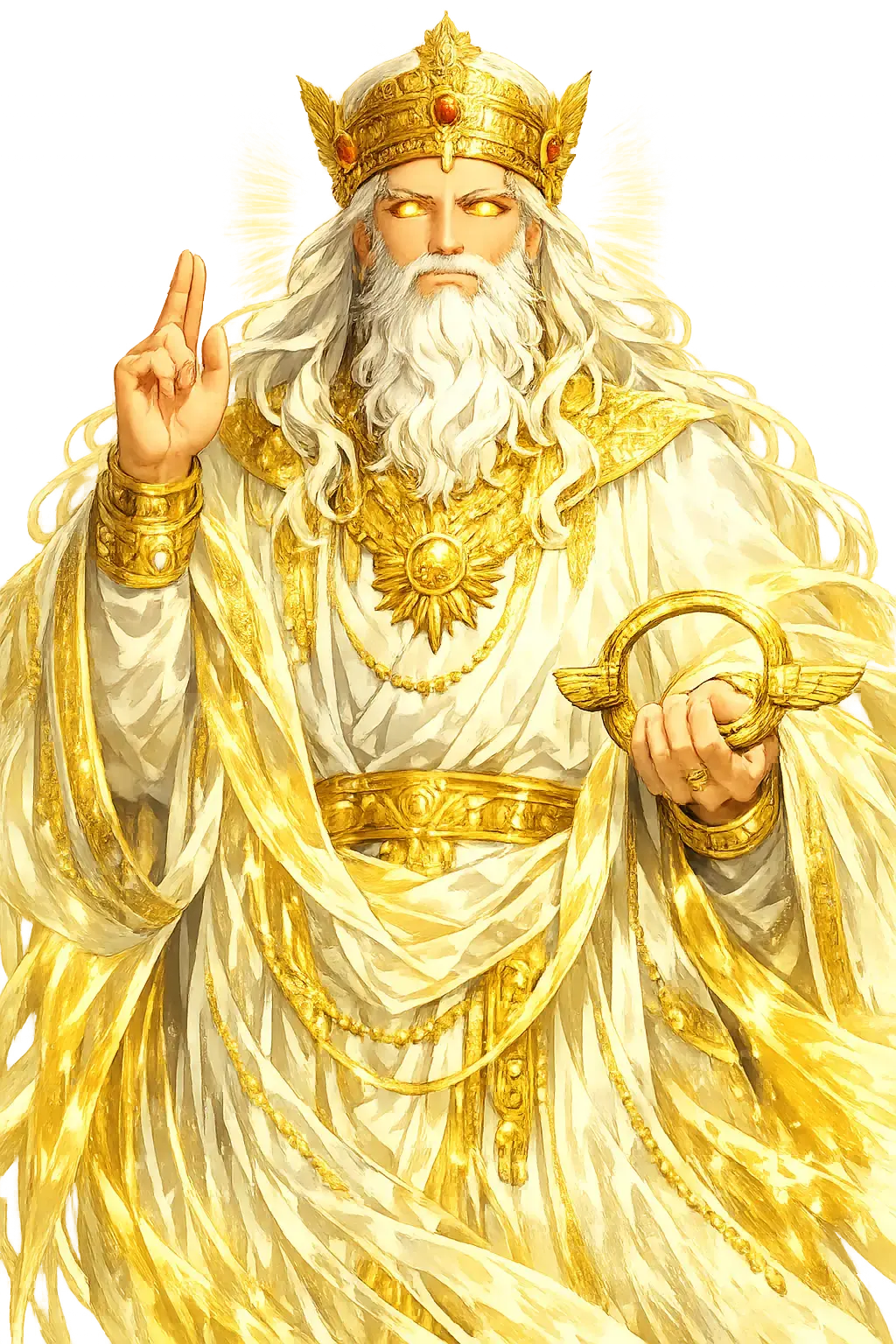
The name AhuraMazdā and the world it opens
A name is a door. AhuraMazdā opens onto an entire world: the domain of supreme creator, wisdom, light, a Zoroastrian tradition, and centuries of storytelling, worship, and scholarship. This post walks through that world room by room — the name and its roots, the original script, the sound of it, the myths, the symbols, the sites, the afterlife across cultures — and ends at the newest room of all: a Unicode domain that makes the whole structure addressable. ahuramazda gets you to the same building, but only the restored form tells you why it was built.
At a Glance
- Restored name: AhuraMazdā
- ASCII form: ahuramazda
- Meaning: "Wise lord"
- Domain of influence: Supreme Creator, Wisdom, Light
- Pantheon: Zoroastrian
- Classification: Tier 1
- Original script: 𐬀𐬵𐬎𐬭𐬀 𐬨𐬀𐬰𐬛𐬁 (Avestan)
- Live domain: ahuramazdā.com
Overview
Ahura Mazdā (Avestan 𐬀𐬵𐬎𐬭𐬀 𐬨𐬀𐬰𐬛𐬁, 'the Wise Lord') is the supreme god of Zoroastrianism: the uncreated creator of the spiritual and material worlds, the father of [[asa|Aša]] (truth) and of the Aməša Spəntas, and the adversary of Angra Mainyu, 'the Hostile Spirit'. In the Gāthās, the oldest Zoroastrian hymns, he is addressed simply as Mazdā Ahura and answers Zarathustra's questions about the order of the world and the choice set before every soul; his defining attribute is not force but wisdom — he creates by thought and governs through Good Mind and truth. In Old Persian he appears as Auramazdā, the god 'by whose favor' (vašnā Auramazdāha) every Achaemenid king claims to rule; in Middle Persian he is Ohrmazd, still the name of God in the living tradition.
PuniCodex restores the name as AhuraMazdā and serves its temple at ahuramazdā.com. The original carries both stress and vowel length, and exactly one historically valid Unicode restoration exists, which places the name in Tier 1. The plain ASCII form ahuramazda survives as a modern convenience imposed by the early domain-name system; the restoration, not the fallback, is the form the project defends as philologically complete.
The Name
The name is attested in Avestan as 𐬀𐬵𐬎𐬭𐬀 𐬨𐬀𐬰𐬛𐬁. Etymologically it means "Wise lord". The compound joins ahura-, 'lord' — an old Indo-Iranian title of sovereign divinities — with mazdā-, 'wise', conventionally analyzed through the roots maz-, 'great', and dā-, 'to set, to place, to keep in mind'.
The ASCII form ahuramazda survives only because the early domain-name system could not carry diacritics; it is a technological compromise, not an ancient spelling. The Unicode restoration AhuraMazdā recovers the vowel length of the original directly in the address bar. The original carries both stress and vowel length, and exactly one historically valid Unicode restoration exists, which places the name in Tier 1.
The letter-by-letter transformation runs:
- a → A — Same
- h → h — Same
- u → u — Same
- r → r — Same
- a → a — Same
- m → M — Same
- a → a — Same
- z → z — Same
- d → d — Same
- a → ā — Macron: long a
The project holds the domain ahuramazdā.com (xn--ahuramazd-ecb.com) as the canonical home of this name.
The Original Script
The name is preserved in Avestan as 𐬀𐬵𐬎𐬭𐬀 𐬨𐬀𐬰𐬛𐬁 — Iranian religious alphabet, attested Avestan, c. 1000 BCE – 400 CE (manuscripts later), in Iran / Central Asia. The script is written right-to-left.
The scholarly transliteration is AhuraMazdā (Avestan scholarly transliteration), giving the normalized reading /aˈhuː.ra mazˈdaː/.
The rendering proceeds step by step:
- The Avestan form 𐬀𐬵𐬎𐬭𐬀 𐬨𐬀𐬰𐬛𐬁 writes the sounds of the Avesta phonetically.
- Long vowels and special fricatives have distinct Avestan letters.
- The Unicode restoration preserves length and the postalveolar/velar nasal distinctions in a registrable Latin form.
- The Unicode restoration AhuraMazdā is registrable in .com; the Avestan script is not in the .com IDN table.
Pronunciation
The reconstructed pronunciation of the name is /aːˈhuːɾə ˈmazdaː/ — Avestan Reconstruction.
Phoneme by phoneme:
- Ahu- — Long [aː] plus voiceless glottal fricative [h] and close back rounded vowel [uː]; the first element means 'lord, master'
- -ra — Rhotic [ɾ], the final consonant of Ahura
- Maz- — Voiced bilabial nasal [m] plus open central vowel [a] and voiced alveolar fricative [z]; from Avestan maz- 'great'
- -dā — Long [aː], the final vowel of 'wisdom' (Avestan dā- 'to know, place')
For the modern speaker, the closest approximation is: ah-HOO-ruh MAHZ-dah — the first 'a' is long, the 'u' is long and rounded, and the final 'dah' is drawn out.
Kindred and historical forms of the name:
- Avestan — Ahura Mazdā, the name of the supreme god in the Gāthās and Younger Avesta
- Old Persian — Auramazdā, the form used in Achaemenid royal inscriptions
- Middle Persian — Ohrmazd / Hormazd, the Zoroastrian creator in the Pahlavi books
AhuraMazdā is a Tier-1 restoration: the long vowels in both Ahura and Mazdā are preserved. The compound is written as a single word in the PUNICODEX domain to keep the name registrable as one Unicode string, following the project's convention for the Zoroastrian supreme being.
Mythology
Ahura Mazdā's mythology is a cosmology rather than a cycle of adventures: the creation of the world, the primordial assault of the Hostile Spirit, the calling of Zarathustra, and the final Renovation (frašō.kərəti) in which the world is healed of evil. Every human moral choice participates in this drama; there is no neutral ground.
The Two Spirits and the Choice (Gāthās)
Yasna 30 proclaims two primordial spirits, twins opposed in thought, word, and deed — the better and the bad — between whom every person must choose: the Life-giving Spirit (Spənta Mainyu) and the Hostile Spirit (Angra Mainyu). Ahura Mazdā stands above the pair as the source and guarantor of the better; the Gāthās' dualism is ethical, waged within creation rather than outside it.
The Summons to Zarathustra (Gāthās)
In the Gāthās the god does not act in a story; he speaks. Zarathustra reports a progressive recognition of Mazda — 'I realized that Thou art holy' (Y 43) — whenever Good Thought came to him, and the hymns end in a commission: to teach the choice of the better spirit to all who live. The 'myth' of Ahura Mazdā is thus a summons more than a narrative: what was offered to the prophet is offered to every worshipper.
The Seven Creations and the Assault of Ahriman (Cosmogony)
The Pahlavi Bundahishn narrates creation in seven works — sky, water, earth, plants, cattle, man, and fire — each later assigned to an Amahraspand. Ohrmazd first fashions the world in the spiritual state (mēnōg); Ahriman then breaks in from the darkness, bringing drought, disease, predators, and death, and slaying the primal bull and Gayōmard, the first man, from whose bodies come the metals, the plants, and the human seed. The material world (gētīg) is thereafter a 'mixture' (gumēzišn) of good and evil — a battlefield, not a fall.
Frashokereti, the Renovation (Eschatology)
At the end of limited time the savior Saōšyant arises from the seed of Zarathustra, the dead are raised, and humanity passes through a river of molten metal — to the righteous it feels like warm milk. Ahriman and his demons are annihilated, and creation is made 'not aging, not dying, not decaying' for ever (Yt 19.89). This is frašō.kərəti, the 'making wonderful': not the end of the world but its healing.
The Call of Zarathustra (Gāthās)
In the Gāthās, AhuraMazdā approaches Zarathustra and asks him to choose between the two primordial spirits: Spenta Mainyu, the holy creative spirit, and Angra Mainyu, the destructive spirit of the lie. Zarathustra chooses good thought, good words, and good deeds, becoming the prophet of the one wise lord. The myth is less a narrative than a summons: every person must make the same choice.
Symbols & Iconography
The Avesta gives Ahura Mazdā no iconography, and the Achaemenid monuments name him without representing him in human form; his presence is registered through emblems and elements:
- The winged disk (faravahar) — the winged figure that hovers over Darius at Bisotun and across the Persepolis reliefs; whether it denotes Auramazdā himself, the royal glory (xᵛarənah), or the fravaši, the soul's heavenly counterpart, is still debated, though modern usage identifies it with the god and with the soul's free choice of the good.
- Sacred fire (ātaxš) — the visible presence of the god and the focus of worship; the liturgy addresses fire as 'the son of Ahura Mazdā' (Ātaš Nyāyiš, Ny 5).
- The unbounded light — the Bundahišn opens with Ohrmazd dwelling on high 'in omniscience and goodness', in the unbounded light that Ahriman's darkness cannot reach (Bundahišn 1).
- The ring of sovereignty — in the Sasanian investiture reliefs at Naqsh-e Rustam and Taq-e Bostan, Ohrmazd proffers the diadem to the king, visualizing rule held 'by the favor of' the god.
- Sun and light — The radiance of wisdom and the purity that drives away darkness and the lie
Archaeology & Evidence
The earliest certain attestations of the god are the Old Persian royal inscriptions. At Bisotun (Behistun), the trilingual cliff monument of Darius I (c. 520 BCE) invokes Auramazdā as the granter of kingship and frames every victory as won 'by the favor of Auramazdā'; the Persepolis foundation and terrace inscriptions and the tomb texts at Naqsh-e Rustam repeat the invocation. The winged figure that floats above the king at Bisotun and on the Persepolis reliefs is the period's only visual correlate of the god, its precise identification still debated. In the Sasanian period the god appears in person: the investiture relief of Ardashir I at Naqsh-e Rustam shows Ohrmazd on horseback handing the diadem to the king, and the great inscription of the priest Kartir at the Ka'ba-ye Zardošt names him. Fire temples — from the Sasanian sanctuary at Takht-e Soleymān to the living ātašgāhs of Yazd and Mumbai — preserve his cult in architecture, and Avestan codices on paper and parchment, the oldest surviving copies dating to the thirteenth–fourteenth centuries CE, transmit his hymns.
Realm & Domain
AhuraMazdā is the highest god of Zoroastrianism, the uncreated creator who thinks the cosmos into being and sustains it through truth (Aša), good thought, and the Holy Immortals. He is not a storm warrior or a tribal patron but a cosmic architect whose weapon is wisdom and whose enemy is the lie (Druj). In the Gāthās, the oldest Zoroastrian hymns, he speaks directly to the prophet Zarathustra, asking humanity to choose between good purpose and evil.
Creator by Thought
AhuraMazdā first conceived the cosmic order in his mind and then spoke it into existence.
Lord of Aša
Truth, righteousness, and cosmic order (Aša) are his first creation and his greatest gift.
The Amesha Spentas
Six divine attributes — Vohu Manah, Aša, Khshathra, Spenta Ārmaiti, Haurvatāt, Ameretāt — emanate from him.
Fire and Light
Fire is his visible presence; Zoroastrian temples guard an eternal flame in his honor.
Across Cultures
Under the Achaemenid empire, AhuraMazdā was identified by Greeks and others with Zeus or the supreme sky god — Herodotus already reports that the Persians sacrifice to 'Zeus' on the highest mountain peaks, by which name they mean the whole vault of the sky (Histories 1.131). Persian kings dedicated monuments to him across their vast realm. In later Zoroastrian tradition he is paired with Angra Mainyu (Ahriman) in a dualistic opposition that some scholars trace back to Zarathustra's own teaching and others see as a later development. The figure of a single creator god opposed by a personified evil influenced Jewish, Christian, and Islamic eschatology, though the exact lines of influence remain debated.
Kindred figures in the PuniCodex cross-tradition index include [[athena|Athénā]], [[ganesha|Gaṇeśa]], [[odinn|Óðinn]], [[orunmila|Ọrúnmìlà]], [[quetzalcoatl|Quetzalcōātl]], and [[thoth|Ḏḥwty]], each linked through wisdom / knowledge.
Cultural Legacy
Ahura Mazdā is the enduring name of God in Zoroastrianism, one of the oldest continuously practiced religions. The Achaemenid formula vašnā Auramazdāha, 'by the favor of Auramazdā', frames the inscriptions of the first Persian empire; the Sasanians carved Ohrmazd into investiture reliefs and named him on their seals and coin legends; and Zoroastrians in Iran and the Parsi diaspora still confess themselves Māzdayasnā, 'Mazda-worshippers', in the Fravarānē. The ethical triad humata, hūxta, hvarshta — 'good thoughts, good words, good deeds' — remains the best-known summary of the religion's ethics, and the faravahar has become an emblem of Iranian identity far beyond the practicing community.
Historians of religion have long debated Zoroastrianism's influence on Second Temple Jewish — and through it Christian and Islamic — eschatology: resurrection of the body, final judgment, a personified evil adversary, and a world renovation all appear early in Iranian dress, though the direction and degree of borrowing remain contested. In modern scholarship the Gāthās are read as the earliest surviving text of a prophetic religion centered on a single wise creator.
The Scholarly Record
The account of Ahura Mazdā given in this edition rests on the witnesses and reference works listed below. The Gāthās (Yasna 28–34, 43–51, 53) are the earliest and most authoritative witness, preserving Zarathustra's own address to the Wise Lord; the Yasna Haptaŋhāiti transmits the ancient liturgy in which he is worshipped together with the Aməša Spəntas; and the Bundahišn systematizes the Pahlavi cosmology of Ohrmazd. Bartholomae's Altiranisches Wörterbuch and the digital Avestan dictionary AirWb secure the lexical form of the name; Boyce's and Skjærvø's syntheses carry the history from the Achaemenid inscriptions to the living community; Narten's monograph is the standard study of the Aməša Spəntas in the Avesta.
- Avesta, Gāthās (Yasna 28–34, 43–51, 53).
- Avesta, Yasna Haptaŋhāiti.
- Bundahišn (Zoroastrian cosmogony).
- Bartholomae, Altiranisches Wörterbuch.
- AirWb (Avestan digital dictionary).
- Boyce, Zoroastrians: Their Religious Beliefs and Practices.
- Skjærvø, The Spirit of Zoroastrianism.
- Narten, Die Aməša Spəntas im Avesta.
A Meditation
The Gāthās present the bond between Ahura Mazdā and the worshipper not as servitude but as partnership: the prophet asks how the world may be 'furthered', and the answer makes every human choice a contribution to creation. The confession of faith, the Fravarānē (Yasna 12), frames this as a free renunciation of the daēvas and a choosing of the Māzdayasnian path, and the daily ethic of humata, hūxta, hvarshta — good thoughts, good words, good deeds — is its practice. The vision is demanding precisely because it is hopeful: the world is good, wounded, and healable, and wisdom is the means of its healing. To honor the Wise Lord is to treat understanding itself as an act of worship.
The Unicode Restoration
AhuraMazdā is classified as Tier 1: the original carries both stress and length, and only one valid Unicode restoration exists. The ASCII fallback ahuramazda still resolves everywhere, but it is the restored form that carries the name's full information. Across the 10 characters of the name, the restoration adjusts 1: 1 mark of length (ā). That is the whole thesis of this temple: the marks are the message.
Character by Character
The journey from ahuramazda to AhuraMazdā, one character at a time:
- a → A — Same
- h → h — Same
- u → u — Same
- r → r — Same
- a → a — Same
- m → M — Same
- a → a — Same
- z → z — Same
- d → d — Same
- a → ā — Macron: long a
The Domain Name
The restored name is live as a working domain: ahuramazdā.com, which the DNS carries in punycode form as xn--ahuramazd-ecb.com — an ASCII-compatible encoding that lets a non-ASCII name travel the global network without breaking older infrastructure. The visitor sees AhuraMazdā; the machines see the encoding. That duality is the engineering compromise on which the entire restoration rests, and it is why a name written the way its own tradition wrote it in Avestan can now be typed into any browser on earth.
Why This Restoration Matters
A door only matters if people walk through it. ahuramazdā.com is open, and everything behind it — the myths, the scholarship, the canvas, the patrons — hangs on the restored spelling. The PuniCodex project bets that the web will make room for names as they were actually written, and AhuraMazdā is one of its standing proofs. Visit, share, cite, type it yourself: each use is a small rehearsal for a web where no name has to hide its marks to be found.
Explore Further
This post is one doorway into the temple. The home page carries the full character breakdown and the ambient canvas; the lore page tells the myths in long form; the Scholarly Edition preserves the sources, pronunciation data, and revision history; and the patron wall supports the restoration directly. For the wider map, browse the Lexicon, explore the Pantheon, or return to the PuniCodex blog.
Related Names
Sources
The full scholarly apparatus — every citation, revision, and review — lives in the Scholarly Edition. Key references for this post:
- Avesta, Gāthās (Yasna 28–34, 43–51, 53), esp. Y 30 on the two spirits.
- Insler, The Gāthās of Zarathustra (Acta Iranica 8, Brill, 1975).
- Kent, Old Persian: Grammar, Texts, Lexicon (the vašnā Auramazdāha formula).
- Avesta, Gāthās (Yasna 28–34, 43–51, 53).
- Lexicon authorities for this entry: AirWb, Bartholomae.