
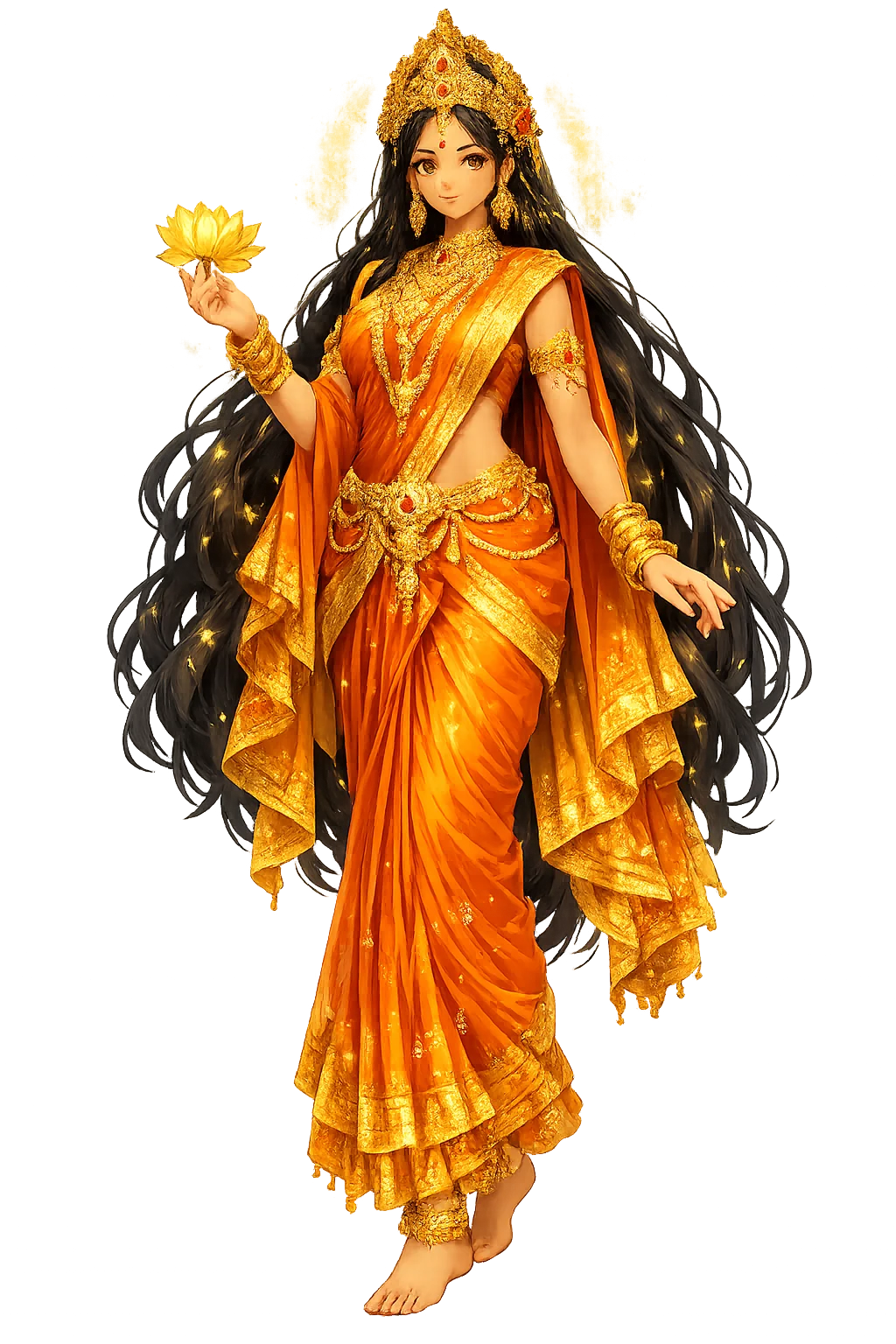
From Devanagari to Unicode: the journey of Sītā
Long before it was a domain, this name traveled through scripts. Sītā begins in Devanagari, passes through scholarly transliteration, and ends — for now — inside the punycode machinery of the global DNS. Each stage of that journey preserves some information and loses some, and the craft of restoration is knowing exactly which marks matter. This post follows the name stage by stage: the original script, the reconstructed pronunciation, the mythological record, the material evidence, and finally the Unicode form that carries all of it into the address bar. Think of it as a biography of a name, told through its spelling.
At a Glance
- Restored name: Sītā
- ASCII form: sita
- Meaning: "'Furrow' — the field-goddess, wife of Rāma and mother of his twin sons"
- Domain of influence: Virtue, Devotion, Fertility
- Pantheon: Sanskrit
- Classification: Tier 1
- Original script: सीता (Devanagari)
- Live domain: sītā.com
Overview
Sītā (sita) — Virtue, Devotion, Fertility · a furrow, the track or line of a ploughshare (also personified, and apparently once worshipped as a kind of goddess resembling Pomona; in RV. iv, 57, 6 — belongs to the Sanskrit tradition, where it is catalogued under the domain "Virtue, Devotion, Fertility". The name means "a furrow, the track or line of a ploughshare (also personified, and apparently once worshipped as a kind of goddess resembling Pomona; in RV. iv, 57, 6".
Sītā is the epic of India told from its quiet center: the furrow-born princess whose abduction sets the Rāmāyaṇa in motion, whose fidelity survives fire, and whose final return is not to her husband but to the earth that bore her. She is virtue tested past every reasonable limit — and found whole.
PuniCodex restores the name as Sītā and serves its temple at sītā.com. The original carries both stress and vowel length, and exactly one historically valid Unicode restoration exists, which places the name in Tier 1. The plain ASCII form sita survives as a modern convenience imposed by the early domain-name system; the restoration, not the fallback, is the form the project defends as philologically complete.
The Name
The name is attested in Devanagari as सीता. Etymologically it means "furrow" — the track of the ploughshare, personified as the field-goddess who became the wife of Rāma.
The ASCII form sita survives only because the early domain-name system could not carry diacritics; it is a technological compromise, not an ancient spelling. The Unicode restoration Sītā recovers the vowel length of the original directly in the address bar. The original carries both stress and vowel length, and exactly one historically valid Unicode restoration exists, which places the name in Tier 1.
The letter-by-letter transformation runs:
- s → S — Same
- i → ī — Macron: long i
- t → t — Same
- a → ā — Macron: long a
The project holds the domain sītā.com (xn--st-ela0o.com) as the canonical home of this name.
The Original Script
The name is preserved in Devanagari as सीता.
The scholarly transliteration is Sītā.
The rendering proceeds step by step:
- Sanskrit Sītā is written in Devanagari as सीता
- IAST transliteration maps each Devanagari vowel and consonant to a Latin equivalent
- Macrons mark long vowels (ā, ī, ū); dots beneath consonants mark retroflex articulation (ṭ, ḍ, ṇ, ṣ)
Pronunciation
The reconstructed pronunciation of the name is /sˈiːtaː/ — Reconstructed Sanskrit.
For the modern speaker, the closest approximation is: SEE-taa — both vowels long, even and open.
Kindred and historical forms of the name:
- Devanagari — सीता
- IAST standard — Sītā
- Thai (Ramakien) — Sida (สีดา)
- Nepali — Janakī
- Owned form — Sītā
Sanskrit sītā carries two long vowels; the restoration Sītā keeps both macrons. Her name means "furrow" — the plough-line of the field from which she rose — making hers the rare theonym that is a farm word before it is a goddess, and the two macrons are the whole of its written dignity.
Mythology
The Rāmāyaṇa calls itself Rāma's story, but its moral engine is Sītā: every choice that matters is measured against her.
Daughter of the Field (The Birth)
King Janaka of Mithilā, ploughing a sacrificial field, struck something that was not stone: an infant in the furrow, whom he named Sītā — "furrow" — and raised as his daughter. Earth-born, not womb-born, the texts insist: her mother is the field itself, and the Rāmāyaṇa's most beloved heroine begins as a gift of agriculture. Her marriage to Rāma follows the bow of Śiva that only he could string.
The Golden Deer (The Abduction)
In the forest of Daṇḍaka, during the fourteen-year exile, the demon Mārīca became a golden deer to draw Rāma from her side, and Rāvaṇa came as a wandering ascetic. She crossed the line — the lakṣmaṇa-rekhā drawn for her protection — only to give alms, and was carried through the sky to Laṅkā. A year in the Aśoka grove, under guard, refusing a king: the epic's center of gravity is her refusal.
Agni-Parīkṣā (The Fire)
Rescued after the war, she was met not with embrace but with doubt, publicly, before the armies. Sītā's answer was the fire: she walked into the flames, and Agni himself bore her out unburned, declaring her purity to the three worlds. The Rāmāyaṇa's hardest scene is also its most debated — every generation of India has argued whether the test was justice or injury, and the arguing is the point.
The Earth Opens (The Return)
Years later, crowned and pregnant, she was exiled again on a rumor — and raised her twin sons in Vālmīki's hermitage. When Rāma finally came for her and asked one more public proof, she asked the earth instead: "If I have been faithful, open for me." The ground split, a golden throne rose, and the daughter of the furrow descended into the earth that bore her — the epic's most devastating line, and its most quoted.
Symbols & Iconography
The iconography associated with Sītā concentrates in a small set of recurring attributes, each a compressed statement about the name:
- The furrow — Her name and origin: the ploughed line — fertility, labor, and the earth's patience
- The golden deer — The lure that crossed her threshold — desire engineered as trap
- The fire — Proof demanded of the innocent; the trial that should never have been asked
- The lotus — Her purity in every depiction from temple bronze to Madhubani painting
Archaeology & Evidence
Janakpur in Nepal's Terai keeps her city: the Janaki Mandir (1911, on older foundations) marks the site tradition calls her birthplace-home, and the Ram-Janaki Vivāha festival re-enacts the wedding annually. Mithilā's painted tradition (Madhubani/Maithil art, from the kohbar wedding-chamber murals) is among the world's oldest continuously practiced narrative arts. The Rāmāyaṇa sites across India and Sri Lanka — the Aśoka Vatika candidates near Nuwara Eliya, the Sītā Amman temple there — form the epic's living pilgrimage map.
Realm & Domain
Sītā is the epic of India told from its quiet center: the furrow-born princess whose abduction sets the Rāmāyaṇa in motion, whose fidelity survives fire, and whose final return is not to her husband but to the earth that bore her. She is virtue tested past every reasonable limit — and found whole.
The Furrow
King Janaka found her in the plough-line of a sacrificial field — the earth's own child, named for the cut in the soil.
The Fire
The agni-parīkṣā: the trial by fire she walked into to prove what everyone watching already knew.
The Exile
Fourteen years in the forest, the abduction to Laṅkā, the second exile while pregnant — endurance as biography.
The Return
Her answer to the second doubt: the earth opens, and the daughter of the furrow goes home.
Across Cultures
Across Asia she travels with the epic: Thailand's Sida in the Ramakien, Cambodia's and Laos' Reamker versions, Indonesia's Kakawin Rāmāyaṇa, and the Jain tellings that soften the fire. In Nepal she is Janaki, daughter of Janakpur — the nation claims her birthplace and keeps her festival. The bhakti traditions make her inseparable from Rāma (Sītā-Rāma as one object of worship), and the Śākta readings make her the goddess herself in human trial: the earth-goddess borrowing a biography.
Kindred figures in the PuniCodex cross-tradition index include Ọbalúayé, Bꜣstt, Cōātlīcue, Dāgan, Dēmētēr, and Gaîa, each linked through earth / mother / fertility.
Cultural Legacy
Sītā is the standard by which Indian womanhood has been both honored and constrained — the "Sītā ideal" of fidelity and endurance, and the modern feminist re-reading that asks why the proving was hers to do. Her festivals (Sītānavamī, Vivāha Panchamī at Janakpur) draw millions; the Madhubani painting tradition of her Mithilā homeland depicts her in every home; Bollywood and television return to her constantly. Every debate on dignity, loyalty, and who owes whom proof in India runs, sooner or later, through the furrow.
The Scholarly Record
The account of Sītā given in this edition rests on the witnesses and reference works listed below. Lexica and etymological dictionaries secure the form and meaning of the name; the literary and religious texts supply the narrative evidence.
- Rāmāyaṇa, Vālmīki; translated by Hari Prasad Shastri, 500 BCE. Full text
- Monier Monier-Williams, A Sanskrit-English Dictionary, Oxford; Cologne Digital Sanskrit Dictionaries, 1899. Full text
- Purāṇas, Various; Internet Sacred Text Archive selections, 300. Full text
- Monier-Williams Sanskrit-English Dictionary, Oxford, 1899. Full text
- Cambridge Ancient History, Multiple volumes, 1970. Full text
- Oxford Classical Dictionary, 4th ed., Oxford University Press, 2012. Full text
A Meditation
Sītā's story is the oldest case study in the difference between being good and being believed. She is proven right every time — by fire, by gods, by the earth itself — and the proving never stops being demanded. Her final answer is the only one that ends the asking: not another proof, but a refusal to be measured again. The furrow closes over her, and the field goes on feeding everyone — which is what the earth, all along, was trying to say.
The Unicode Restoration
Sītā is classified as Tier 1: the restoration preserves at least one distinctive feature — a diacritic or a distinctive letter — that the ASCII form loses. The ASCII fallback sita still resolves everywhere, but it is the restored form that carries the name's full information. Across the 4 characters of the name, the restoration adjusts 2: 2 marks of length (ī, ā). That is the whole thesis of this temple: the marks are the message.
Character by Character
The journey from sita to Sītā, one character at a time:
- s → S — Same
- i → ī — Macron: long i
- t → t — Same
- a → ā — Macron: long a
The Domain Name
The restored name is live as a working domain: sītā.com, which the DNS carries in punycode form as xn--st-ela0o.com — an ASCII-compatible encoding that lets a non-ASCII name travel the global network without breaking older infrastructure. The visitor sees Sītā; the machines see the encoding. That duality is the engineering compromise on which the entire restoration rests, and it is why a name written the way its own tradition wrote it in Devanagari can now be typed into any browser on earth.
The Sanskrit Pantheon
Sītā is one of 100 entries the PuniCodex lexicon catalogues under the Sanskrit pantheon. The Pantheon page gathers the tradition's major figures in one place, and the Lexicon lets you filter all 974 restorations by tradition, tier, or script — the fastest way to see where this name sits among its kin.
Frequently Asked Questions
What does Sītā mean? The traditional gloss is "'Furrow' — the field-goddess, wife of Rāma and mother of his twin sons."
Which tradition does Sītā belong to? Sītā is catalogued in the Sanskrit pantheon of the PuniCodex lexicon.
Why is Sītā classified as Tier 1? Because the restoration preserves at least one distinctive feature — a diacritic or a distinctive letter — that the ASCII form loses — and the marks in the restored spelling preserve exactly that evidence.
Is Sītā a working domain? Yes — sītā.com resolves today and routes to this temple.
What is the punycode for sītā.com? The DNS encoding is xn--st-ela0o.com; browsers perform the translation automatically, so visitors only ever see the restored name.
Can I use Sītā in a normal browser? Yes. The DNS resolves the punycode form automatically, and the type tool on this site converts sita to Sītā for copying and pasting.
Where does the scholarly information come from? The entry is built from lexica, inscriptional evidence, and reviewed scholarly sources listed in the Scholarly Edition. Every claim is traceable to a canonical source.
Typing Sītā
You do not need a special keyboard to use this restoration. The PuniCodex Type Tool converts the ASCII form sita into Sītā as you type, and the browser extension offers the same conversion inside any text field. Copy the restored form, paste it into the address bar, and the DNS does the rest.
Sister Temples
Other temples in the Sanskrit pantheon include Rātrī, Saṃsāra, and Sāvitrī — each with its own restoration story, its own scholarly record, and its own place in the lexicon.
Why This Restoration Matters
Every stage of the journey from Devanagari to Unicode was an act of care: the scribe who first wrote the name, the lexicographer who glossed it, the engineer who taught the DNS to carry it. The PuniCodex restoration is the latest stage, not the last word — the Scholarly Edition is revised as the evidence improves. What does not change is the principle: a name deserves to be written the way its own tradition wrote it. Sītā in the address bar is that principle, made routable.
Explore Further
This post is one doorway into the temple. The home page carries the full character breakdown and the ambient canvas; the lore page tells the myths in long form; the Scholarly Edition preserves the sources, pronunciation data, and revision history; and the patron wall supports the restoration directly. For the wider map, browse the Lexicon, explore the Pantheon, or return to the PuniCodex blog.
A Closer Look at the Marks
A restored name is a small map. In Sītā, the journey from the ASCII fallback sita to the Unicode form can be read letter by letter, and each letter tells a story. Of the 4 characters, 2 remain unchanged; they anchor the name to its modern shape. The remaining adjustments recover marks the source tradition used to distinguish this name from every other word built from the same letters.
The s stays as it is — Same.
The i becomes ī — Macron: long i.
The t stays as it is — Same.
The a becomes ā — Macron: long a.
Together these changes are not decoration. They are the minimum set of marks needed to keep the name legible in its own tradition. Remove them and you still have a string of letters; you no longer have the name as it was written.
Sītā in Its Tradition
Sītā does not stand alone. It belongs to the Sanskrit tradition, where it is counted among 100 names in the PuniCodex lexicon. Its sphere — Virtue, Devotion, Fertility — places it beside other figures who govern similar aspects of experience. The restored spelling is therefore not only a philological decision; it is a way of keeping the name in the company of its kin. When the address bar shows Sītā, it marks the boundary between a generic search term and a named entry in a living catalog of myth. That catalog is the point of the project. Every restored name is a vote for specificity: the web should know the difference between a figure and a keyword, between a tradition and a trend. Sītā is one such vote.
What You Will Find in the Temple
The temple page for Sītā is more than a landing page. The home tab presents the character breakdown, the pronunciation guide, and the live domain status in a single view. The lore tab gathers the myths and narratives that give the name its depth. The Scholarly Edition tab publishes the sources, variant forms, and review history that justify the restoration. Industry patterns show where the name appears in modern commerce and culture, while the gallery and creatives tabs collect visual and sponsor material. The patron wall lets visitors support the restoration directly. Each tab is generated from the same canonical sources, so the domain, the blog, the scholars page, and the search index all agree. The result is a single source of truth about a name, delivered through several doors.
Related Names
Sources
The full scholarly apparatus — every citation, revision, and review — lives in the Scholarly Edition. Key references for this post:
- Rāmāyaṇa, Vālmīki; translated by Hari Prasad Shastri, 500 BCE.
- Monier Monier-Williams, A Sanskrit-English Dictionary, Oxford; Cologne Digital Sanskrit Dictionaries, 1899.
- Purāṇas, Various; Internet Sacred Text Archive selections, 300.
- Cambridge Ancient History, Multiple volumes, 1970.
- Oxford Classical Dictionary, 4th ed., Oxford University Press, 2012.
- Ṛgveda 4.57 (Kṣetrapati Sūkta); Atharvaveda field hymns.
- The pṛthivī teachings; the Sītā-Rāma devotional commentaries.
- Padma Purāṇa; Adhyātma Rāmāyaṇa (shadow-Sītā doctrine).
- Ṛgveda 4.57.8; the Vivāha Panchamī liturgy.
- Lexicon authorities for this entry: MW, KEWA.