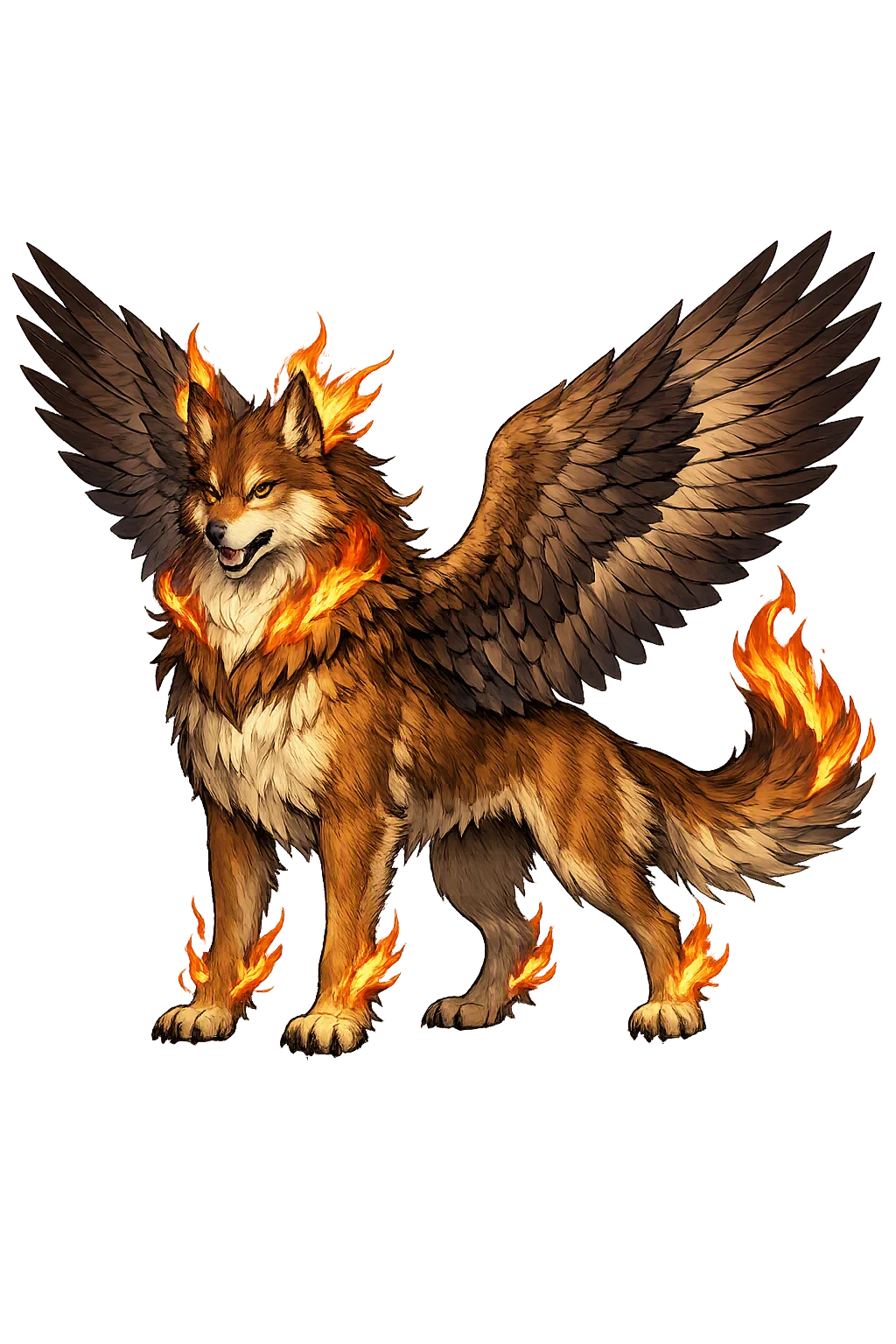
Stories of Simargl
Simargl has no mythology in the ordinary sense — no tale was ever told about him. He exists as a single line in a chronicle, a name of Iranian ancestry, and a century of scholarly argument about what a winged guardian was doing in a Slavic pantheon.
In 988 the Primary Chronicle's procession of drowned gods includes, between Stribog and Mokosh, a name no Slavic tongue built: Simargl. The chronicler lists him without curiosity, one idol among six, but modern scholarship has never been able to leave him alone — because his name betrays a long journey, from the Iranian Simurgh, through the speech of steppe peoples who traded and raided along the Black Sea, into the capital of Christianizing Rus'. A pantheon is a nation's self-portrait; Kyiv's included a god borrowed from Persia's. The chronicle line is the whole dossier: no oath, no gloss, no sorcerer, no saint. One drowning, recorded by the enemies who arranged it — and a foreign accent still audible in the name as it went under. No later source ever asked who had carried him there; only modern scholarship heard the accent at all.
The Simurgh of Iranian tradition is one of the oldest great birds of world mythology. In the Avesta she roosts in the branches of the sacred tree; across Sogdian and Sasanian art she spreads composite wings over the Tree of Life; and in Ferdowsi's Shahnameh she rears the hero Zal and guides his son Rostam through every impossible task — part dog, part lion, part bird, and wholly wise. How her name crossed into Slavic as Simargl is the ordinary work of steppe history: Alanic- and Sarmatian-speaking peoples of the north Pontic steppe served as carriers, and a worn-down Simurgh entered East Slavic speech generations before a chronicler wrote it down. The borrowing tells its own myth: a god can be an import, and a pantheon a port — Kyiv's sky had been in conversation with Persia's for centuries before either had a church.
Boris Rybakov, the most influential historian of Slavic religion, gave Simargl his modern job description: guardian of seeds and plant life. The argument runs on two legs — the Simurgh's Iranian role as protector of the Tree of Life and of vegetation, and the presence in Slavic folklore of the Sey Div, a chthonic being who guards sown fields and must be placated at sowing and harvest. If Simargl is a worn Simurgh, and the Sey Div is his folk memory in reverse, then the god who drowned in the Dnieper was the protector of every furrow in Rus'. The hypothesis is ingenious and untestable: no text calls Simargl a seed-guardian, and the Sey Div connection rests on names and functions, never on an attestation. It is cited here exactly as Rybakov framed it — a structure built from parallels, honest about its own materials, and better than any rival precisely because it admits what it is.
Like Stribog, Simargl must be described by what is missing. No treaty swears by him; the Malalas gloss that rescued Dažbog passes him by; no saint inherits his day; South Slavic folklore preserves no Dajbog-like fossil of his name; and no archaeological find — not the Zbruch idol, not the axe-amulets, not the Peryn' enclosure — can be tied to him with any confidence. What remains is structural: a pantheon needs a vegetation-guardian, the name is Iranian, and the Iranian original is the greatest plant-guardian of the Near Eastern myth-world. Modern scholarship has filled the gap with a functional god; modern paganism has filled it with a feathered angel of gardens. Both are guesses at a shape the sources never drew. Simargl is the Kyiv pantheon's sphinx: a riddle posed in a foreign accent, guarding a seed no one has ever seen.
Winged Guardian
Simargl is the strangest god in the Kyiv pantheon: a name borrowed from the Iranian Simurgh, worn smooth by Slavic tongues, standing sixth among Vladimir's idols in 988 with no story, no oath, and no gloss to say what he did. Scholars have made him a guardian of seeds and plant life by inference; the sources themselves are silent.
One of the six gods of Kyiv drowned in the Dnieper in 988, listed without comment by the Primary Chronicle.
His name is the Simurgh of Persian epic — a loan carried north by steppe contact, like amber carried by rivers.
Rybakov's influential hypothesis made him protector of sown fields — a reconstruction, not an attestation.
No oath, gloss, festival, or folk name survives — the least documented god of the six.
From the original script to the living URL
Simargl
The name survives in scholarly transliteration. Simargl is the standard Slavic romanisation, documented in academic sources — “From Simurgh (Iranian)”. Because the spelling uses only Latin letters, the form is the same in both ASCII and Unicode.
No indigenous writing system is securely attested for individual slavic names. The form shown is a modern scholarly transliteration.
simargl
The plain simargl form is identical to the Unicode restoration. Because this name is already written in Latin letters, no diacritics, stress, or script information were lost — only capitalization differs.
Simargl
The Unicode restoration does not need to recover lost marks for Simargl. Its value is canonical spelling and consistent cataloguing, not the reconstruction of erased orthography. The domain is readable as-is to both DNS and humanity.
Simargl.com
This restoration is written entirely in ASCII letters — no Punycode encoding stands between Simargl and the DNS. The domain reads identically to machines and to human eyes.
Owned, ideal, and ASCII forms of Simargl
Simargl
The full Unicode restoration. simargl.com is not in the PuniCodex collection — it is watched for release; if it drops, this temple upgrades to an owned flagship.
How Simargl was spoken
How Simargl is preserved in writing
No indigenous writing system is securely attested for individual slavic names. The form shown is a modern scholarly transliteration.
Contribute scholarly provenance →The lore you have read is the living myth. Extended Lore opens the scholarly vault beneath it: the cult and its material remains, a history of the image, the name after antiquity, a meditation on what the name still means, and the full scholarly apparatus — etymology, orthography, sources.
Enter Extended Lore