PuniCodex

Extended Lore

四国 Shikoku

Etymology · Orthography · Cult · Iconography · Reception · Sources

Tier 2 Shikoku
Shikoku — Smallest Main Island
01

Quick Facts

Essential information about Shikoku, Smallest Main Island

Original Script四国
Unicode RestorationShikoku
Reconstructed Pronunciation/ɕi.ko.kɯ/
PantheonJapanese
DomainSmallest Main Island
MeaningFour provinces
ClassificationTier 2
Primary DomainShikoku
Sacred SymbolsPilgrim's staff and sedge hat, Osettai, Eighty-eight temples, Naruto whirlpools, The white robe (byakue)
02

Etymology & Word Family

From original script to Unicode restoration

Original Script 四国 Shikoku — "Four provinces"
Unicode Restoration Shikoku Canonical scholarly spelling — ASCII-identical
Modern ASCII shikoku Plain-ASCII fallback

The name Shikoku reaches the modern world through scholarly transliteration of the japanese tradition. Because the conventional spelling uses only Latin letters, its Unicode and ASCII forms coincide — the tradition it carries is in the name itself, not in diacritics.

03

Unicode Character Breakdown

Character-by-character philological analysis

CharacterUnicodeNameBlockPhonetic Role
SU+0053Latin Capital Letter SBasic LatinSame
hU+0068Latin Small Letter HBasic LatinSame
iU+0069Latin Small Letter IBasic LatinSame
kU+006BLatin Small Letter KBasic LatinSame
oU+006FLatin Small Letter OBasic LatinSame
kU+006BLatin Small Letter KBasic LatinSame
uU+0075Latin Small Letter UBasic LatinSame

The Tier 2 classification here reflects fidelity to the attested tradition, not recovered diacritics: every character of Shikoku already survives in ASCII. What the restoration preserves is the canonical spelling itself — the form scholarship standardised.

04

Cult & Worship

How the sacred was kept — rites, sanctuaries, remains

The Cult

The henro is a liturgy in hiking boots. At each of the eighty-eight temples the pilgrim performs the same compact rite: bow at the gate, wash, ring the temple bell, light incense, and chant the Heart Sutra before the main image — then turn to the Daishi hall and recite the mantra Namu Daishi Henjō Kongō, 'homage to the Daishi, whose illumination is the vajra,' because Kōbō Daishi is present, not remembered. The nōkyōchō stamp book and the osame-fuda name slip carry the proof of each visit, and the rings of the white staff announce the dead walking beside.

The deepest cult act happens off the island. At the Okunoin on Kōya-san the monks still carry meals to Kūkai's tomb twice a day, twelve centuries on, setting food before a master who is believed to be meditating, not gone. Shikoku's islanders complete the rite from the other side with osettai, the gifts of food and lodging that make every walker a walking altar and every doorstep a chapel.

In the Earth

The material record of the island's sacred culture is continuous and visible. Zentsū-ji (temple 75) preserves the Kūkai birth precinct, the Miedō hall with the birth room still shown to pilgrims, and Tairyū-ji (temple 21) on its eastern ridge guards the vajra said to have flown there when the young Kūkai prayed for a sign. Henro temples from Ryōzen-ji (temple 1, early 9th c.) onward preserve Daishi halls where food is offered daily to Kūkai as one still present — because he is believed to be. On Ishizuchi-san, the summit shrine and the chained final ascent mark the Shugendō layer of the cult. Across the water, the Okunoin of Kōya-san — Kūkai's mausoleum, part of the UNESCO World Heritage 'Sacred Sites and Pilgrimage Routes in the Kii Mountain Range' (2004) — is the circuit's gravitational center, where the lanterns before the master are said to have burned for twelve centuries.

05

Iconography

How Shikoku was imaged across the ages

The Image

Shikoku's sacred images are portraits and waymarks. The supreme likeness is a monk's face: tradition credits the disciple Shin'nyo with a painting of Kūkai made from life, preserved on Kōya-san as the sacred image of the Miedō, and the gentle, round-cheeked master in travelling robe, vajra and rosary in hand, descends from it in every Daishi hall on the circuit.

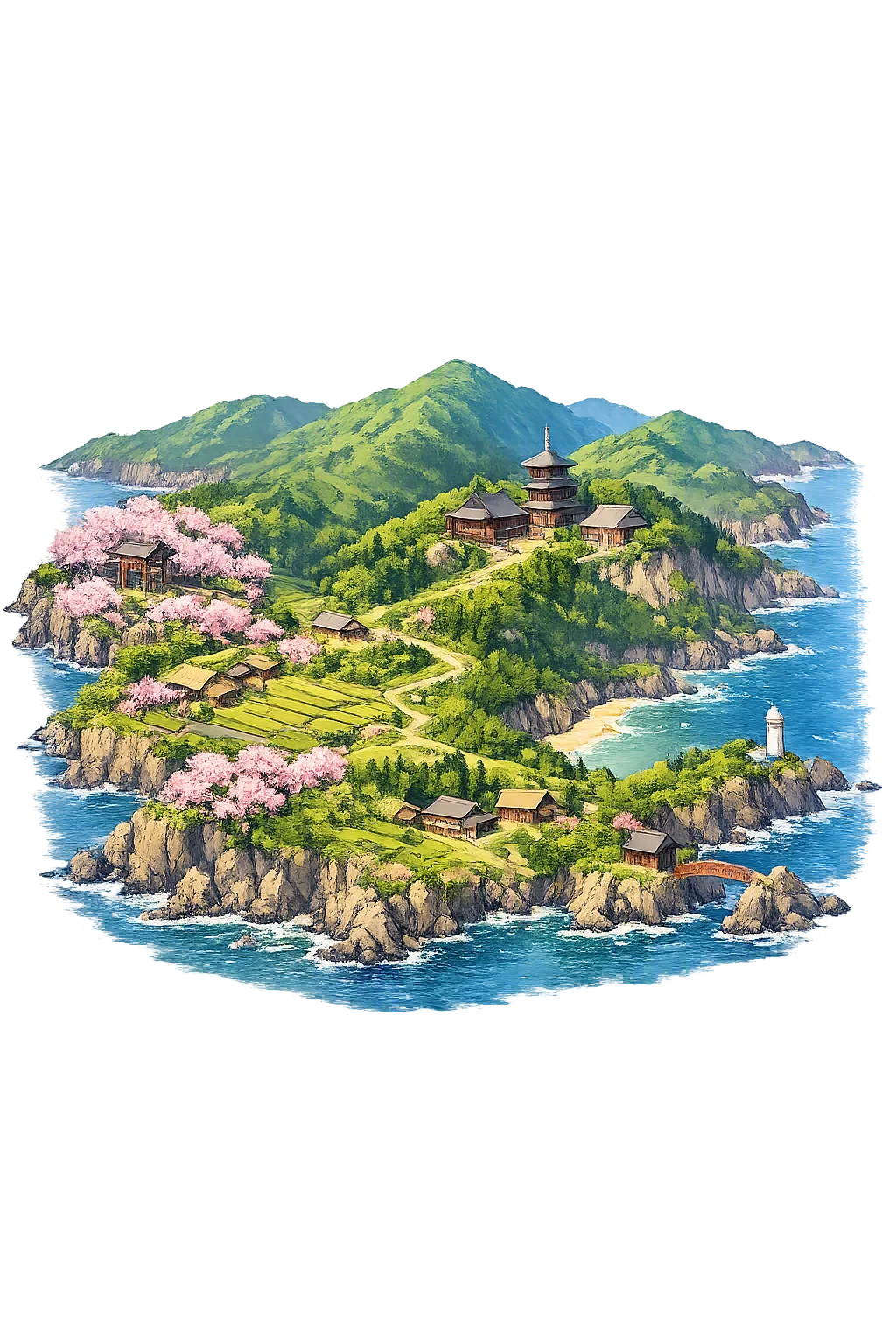
The walking image is older than any statue: pilgrims read the island itself as his body, and early modern Japan printed it — the Edo-period guidebooks and pilgrimage mandalas compress the whole circuit, temples, coasts, and mountains, into a single sacred diagram. On the route the Daishi stands in bronze or stone at nearly every temple gate, straw-sandalled and staff in hand, and small anonymous figures appear at the roadside too, since the road's first principle is that he may be anyone you meet. Ishizuchi-san's chained summit shrine and its tengu images mark the older Shugendō layer above the circuit.

06

Reception & Transformation

The name after its own age — transmission, translation, survival

Afterlives

The transmission of Kūkai's Shikoku runs from hagiography to hiking boot. Medieval compilations of the thirteenth and fourteenth centuries fixed the wonder-filled biography pilgrims still carry — the boy of Zentsū-ji, the voyage to Chang'an, the master who would not die — and Edo-period printing turned the circuit into a mass institution with guidebooks, temple guilds, and the osettai village network that still feeds walkers.

The modern era first thinned the roads, then made the pilgrimage famous abroad: Oliver Statler walked it and wrote Japanese Pilgrimage (1983), the book that carried the henro to Anglophone readers, and Reader and Tanabe's Practically Religious (1998) made it the textbook case of religion practiced for worldly benefit. In Japan the circuit recovered as the nation's counter-rhythm, walked by tens of thousands each year — on foot, by bus, a few temples a year for a lifetime — and the Shugendō rites on Ishizuchi were re-founded after near-abandonment in the 1970s. What the Middle Ages made legend and the Edo age made infrastructure, the twentieth century made literature; the walk itself continues.

Identifications Across Traditions

Shikoku's religious landscape is layered rather than replaced. Buddhist temples and Shinto shrines share precincts along the henro, and the island's kami — the mountain powers of Ishizuchi, the sea deities of the whirlpool coast — are read through the honji-suijaku logic as local manifestations of buddhas and bodhisattvas. The pilgrimage itself absorbed folk religion: osettai is a village institution older than any temple guild, and the Daishi is at once a historical monk, an incarnation of a cosmic buddha, and a helpful stranger on the road. In the modern era the henro has been recast for international walkers, secular hikers, and 'power spot' tourists without losing its ritual grammar, and churches and new religions appear among the givers of osettai. Syncretism here is not a single historical event but the island's permanent condition: every age walks the same road and calls the companion by a different name.

Modern Legacy

The Shikoku Henro remains one of Japan's most important pilgrimages, walked by tens of thousands each year — on foot, by bus, in section over a lifetime — and studied worldwide as a model of living religious practice (Statler, Japanese Pilgrimage, 1983; Reader & Tanabe, Practically Religious, 1998). The island's rural culture, its udon, its vine bridges and thatched Iya villages are celebrated as the 'hidden Japan' of slow travel. Kūkai's bequest runs beyond religion: tradition credits him with perfecting the kana syllabaries and founding Japan's first school open to commoners, and the Daishi's name opens esoteric rites across the country. Shikoku has become the national emblem of a counter-rhythm — the island where the answer to speed is not nostalgia but a walking staff.

07

The Meditation

What Shikoku means — beyond the dictionary

Shikoku teaches that a place can become sacred through walking. The island is not merely the setting of the pilgrimage; the pilgrimage is the island's true form. Every mountain pass, fishing hamlet, and henro trail between the temples is part of the rite, and the islanders' osettai makes the whole population liturgists. To walk the henro is to let the land shape the soul at walking pace — the pace at which things actually change. The circuit also makes an audacious claim about numbers: eighty-eight is not a route length but a diagnosis, one temple for each delusion of the human heart. You do not walk the island to see Kūkai's sites; you walk it so that the walking, repeated daily for weeks, wears the self down to something lighter. In an age of acceleration, Shikoku's quiet insistence is that the shortest distance to the sacred is the long way round.

08

Frequently Asked Questions

Common questions about Shikoku, Smallest Main Island, and Unicode restoration

01How do you pronounce Shikoku?

In reconstructed pronunciation, Shikoku is /ɕi.ko.kɯ/ — approximately 'SHEE-koh-koo' — three crisp syllables.

02What does Shikoku mean?

Shikoku means Four provinces in the japanese tradition.

03What are the symbols of Shikoku?

Shikoku is associated with Pilgrim's staff and sedge hat (The kongō-zue staff rings for the dead who walk with the henro, and the sugegasa shades the white-robed pilgrim.), Osettai (The free food, lodging, and small gifts islanders offer walkers — the gift economy that sustains the circuit.), Eighty-eight temples (The sacred circuit that defines Shikoku's spiritual geography, one temple for each of the bonnō.), Naruto whirlpools (The famous tidal whirlpools at the island's eastern edge, where the Seto Inland Sea meets the Pacific.), The white robe (byakue) (The pilgrim's garment, worn as a funeral shroud for the self — the walker dies to ordinary life at temple one.).

04Why restore Shikoku in Unicode?

Shikoku is written entirely in ASCII letters, so its restoration is about canonical fidelity rather than recovered diacritics: the temple fixes the name in its scholarly standard spelling, attested in the source tradition, instead of leaving it to drift.

05What is the most important myth about Shikoku?

“Kūkai: The Boy of Zentsū-ji” — the Buddhist history story that anchors the mythology of Shikoku, told in full on the lore page.

09

Scholarly Sources

The philological foundations of this restoration

Every claim on this page is grounded in established scholarship. The orthographic restorations follow disciplinary convention. The etymological chain follows the best available reference works. This is not invention — it is resurrection through scholarship.

◈

Lexicography & Philology

  • Hepburn
◎

Primary Texts

◉

Archaeology & Art History

  • Material evidence — iconography, inscriptions, and temple archaeology — for Shikoku and related cults.
✦

Religious Studies

  • Kūkai, Sango Shiiki (797) and Shōrai Mokuroku (806).
  • Statler, Oliver, Japanese Pilgrimage (Morrow, 1983).
  • Reader, Ian, and George J. Tanabe Jr., Practically Religious: Worldly Benefits and the Common Religion of Japan (University of Hawai'i Press, 1998).
  • Shikoku Reijōki and Edo-period henro guidebooks.
Return

The Surface Awaits

You have traced the name from its earliest attestation to its Unicode restoration. Now return to the myth. The story is where the name lives.

Back to Lore
Shikoku mascot