
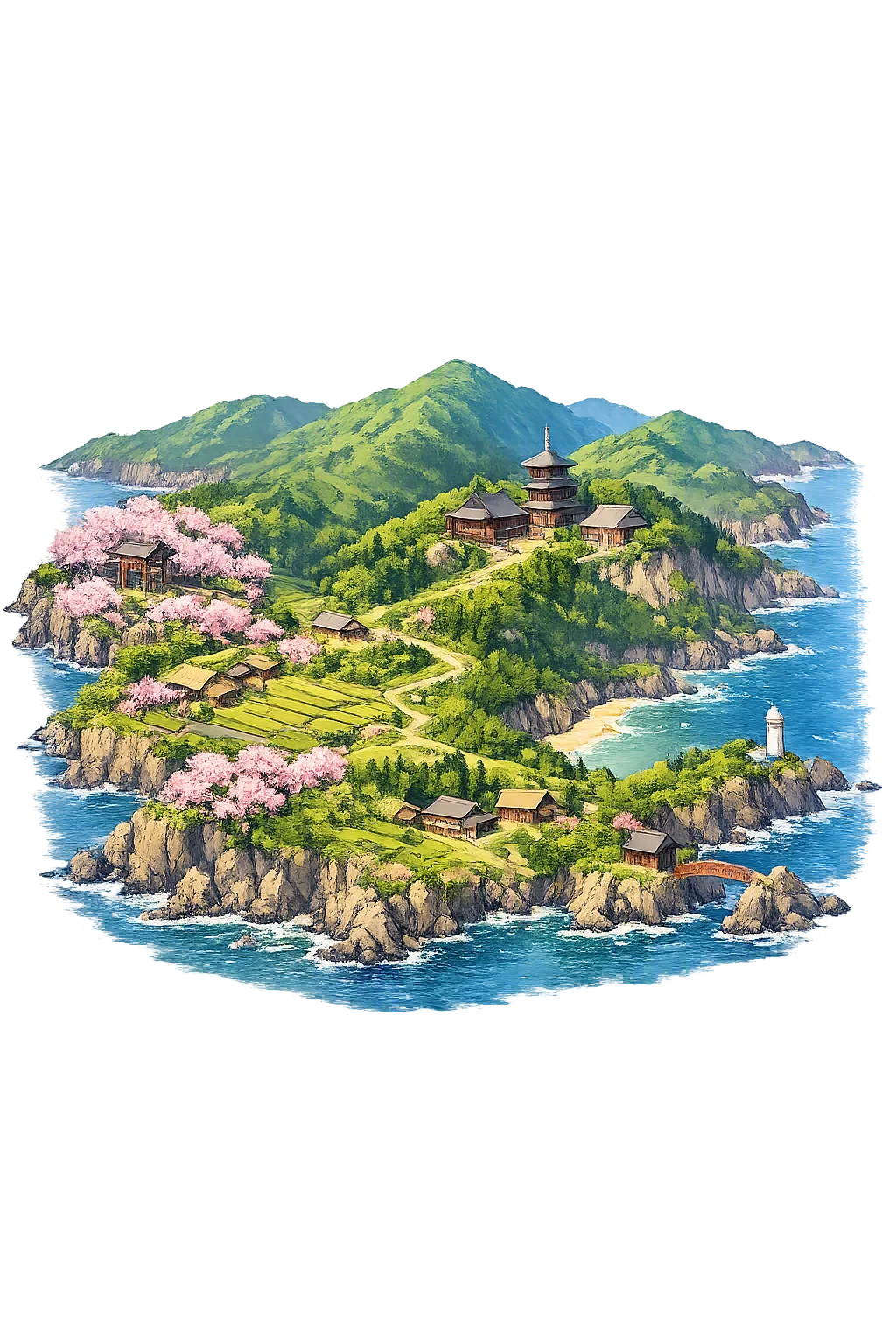
The provenance file on Shikoku
Catalogue entry — Shikoku. Every claim below carries its chain of custody.
Provenance
1. The attestation. 四国 — "Four provinces". On record: Kūkai, Sango Shiiki (797) and Shōrai Mokuroku (806)., Statler, Oliver, Japanese Pilgrimage (Morrow, 1983)., Reader, Ian, and George J. Tanabe Jr., Practically Religious: Worldly Benefits and the Common Religion of Japan (University of Hawai'i Press, 1998)., Shikoku Reijōki and Edo-period henro guidebooks..
2. The narrative record. Kūkai: The Boy of Zentsū-ji — Kūkai (774–835), later venerated as Kōbō Daishi, was born in the village of Byōbugaura in Sanuki province — present-day Zentsū-ji city, where temple 75 still marks the family home. The medieval biographies wrap his life in marvel: as a youth he was sent by a despairing kinsman into the mountain wilderness, and there, tradition says, the esoteric teachings came to him in visionary form. The Eighty-Eight Temples and the Companion Beside You — The Shikoku Henro links 88 temples in a circuit of some 1,200 kilometres, and the number is itself theology: in Shingon numerology there are eighty-eight bonnō, the delusions that bind the heart, and each temple is understood to release one. The circuit as pilgrims walk it took shape in the Edo period, when temple associations, printed guidebooks such as the Shikoku Reijōki, and the island-wide institution of osettai — free food and lodging offered to walkers — made the henro a mass practice.
3. The physical record. The material record of the island's sacred culture is continuous and visible. Zentsū-ji (temple 75) preserves the Kūkai birth precinct, the Miedō hall with the birth room still shown to pilgrims, and Tairyū-ji (temple 21) on its eastern ridge guards the vajra said to have flown there when the young Kūkai prayed for a sign. Henro temples from Ryōzen-ji (temple 1, early 9th c.) onward preserve Daishi halls where food is offered daily to Kūkai as one still present — because he is believed to be. On Ishizuchi-san, the summit shrine and the chained final ascent mark the Shugendō layer of the cult. Across the water, the Okunoin of Kōya-san — Kūkai's mausoleum, part of the UNESCO World Heritage 'Sacred Sites and Pilgrimage Routes in the Kii Mountain Range' (2004) — is the circuit's gravitational center, where the lanterns before the master are said to have burned for twelve centuries.
4. The current holding. The temple at /shikoku/, classified Tier 2. Tier-2 here means one preserved truth — not less important, just singular. The temple shows it and names it.
5. The documented resonances. Faith & Spiritual Organizations, Travel, Tourism & Place Branding, Food & Hospitality — seats argued and weighted in the pattern atlas, read through the myths in this temple's Resonance File.
6. The primary sources. Kojiki, Nihon Shoki — the library this file answers to, open at the Sacred Texts collection.
7. The continuing record. The Shikoku Henro remains one of Japan's most important pilgrimages, walked by tens of thousands each year — on foot, by bus, in section over a lifetime — and studied worldwide as a model of living religious practice (Statler, Japanese Pilgrimage, 1983; Reader & Tanabe, Practically Religious, 1998). The island's rural culture, its udon, its vine bridges and thatched Iya villages are celebrated as the 'hidden Japan' of slow travel.
At a Glance
- Restored name: Shikoku
- ASCII form: shikoku
- Meaning: "Four provinces"
- Domain of influence: Smallest Main Island
- Pantheon: Japanese
- Classification: Tier 2
- Original script: 四国
- Series: The Restoration Files, No. 442 of 548
The File Continues
Read the founding dispatch for the name's full story, the Resonance File for the archetype at work — or the whole archive in one sitting.
Continue the series — previous file: Šāpšu (read it here) · next file: Śiva (read it here).
The Restoration Files are written from the same canonical record as the temples themselves: the lexicon, the lore catalog, the pattern atlas, and the cited scholarly sources. If a file ever disagrees with its temple, the temple is right — tell us, and the file will be corrected.