PuniCodex

Extended Lore

Ṣàngó

Etymology · Orthography · Cult · Iconography · Reception · Sources

Tier 1 Ṣàngó.com
Ṣàngó — Thunder, Fire, Justice
01

Quick Facts

Essential information about Ṣàngó, Thunder, Fire, Justice

Scholarly TransliterationṢàngó
Unicode RestorationṢàngó
Reconstructed Pronunciation/ʃà.ŋɡó/
PantheonYoruba
DomainThunder, Fire, Justice
MeaningHe who strikes
ClassificationTier 1
Primary DomainṢàngó.com
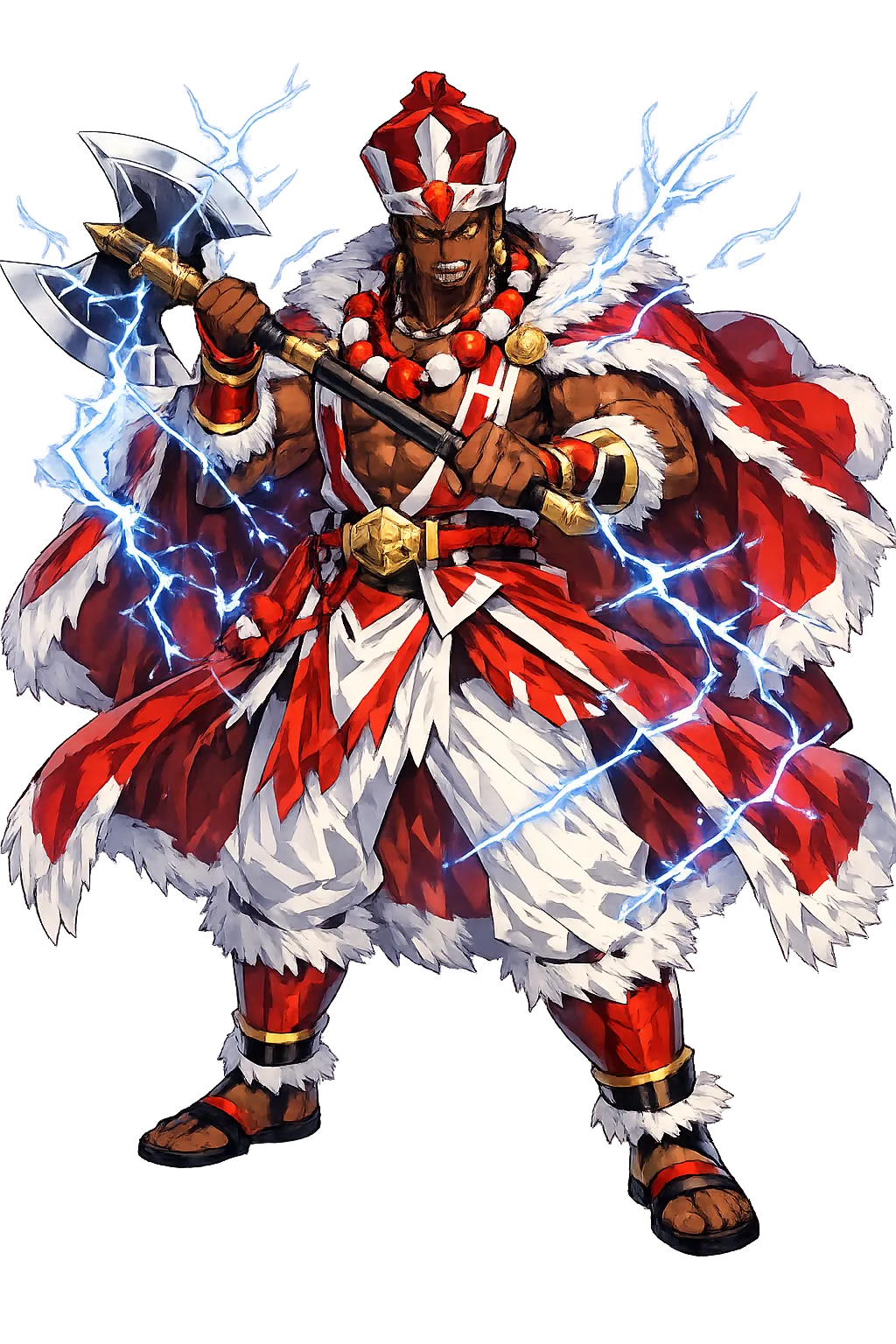
Sacred SymbolsThunderstones (ẹ̀dùn àrá), Double-headed axe (ọ̀ṣẹ́ Ṣàngó), Bàtá drum, Red and white beads
02

Etymology & Word Family

From original script to Unicode restoration

Scholarly Transliteration Ṣàngó Ṣàngó — "He who strikes"
Unicode Restoration Ṣàngó Restored stress, length, and script
Modern ASCII shango Plain-ASCII fallback

The name Ṣàngó carries the orthographic signature of the yoruba tradition. Unicode restoration recovers what ASCII flattens.

03

Unicode Character Breakdown

Character-by-character philological analysis

CharacterUnicodeNameBlockPhonetic Role
ṢU+1E62Latin Capital Letter S with Dot BelowUnknownS with dot below
—N/ADropped characterYoruba orthographyNot written
àU+00E0Latin Small Letter A with GraveLatin-1 SupplementGrave on a
nU+006ELatin Small Letter NBasic LatinSame
gU+0067Latin Small Letter GBasic LatinSame
óU+00F3Latin Small Letter O with AcuteLatin-1 SupplementAcute on o

The Tier 1 classification reflects how much of the original phonology this restoration preserves — stress and vowel length for Greek names, distinctive letters and diacritics for every other tradition.

04

Cult & Worship

How the sacred was kept — rites, sanctuaries, remains

The Cult

Ṣàngó's cult is the cult of a deified king, and its center held at Ọ̀yọ́: the shrine at Koso, near the old capital, preserves the spot where tradition says he vanished, and the Ṣàngó festival there remains an act of state, the Aláàfin's line renewing its bond with the storm-founding ancestor. His priests kept his thunderstones — prehistoric celts collected as the bolts he spent — setting some into shrine arrangements and dance staffs, and the bàtá drummers, a titled guild, called him into the dancers at his festivals. Court and oath were his as well: oaths sworn in his name bound litigants, which made the thunder-god a juror no perjurer could escape. The Fulani wars of the nineteenth century broke the empire and scattered the cult; it re-founded itself in Bahia as Xangô's houses and in Havana as Changó's feast of 4 December. The old royal cult lost its palace — and gained an ocean.

In the Earth

The Ṣàngó cult centre at Koso, near Ọ̀yọ́ in present-day Nigeria, preserves the ritual memory of the deified king, and the Ṣàngó festival re-enacts his kingship annually. Prehistoric stone celts — the thunderstones his priests collected as his spent bolts — are held in shrines and museum collections; so are brass double-headed axes, bàtá drums, and the red-and-white bead regalia of his initiates. Diaspora terreiros and ilés conserve his dance wands and thunderstone altars, making Ṣàngó one of the best-documented royal cults in African religious history.

05

Iconography

How Ṣàngó was imaged across the ages

The Image

The oldest images of Ṣàngó are not images of him at all: the thunderstones — Neolithic celts reinterpreted as his spent lightning — were treasured in shrines centuries before any figure was carved for the god. The canonical modern attribute is the double-headed axe, the oshe Ṣàngó: a dance staff with twin blades and often a kneeling devotee beneath, red and white his colors, the ram his animal; fine examples are held by the Metropolitan Museum and the British Museum among others. Carved oshe staffs are a nineteenth- and twentieth-century tradition, and what they crown is arguably the thunderstone itself, prehistoric hardware reframed as divine. In the diaspora the image absorbed Catholic emblem — Changó of Cuba carries Santa Bárbara's tower and sword alongside his own — while Brazil's Xangô keeps the double axe and royal robes. His iconography thus reads in layers: Stone Age geology at the root, royal regalia above, a saint's tower added by history.

06

Reception & Transformation

The name after its own age — transmission, translation, survival

Afterlives

Ṣàngó's transmission begins in the chronicles of his own people: court traditions carried him from king to orisha, and Samuel Johnson's History of the Yorubas (1921) gave the English-speaking world the full cycle — the fire-sorcery, the fall, the proud folk-etymology of Koso. Robin Law's The Oyo Empire (1977) then did the essential scholarly work, separating the deified king's history from his worship and treating both with rigor. Across the Atlantic the cult wrote itself into new records: Fernando Ortiz's monumental studies of Afro-Cuban religion, from the 1900s through the 1950s, fixed Changó in the Cuban national ethnography; Lydia Cabrera preserved his praise-verses; Pierre Verger documented Xangô's houses in Bahia. Robert Farris Thompson's Flash of the Spirit (1983) carried the thunder-king into the art-historical mainstream, reading his axes, beads, and dance as a coherent Atlantic aesthetic. From Johnson to Law to Thompson, the scholarship kept pace with the drumming: the king who lost his empire became one of the best-documented royal cults in African religious history.

Identifications Across Traditions

In Cuban Santería, Ṣàngó became Changó, one of the most beloved orishas, merged with Santa Bárbara because of her lightning, her tower, and her protection of the faithful — his feast, 4 December, is hers as well. In Brazilian Candomblé he is Xangô, syncretised in the Ketu nation with São Jerônimo, the thunder-voiced doctor of the Church. The diaspora preserved and amplified what Ọ̀yọ́ began: the union of kingship, rhythm, and storm. Where the old empire fell to the Fulani wars of the nineteenth century, its thunder-god reigned on in Havana, Salvador, and Brooklyn — a royal cult that lost its palace and gained an ocean.

Modern Legacy

Ṣàngó is one of the most recognisable orishas in the African diaspora. His image strides through Caribbean and Latin American art, music, and festival; his bàtá drumming — carried by Cuban santeros to stages worldwide — has fed into jazz, salsa, and contemporary percussion. In Nigeria the Ṣàngó Festival in Ọ̀yọ́ draws thousands each year, and the Aláàfin still keeps ritual ties to the deified founder of his line. Politically, Ṣàngó remains a badge of Yoruba royal authority and cultural pride; spiritually, he embodies the demand that justice be as visible and unavoidable as a thunderclap. His double-headed axe has become an emblem of Afro-Atlantic religion itself, recognisable from Lagos to Havana.

07

The Meditation

What Ṣàngó means — beyond the dictionary

Ṣàngó is the god who refuses to be ignored. His thunder does not negotiate; it announces. In a world of deferred justice and hidden corruption, he represents the fantasy — and the danger — of immediate consequence. To call on him is to ask that the truth be made loud.

Yet his mythology is also a caution. He was a king who lost control, a husband whose charisma burned the women around him, a storm that could not be aimed with precision. His double-headed axe cuts both ways; the same fire that punishes the liar consumes the proud. Ṣàngó's deepest teaching may be that justice without patience becomes spectacle — and that the thunderclap, however satisfying, is only the beginning of the rain.

08

Frequently Asked Questions

Common questions about Ṣàngó, Thunder, Fire, Justice, and Unicode restoration

01How do you pronounce Ṣàngó?

In reconstructed pronunciation, Ṣàngó is /ʃà.ŋɡó/ — approximately SHAH-ngoh — low 'sha', then a sharp high 'ngoh' with the final syllable slightly nasal.

02What does Ṣàngó mean?

Ṣàngó means He who strikes in the yoruba tradition.

03What are the symbols of Ṣàngó?

Ṣàngó is associated with Thunderstones (ẹ̀dùn àrá) ('Thunder stones' — prehistoric stone axes kept in his shrines as the thunderbolts he hurled to earth; collecting one is collecting his signature.), Double-headed axe (ọ̀ṣẹ́ Ṣàngó) (The emblem of his kingship and his power to render judgment; carved dance wands of it are carried by the possessed.), Bàtá drum (The hourglass drum whose pitch bends under the arm — the drum language that summons him and encodes the history of Ọ̀yọ́.), Red and white beads (The colours of fire, blood, and royal authority; his initiates wear them in double strands.).

04Why restore Ṣàngó in Unicode?

Plain ASCII shango strips the stress, length, and script that make the name specific. Unicode restoration returns the name to its original written dignity.

05What is the most important myth about Ṣàngó?

“The Fourth Aláàfin of Ọ̀yọ́” — the Royal History story that anchors the mythology of Ṣàngó, told in full on the lore page.

09

Scholarly Sources

The philological foundations of this restoration

Every claim on this page is grounded in established scholarship. The orthographic restorations follow disciplinary convention. The etymological chain follows the best available reference works. This is not invention — it is resurrection through scholarship.

◈

Lexicography & Philology

  • Abraham
◎

Primary Texts

  • The Ifá divination corpus; ọ̀rọ̀ àṣà and oríkì traditions; Abraham’s Dictionary of Modern Yoruba.
◉

Archaeology & Art History

  • Material evidence — iconography, inscriptions, and temple archaeology — for Ṣàngó and related cults.
✦

Religious Studies

  • Johnson, The History of the Yorubas (1921)
  • Law, The Oyo Empire c. 1600–c. 1836 (1977)
  • Bascom, Ifa Divination (1969)
  • Mason, Four New World Yoruba Rituals
  • Verger, Notes sur le Culte des Orisa et Vodun (1981)
  • Murphy, Santería: African Spirits in America (1988)
Return

The Surface Awaits

You have traced the name from its earliest attestation to its Unicode restoration. Now return to the myth. The story is where the name lives.

Back to Lore
Ṣàngó mascot