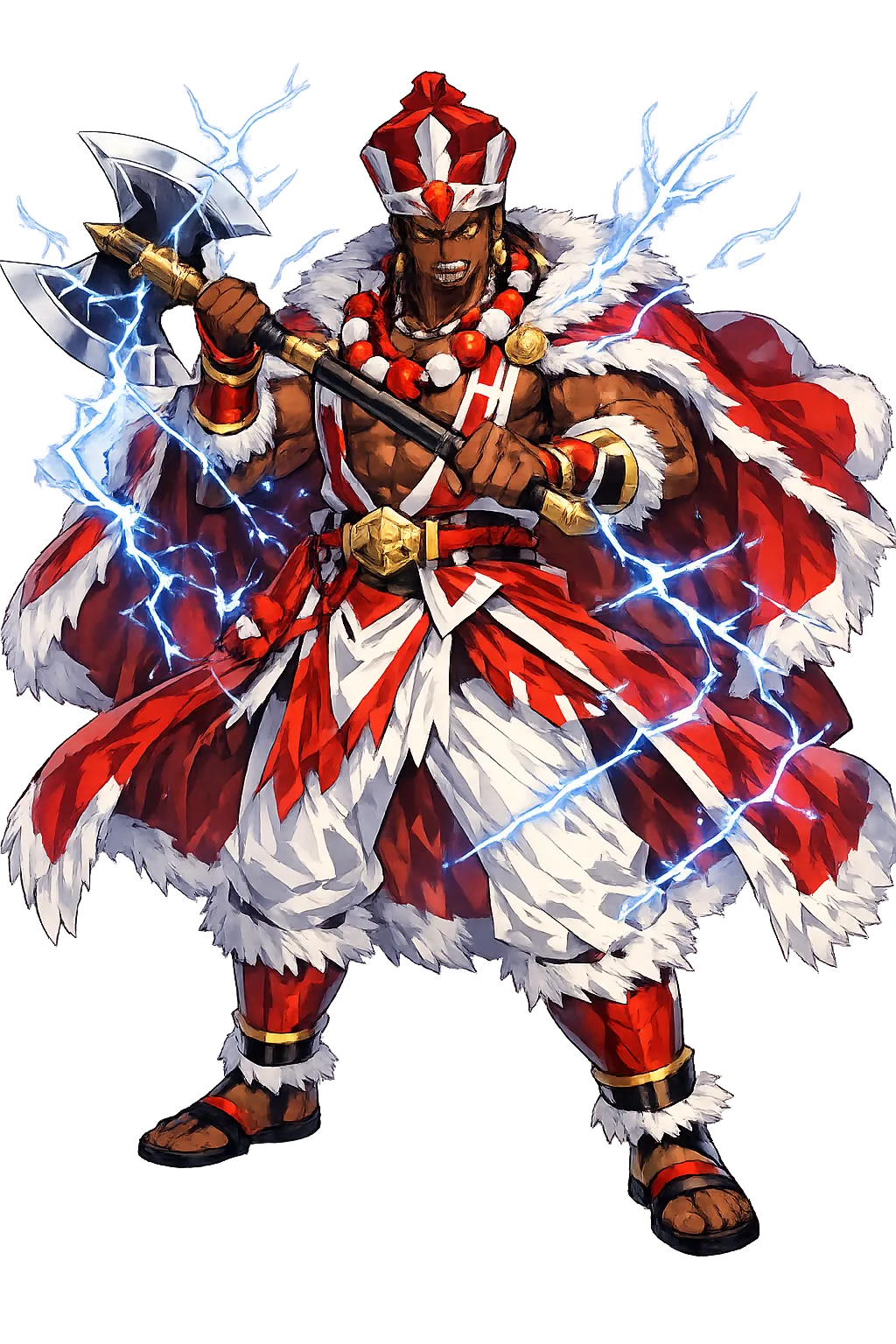
Stories of Ṣàngó
Ṣàngó's mythology moves between the palace and the sky. He is a king who could not govern his own household, a husband of powerful and dangerous wives, and a storm whose justice is as dramatic as its noise.
Ṣàngó was the fourth Aláàfin — king — of Ọ̀yọ́, and the traditions collected by Samuel Johnson (The History of the Yorubas, 1921), checked against the chronicles analysed by Robin Law (The Oyo Empire, 1977), make him a historical ruler later wrapped in divinity. His capital was at Koso, and his cult grew from the worship of a deified king: subsequent Aláàfins ruled as his heirs, and the Ṣàngó festival at Ọ̀yọ́ remains an act of state as much as of religion. The sources disagree about his end — some say he hanged himself in defeat, others that his own fire consumed him and he ascended bodily — and the people of Koso answered the shameful version with a proud folk etymology: Koso, they said, means 'he did not hang'. Whatever happened in history, mythology turned a failed king into an eternal verdict from the sky.
Johnson's chronicle credits Ṣàngó with a fearful sorcery: charms that breathed fire on his enemies. In the most told episode, his own overreaching turned the weapon inward — the fire that burned his foes spread through his palace and his household, and the king who had terrorised Ọ̀yọ́ with thunder-magic died, or fled, by the same element (Johnson 1921; Law 1977 treats the traditions with scholarly reserve). Later Ifá verses and praise-chants amplify the tale into cosmic register: Ṣàngó did not merely wield fire, he was fire, and he left the earth by immolating himself into the storm. The palace fires of the chronicle became, in worship, the lightning of the sky. The legend reads like a parable of charisma — the force that makes a king irresistible is the force that finally consumes him, and only deification survives the burning.
Ṣàngó's household is a small pantheon, and its myths are the corpus's sharpest studies of desire and power. Ọbà, his first wife, tried to win back his wandering love by cutting off her ear to season his stew — the myth's warning is against sacrificing identity for affection. Ọṣun won him with honey, brass, and laughter, becoming the one being who can calm his rage. Ọya, his favourite in war, learned the secret of fire and lightning from him and did not abandon him in disgrace. His children by them inherit his fire; his cult inherits their lessons. The stories, told across Ifá verses, praise-songs, and diaspora liturgies (Verger 1981; Mason), make the thunderer's marriage bed the site where three kinds of female power — devotion, sweetness, and fury — each take the measure of male force and outlast it.
In Yoruba courts and shrines, oaths sworn in Ṣàngó's name were binding because the thunder-god was believed to strike perjurers — and the fear was not merely supernatural. Law notes that royal authority in Ọ̀yọ́ leaned on the cult: the king who could call the storm to witness promises made his own word unbreakable, and his priests kept the thunderstones (prehistoric celts) that proved the strikes were real (Law 1977; Bascom 1969). Even today, devotees say that a liar who swears falsely by Ṣàngó will be found out by fire. Even where courts have replaced oaths, devotees still decline to swear falsely by his name, and lightning still makes honest witnesses of the frightened. His justice is swift, public, and terrifying — the sky itself made a witness to human promises, and a penalty no wall could delay.
Priestly tradition holds that the bàtá drum was Ṣàngó's before it was anyone's: the hourglass drum whose pitch bends under the player's arm speaks a language the thunder-king cannot refuse, and at his festivals the drummers 'talk' him down into the dancers (Mason, Four New World Yoruba Rituals; Drewal 1992). Possession by Ṣàngó begins in the shoulders and feet — the stamping, whirling dance of a warrior — and the possessed speak with his voice, rendering judgment and greeting the crowd as a king greets subjects. The mythology completes itself here: the king who died left no tomb to visit, so his people built a throne of rhythm. The drummers themselves are minor royalty of the cult, addressed with titles and fed before the crowd. When the bàtá plays, Ọ̀yọ́ has a king again, and the storm walks in human form.
Fire, Royalty, and the Drum
Ṣàngó is the thunder-god and the deified fourth king of the Ọ̀yọ́ Empire — the fire that strikes from heaven and the drumbeat that brings the possessed to their feet. His justice is public and swift: the oath-breaker, the thief, and the liar hear him before they see him. In life a warrior-king, in death he became the storm itself.
He strikes the liar, the thief, and the oath-breaker; his fire is both weapon and verdict.
The ọ̀ṣẹ́ Ṣàngó — the double-axe dance wand, his emblem of royal justice and the power to split heaven and earth.
He was king before he was god; his worship links divine power to political authority.
The bàtá drum calls him down; possession by Ṣàngó begins in the shoulders and feet.
From the original script to the living URL
Ṣàngó
The name survives only in scholarly transliteration. Ṣàngó is the standard Yoruba romanisation, documented in academic sources — “He who strikes”. Its emphatic consonants and acute stress marks preserve distinctions lost in plain ASCII.
No indigenous writing system is securely attested for individual yoruba names. The form shown is a modern scholarly transliteration.
shango
Reduced to plain shango, the name loses everything that made it specific: emphatic consonants and acute stress marks. What remains is an ASCII string that machines can parse but that no longer speaks with its original voice.
Ṣàngó
The Unicode restoration recovers what ASCII flattened. Ṣàngó restores emphatic consonants and acute stress marks, returning the name to its original written dignity. The domain encodes to Punycode, but the browser displays the truth.
Ṣàngó.com → xn--ng-iia2fq79p.com
The non-ASCII characters in Ṣàngó are encoded while the ASCII remains visible. To the DNS, it is Punycode. To humanity, it is Ṣàngó.
Owned, ideal, and ASCII forms of Ṣàngó
Ṣàngó
The live temple domain — ṣàngó.com.
shango
The plain ASCII fallback — what DNS and legacy systems see.
How Ṣàngó was spoken
How Ṣàngó is preserved in writing
No indigenous writing system is securely attested for individual yoruba names. The form shown is a modern scholarly transliteration.
Contribute scholarly provenance →The lore you have read is the living myth. Extended Lore opens the scholarly vault beneath it: the cult and its material remains, a history of the image, the name after antiquity, a meditation on what the name still means, and the full scholarly apparatus — etymology, orthography, sources.
Enter Extended Lore