The Living Myth
Power, Energy, Divine Feminine · Power, ability, energy — the active power of a deity personified as his consort
Stories of Śakti
Śakti is both a theological principle and a goddess with a story. The Veda knows her as śacī, the might of Indra; the Purāṇas give her a body, a husband, and a battlefield; the Tantras make her the equal — in places the superior — of the god she empowers.
Before Śakti had temples she had a word. The Ṛgveda uses śacī-, 'might, help, assistance,' for the power that makes Indra the conqueror of Vṛtra, and already personifies it: Indra is śacīpati, 'lord of śacī,' and his consort bears the name Śacī/Indrāṇī — celebrated in RV 10.86, where Indrāṇī boasts she is greater than all the wives of the gods. The abstract noun never quite loses its abstractness: Śakti the goddess grows directly out of śakti the grammatical fact, the capacity to act. The interpretive core of later Śākta theology is already visible in the Vedic idiom — a god's power is not his possession but his partner. What the Veda states as a linguistic intuition, that might is feminine and stands beside the god as his wife, the Purāṇas will raise into a cosmos.
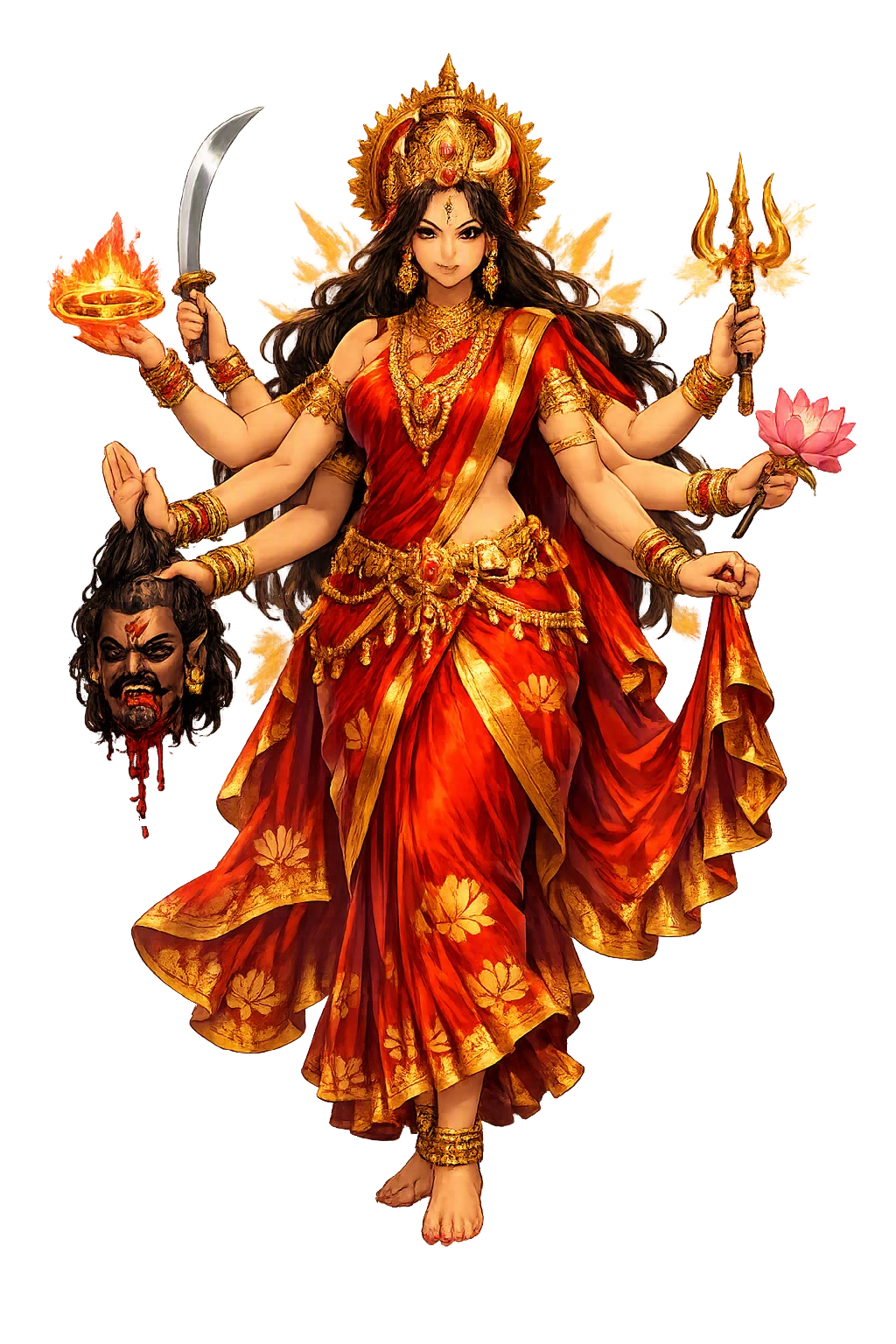
The Devīmāhātmya (Mārkaṇḍeya Purāṇa 81–93) stages the supreme demonstration. When the buffalo-demon Mahiṣa overthrows the gods, they gather and pour forth their śaktis — a flame-mass of energy issues from Śiva, from Viṣṇu, from Indra, from each — and the blazes converge into female form: the ten-armed Devī, 'the śakti of all, whose form is the power of all beings.' Riding a lion, armed with every god's own weapon, she battles Mahiṣa across nine days and nights, cuts off the buffalo head, and pins the demon with her spear as he emerges in human form; the gods hymn her as the power behind their power — 'only in you do we triumph.' The text's claim is the charter of Śākta religion: the goddess is not one deity among many but the energy by which every deity acts, and without her the pantheon stands unarmed.
The Purāṇic cycle tells how Śakti once lived with Śiva as Satī, daughter of Dakṣa. Dakṣa held a great sacrifice and invited every god but his son-in-law; when Satī came uninvited and found no portion set for her husband, she reproached her father and immolated herself in the sacrificial fire. Śiva, mad with grief, danced the world-threatening tāṇḍava with her corpse on his shoulder until Viṣṇu cut the body apart with his discus, and where each part fell a śakti-pīṭha — 'seat of śakti' — arose, fifty-one in the standard count (Devī Purāṇa; expanded in the later Devībhāgavata). The myth grounds Śākta geography: India's great goddess shrines are literally her scattered body, her yoni at Kāmākhyā above all. Its deeper teaching is the one the Tantras repeat endlessly — the god without his śakti is not merely bereaved but broken.
Tantric theology states the doctrine as a pun and means it literally: śaktiṃ vinā śivaḥ śavaḥ — 'without Śakti, Śiva is a corpse.' Abhinavagupta's Parātrīśikā-vivaraṇa and Kṣemarāja's Uddyota on the Śivasūtra teach that Śiva is pure light (prakāśa) and Śakti the self-awareness (vimarśa) by which light knows itself: consciousness without energy is inert, energy without consciousness is blind, and liberation is their union. The Śrīvidyā schools worshipped the union as the śrīcakra and the goddess Tripurasundarī; the yoga traditions mapped it as kuṇḍalinī, the coiled serpent-power raised through the cakras to meet Śiva at the crown. The sentence no myth could improve on: the corpse and the god are divided by exactly one thing — the presence of the feminine power.
The grammarian-philosopher Bhartṛhari (5th–7th c.) closed the circle by making śakti a theory of language: the Vākyapadīya teaches that every word carries an innate śakti, an expressive power by which it means anything at all — distinguished from the secondary powers lakṣaṇā and vyañjanā. Grammar, like the goddess, is the invisible energy that makes signification happen. The Mahābhārata had already used śakti for a god-forged weapon — the spear that Karṇa carries into his last battle is named Śakti, the power given him by Indra in exchange for his divine armor. From might to missile to meaning, the word's career traces the goddess's own: wherever something acts, the tradition first names the agent — and then, looking closer, names the energy that acts through him.
Power, Energy, Divine Feminine
Śakti is power itself: the energy without which the god is a lifeless body — śiva without śakti is a corpse. She is the active power of the divine personified as the goddess: consort of Śiva in the Purāṇas, the Devī who slays the buffalo-demon in the Devīmāhātmya, and the coiled force of Kuṇḍalinī in Tantra.
The name means power, ability, energy — the operative might of a deity personified as his consort (Monier-Williams, s.v.).
In the Caṇḍī (Mārkaṇḍeya Purāṇa 81–93) the gods' combined śaktis blaze forth as the Devī who destroys Mahiṣāsura.
The palatal Ś — IAST's ś, the sound English writes 'sh' — is recovered from the ASCII flattening, letter by letter.
Devanagari शक्ति — attested from the Ṛgveda's śacī-, 'might', onward as śakti, 'power, ability, energy'.
From the original script to the living URL
शक्ति
The name in its original Sanskrit form. Śakti (शक्ति) is attested in the source tradition — “Power, ability, energy — the active power of a deity personified as his consort”. Its original diacritics and script distinctions carry the full phonetic and orthographic weight of the source tradition.
shakti
Reduced to plain shakti, the name loses everything that made it specific: original diacritics and script distinctions. What remains is an ASCII string that machines can parse but that no longer speaks with its original voice.
Śakti
The Unicode restoration recovers what ASCII flattened. Śakti restores original diacritics and script distinctions, returning the name to its original written dignity. The domain encodes to Punycode, but the browser displays the truth.
Śakti.com → xn--akti-k5a.com
The non-ASCII characters in Śakti are encoded while the ASCII remains visible. To the DNS, it is Punycode. To humanity, it is Śakti.
Owned, ideal, and ASCII forms of Śakti
Śakti
Restores शक्ति. The live temple domain — śakti.com.
shakti
Flattens शक्ति. The plain ASCII fallback — what DNS and legacy systems see.
How Śakti was spoken
How Śakti travels from ancient script to the modern URL
The lore you have read is the living myth. Extended Lore opens the scholarly vault beneath it: the cult and its material remains, a history of the image, the name after antiquity, a meditation on what the name still means, and the full scholarly apparatus — etymology, orthography, sources.
Enter Extended Lore