
Śakti: the stories first, then the spelling
Before the spelling, the story. Śakti earns its restoration the old way — through what was actually told.
The Stories That Carry the Name
Śacī, the Might Before the Goddess. Before Śakti had temples she had a word. The Ṛgveda uses śacī-, 'might, help, assistance,' for the power that makes Indra the conqueror of Vṛtra, and already personifies it: Indra is śacīpati, 'lord of śacī,' and his consort bears the name Śacī/Indrāṇī — celebrated in RV 10. 86, where Indrāṇī boasts she is greater than all the wives of the gods.
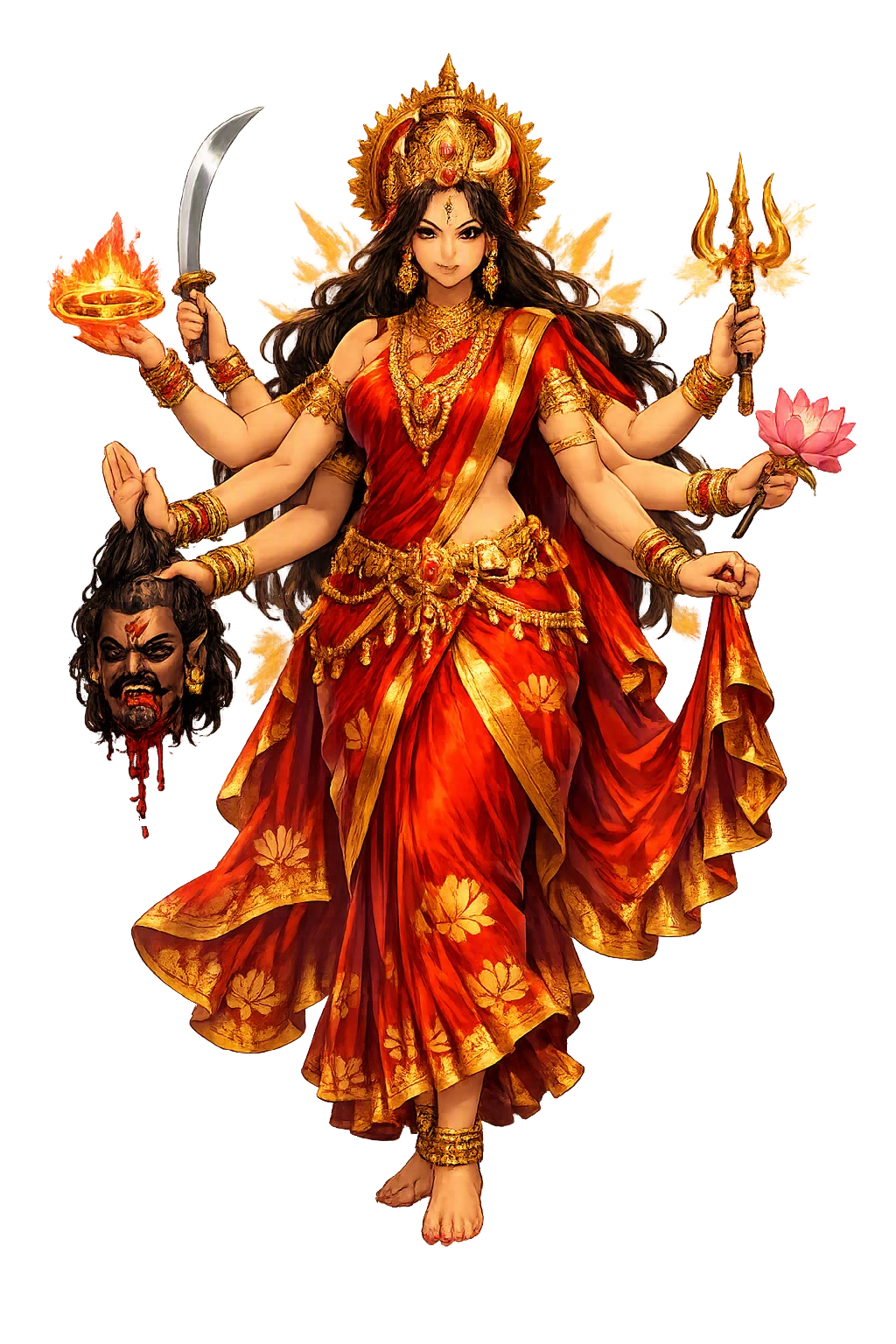
The Power of All the Gods. The Devīmāhātmya (Mārkaṇḍeya Purāṇa 81–93) stages the supreme demonstration. When the buffalo-demon Mahiṣa overthrows the gods, they gather and pour forth their śaktis — a flame-mass of energy issues from Śiva, from Viṣṇu, from Indra, from each — and the blazes converge into female form: the ten-armed Devī, 'the śakti of all, whose form is the power of all beings. ' Riding a lion, armed with every god's own weapon, she battles Mahiṣa across nine days and nights, cuts off the buffalo head, and pins the demon with her spear as he emerges in human form; the gods hymn her as the power behind their power — 'only in you do we triumph.
The Sacrifice of Dakṣa. The Purāṇic cycle tells how Śakti once lived with Śiva as Satī, daughter of Dakṣa. Dakṣa held a great sacrifice and invited every god but his son-in-law; when Satī came uninvited and found no portion set for her husband, she reproached her father and immolated herself in the sacrificial fire. Śiva, mad with grief, danced the world-threatening tāṇḍava with her corpse on his shoulder until Viṣṇu cut the body apart with his discus, and where each part fell a śakti-pīṭha — 'seat of śakti' — arose, fifty-one in the standard count (Devī Purāṇa; expanded in the later Devībhāgavata).
And Here Is What the Spelling Preserves
At a Glance
- Restored name: Śakti
- ASCII form: shakti
- Meaning: "Power, ability, energy — the active power of a deity personified as his consort"
- Domain of influence: Power, Energy, Divine Feminine
- Pantheon: Sanskrit
- Classification: Tier 1
- Original script: शक्ति
- Series: The Restoration Files, No. 436 of 548
The Name Travels
Buddhism absorbed śakti as readily as it debated it. Vajrayāna pairs every male buddha with a female consort — Prajñā as the śakti of Upāya, wisdom as the power of compassion — and elevates Tārā, Vajrayoginī, and the ḍākinīs to powers the male figures cannot act without, a structural debt to Śākta theology the tantras do not conceal.
The Address It Earned
The temple of Śakti stands at /shakti/ — lore, scholars, patterns — because a name carrying this much story deserves more than a parking page. Tier-1 is not a compliment; it is a measurement. This restoration keeps something the ASCII form provably loses, and the measurement is repeatable.
The Sources Are Open
The myths above are retold from the temple's record; the primary voices are in the Sacred Texts: Rig Veda and Ramayana. Nothing in this file outranks them.
The File Continues
Read the founding dispatch for the name's full story, the Resonance File for the archetype at work — or the whole archive in one sitting.
Continue the series — previous file: Stḫ (read it here) · next file: Śākyamuni (read it here).
The Restoration Files are written from the same canonical record as the temples themselves: the lexicon, the lore catalog, the pattern atlas, and the cited scholarly sources. If a file ever disagrees with its temple, the temple is right — tell us, and the file will be corrected.