The Living Myth
Agriculture, Peace, Cultivated Foods · Peace, news (from Proto-Polynesian *longo)
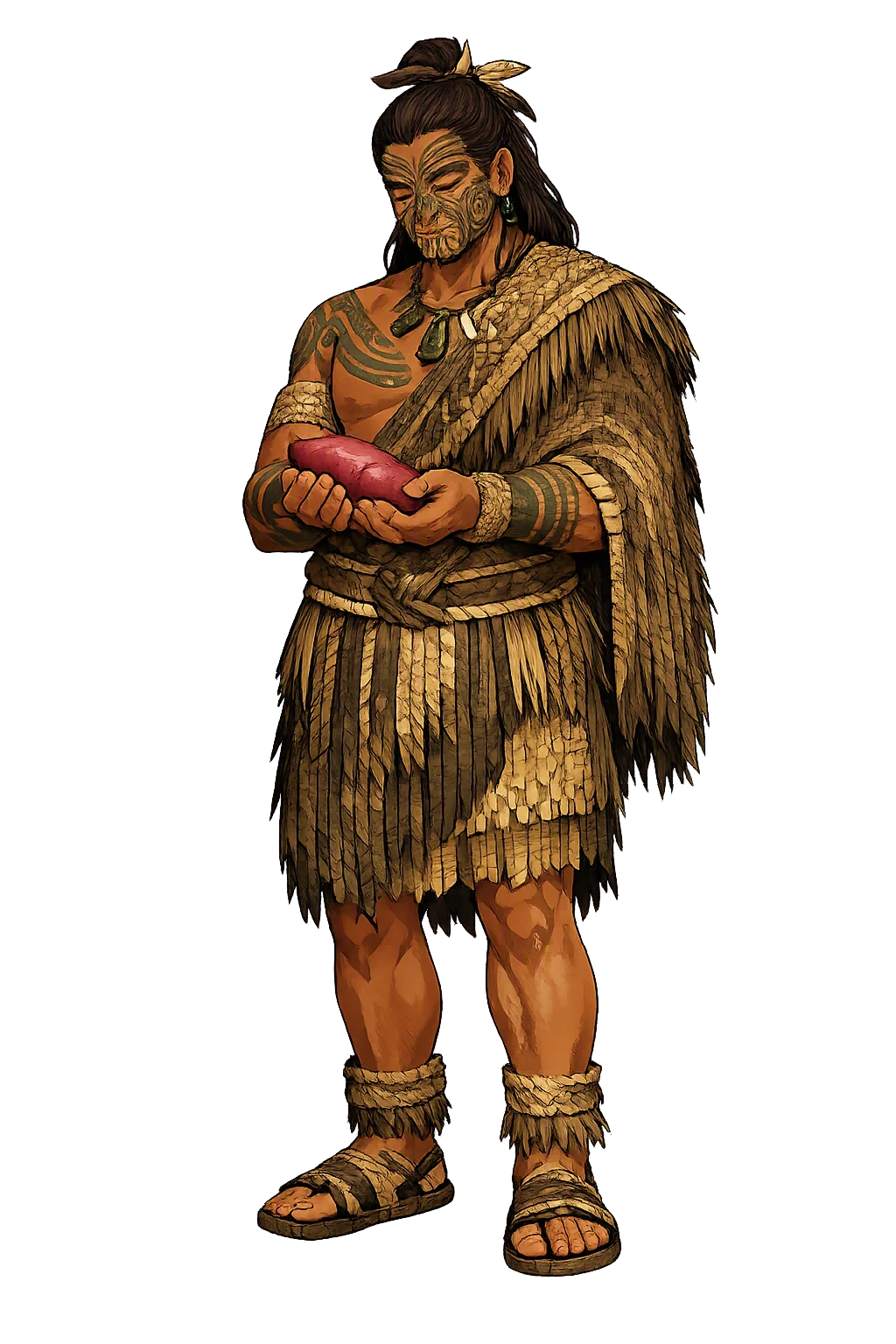
Stories of Rongo
Rongo stands at the junction of garden and peace. His cycle — born in darkness between Sky and Earth, hidden from the storm, dug up as food — makes cultivation itself a rescue of hidden gods, and the planted field a treaty renewed every spring.
In the Māori creation told by Wiremu Maihi Te Rangikāheke and printed by George Grey, the Sky Father Ranginui and the Earth Mother Papatūānuku lay locked in an embrace, and their children — among them Rongo, Tāne, Tangaroa, Haumia-tiketike, Tāwhirimātea, and Tūmatauenga — lived crushed in darkness between them. Rongo's fiercest brother Tū urged the final solution: kill the parents and have done. The others recoiled at the thought of slaying their own father and mother, and the gentler plan of Tāne prevailed — the parents would be forced apart, not slain. Rongo stood with Tāne's party. Tāne braced his head against the earth and his feet against the sky and thrust, and light came pouring in where darkness had been (Grey, Polynesian Mythology, the legend of the children of Rangi and Papa). In this telling the gods of food are born of suffocation: Rongo's whole mythology begins in a space too tight to live in, and every field he blesses is a little of that darkness opened to the sun.
Tāwhirimātea, god of winds, had opposed the separation of his parents, and when it was done he took war to his brothers. Tangaroa fled to the sea; Tāne withdrew into the forests; but Rongo and Haumia-tiketike thrust themselves into the open bosom of their mother the Earth, and there they hid (Grey, Polynesian Mythology). When the storm at last spent itself, it was Tūmatauenga, the one brother who had stood his ground, who turned on the hidden gods: he dug with a sharp stake into the earth and dragged them out — Rongo's kūmara and Haumia's aruhe, the fern-root — and so those foods were given to humankind. The myth is exact about its meaning: agriculture is not a theft from nature but a rescue of hidden gods. The digging-stick wounds the mother gently, and what it brings up is a brother.
In ritual rather than epic, Rongo's story was re-enacted every planting season. The fuller name Rongomatāne — Rongo-of-the-abundant-soil — was invoked in the karakia that opened the kūmara garden; the seed-tubers went into the ground with the digging-stick, the first fruits of the old crop were returned to the god before anyone ate, and the storehouse stood under his tapu until the new year (Tregear, The Maori-Polynesian Comparative Dictionary, s.v. Rongo; Best, Māori Religion and Mythology). To eat kūmara without acknowledging Rongo was to break the treaty between the digger and the hidden brother; Best records planting prayers that address the god by name and lineage, asking the earth's permission as one asks a chief's. The myth's ending was thus rewritten annually in every garden of the North Island: the god hides in the ground, the people dig him up with thanks, and the harvest is the two keeping faith.
In Hawai'i the same god walks as Lono, lord of agriculture, rain, and peace, whose annual Makahiki season suspended war, gathered the year's tribute on a circuit of the islands, and filled the days with games, feasting, and sport (Beckwith, Hawaiian Mythology). When Captain Cook anchored at Kealakekua Bay in November 1778 — in the heart of Makahiki — the Hawaiians received him as the god's own return from Kahiki, his ancestral land; the identification held for weeks before it collapsed in violence (Sahlins, Islands of History; the sceptical counter-case is Obeyesekere, The Apotheosis of Captain Cook). Whatever the truth of that reception, the scholarship agrees on the god: a deity whose season stops wars and feeds the people, met on his own festival ground. Rongo's pan-Polynesian career — kūmara-god in the south, peace-king in the north — makes him one of the deepest layers of shared Oceanic religion.
Agriculture
Rongo is the Māori god of cultivated foods and of peace — the kūmara in the ground, the stored harvest, the quiet field. One of the sons of Ranginui and Papatūānuku, he is the brother who hid from the storm inside the Earth and became, in the people's telling, the very food dug from her bosom. Across Polynesia his name resounds as Hawaiian Lono and Tahitian Ro'o: the god of what is planted.
The sweet potato is his body in Māori telling; the first-fruits rites invoke Rongomatāne before a single tuber is lifted.
His name from Proto-Polynesian *longo, 'news, hearing' — the settled season when tidings travel instead of war-parties.
Rongo and Haumia thrust themselves into the Earth to escape Tāwhirimātea's storm; the digging-stick and the karakia bring them back as food.
One god under many names: Rongo in Aotearoa, Lono in Hawai'i, Ro'o in Tahiti — the oldest shared deity of the Pacific.
From the original script to the living URL
Rongo
The name survives in scholarly transliteration. Rongo is the standard Polynesian romanisation, documented in academic sources — “Peace, news (from Proto-Polynesian *longo)”. Because the spelling uses only Latin letters, the form is the same in both ASCII and Unicode.
No indigenous writing system is securely attested for individual polynesian names. The form shown is a modern scholarly transliteration.
rongo
The plain rongo form is identical to the Unicode restoration. Because this name is already written in Latin letters, no diacritics, stress, or script information were lost — only capitalization differs.
Rongo
The Unicode restoration does not need to recover lost marks for Rongo. Its value is canonical spelling and consistent cataloguing, not the reconstruction of erased orthography. The domain is readable as-is to both DNS and humanity.
Rongo.com
This restoration is written entirely in ASCII letters — no Punycode encoding stands between Rongo and the DNS. The domain reads identically to machines and to human eyes.
Owned, ideal, and ASCII forms of Rongo
Rongo
The full Unicode restoration. rongo.com is not in the PuniCodex collection — it is watched for release; if it drops, this temple upgrades to an owned flagship.
How Rongo was spoken
How Rongo is preserved in writing
No indigenous writing system is securely attested for individual polynesian names. The form shown is a modern scholarly transliteration.
Contribute scholarly provenance →The lore you have read is the living myth. Extended Lore opens the scholarly vault beneath it: the cult and its material remains, a history of the image, the name after antiquity, a meditation on what the name still means, and the full scholarly apparatus — etymology, orthography, sources.
Enter Extended Lore